
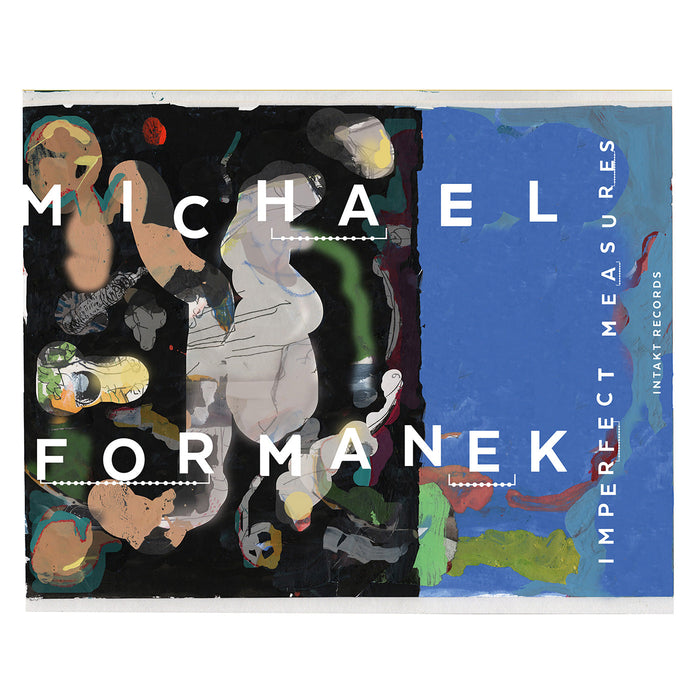
359: MICHAEL FORMANEK. Imperfect Measures
Intakt Recording #359/ 2021
Michael Formanek: Bass
Recorded on September 10, 2017 at Heartwood Sound Studio, Baltimore, MD by Ben Frock.
Sale
Sale
Original price
CHF 12.00
-
Original price
CHF 30.00
Original price
CHF 30.00
CHF 12.00
-
CHF 30.00
Current price
CHF 30.00
| /
More Info
With his extensive artistic biography, Michael Formanek is one of the most outstanding figures in American jazz – As a compo- ser, as a bassist in ensembles, and as a soloist. Although the bass often plays in the background, bassists write jazz history. So does Michael Formanek, who makes an impressive solo statement with Imperfect Measures (24 years after his first solo album).
About the creative process, Formanek writes: "I came to realize that for me, playing solo bass is much closer to a compositional process than a performance practice ... Any structure inherent in a piece evolves in the moment, the product of the improvisa- tion itself – as if one were building and traveling along a road simultaneously. The road only extends as far as we are in the moment, so there must be a total commitment to what is being created and constructed in real time, lest things quickly fall apart.“
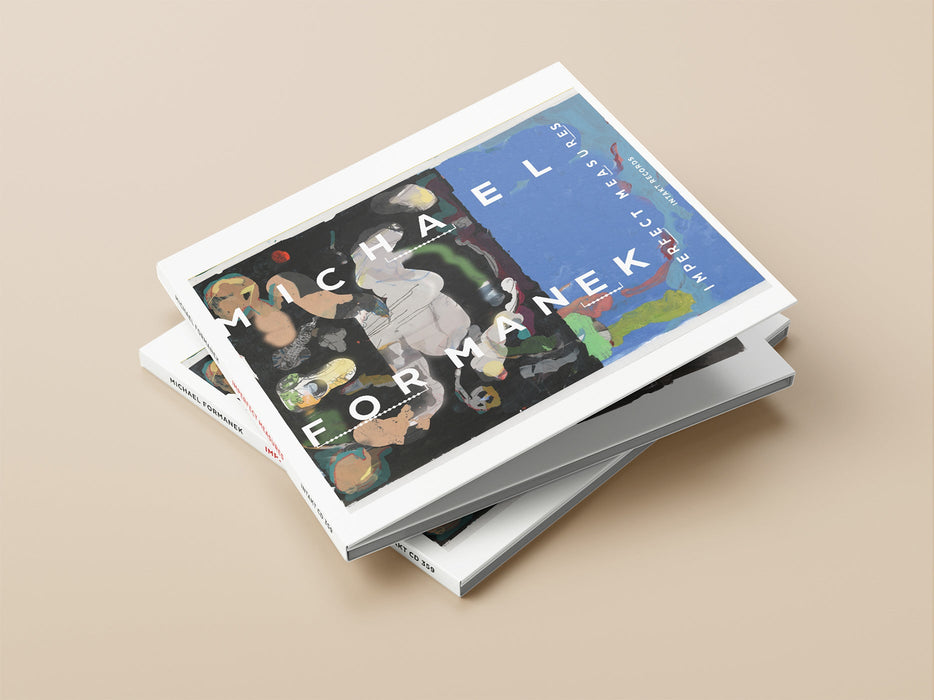
The inspiring music is embedded in works by artist and illustrator Warren Linn, who created sketches during the recording process, developed them into collages/paintings, some of which are now featured in the CD package designed by Stephen Byram. An absolute work of art!
Album Credits
Liner Notes: Michael Formanek
Photo: Palma Fiaco
Paintings: Warren Linn
Design: Stephen Byran
Booklet Design: Fiona Ryan
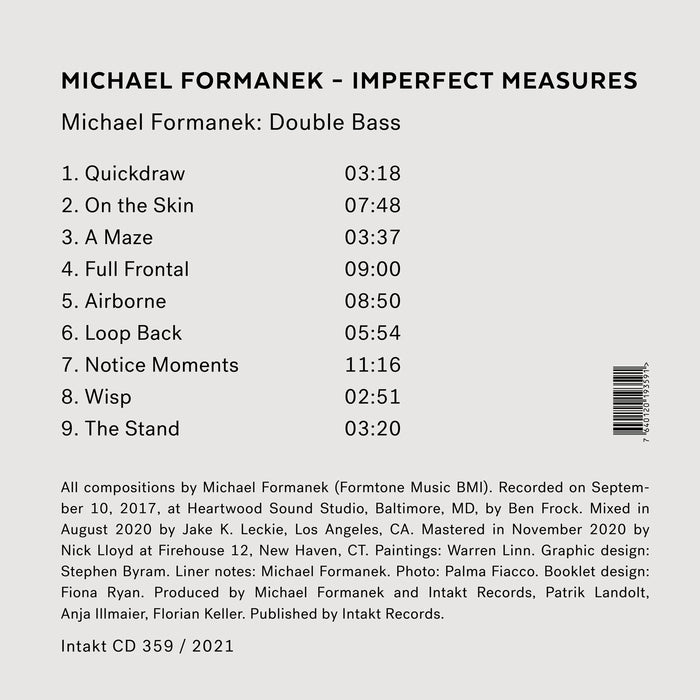
All compositions by Michael Formanek (Formtone Music BMI).
Recorded on September 10, 2017 at Heartwood Sound Studio, Baltimore, MD by Ben Frock. Mixed in August 2020 by Jake K. Leckie, Los Ange- les, CA. Mastered in November 2020 by Nick Lloyd at Firehouse 12 New Haven, CT. Produced and published by Michael Formanek and Intakt records, Patrik Landolt, Florian Keller, Anja Illmaier. Published by Intakt records.
- 5 stars: 21 (100%)
- 4 stars: 0 (0%)
- 3 stars: 0 (0%)
- 2 stars: 0 (0%)
- 1 star: 0 (0%)
A
Anonymous BEST ALBUMS OF 2021
MASTERPIECES
J
Jean Buzelin À côté des soprani aériens et virevoltants, la rude et grave contrebasse peut apparaître comme un instrument plus ingrat. Pourtant les solos sur cet instrument sont assez fréquents et souvent orientés vers la libre improvisation. Pour Michael Formanek, ils représentent d’abord un processus de composition plutôt qu’une performance. Ce qui apparaît évident à l’écoute de ces neuf créations personnelles qui, plus que des études, apparaissent comme une sorte d’aboutissement, vingt-quatre ans après un premier disque solo, dans l’art de l’équilibre entre composition et improvisation. Sonorité superbe, profondeur, fermeté de l’attaque, résonance de la corde sur le bois, raclements parfois... Michael Formanek fait chanter son instrument, affectionnant, même s’il grimpe un peu parfois dans les aigus, les registres graves, facteurs de beauté. « Imperfect Measures » (CD 359). OUI !
https://www.culturejazz.fr/spip.php?article3689
N
Nazim Comunale MICHAEL FORMANEK, Imperfect Measures
Dopo i fuochi d’artificio del Very Practical Trio con Tim Berne e Mary Halvorson, torna su Intakt il contrabbassista Michael Formanek con un solo: nove tracce nude e luminose nella loro essenzialità. Chi scrive ha una predilezione speciale per i soli di contrabbasso ed anche questo lavoro la conferma: monologhi filosofici da qualche parte a metà strada tra un cielo in cui non abbiamo cittadinanza ed abissi che ci tentano ma continuiamo a temere; brividi quando ci ritroviamo in un labirinto (l’archetto che fruga tra le nostre vane intenzioni in “A Maze”), esercizi di speleologia, prove di decollo (“Airborne”), prototipi di umanità indicibile se non tramite le mani sulle quattro corde (il mood pensoso di “On The Skin”). Un musicista cruciale e ispiratissimo, un disco da ascoltare al massimo del volume al tramonto, con le finestre spalancate, convocando gli dei della notte.
https://www.thenewnoise.it/ombre-infrante-nelle-imperfette-misure-della-luce-quattro-dischi-intakt/
C
Chris Searle ALTHOUGH US bassist Michael Formanek’s new record Imperfect Measures is a solo album, he acknowledges in his liner notes that it is in truth a duo effort, due to the extraordinary series of drawings of him while he played during the recording by artist Warren Linn, reproduced in the sleeve booklet.
Sound and image brilliantly cohered and Formanek’s bass was blissfully recorded in a Baltimore studio, with the lucidity of his sound superbly crystallise on tracks like On the Skin or the bowed virtuosity of A Maze.
Formanek’s formidable artistry makes his strings sing, with their voices vibrant and dancing, on Full Frontal or Wisp.
And what about the album title? Formanek was trying to invent one when he saw a newspaper comment by a New York infectious disease expert: “Against Covid-19, imperfect measures do the most good.”
Music and real life, never to be separated.
https://morningstaronline.co.uk/article/c/album-reviews-52
J
John Litweiler For over a thousand years the Persian-Turkish-etc. weavers of rugs and kilims have deliberately included imperfections into their beautiful, elaborate designs, on the principle that only God is perfect. In the notes to Imperfect Measures, Michael Formanek says he doesn’t want to invent perfect bass solos. No worries, Michael. This is an album of solo improvisations by a free developer of the Mingus bass-soloing tradition, with its expressiveness, its rhythmic mobility and linear color, and of course its imperfections.
In fact, the album opens with a display of Mingus-like virtuosity, “Quick Draw.” Formanek is a real master who likes to begin solos with direct statements that he thoughtfully varies. But contradictions enter his discourses, not as interventions but as new views that evolve naturally. Arguments ensue; little phrases are repeatedly asserted. The opening tracks are in fast tempos, including double stops like a fast Amtrak train in “Full Frontal.” Midway through the CD is the gloomy “Airborne,” in a very slow rubato, mostly bowed, with very low growling sounds. The two other bowed solos bring their own gloom, with a bit of Chopin’s funeral march in “A Maze.” Different, brief passages in shuffle rhythms pop up in “Notice Moments” as a unifying element in an especially juicy solo that goes from very, very slow rubato to quite conflicted.
I think the dramatic current in Formanek’s solos make this CD rewarding. But readers should remember that jazz critics ain’t perfect either.
–John Litweiler
https://www.pointofdeparture.org/PoD75/PoD75MoreMoments3.html
T
Troy Collins Michael Formanek: Looping Back, Part One
Born in San Francisco, Michael Formanek has made quite a name for himself as a first-call bassist in the East Coast scene he calls home. Formanek has worked with several generations of musicians throughout his distinguished career: as a teenager in the 1970s he toured with Tony Williams and Joe Henderson; and in the ‘80s he played with Stan Getz, Gerry Mulligan, and Freddie Hubbard. During the ‘90s he played a key role in the fertile Downtown scene, leading his own ensembles while working closely with Tim Berne and his associates. Currently, Formanek is most often found working in the collective trio Thumbscrew, with Mary Halvorson and Tomas Fujiwara, and in the numerous outfits that the trio serves as a rhythm section.
A veteran bandleader, Formanek’s primary working group has been his acclaimed quartet with Berne, Craig Taborn, and Gerald Cleaver, although he has spearheaded a variety of other projects as well, ranging from the massive 18-piece all-star Ensemble Kolossus to solo bass excursions, as first documented on Am I Bothering You? (1998, Screwgun). Additionally, Formanek has been an in-demand sideman, touring and recording with peers like Dave Ballou, Uri Caine, and Marty Ehrlich, along with doing extensive work as a session musician, appearing on albums by Jane Ira Bloom, Lee Konitz, and Jack Walrath, among many others.
A composer of works for ensembles ranging in size from duo to orchestra, Formanek has received institutional support from Chamber Music America, the Mid-Atlantic Arts Foundation, the Peabody Conservatory, the Maryland State Arts Council, and the Virginia Center for the Creative Arts.
Formanek was director of the Peabody Jazz Orchestra and the jazz bass instructor at the Peabody Conservatory of Music in Baltimore, Maryland for 17 years, leaving teaching full-time in 2017 to concentrate on his solo career. He currently has three albums out: Never Is Enough (Cuneiform), the sixth album by Thumbscrew, Imperfect Measures (Intakt), his second solo bass recording, and Dyads (Out Of Your Head), a duet with his son Peter. I interviewed Formanek during the spring of 2021, concurrent with the release of these albums.
****
Troy Collins: Some early biographical information might be of interest to readers unfamiliar with your background. How did you get your start playing music?
Michael Formanek: I was born in San Francisco and grew up in a town a little bit south along the coast, called Pacifica. I tried to play guitar, like everyone else back then, but ended up being told to just play only on the four lowest strings. There were other, more competent guitar players around, and there really weren’t any bass players. I got the message and ended up getting an electric bass, and that got me moving in some direction that eventually led to becoming a musician. In high school I played in a Christmas concert with the “stage band” that featured an alto saxophone player named Bishop Norman Williams, who was a friend of a friend of the director of the jazz band there. Norman was from Kansas City and was a regular fixture in the SF jazz scene from the late 1960s until he passed away a few years ago. For some crazy reason he liked me and started calling me to play gigs with him in San Francisco while I was still in high school. That put me in contact with a lot of musicians, and I began playing around town with different groups. I made a couple of recordings with him, one of which Woody Shaw played on, and I started to meet some of the great players who were living there at the time. Before I left the West Coast in 1978 I had worked with, and even toured with, Joe Henderson, Eddie Henderson, Tony Williams, Dave Liebman, Art Lande, Baikida Carroll, and quite a few others. In those years if you were a bass player in the SF Bay Area you could work a lot but had to be really flexible and be able to deal with all kinds of music. There were times when in the same week I would play a funk gig, a Latin gig, a really straight-ahead jazz gig, a hotel lounge gig, and a free jazz gig. I got a lot of experience doing all of that, and it gave me a chance to get an early sense of what I did and did not want to do. I left California to go and play in a Brazilian band in Buffalo, New York, and never moved back to California. When the gig in Buffalo ended, I went to New York City and just ended up staying there, and in other parts of the East Coast.
TC: Wow! I have to ask, if you were already experienced playing numerous styles of music in the Bay Area, what was it about the Brazilian music gig (or Buffalo, perhaps) that influenced your decision to stay in New York, instead of going back to California? That’s such a radical change in locale.
MF: Great Question! As has often been the case with me, there was a bit of planning, a bit of stumbling into things, and an innate ability to recognize potential opportunities. The period that I decided to take that summer gig with the Braz...
B
Bill Meyer Michael Formanek Imperfect Measures INTAKT RECORDS **** After the world went to lockdown last year, a lot of musicians spent time playing alone. But this CD is not a product of COVID. It addresses a moment of personal challenge. In 2017, bassist Michael Formanek went back to full-time performing after 17 years of conservatory teaching. And two decades after recording his first solo album, he made a second, Imperfect Measures. He's spent the intervening years earning acclaim as a composer, collaborator and band-leader, and elements of those pursuits insinuate themselves into this record. While Formanek is the only musician heard on Imperfect Measures, he created a collaborative environment by inviting artist Warren Linn to come into the studio and draw while Formanek played Several pieces adorn the album's packaging.
And Formanek exercised a compositional influence upon the unscripted music by selecting excerpts from much longer improvisations. The result is a collection of nine tracks, ranging from three to 11 minutes, that are the product of abstraction, but don't sound especially abstract. The recording quality is clear and unenhanced, preserving Formanek's rich, round tone. The opener, "Quickdraw," progresses at an undeniably dazzling clip, but also with inescapable logic. Both "Loop Back" and "Notice Moments" punctuate intricate passages with flamenco-like flourishes, which results in music that imparts a sense of narrative structure even though it rarely repeats. Imperfect Measures isn't just a selection of great bass solos; it's a distillation of a keenly organized musical mind.
W
Wolfgang Giese Der 1958 in San Francisco geborene Michael Formanek arbeitete lange als Sideman, bis er 1990 sein Debüt "Wide Open Spaces" vorlegte. Der Jazz-Bassist war stets als kreativer Musiker bekannt und eng mit der New Yorker Jazz-Szene verknüpft. Wie viele andere Bassisten vor ihm, legt er nun mit Imperfect Measures erneut ein reines Solo-Album vor.
1968 war es, als Barre Phillips mit "Journal Violone" das erste Solo-Album als Bassist vorstellte. Viele andere folgten diesem Beispiel, und aus unterschiedlichen Stilrichtungen des Jazz' legten zum Beispiel Miroslav Vitous ("Emergence"), Ron Carter ("All Alone"), Eberhard Weber ("Pendulum"), Henri Texier ("Amir/Varech")oder Ingebrigt Håker-Flaten ("Double Bass") nach.
Während Weber zum Beispiel mit reichlichen Overdubs und Technik arbeitete, Phillips sehr experimentell und recht frei agierte und auch Vitous seinen eigenwilligen Stil präsentierte und Ingebrigt Håker-Flaten ein sehr unruhiges und eigenwilliges Album vorlegte, so ist auch Imperfect Measures recht individuell gelungen.
Mit einer unglaublich versierten Technik im Spiel ist bereits der erste Song sehr zupackend durch den immensen Druck, den der Bassist aufbaut. Dabei geniesst er die Freiheit, die einem Musiker gegeben ist, wenn er auf keine Mitspieler Rücksicht nehmen muss. Er swingt, klingt bluesig, lässt den Hummelflug auferstehen zu Beginn von " A Maze", indem er wild die Saiten streicht, er lässt den Bass tief brummeln, er schlägt die Saiten und so scheint es gar heftig und perkussiv zu rocken ("Full Frontal").
Ein ruhiges und beschauliches Bild entsteht mit "Airborne", das mich gedanklich dahingleiten lässt und innerhalb der fast neun Minuten so manche Stimmung aufbaut. Mit "Moment's Notice" liegt das längste Stück vor, auf 11:16 Minuten wird langsam eingeleitet, mit Pausen zwischen jedem Anschlag des Basses und baut sich langsam auf, die eine oder andere Sequenz wirkt gar leicht funky, eine Art Groove entwickelt sich, weitere Instrumente entwickeln sich bei mir beim Hören instinktiv in Gedanken. Um etwa Minute Sieben herum schleichen sich gar orientalisch-arabische Elemente ein.
Zum Abschluss bringt Formanek seine Platte mit "The Stand". Nein - das ist nicht "Smoke On The Water", wenngleich der Eingangs-Riff daran ein wenig erinnert. Und um diesen Riff, der zwischendurch wiederkehrt, baut sich die elastische Improvisation auf.
https://www.musikansich.de/review.php?id=22243
A
Alexander Preuss MICHAEL FORMANEK IMPERFECT MEASURES Intakt
Bevor es ans Hören des Solo-Albums des US-amerikanischen Bassisten Michael Formanek geht, bleiben die Augen am aufwendig gestalteten CD-Cover hängen. Verschiedene Collagen sind zu sehen, in deren Mittelpunkt ein Wuchs aus Mensch und Bass. Der Künstler heißt Warren Linn. Die Collagen entstanden 2017 und sind untrennbar mit Formaneks neun Solo-Stücken auf diesem Album verbunden. Sie entstanden nämlich gleichzeitig. Die Idee eines gemeinsamen Schaffens-prozesses der beiden Freunde beschreibt Formanek im Booklet seines Albums: »/ liked the idea of him drawing while / recorded, having no agenda other than, you do your thing while / do mine.« Der Großteil dessen, was auf »Imperfect Measures« zu hören ist, entstand spontan. Die Improvisation beschreibt Formanek als einen kompositorischen Pro-zess, der beim Solospiel einzigartig ist. Denn hier muss der Solist auf musikalische Impulse
seiner Ensemblepartner*innen verzichten. Jegliche Struktur entsteht im Moment der So-lo-Improvisation und ist gleichzeitig Produkt ihrer selbst: »The road only extends as far as we are in the moment, so there must be a total commit-ment to what is being created and constructed in real time lest things quickly fall apart.« Formanek spielt einige seiner Stücke ausschließlich mit dem Bogen ein. Dabei wählt er meist einen brüchigen, harten Klang nah am Steg, begleitet von kantigen Bogenwechseln. Dieser Klang ist so dominant und meist unflexibel, dass es schwer fällt, hier einer Entwicklung zu fol-gen. Ganz anders hingegen die gezupften Nummern, der große Teil des Albums. Mit kräftigem, sonorem Pizzicato-Klang und großer Virtuosität scheint Formanek hier ganz in seinem Element. In »On the Skin« und »Notice Moments«, für mich die Herzstücke dieses Albums, wird er zum großen Geschichte-nerzähler. Er geleitet durch diese Improvisationen mit Zeitlosigkeit beim Gestalten eines jeden Moments und ist dabei doch so zwingend, dass der Augenblick nie Selbstzweck ist, sondern Teil einer großen Linie wird. Perfect measure!
F
Franck Bergerot "Imperfect Measures" (Intakt / Orkhestra) [CHOC] est une moindre surprise dans l'œuvre polymorphe de Michael CHOC jazz Formanek, même si son unique précédent solo date de 1997. NE K On le sait leader et compositeur depuis trente ans, familier de figures émancipées (Wayne Krantz, Tony Malaby, Tim Berne, Jim Black...). Ces "mesures imparfaites" furent improvisées en 2017 en présence de son ami dessinateur Warren Linn venu le croquer en action. Il en reste cette sélection de fragments (de trois à onze minutes) et un cover art de six esquisses retouchées à la peinture et au collage. Musique vagabonde, partant d'un motif ou allant à sa rencontre, lignes droites, bifurcations ou écarts buissonniers, abstraction pure ou lyrisme déroulé à l'infini sans refrain, jeux de notes ou jeux de timbres (parfois avec archet)... état des lieux d'un chantier en cours, "imperfect" au regard de l'admirable poli d'"Autoportrait" digne d'un ébéniste. Mais il nous semble que réunis autour d'une bonne bouteille, Nicolas et Formanek auraient des choses à se dire à propos de leur instrument, de Jean-Sebastien Bach, Béla Bartók... ou Ron Carter.
D
Dan Bilawsky Solo sessions and duo dates are de rigueur these days, what with COVID-19 calling for solitary confinement and creation. But neither one of these releases actually came about as a product of the pause on gatherings.
Instead, each reflects a different facet of formidable bassist Michael Formanek's complete return to the scene prior to the pandemic. After spending 17 years teaching at the prestigious Peabody Conservatory while channeling additional strengths and ambitions into sideman work, cooperative ventures and three notable leader dates on the ECM imprint, Formanek moved back into the life of the full-time improviser. Over the past several years, since making that transition, his bass has carried significant weight on a pair of albums from guitarist Mary Halvorson's Code Girl, three releases from collective trio Thumbscrew and a set apiece from his own Elusion Quartet and Very Practical Trio. Along the way, Formanek clearly found time also to bottle and preserve sage wisdom and searching suggestions in the solo format and with a familial duo.
Bass is the lone instrument on Imperfect Measures, but Formanek wasn't all by his lonesome when he recorded this in 2017. Building the project around the concept of music giving rise to art, he invited illustrator Warren Linn to sketch along with/to his discoveries. Some of Linn's finalized creations, in turn, helped to finish Formanek's work, appearing in the CD's packaging. The music - almost exclusively improvised, with only a couple of sketches or seeds to grow - offers serious thoughts) on time and dimension. The bustling "Quickdraw" holds tension through pace. "On The Skin" subtly nods to tango composer Eduardo Arolas' "Comme il Faut". "A Maze" adopts a trembling arco.
And "The Stand" works rhythmic and motivic hooks to their fullest. Open to wherever the muse of the moment takes him, Formanek is always seeking out the sound of opportunity in these performances. As restless as it is assured, this program possesses a mesmeric draw. While self-motivation is at the root of most solo endeavors, a duo declaration-one like Dyads, especially - is less about individual drive than shared experience(s). So with concentric interests and connections nourished and strengthened over time, Formanek and his son, saxophonist/clarinetist Peter, were primed for this pairing. Recorded at the close of 2019, soon after they finished touring, this album speaks directly to lives and minds intertwined. From the very beginning, with the mysterious-turned-grooving "Two, Not One", things just click. And no matter where they go from there - further left, or right, or straight down a rabbit hole - these men are in sync.
There's rooted back-and-forth talk on "After You", material and scenic suggestions in "The Woods" tempestuous streaks storming through "Hurricane" unsettled (and unsettling) thoughts forwarded in "Hoarse Syrinx" and a blend of order and impulse behind "That Was Then". Genes may have a little something to do with the magic here, but don't discount a tremendous work ethic and big, developed ears. It's all in the family.
A
Andrey Henkin Nazareno Caputo - Phylum (AUT)
George Colligan Theoretical Planets -
Long Term Goals (PJCE)
Don Kapot -Hooligan (W.E.R.F.)
María Grand - Reciprocity (Biophilia)
Masabumi Kikuchi - Hanamichi (The Final
Studio Recording) (Red Hook)
Rebecca Kilgore Trio - Vol. 1 (Heavywood)
James Brandon Lewis Red Lily Quintet -
Jesup Wagon (TAO Forms)
Hedvig Mollestad Trio- Ding Dong. You're
Dead (Rune Grammofon)
Natsuki Tamura/Satoko Fujii -
Keshin (Libra)
Saadet Türköz/Nils Wogram -
SongDreaming (Leo)
Laurence Donohue-Greene, Managing Editor
Larry Coryell & Philip Catherine
(with Jazz at Berlin Philharmonic XI) - The Last Call (ACT Music)
Michael Formanek - Imperfect Measures (Intakt)
Susie Ibarra - Talking Gong (New Focus)
Hedvig Mollestad Trio - Ding Dong. You're
Dead. (Rune Grammofon)
Rempis Percussion Quartet - Sud Des Alpes (Aerophonic)
Irène Schweizer/Hamid Drake -
Celebration (Intakt)
Martial Solal - Coming Yesterday: Live at Salle Gaveau 2019 (Challenge)
Sabu Toyozumi/Mats Gustafsson - Hokusai (NoBusiness Chap Chap Series)
Min Xiao-Fen -White Lotus (featuring
Rez Abbasi) (Outside In Music)
Miguel Zenón - Law Years: The Music of Ornette Coleman (Live at the Birds Eye Jazz
Club) (Miel Music)
(Recommended Releases)
A
Aldo Del Noce MICHAEL FORMANEK
Imperfect Measures
Intakt Records, CD 359
2021
In un’altra recente occasione [n.d.r. MEINRAD KNEER | Vocabularies] svolgevamo una sintetica disamina della letteratura discografica per contrabbasso solo, primariamente focalizzata sul mondo del jazz, che attraverso più generazioni e svariati sottogeneri espressivi ha in effetti espresso un ventaglio di personificazioni dello strumento e del proprio ruolo; secondo l’autarchico animatore del presente album Michael Formanek “sebbene il contrabbasso sembri suonare nello sfondo, sono i bassisti a scrivere la storia del jazz” – posizione partigiana e discutibile, probabilmente, ma con la quale il Nostro avoca a sé e alla filiera dei suoi omologhi, praticamente d’ufficio, un ruolo cardinale entro il filone.
L’operoso musicista, originario della West Coast ed installatosi con ruolo ineludibile sulla scena newyorkese, si è costruito solida credibilità non circoscritto alla scena nord-americana, lungo una partecipazione concertistica e discografica di ruolo esposto nelle orbite di Tim Berne ed Uri Caine, alla testa di diverse esperienze proprie in Enja ed ECM, avendo peraltro rilasciato un primo saggio di contrabbasso solo (”Am I Bothering You?”) già un quarto di secolo fa.
“Mi sono reso conto che la pratica del solo è per me molto più simile ad un processo compositivo che ad una pratica esecutiva” secondo le parole di Formanek, che conseguentemente ne rilascia un’aggiornata testimonianza, qui dispensata lungo nove assortite misure connotate ad un primo esame da indubbia perizia fraseologica nell’oculato bilanciamento del sovrappeso timbrico, smarcandosi con eloquenza espressiva da ogni zavorrante “gravitas” (con l’ulteriore vezzo di alleviare l’impegno profuso nella definizione di “misure imperfette” nel titolo del lavoro).
Di ciò attesta l’ascolto, dalla pulsazione potente e sempre tracciabile dell’iniziale Quickdraw, transitando per la scultorea assertività di On the Skin, non priva di marmoreo classicismo, le frenesie lineari dell’arco in A Maze, ed in così alterna successione si perviene all’introspezione immaginifica dell’increspata Wisp, e alle nervose scansioni della conclusiva The Stand.
Connotato da una diteggiatura calibrata e una costante leggibilità, si può da una parte considerare il carattere della sequenza pervaso dal senso dell’urgenza e da un generale tono di freschezza, pure non sfugge il palese grado di pianificazione estetica del complesso dell’opera, che avvalora il peso della scrittura in dinamico bilanciamento con estro ed ispirazione istantanea.
Confezionato in digipack come le più recenti uscite Intakt, nel presente caso impreziosito dai contributi pittorici del graffitista Stephen Byram (già prodottosi per la label JMT e per diversi album di jazzisti d’area newyorkese), “Imperfect Measures” di fatto quota ulteriormente gli eterogenei investimenti di copertina (nei diversi sensi del termine) di Intakt records, che anche in questo critico periodo seguita coerentemente a collocare calibrate produzioni.
https://www.soundcontest.com/michael-formanek-imperfect-measures/
M
Mark Corroto Although recorded in 2017, two years before the majority of us considered the implications of a global pandemic and a hundred years since the previous one, Michael Formanek's solo outing imagines art in lockdown. Mixed and mastered in 2020, these nine (mostly) improvised tracks materialize as compositions. That should not be surprising if you consider the bassist's work supporting Tim Berne, Russ Lossing, and Susan Alcorn, plus his contributions in Thumbscrew (with Mary Halvorson and Tomas Fujiwara), Code Girl, and his own trio, quartet, quintet, and Ensemble Kolossus. He is the consummate timekeeper, and if you drill down just below the surface his talents as a composer and arranger are quite apparent, evidenced by these tracks. Also apparent is the physicality of the music making. Formanek's bass registers not only in your ears, but also your chest. Pieces like the plucked "Quickdraw" and bowed "A Maze" are felt as much as heard. The impeccable studio sound captures Formanek's creative process as does the drawings that accompany the CD's packaging. Visual artist, Warren Linn sketched, painted, and collaged in studio while the bassist was laying down these tracks. What emerges is a visual representation of what you're hearing. "Full Frontal" chases a weighty pulse while also producing a satisfying melody. That can be said of the entirety of this recording. Formanek has a way of pulling together sounds into song. Bravo.
https://www.allaboutjazz.com/the-pandemic-sessions-solos-pt-1
S
Salvador Catalán ¿Te estamos aburriendo? Jazz Los nuevos álbumes del violinista Mark Feldman y el contrabajista Michael Formanek reivindican los requerimientos del formato en solitario Excesivamente ásperas para algunos, absolutamente libres para otros, las grabaciones en solitario siempre han supuesto un reto para aquellos músicos de jazz que se han atrevido a abordarlas. Y más cuando sus instrumentos no gozaban del registro armónico de otros como el piano, habituados por tradición y características a desenvolverse en estos contextos.
Dos instrumentos de cuerda frotada como violín y contrabajo saltan ahora a la pasarela discográfica de la mano de sendos músicos asentados en la primera fila de sus respectivas especialidades: el violinista Mark Feldman y el contrabajista Michael Formanek. Y ambos lo hacen de la mano de un sello discográfico –el suizo Intakt Records– plenamente comprometido con este tipo de lances, no aptos para públicos pusilánimes.
Así, 26 años después de su primer registro en solitario (Music For Violin Alone, 1995) Feldman plasma en Sounding Point su apuesta tanto por la improvisación libre (Unbound o New Normal) como por estructuras prefijadas. En ambos casos, despuntan los recursos del músico de Chicago puestos al servicio de las sugerentes historias que transmite y que saltan de la tensión al sosiego. Todas llegan suscritas por él con la excepción de sendos temas de Ornette Coleman (Peace Warriors) y de su habitual aliada, la pianista suiza Sylvie Courvoisier.
Una ruta similar asume el gran Michael Formanek, 23 años después de su primer álbum en solitario, Am I Bothering You? (1998). En este caso, Imperfect Measures parte de la idea de crear música interactuando con su amigo, el ilustrador Warren Linn, cuyo valioso trabajo resultante figura en la cubierta del álbum. Más cercano al proceso compositivo que a la práctica interpretación, Formanek se preocupa por captar la sensación de cada momento a través de una exploración que –de ahí el título del álbum– revaloriza incluso sus imperfecciones. Música exigente para creador y también para oyente, molesta para oídos acomodados, pero, sobre todo, profunda y autónoma.
https://www.diariodesevilla.es/ocio/aburriendo_0_1560745893.html
F
Filipe Freitas Michael Formanek is a a peerless genius of the rhythm, whose incredible technique and sublime ears made him one of the most respected bass players in the avant-garde jazz scene. Although he has played in all group formats, Imperfect Measures is just his second solo effort, succeeding to Am I Bothering You? (Screwgun, 1999).
Having structured this work cannily, the bassist enjoys all the freedom he wants, allowing the natural flow of his musical expression to move from track to track with inner logic. The artist/illustrator Warren Linn joined him in the recording session, creating sketches that evolved into collages/paintings that are partly featured in the CD package.
“Quickdraw” initiates this sonic journey with Formanek roaming through a fast, muscular pizzicato imbued with a thrilling melodic sense; this number is followed by “On the Skin”, which, easing up the pace, adds a dark and bluesy poignancy to the melody. The bassist completes the scenario with occasional intervals that help us situate within the harmonic context.
The excellent bowing skills brought to light on “A Maze” echo a sort of chant that becomes more ritualistic as it moves forward. Another conspicuous arco statement occurs in “Airborne”, where Formanek shows off a wide range of action and probes a multiphonic approach that intensifies the enigmatic nature of the moment.
Percussive and reverberating, “Full Frontal” is projected with crisp attacks and sonorous timbre, with some parts of the rhythm denoting rock influences that go perfectly well with the Eastern and folk impressions in the melody. Eastern undertones are also detected with plenty of chromatic wriggling on “Notice Moments”, a rhythmically interesting lament expressed with an instinctive sense of groove.
Formanek finishes off the album with “The Stand”, where a palpable riff becomes the object at the center, around which everything else revolves.
In its essence, it’s beside the point whether the inspiration comes from dance-rock or groove-centered jazz. Some dedication from the listeners will unlock any initial resistance involved in a solo bass storytelling of this nature. And the rewards will come.
https://jazztrail.net/blog/michael-formanek-imperfect-measures-album-review