
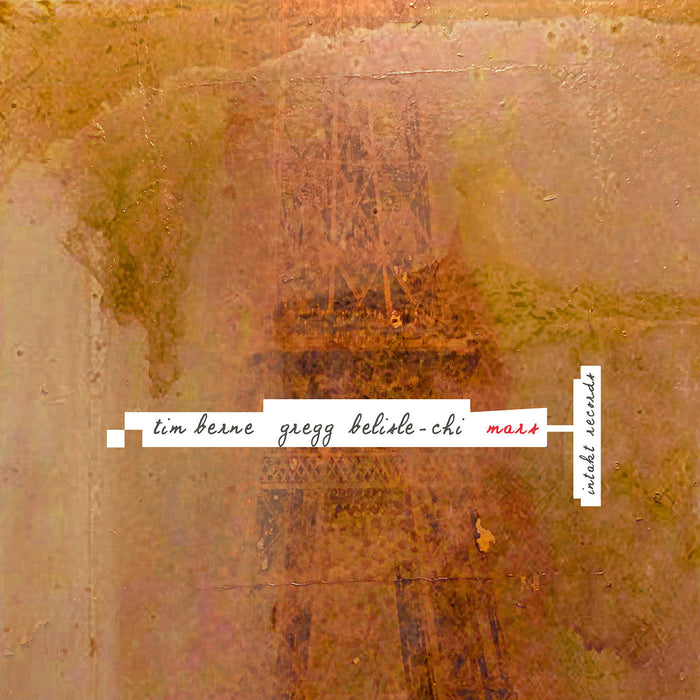
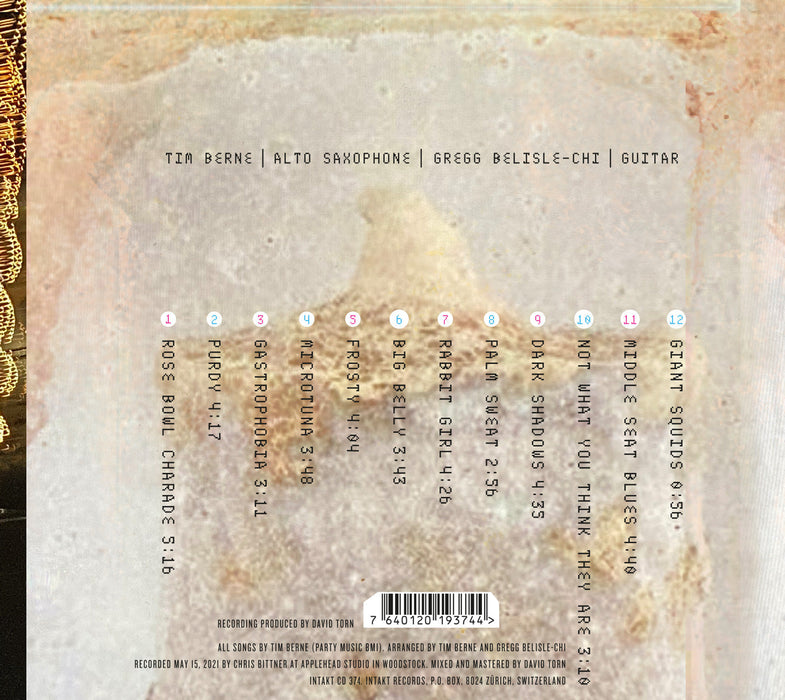
374: TIM BERNE – GREGG BELISLE-CHI. Mars
Intakt Recording #374/ 2022
Tim Berne: Alto Saxophone
Gregg Belisle-Chi: Guitar
Recorded May 15 by Chris Bittner at AppleheadStudio in Woodstock.
Sale
Sale
Original price
CHF 12.00
-
Original price
CHF 30.00
Original price
CHF 30.00
CHF 12.00
-
CHF 30.00
Current price
CHF 30.00
| /
More Info
With his extensive artistic biography, Tim Berne is one of the most outstanding figures in American jazz. Rising star Gregg Belisle-Chi, a connoisseur of Berne's music, has this year released the acclaimed album Koi, featuring interpretations of Tim Berne's compositions on solo acoustic guitar. With his extensive skills and immense sonic potential, he is earning a central place in the landscape of contempor- ary acoustic guitar.
With Mars, these two exceptional musicians present their first duo album. All songs are penned by Tim Berne and enchant the listener with an intense interplay that is playful, poetic and sonically stunning. David Torn, who is responsible for the grandiose sound, writes in the liner notes: "Space Music? no, nope: Earth Music? well, yeah. Folk Music? well... i dunno, could be, but these songs on Mars are written by Tim & reimagined in-real-time by he & Gregg: them 2 being edified by, appreciative & respectful of those who’ve come before, & especi- ally those ones who stayed lit and busted their own asses & spirits in order to continue initiating the kinds of flames that push us all to strive to express & to feel things of life & lives that may otherwise be functio- nally inexplicable, and may even be ineffable, somehow."
Album Credits
Cover art and design: Stephen Byram
Liner notes: David Torn
Photos: Tim Berne
Booklet design: Fiona Ryan
Band Photo: Robert Lewis
All songs by Tim Berne (Party Music BMI). Arranged by Tim Berne and Gregg Belisle-Chi.
Recorded May 15 by Chris Bittner at AppleheadStudio in Woodstock. Mixed and mastered by David Torn.Produced by Tim Berne, Gregg Belisle-Chi and Intakt Records.
- 5 stars: 37 (100%)
- 4 stars: 0 (0%)
- 3 stars: 0 (0%)
- 2 stars: 0 (0%)
- 1 star: 0 (0%)
J
Jean Buzelin Après trois disques Intakt en des formules diverses, le saxophoniste-alto Tim Berne choisit le duo avec le guitariste Gregg Belisle-Chi. Ce jeune musicien avait enregistré des œuvres de Berne en solo, les deux “devaient” donc se rencontrer. Douze compositions du saxophoniste sont revues avec le guitariste et interprétées dans un format ramassé qui oblige à la concentration. Servi par un travail considérable sur l’instrument, le jeu somptueux de Tim Berne est superbement mis en valeur par celui, ciselé de la guitare acoustique. Une musique d’une grande pureté et de très haut niveau.
https://culturejazz.fr/spip.php?article3852
G
Guy Peters Het klikt tussen Tim Berne en Intakt Records, het Zwitserse huis waar hij recent blijft opduiken en dat sinds 1986 is uitgegroeid tot een instituut van de avontuurlijke jazz met een ijzersterke catalogus van intussen bijna 400 releases. Het klikt overduidelijk ook tussen Berne en de jonge Aziatisch-Amerikaanse gitarist Gregg Belisle-Chi. Die bracht met Koi (2021) al een persoonlijke hommage aan de meester en mag nu de klus klaren in zijn gezelschap. Hun ontmoeting is een iriserend samenkomen van onvoorspelbare composities vol vrijheid, met Berne die zichzelf regelmatig verliest in die zo herkenbaar spiralende cirkels, terwijl Belisle-Chi de muziek even stoïcijns als daadkrachtig richting kamermuziek port. Complex, zonder te overrompelen. Cerebraal, maar met een hart. Eentje voor fijnproevers met een beetje ervaring.
A
Anonymous Metrica sinuosa, traghettata nel mondo del minimalismo jazz. Tim Berne (Alto Saxophone) e Gregg Belisle-Chi (Guitar) disegnano in musica un patchwork vario che assorbe le loro linee astratte e melodiche. Bozzetti Impro. timbri free e una fedele riproposizione di schemi jazz su tessuti decisamente informali. Con la sua vasta biografia artistica, Tim Berne è una delle figure più importanti del jazz americano, la stella nascente Gregg Belisle-Chi con le sue vaste capacità e l'immenso potenziale sonoro. Dodici tracce tutte scritte da Tim Berne, incantano l'ascoltatore con un'interazione intensa e giocosa. Avanguardia.
https://www.facebook.com/WIndout-156994887987877/
J
John Fordham Five years back, the circuitous melodic journeys and rhythmic contrariness of Tim Berne's music spawned a brilliant devotee in pianist Matt Mitchell, whose dedication to the New York one-off's composing inspired the remarkable solo-piano album of Berne interpretations, Førage.
Last year, another quirkily gifted connoisseur turned up in the shape of young acoustic guitarist Gregg Belisle-Chi, with the comparably imaginative solo session Koi: Performing the Music of Tim Berne. Now, Mars brings Berne's alto and Belisle-Chi's guitar together on a dozen short dialogues around the composer's pieces, produced by David Torn.
The acoustic guitar's necessary fragility, and the intimacy of this partnership, casts Berne's music in a different and in some ways warmer light, and though Belisle-Chi distils the compositions to their essentials, these tracks nonetheless radiate immense vividness. The guitar chimes quietly behind the softly buzzy twists and turns of the alto sax on 'Gastrophobia, pillows its soulful dreaminess on 'Middle Seat Blues', shepherds the busy melodic lines of 'Dark Shadows', skips brightly around the Ornettish 'Giant Squids'. Without cranking up the percussiveness, Belisle-Chi imparts a mysterious momentum to these serpentine tunes - his folk-bluesy relentlessness and scatterings of lateral melody drive 'Big Belly' long before Berne's free-jazzy alto floats into the picture, while the pair are animatedly joined at the hip on the episodic 'Palm Sweat'. By paring Tim Berne's music to the bone, Gregg Belisle-Chi may just have helped his hero to unveil fascinating new stories within it.
J
Josef Woodard Since the 1980s, alto saxophonist/composer/record company micro-mogul Tim Berne has operated in multiple settings, releasing albums with prolific regularity and restlessly creative energy. Something relatively new is afoot with his new sax-acoustic guitar duet with Gregg Belisle-Chi, of the sort we haven't heard since Berne's fascinating and now hard-to-find 1984 duet recording with Bill Frisell, Theoretically.
Critical backstory: Nimble-fingered guitarist Belisle-Chi worked his way into Berne's world via his impressive 2021 solo guitar album Koi, interpreting Berne's music. Not surprisingly, given the guitarist's sensitive approach to Berne's musical language, they get along famously in a duet context. Conversation flows freely between them, with digressive chatter and contrapuntal spiciness in the mix to keep things lively. Despite the serious nature of Berne's music and playing - though never brooding or lacking in drive or energy - his innately, wily sense of humor sneaks in via his song titles. Some of the tracks here relate to the eating arts, as in "Gastrophobia" (fear of eating?), “Big Belly" and "Microtuna."
Opening the album, the punningly named "Rose Bowl Charade" sets the stage for what's to come, through Berne's melody line. Nattering, stuttering heated notes peel off into angular flurries and generally keep our ears in suspended mode: Berne's happy place. Sentimentality has no sway here, as is Berne's wont, but he can find angular roots to heartfelt expressions.
K
Ken Waxman Chamber Jazz with a crisp filter, these collections of multiple brief tracks use contrast and cooperation to avoid the uniformity engendered when only a saxophone and guitar duo is involved. True to its title, Nine Improvisations for Sopranino and Guitar features the Italians, saxophonist Marco Colonna, who has played with AgustíFernández; and electric guitarist Enzo Rocco, who has partnered Carlo Actis Dato. Saxophonist Tim Berne who leads a series of other bands, also composed Mars' dozen selections. His partner here is fellow American acoustic guitarist Gregg Belisle-Chi, who has played with Cuong Vu among others. Often condensed, the tracks on both sets primarily have the saxophonist state the theme statement and work out variations while each guitarist's comping providing the rhythmic backing and chromaticism.
Throughout the Colonna/Rocco session the guitarist keeps the program moving by switching between sliding pressurized strokes and diaphanous displays of finger-style frails or moderated plinks. For his part Colonna's scene-setting encompasses flashing reed arabesques and slides plus shrills that sometimes reach altissimo and above.
Despite detours into squeaks and whines from one player, and casual or intense strumming from the other, tunes remain linear and expositions usually evolve with reflective harmonies. While some such as "Bianchi e Neri" pivot to a folksy or balladic narrative, others such as "Ridondanze" propel intensity that comes from reed biting variations and flat-picking percussive string strokes. The most impressive tracks are those which integrate extended techniques within horizontal narratives. "Alti e Bassi" for example begins with strident reed trills in near-piccolo range that are met by tense electrified twangs. But the resolution involves Rocco's cerebral phrasing which moves Colonna away from stratospheric squeaks to a moderated conclusion.
Having the peripherals available from an electric guitar helps in constructing proper expositions or responding to the sometimes strident saxophone tones. However Belisle-Chi has to do the same with an acoustic instrument. Occasionally he defaults to a folksy solemness which is less helpful on certain tracks. As the duo's junior partner and as the interpreter not the composer of the tunes, it's his warm and cushiony tone s which work best to lessen the stridency implicit in Berne's sometimes mercurial themes and variations. When he's more assertive, a better balance of intersection and tone rebounds is maintained. One such track is "Big Belly", where metal-tinged pinpointed strokes set the scene for the eventual entrance of Berne's screechy Ornette-like theme that widens into a proper narrative as reed slurs intermingle with responsive guitar rebounds. Other tunes like "Rabbit Girl" evolve in double counterpoint, with the exposition a mixture of the saxophonist's dynamic slides from high to low expressions as Belisle-Chi's concentrated strums become both soothing and connective. With allowances made for Berne to pull textures from the middle of his saxophone's s-curve and even highlight some R&B honking in part, the crunches and doubled strums Belisle-Chi add to the interpretations.
As a first-time effort Mars passes muster as a tentative exploration of sonic space and time, but lacks the truculent confidence that a project with that tile should project. Nine Improvisations for Sopranino and Guitar sets out to do exactly what the title promises. Notable within that paradigm, extending the project still further could possibly expose its built-in limitations.
http://www.jazzword.com/one-review/?id=131043
F
Franck Bergerot Nouveauté. Voici un album qui rend justice au lyrisme fondamental de la musique de Tim Berne. Toujours ce son de saxophone sans apprêt, mais des mélodies à tue-tête déroulées comme à l'infini sans jamais nous lasser, entretenant constamment notre envie d'aller voir ce qui se passe au prochain tournant. Le guitariste Gregg Belisle-Chi - qui ne cache pas son admiration pour Bill Frisell et Ben Monder - avait exploré ce répertoire en solo, pour se faire la main sur une musique "différente". Il en résulta "Koi - Performing The Music Of Tim Berne" sur Screwgun le label du saxophoniste, co-producteur, comme ici, avec David Torn. Sur "Mars", Belisle-Chi reprend la guitare acoustique à cordes acier, mais cette fois-ci en duo avec Berne, toujours sur les compositions de ce dernier dont il fait sonner les sinuosités à perte de vue comme des mélodies folk. Unissons écrits, divagations en contrepoints, extensions harmoniques des lignes écrites ou improvisées par le saxophoniste, fruit d'un travail de longue haleine entre les deux artistes qui inspire à David Torn cette citation de Gustav Malher en regard de ses notes pochettes :
<<< La tradition n'est pas la culte des cendres, mais l'entretien du feu. >>> Et il y a bien là quelque chose d'incandescent!
S
Steve Futterman That Tim Berne's name rings a bell to few outside a devoted coterie doesn't make him any less of a jazz hero. Since putting down New York City roots, in 1974, this audacious alto saxophonist, composer, and bandleader has never strayed from a path of his own making, hewing to left-of-center forms and unfettered improvisation. Berne originally drew inspiration from such second-generation avant-gardists as Julius Hemphill; he's now a patriarch of sorts to a new generation of similarly risk-taking players. United in a compact trio with the gifted drummer Nasheet Waits and the guitarist Gregg Belisle-Chi, Berne flaunts skills that are as passionate as they are exploratory.
https://www.newyorker.com/goings-on-about-town/night-life/altin-gun-and-sessa
J
Jason Bivins Tim Berne has long been a composer whose lines are instantly recognizable, whether heard on his own alto saxophone or from another instrumentalist. They snake here and there, they morph in and out of composed or improvised sections. Berne has long favored guitarists in his band, from Nels Cline and Bill Frisell to Marc Ducret and David Torn. That’s some pretty heavy company.
Last year, the brilliant young Gregg Belisle-Chi released an album of solo Berne tunes performed on his acoustic. Mars sees him meet up with Berne with the same axe in tow. The results are absolutely wonderful. Belisle-Chi is clearly possessed of prodigious technique, and across twelve tracks he uses it to flesh out the compositions themselves rather than taking chops-heavy flights. He uses arpeggios, complex fingerings, dynamic shifts, and other approaches to create the most fascinating shapes inside these tunes.
The compositions themselves are highly varied in structure and affect. There is, however, a general atmosphere of haziness and uncertainty. The pair alternate between passages of chiming repetition, as on the opening “Rose Bowl Charade,” and unpredictable melodic darting. Listening to the spiky “Big Belly” or the spacious “Rabbit Girl,” you could almost hear these tunes as cartoon lullabies. Berne’s Ornette influence is especially strong on this release, or maybe it’s just the duo format that makes it plainer. In any case, his playing packs a real punch on the bluesy “Microtuna” and “Frosty,” abetted wonderfully by Belisle-Chi’s resonating chords, his brimming arpeggios, and his reflective lines.
The synergy between the two players is just infectious. On standout tunes like “Palm Sweat” and “Gastrophobia,” I kept getting the vivid impression of two friends walking animatedly down the street, delighting in their conversation. Berne soars while Belisle-Chi works a tasty descending sequence, or works some pulloffs on the high strings. Whether on enigmatic pieces like “Dark Shadows” or buoyant numbers like “Middle Seat Blues,” the line between composed and improvised is at best hazy. It’s never quite certain whether the shifts of dynamics or harmony are mapped out or spontaneous. Fascinating as that is to follow, it’s best just to roll along with the tunes, marveling about Belisle-Chi’s harmonic range, or sinking into Berne’s urgent playing. It’s a fantastic document of the ever-vital Berne, and a real statement from the guitarist.
https://pointofdeparture.org/PoD78/PoD78MoreMoments2.html
C
Christoph Haunschmid Dass Tim Berne seit Jahrzehnten eine unverzichtbare Größe in der US-Jazzszene ist, weiß man. Gitarrist Gregg Belisle-Chi dürfte hierzulande aber weniger bekannt sein. Der 1990 in Kanada geborene, mittlerweile in Brooklyn lebende Sohn chinesischer Einwanderer hat mit dem Altsaxofonisten eine ungewöhnlich lyrische, fast melodienselige Duo-CD eingespielt. Mit Tim Berne ist er vertraut, hat er doch im Vorjahr auf Screwgun schon eine Platte mit dessen Musik auf akustischer Gitarre solo herausgebracht. Diesmal spielt Berne auch selbst mit, zieht ausschließlich auf dem Altsaxofon sorgfältige, fast mit Bedacht gesetzte Linien. Die Gitarre schmiegt sich daran, unterstützt die Linienführung durch ausgesuchte Akkorde. Eine sehr feinsinnige kammermusikalische Einspielung, die ihre Spannung aus den wohlüberlegten Kompositionen und dem ausgewogenen Miteinander der beiden Protagonisten zieht.
U
Udo Andris Der Titel dieses Duo-Albums mag vielleicht auf eine falsche Fährte locken. Denn >>Mars<<< führt nicht in die Weiten des Universums, orientiert sich nicht an Space-Music (im Sinne eines Sun Ra etwa) oder an Sonic Fiction. Im Gegenteil: Die zwölf Tracks dieser CD geben sich sehr irdisch, eine Nähe zum Song lässt sich oft entdecken. Der kanadische, inzwischen in Brooklyn lebende Gitarrist Gregg Belisle-Chi und der New Yorker Altsaxophonist Tim Berne (verantwortlich für alle Kompositionen) dialogisieren hier mit viel Empathie, Gespür für Filigranes und Transparenz. Be-lisle-Chi beschäftigt sich schon seit geraumer Zeit mit der Musik Bernes und veröffentlichte mit >>Koi<< ein Solo-Album, auf dem er Kompositionen des renommierten Saxophonisten und Bandleaders für die akustische Gitarre arrangierte. Sicher auch ein Grund für das homogene, ja intuitive Interplay dieses Duos. Bernes Kompositionen und Improvisationen lassen, bei aller Kantabilität, auch gerne dessen Liebe zum Avantgarde-Jazz erkennen: Songcharakter trifft auf die Grammatik des New-Jazz. Und Gregg Belisle-Chi erweist sich mit seinem glasklaren, elegant phrasierenden und auf Ökonomie achtenden Spiel auf der akustischen Gitarre als ebenbürtiger Dialog-Partner.
A
Anonymous Dopo le ottime prove con gli Snake-oil e il quartetto Broken Shadows, Tim Berne riduce gli effettivi e si concentra in un duetto con il chitarrista acustico Gregg Belisle-Chi, giovanotto di belle speranze autore già di un'incisione ("Koi") in cui riprendeva vari temi del sassofonista. È un dialogo serrato, conciso, caratterizzato dai saliscendi e dagli improvvisi di Berne così come dalle risposte in tempo reale di Belisle-Chi, affermativo e dinamico negli interventi. La sua non è una presenza accessoria e anche se l'altista pare dominare la scena in misura maggiore si finisce ben presto per tendere l'orecchio verso la controparte, che per forze di cose si ritrova a prodursi a un livello di volume un gradino inferiore. In contraddizione al titolo non è musica per volare su Marte, ma basta e avanza per stare bene sulla terra.
G
Gerd Filtgen Seit mehr als vier Dekaden gehört Tim Berne zu den Künstlern ohne kreativen Stillstand. Beharrlich setzt der Altsaxofonist seine musikalischen Visionen mit unterschiedlichsten Besetzungen um. Allein seine Begegnungen mit Gitarristen, unter ihnen Bill Frisell und David Torn, sprechen für sich. Zu diesen illustren Protagonisten stößt jetzt Gregg Belisle-Chi, der offenbar keine Schwierigkeiten hat, sich in Bernes musikalischem Kosmos zurechtzufinden. Seine auf der akustischen Gitarre kreierte Begleitung und seine Soli ergänzen hervorragend Bernes fantasievoll mäandernde Altsaxlinien.
S
Sergio Spampinato Ennesimo album di Tim Berne, uno dei tanti pubblicati dalla favolosa etichetta svizzera Intakt Records. L’altosassofonista dell’avanguardia newyorkese stavolta però, con questo Mars, si presenta in duo con un chitarrista, un giovane e suo grande estimatore, Gregg Belisle-Chi, che solo l’anno scorso, anzi pochi mesi fa, verso la fine del 2021, aveva dedicato proprio a Berne un intero progetto, dal titolo Koi: Performing The Music Of Tim Berne, in cui ha suonato, in solo con chitarra acustica, le sue composizioni. Anche in questo Mars le composizioni sono tutte a firma di Berne, ma l’approccio negli arrangiamenti è quello di una condivisione col suo sodale chitarrista le cui armonie sostengono notevolmente le intricate e sinuose linee melodiche del sassofono. Forse era dai tempi del duo sperimentale con Bill Frisell degli anni ’80, che Berne non compariva soltanto assieme ad un chitarrista; nel 2021 aveva dedicato un intero progetto ad Ornette Coleman, dal titolo Broken Shadows, pubblicato sempre dalla Intakt, che riproponeva lo stile colemaniano nell’intersezione di due sax, l’alto di Berne appunto e il tenore di Chris Speed che sostituisce la tromba di Don Cherry. Lo stile di Coleman ritorna con evidenza anche in Mars nella penultima traccia, Middle Seat Blues, ma in tutto l’album Berne segue una linea propria, uno stile sempre autentico ed un suono di grande potenza, sotto il cui spessore si allargano le maglie delle tessiture armoniche costruite da Belisle-Chi, che nell’esposizione dei temi diventa invece una formidabile eco cameristica del sax. Altro elemento di forza è la supervisione dell’amico chitarrista David Torn, che ne ha curato missaggio e mastering. Un album di ascolto non semplice perché potrebbe sembrare un po’ ridondante di primo acchito, ma che è in verità un momento musicale di grande intensità.
https://www.frastuoni.it/?p=8462
G
Gary Chapin I feel like this duet recording is closing a thesis-antithesis-synthesis loop. In May 2020 Tim Berne released his first solo recording, Sacred Vowels. In June 2021 Gregg Belisle-Chi released Koi: Performing the Music of Tim Berne. A few months ago, I interviewed Belisle-Chi , and he told me that he and Berne had just recorded a duet—which is what we’re reviewing now. A nice arc or circle, but I hope not a closed one, because I’m going to want more music like this.
I don’t always know what’s going on with the com-provisation balance in this type of thing, and I admit that I might be overly fascinated by the creation process of musicians like this. Here we’ve got Tim Berne’s horn, a powerful instrument that can fill any room, and Belisle-Chi’s guitar, an instrument marked by measured gentleness. The production helps it work. The guitar is intimate and personal, the sax surrounds you. Kudos to David Torn.
Belisle-Chi’s approach is baroque in its spirit, though not its content. As he explained in his interview, he took Berne’s sheet music and created skeletons (with guitar fingerings and all) that had him serving bass, harmony, and melody roles all at various times. The improvisation is woven throughout. It’s unpredictable but logical in its form, like the striations in marble.
There is a sense of introspection and conversation; solitude in partnership. Tim’s improvisations are calls for Belisle-Chi’s responses. I’m reluctant to talk in terms of “purity,” but the distillation that takes place on Mars provides a remarkable clarity to Tim’s tunes. Just the brevity of the pieces (only one longer than 5 minutes, and one under a minute) leaves us understanding that nothing here is excess. You feel this is what the tunes really are. Their purest form.
And that’s a fiction the listener brings and probably a bias of my own. At the very least this album—like the other two in the triptych—provides a different window into Berne’s work. And is beautiful in its own right besides.
I wonder when a recorder consort will step up to the challenge.
https://www.freejazzblog.org/2022/03/tim-berne-gregg-belisle-chi-and-gordon.html
D
Derek Taylor Tim Berne is a cottage industry of his own design. Fiercely independent and self-determinant, he’s exercised admirable autonomy and agency over his career and output across four decades. Berne’s also been famously averse to providing promotional copies of entries from his voluminous catalog over the years. The exceptions to that rule are the occasions when he cedes those concerns to labels other than his own Screwgun imprint. Mars is a recent example of such capitulation, released on the Swiss Intakt imprint and combining his itinerant, incisive alto with the acoustic guitar of Brooklyn-based Gregg Belisle-Chi.
The session’s precursors lie in an album, Koi, by Belisle-Chi of solo Berne covers released on Screwgun in June 2021. The guitarist’s entry point into Berne’s expansive oeuvre came through the altoist’s various projects with guitar players including Nels Cline, Bill Frisell and Marc Ducret. Belisle-Chi’s approach to frets is similarly versatile, incorporating ironclad technique with a ranging restlessness that doggedly resists predictability. He and Berne connected over the early months of the pandemic, engaging virtually in the context of the solo project. In-person collaborations and concerts were a natural outgrowth including a handful of performances and this studio date.
Immediately apparent across the program’s dozen pieces are the close, diegetic colloquies the pair engages in. Independent solo passages are comparatively uncommon and fleeting, replaced by often dizzyingly intricate contrapuntal exchanges and potent shadowboxing unisons. Berne’s piquant tone bleeds a brusque complement to Belisle-Chi’s sharp, but never prickly picking. “Frosty” and “Big Belly” are deviations. Alto opens alone on the first in the investigation of a phrase and guitar joining with strummed embellishments. The second gives guitar the opening salvo with Berne blowing craggy modulations against a roiling thicket of resonant chords.
The altoist’s distinctive design traits are all over the pieces, from their tersely descriptive titles to the collective absence of dross and emphasis on the expression of elliptical energy in their various executions. It’s also present in the album packaging, which does no favors in making script discernible through tiny cursive fonts and camouflaging color schemes and pulls the fast one of reverse track sequencing. An expert improvisational conversationalist on his instrument, Berne’s found an exceptional partner in Belisle-Chi, and these miniatures offer up intriguing distillations of his compositional art that each sound fully rendered despite their relative brevity.
https://dustedmagazine.tumblr.com/post/677719024795287552/tim-berne-gregg-belisle-chi-mars-intakt
G
George Grella Tim Berne is, for most jazz fans, primarily thought of as a saxophonist, improviser and bandleader and only secondarily as a tunesmith or composer. But the quality of his groups and records comes directly out of his composing and though that may be subsumed for a lot of listeners, musicians hear it. In 2017, Matt Mitchell released FØRAGE, piano interpretations of Berne's pieces, and now comes Gregg Belisle-Chi with the beautiful Koi, Berne played on solo guitar.
Stripped down and especially with the limited sustain of the guitar, it is easy to hear all the facets and sophistication in the pieces. Berne doesn't produce song-like melodies as he crafts pithy, but meaty phrases and sets them into chord changes and harmonic rhythms that outline both clear form and keep a strong tonal center. They are also full of details and quirks that set them apart from both standard song form and also the kind of liminal forms that often stand in for a highly improvisational concept of composition. Berne was an acolyte of Julius Hemphill, but his composing also reminds one of Wayne Shorter; not that Berne's material follows Shorter, but in taking his own oblique pared-down path to making pieces that improvisers will play. "Reception", for example, sounds at first like a response to two different Thelonious Monk tunes, then turns both inward structurally and outward harmonically. Berne's music is like Doctor Who's TARDIS, bigger on the inside.
To say that Belisle-Chi plays this stuff well is an understatement. His technique is excellent and it sounds like he is caressing the music. The recording quality is superb and meaningful in that the guitarist is solo but doesn't sound alone, the space and reverb around his instrument sounds like an accompaniment. Hearing Berne so stark yet glowing is frequently a moving experience.
Belisle-Chi has a concentrated gentleness that pairs superbly with Berne on Mars. They are an oil and vinegar mix and the guitarist brings out the depth of beauty and feeling in Berne's more questing, agitated approach. He also does something strange to the tune names. Berne favors acerbic titles like "Rose Bowl Charade" and "Middle Seat Blues"; reading this primes the mind for one thing, but the searching emotional exploration in the playing delivers something else altogether, like the titles are a loss-leader for a substantial payoff. Berne sounds as velvety as he has ever been and that contrast with the picked guitar strings is ideal.
"Middle Seat Blues" and "Giant Squids" are heard across both albums. On Mars, the guitarist lays back for some relaxed, Ornette Coleman-ish blues from Berne while solo Belisle-Chi gives the music a Delta blues sound with some nice slide work. "Giant Squids" is far more skeletal and angular heard solo while as a duo it has the fascinating sound of musicians near to constructing the thing on the spot, negotiating what comes next and when. As the last track on Mars, they play the head then it all comes to an end. A nice encore to two sides of the same unique, impressive coin.
L
Luc Bouquet L’idée de retrouver Tim Berne en duo avec un guitariste n’est pas pour nous déplaire. Son compagnon du jour se nomme Gregg Belisle-Chi. Ce dernier, influencé par Bill Frisell, Ben Monder, Marc Ducret ou David Torn (tiens tiens : tous des familiers de Tim Berne) connait bien l’univers de l’altiste. Pour preuve le disque Koi, publié il y a un an et reprenant en solo quelques-unes des compositions de ce dernier.
Si les compositions labyrinthiques de Berne le sont moins qu’à l’ordinaire, elles sont suffisamment chargées de complexités pour impressionner un jeune novice tel que Gregg Belisle-Chi. Et comme de bien entendu, le novice balaie d’un coup de médiator tout piège passant à sa portée, donnant même aux partitions de Tim Berne des audaces printanières, peu entrevues jusqu’ici.
L’obsession du saxophoniste y est moins prégnante que d’habitude et même si gardant la même tessiture d’un thème à l’autre (il y en a douze et de courte durée sur ce disque), le saxophoniste ne s’encombre que de l’essentiel, réduisant –et non plus essorant- un phrasé parfois surchargé.
Quant au guitariste (ici acoustique), il est celui qui prolonge le jeu de Berne. Ni accompagnateur, ni soliste, ni suivi, ni suiveur, il crée une dynamique qui doit autant à l’instantané qu’à la mûre réflexion.
Ni blues, ni jazz, ni folk (quoique…) pour un duo hors des sentiers battus. Duo à suivre, cela va sans dire.
https://www.jazzin.fr/tim-berne-gregg-belisle-chi-mars/