
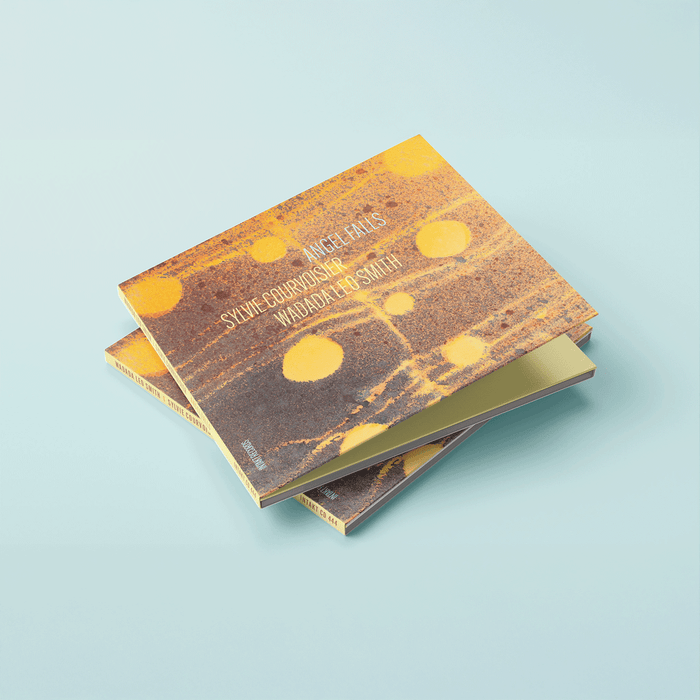
444: SYLVIE COURVOISIER – WADADA LEO SMITH. Angel Falls
Intakt Recording #444/ 2025
Wadada Leo Smith: Trumpet, Composition
Sylvie Courvoisier: Piano, Composition
Recorded and mixed on October 12, 2024, at Oktaven Audio, Mount Vernon, NY, by Ryan Streber.
More Info
Swiss pianist and composer Sylvie Courvoisier has been a defining figure on the contemporary jazz scene for 20 years and is at the epicentre of the New York music scene. Having just been awarded the prestigious Swiss Grand Prize for Music 2025, she now presents her duo album with the legendary Wadada Leo Smith. This follows the recent acclaimed release of her solo album To Be Other-Wise and the atmospherically multi-layered sextet album Chimaera. An exceptional musician, Smith is always at the pulse of the times, celebrating musical diversity and creativity and speaks out against any labelling of his work. He has helped shape the development of music in various contexts over the last 50 years. Angel Falls exudes the magic of musical freedom, possesses an astonishing immediacy, and has a captivating sense of dazzling sound architecture. “They both sound great. They complement each other without resorting to obvious moves. There is no ‘comping’, no showmanship, just a constant feeling of continuous calibration, quirky elements that are somehow perfectly balanced. How do they do it?” writes John Sharpe in the liner notes. A musical experience!
Album Credits
Cover and Booklet Art: Sophie Bouvier Ausländer
Graphic design: Paul Bieri
Liner notes: John Sharpe
Photo: @Ogata_Photo
All compositions by Sylvie Courvoisier and Wadada Leo Smith (SUISA, ASCAP). Published by Sylvie Courvoisier Music (ASCAP) and Kiom Music (ASCAP). Recorded and mixed on October 12, 2024, at Oktaven Audio, Mount Vernon, NY, by Ryan Streber. Mastered in January 2025 at Skye Mastering by Denis Blackham. Recording produced by Sylvie Courvoisier, Wadada Leo Smith. CD produced by Intakt Records, P.O. Box, 8024 Zürich, Switzerland.
ANY jazz listeners have affirmed, that in the long wake of the John Coltrane Quartet, the foursome that has since most touched their brilliance is the English quartet, Mujician. Composed of the Bristolian pianist Keith Tippett, the south London tenor and soprano saxophonist Paul Dunmall, Luton-born seven-string bassist Paul Rogers and the Shropshire drummer, Tony Levin.
Between 1990 and 2005 they waxed six memorable albums on the US Cuneiform label, but now a triple CD has been created by Jazz in Britain, recorded from concerts in Cheltenham (1993), Vienna (2003) and Birmingham (2010). It is a beautiful sonic triptych called Mujician in Concerts, with the four members playing at their unified peak.
Sometimes haunting and hymnal as if coming from ancestral spirits — as in the opening message of Dunmall and Tippett in Cheltenham, othertimes rhapsodic and joyous: “We never spoke about the music beforehand,” declared Dunmall, “we just walked on stage and trusted in the music and each other.”
Rogers is a virtuoso bassist like no other, playing an instrument like no other, and Levin’s sense of time and moment is deeply empathetic, knowing instinctively the musical minds of his quartet-mates. Tippett and Levin are gone, but thanks to devoted and skilled travelling recordists, Andy Isham and Steve Trent, these long and precious musical instants are still with us, throbbing with life and artistry.
Between 1959 and 1970, Washingtonian tenor saxophonist Charlie Rouse (1924-88) was the featured horn of Thelonious Monk’s Quartet, and his husky, quasi-adenoidal tone became the companion sound to Monk’s genius melodies and “brilliant corners.” But he showed another sphere when he recorded Cinnamon Flower in 1977, an album full of sounds of Brazil. The new reissue on Resonance Records includes this release with some overdubbing, plus the tracks in their undubbed, original form.
So we have a Latin feast of Rouse with Brazilian compadres trumpeter Claudio Roditi, pianist Dom Salvador and drummer Portinho, plus the great Michigan-born bassist Ron Carter, late of the Miles Davis Quintet. Rouse is joyous, in another element, on Cinnamon Flower, buoyed up by a relentless rhythmic upsurge and melodic beauty, for example on Desencontro (Disenchantment), and his notes leap up blissfully on Alvorada. It’s a powerful reissue, racked with elation and flair.
The great Mississippi-born trumpeter Wadada Leo Smith is 84 this year, but it hasn’t curtailed his mighty breath. His new album is Angel Falls (Intakt Records), partnered with the Swiss pianist Sylvie Courvoisier, whose pianism he describes as “advancing as if she’s going there to save creation.” In the destructive era of Trump and Musk that is certainly what they are both doing, with power and beauty too. Wadada’s horn talks fire and Courvoisier’s keyboard words make a palaver of freedom. No wonder one track is called Sonic Utterance, for that is what the entire album is.
Finally there is the burning saxophonist of Canterbury, the late Tony Coe. In 1977 his quintet, Axel, recorded the tracks of What Say We Play Today? (Jazz in Britain Records) at the Camden Jazz Festival. It’s taken 48 years, but now it’s there for us.
Pianist Gordon Beck, guitarist Phil Lee, bassist Chris Laurence and drummer Bryan Spring join Coe for a gripping performance, with the final title track reaching 28 minutes. Throughout, sheer musicianship excels, with the luminous, underrated Lee taking on the prominence of a second horn, and Coe playing clarinet, bass clarinet, soprano and tenor saxophones as if he were born to each. The fivesome create their own inventive sound, driven by uniqueness.
https://morningstaronline.co.uk/article/best-2025-jazz-albums
Pianist Sylvie Courvoisier teams up with trumpeter Wadada Leo Smith for a collection of duets composed by the pair, seemingly on sight, judging by the spontaneity of the tunes. Smith has an immediately identifiable tone, strong and clear, and expresses it in a variety of ways here. He goes ito subtones around the pouncing chords on ”Sonic Uttereance” and squeezes out ideas like spitting out grapefruit seeds on ”A Line Through Time”. A muted horn gets Miles Davisy on “Whispering Images’ while he slurs and sputters around Courvoisier’s eerie twinkles during “Kairos”. Courvoisier probes darkly with the strings during “Ol’upnea and Lightning” and tinkle tinkles like a star under Smith’s popping declarations of “Vireo Bellii”. Musical volleys.
https://jazzweekly.com/2025/12/sylvie-courvoisier-wadada-leo-smith-angel-falls//
Putting the Accent on the 2
Piano and trumpet is not a common jazz format, though it draws a prestigious lineage back to the 1928 Louis Armstrong/Earl Hines matchup "Weatherbird." The best trumpet-and-piano duos here, however, range far from tradition.
One is Angel Falls (Intakt; ★★★½; 59:17) by Swiss pianist Sylvie Courvoisier and trumpeter Wadada Leo Smith. The album features eight succinct, vitally engaging pieces that, per the title, often recall the architectural natural beauty Smith explored on his album America's Natural Parks. Both players draw from large vocabularies, the trumpeter coursing through clarion calls, stutters, multiphonics, squirts, smudges, chortles and harmon-muted sighs and Courvoisier preparing the keyboard, sometimes sounding like a marimba or tinkling glass, and playing inside and outside the piano box. Silences and space define the music as much as the sounds it encloses. "Olo'Upnea And Lightning" manages both grandeur and delicacy. Minor and blue, "A Line Through Time" hangs in space, and "Vireo Belli" invokes the chattering bird of its namesake.
Sylvie Courvoisier & Wadada Leo Smith
Angel Falls
Intakt CD444 (CD, DL)
★★★★ EDITOR'S CHOICE
Sylvie Courvoisier (p) and Wadada Leo Smith (t). Rec. 2024
Trumpeter Wadada Leo Smith has had significant pianist-duet partners in Amina Claudine Myers, Anthony Davis and Vijay Iyer – and now Swiss legend Sylvie Courvoisier joins that illustrious list.
As two artists who are at a 'later years peak', with each producing excellent work in many settings, Courvoisier and Smith sound entirely assured and receptive as they probe their way through a set that excels for both the breadth of ideas as well as the skill of execution.
On one hand the understatement, or rather strength of subtext, of a piece such as 'Whispering Images' is notable. Courvoisier's opening tremolo is like a ripple under Smith's muted cries, together evoking a vividly outdoor space but the arrival of offbeat string plucking and gravelly chords slant the atmosphere towards something dreamily sub-aquatic.
On the other hand, the variety of tempo and attack on 'Naomi Park', where the eighth and sixteenth motifs splutter and spurt, lends a rousing vigor to stop time traditions, while Courvoisier's independence of left and right hand lines simply adds to the structural whirlwind.
Electronic effects and prepared piano rustlings are deployed with finesse on occasion, bringing imaginary wind chimes into the air, but a single open note from Smith or a stark, densely voiced chord from Courvoisier are enough to bring intense emotion and grand virtuosity into alliance. Captivating music by two modern masters.
SYLVIE COURVOISIER/ WADADA LEO SMITH
ANGEL FALLS
Intakt
In einer gerade veröffentlichten Studie des Max-Planck-Instituts heißt es, musikalische Schönheit werde auf dreierlei Weise erlebt: als ruhige Ergriffenheit, freudige Erregung und gespannte Erwartung. Ob das Phänomen damit angemessen erfasst ist, sei dahingestellt, aber mit dem Ergebnis lässt sich etwas anfangen. Zum Beispiel kann man jetzt mit gutem Gewissen behaupten, bei der Begutachtung von Sylvie Courvoisier und Wadada Leo Smith handele es sich um schöne Musik reinsten Wassers. Die acht Titel sind emotional bewegend, auf stille Weise aufregend, und sie ziehen einen in ihren Bann, wie es eben nur schöne Dinge vermögen.
Das Ergreifende, dabei völlig Unsentimentale dieser im Studio improvisierten komponierten Musik ist nicht auf kurze, herausragende Episoden begrenzt; wer darin nach den berühmten »schönen Stellen« sucht, auf die auch die wissenschaftliche Studie fokussiert, wird sie entweder nirgends finden oder im Ganzen, also in jedem einzelnen Moment – eine wunderbare Stunde lang.
Auf Courvoisiers erst kürzlich veröffentlichtem Duo-Album »Bone Bells« hat man zumeist den Eindruck, als würden ihr Klavier und Mary Halsersons Gitarre zu einem einzigen, neuartigen Instrument verschmelzen. In der Kooperation mit Smith ist die Verbindung von anderer Art. Die Individualität
und Spontaneität der beiden Instrumentalstimmen bleibt jederzeit vollständig erhalten. Smiths pointiertes Trompetenspiel, das heute so kraftvollmelancholisch glänzt wie vor fünfzig Jahren, und Courvoisiers sublime Virtuosität, die keinen überflüssige Ton zulässt, begegnen einander in Freiheit und wechselseitiger Anziehung. Hier treffen sich zwei Seelenverwandte, die jeden flüchtigen Augenblick zu einem besonderen musikalischen Erlebnis machen. Dass das schön anzuhören ist, versteht sich auch ohne Max-Planck-Studie.
Dissonance. Abstraction. Tonal clusters. Flurries. Rolling ostinatos. Ornate and defiant piercings. These are some of the various musical elements of Angel Falls, a striking masterpiece of space and sound generated by two of the best – the legendary Mississippi-born Wadada Leo Smith on trumpet (now 83) and the always fascinating Swiss pianist Sylvie Courvoisier. The duo draws on a range of influences and idioms to construct their tone poems. From the formal classical side, one can hear degrees of impressionism, Messiaen abstractions, and Charles Ives. Then there are bouncy, jagged blues passages (the ending of “Naomi’s Peak”) and of course plenty of improvisatory and experimental jazz.
From this diverse palette, Smith and Courvoisier deliver striking and challenging explorations that boggle and intrigue. To illustrate, listen to the album’s longest piece, “Angel Falls” and its shortest piece, “Sonic Utterance.” On “Angel Falls,” Courvoisier creates a dissonant barely audible opening by stroking the inside of the piano. The duo proceeds to fashion a dark meditative impression that evolves into a rolling stormy motif. Smith always finds just the right note to craft his reflective mood while Courvoisier goes from pianissimo to forte on the keys in short order, creating sparkling color and deep textures. Both explore the highest and lowest notes on their respective instruments – creating a sense of awe, yearning, and other moods and expressions. There is a point where Courvoisier constructs a full-blooded harmonic maelstrom and Smith responds with hard blowing high notes to produce dramatic effect. The soul-searching continues, as Courvoisier’s passages build into a cliff like peak underneath Smith’s sostenuto responses.
On “Sonic Utterance,” Courvoisier generates precise jarring attacks with tonal clusters while Smith demonstrates his breathing technique, uttering low volume blues phrases above Courvoisier’s back and forth splashes. The music alternates between peaceful interludes and explosions until Courvoisier develops a wandering, repeating motif underneath Smith’s muted trumpet. A roller coaster ride ensues, and Courvoisier really brings it towards the end – with fierce abstractions that seem to explode off the keys like fireworks.
The high degree of formalism found on Angel Falls does not detract from the spontaneity and openness found within the music. It enhances it, giving the music the foundation necessary to develop and explore impulsively and creatively. Art can be representative and exist beneath conscious reality. And this album most certainly is a work of art. Enjoy!
https://www.freejazzblog.org/2025/11/wadada-leo-smith-sylvie-courvoisier_0534141353.htmll
Last quarter of the year and the top seeded players enter the court: Sylvie Courvoisier and Wadada Leo Smith together on Angel Falls, out for Intakt Records. Should someone need to get acquainted with these two Aces, the simple, right move to be done is to check the Free Jazz Blogs’s past pages where both of them are hugely covered, especially Stef’s peerless reviews of Wadada, making him the Supreme Cantor of the trumpeter. For what is worth, our cups of tea are America along with the late Jack DeJohnette and Sacred Ceremonies with Milford Graves and Bill Laswell but get what you prefer, even by chance, and after a couple of notes it will be perfectly clear for you that the trumpet of our 84 years old hero is a prism refracting the sound, opening sonic worlds or better to say, sonic galaxies. Madame Courvoisier, Swiss born and New York based, for the sake of our sheer, infinite pleasure, delivered in the last years a body of astonishing music, showing to old and new listeners her palette of piano ammunitions, be alone (To be other-wise), with her trio (Free Hoops), with Mary Halvorson (Bone Bells) or in a larger ensemble such as Chimaera, an absolute 2024 masterpiece that sees Sylvie teaming up with Wadada, Nate Wooley, Christian Fennesz, Drew Gress and Kenny Wollesen.
The pianist and the trumpeter first played together in 2017 at a concert organized by John Zorn and as Courvoisier recalls: “Right after he asked me for my number and a couple of months later we did a recording in New Haven, in trio with Marcus Gilmore”. The outcome of that session has yet to see the light of the day but there have been regular collaborations since, including further trios with drummers Kenny Wollesen and Nasheet Waits, a Smith ensemble with two pianos. Given the love of Wadada for duos with piano (see the works with Vijay Iyer, John Tilbury, Angelica Sanchez, Aruan Ortiz and Amina Claudine Myers), and his admiration for Sylvie (“Whenever I’ve played on stage with her, it’s always been a journey that has been mutual and creative. She’s got courage and you can see it when she’s at the piano, when she is inspired to go toward something, she doesn’t just go near it, she advances as if she’s going there to save creation”, from the liner notes) it wasn’t a matter of “If” but of “When” the two would have entered a studio together. This happened in October 2024 at Octaven Audio, Mount Vernon, NY for an output of 8 magnificent compositions that sound as the perfect epitome of such top notch musicians. Wadada spacious notes don’t hide their blues roots, while Sylvie combined upbringing of classical and jazz studies allows her to draw sonic textures that are a real, unmatched trademark; together they’re building a shadowplay of sounds, designing perfectly balanced geometries around and dissolving them into the fire soon after.
As per the creation process of the album, let’s listen to what Courvoisier says in the liner notes: “We just played right through exactly the order of the CD and exactly the amount of music on the CD, with no edits. We probably did that in two hours and after we mixed it. The same day we recorded and mixed. We started at noon and at 5 pm it’s finished”. Are you thinking about a labour of genius? We are, too. It’s absolutely interesting to read Smith in the liner notes about the composition process: “In composing, you got the inspiration that comes to you as you construct the page. That inspiration comes throughout the process, even if it takes 5 years or 27 or 37 years to complete it. It comes off and on throughout that process. In a performance the same thing happens. The difference is that in performance you’re allowing those moments of inspiration to come directly through”. This record delivers all that and more and we let Sylvie conclude about the chemistry they’ve been able to create together: “With Wadada I feel we’re creating in the moment and I feel something very joyful. We’re like kids discovering things. I feel I can hear harmonically where he wants to go. Basically, I try to erase myself and try to make him sound great”. And there is still someone wondering why this music is floating in our bloodcells…
https://www.freejazzblog.org/2025/11/wadada-leo-smith-sylvie-courvoisier.htmll
Wadada Leo Smith likes duets with pianists. He's performed and released albums with this format for many decades, and with great success, and with great musicians: Vijay Iyer, Matthew Goodheart, Angelica Sanchez, John Tilbury, Tania Chen, Amina Claudine Meyers.
Swiss pianist Sylvie Courvoisier adds her own touch to Smith's music. Both musicians performed for the first time together in 2017, at a concert organised by John Zorn. Several unissued performances followed, in duos, trios or with two pianos. Of course, Smith is one of the two trumpeters on Courvoisier's brilliant "Chimaera".
Courvoisier's natural feeling of creating mysterious yet gentle sounds match perfectly with Smith's jubilant spiritual tone. On "Whispering Images", she adds an unexpected rhythm with muted piano strings, and a bluesy theme that reminds of "Chimaera". It gives me goose bumps.
Despite the incredible quality of the music and its beauty, it was recorded in one take: “We just played right through exactly the order of the CD, and exactly the amount of music on the CD, with no edits. We probably did that in two hours. And after, we mixed it. The same day we recorded and mixed. We started at noon and at five p.m. it’s finished.” says Courvoisier in the liner notes. It makes the whole process sound cheap and sloppy, yet the exact opposite is true. It says a lot about the skills of the artists, their natural symbiosis and the authenticity of their music: there is no need to change anything if it comes straight out of your very nature, if it flows organically and spontaneous, as it does here.
The title, "Angel Falls" refers to the world's highest waterfall in Venezuela, but it of course also has a double meaning of a falling angel.
Smith has always refused to be boxed into any musical category or genre, and so is Courvoisier: it's classical, free music, expansive and intimate, deeply human but with a level of abstraction that holds the compositions together. Neither Smith nor Courvoisier are iconoclasts or real avant-gardists, preferring a welcoming sonic environment that has deep roots in many musical traditions, yet lifting to a level rarely heard before.
What they present us here, is again among the best things I've heard this year.
https://www.freejazzblog.org/2025/11/sylvie-courvoisier-wadada-leo-smith.htmll
Szwajcarska pianistka i kompozytorka Sylvie Courvoisier od ponad dwóch dekad jest jedną z najważniejszych postaci współczesnego jazzu i znajduje się w samym centrum nowojorskiej sceny muzycznej. Właśnie otrzymała prestiżową Szwajcarską Nagrodę Główną Muzyki 2025, a teraz prezentuje swój najnowszy album nagrany w duecie z legendarnym Wadadą Leo Smithem. Album „Angel Falls” jest to kontynuacja koncepcji znanych już w solowego albumu „To Be Other-Wise” oraz nastrojowego, wielowarstwowego albumu sekstetu „Chimaera”.
Sylvie Courvoisier jest pianistką, kompozytorką oraz znakomitą improwizatorką. Urodzona w Lozannie w Szwajcarii, w 1998 roku przeprowadziła się do Nowego Jorku. Koncertowała i nagrywała z Johnem Zornem, Wadadą Leo Smithem, Joey’em Baronem, Ellery Eskelinem, Natem Wooley’em, Fredem Frithem, Yusefem Lateefem, Timem Berne, Joëlle Léandre, Erikiem Friedlanderem, Butchem Morrisem, Tony’m Oxley’em, Herbem Robertsonem, Tomaszem Stańko oraz z Ikue Mori i Susie Ibarra (w trio Mephista). Pianistka zrealizowała kilkanaście autorskich albumów oraz kilkadziesiąt jako artystka zapraszana do projektów innych muzyków. Jej nagrania znajdują się zarówno w katalogu ECM Records, Tzadik Records (Johna Zorna), jak i szwajcarskiej oficyny Intakt Records. Jest najciekawsze sesje to m.in. „Time Gone Out” – duet z Markiem Feldmanem, „D’Agala Sylvie Courvoisier Trio”, „Crop Circles”- duet z Mary Halvorson, „Miller’s Tale”- kolektywny kwartet z Evanem Parkerem, Ikue Mori i Markiem Feldmanem, „Salt Task” – trio z Chrisem Corsano i Natem Wooley’em. Od 1998 roku Sylvie Courvoisier regularnie występuje solo lub w duecie ze skrzypkiem (i mężem) Mark’em Feldmanem. Od 2013 roku jest liderem własnego Trio z Drew Gressem (kontrabas) i Kenny’m Wollesenem (instrumenty perkusyjne). Album „D’Agala Sylvie Courvoisier Trio” został doceniony przez krytyków i znalazł się na listach najlepszych albumów roku New York Times i Los Angeles Times. Pianistka jest także współliderem Sylvie Courvoisier/Mark Feldman Quartet ( z Drew Gressem i Tomem Rainey’em), VWCR Quartet (z Kenem Vandermarkem, Natem Wooley’em i Tomem Rainey’em) oraz TISM Quartet z Tomem Raineyem, Ingrid Laubrock i Markiem Feldmanem. Od 2017 roku gra także w duecie z Mary Halvorson a od 2000 roku jest członkiemMephista– improwizującego kolektywnego trio z Ikue Mori i Susie Ibarra. Sylvie Courvoisier regularnie występuje w wielu zespołach i projektach kompozytorskich Johna Zorna, takich jak, „Cobra and the Masada” oraz „Bagatelle Marathon”. Od 2010 roku jest pianistką i kompozytorką w projekcie „La Curva” tancerza flamenco Israela Galvana, z którym zrealizowała ( w 2018 roku) „Cast-aNet” – z Evanem Parkerem, Markem Feldmanem i Ikue Mori a w 2020 roku „La Consagración de la primavera” z Cory’m Smythem, wykonując „Święto wiosny” Igora Stravinky’ego i autorskie „Spectro” na dwa fortepiany i taniec.
Legendarny Ishmael Wadada Leo Smith jest jedną z najbarwniejszych i najważniejszych postaci improwizowanego jazzu. Ostatnie lata to najpiękniejszy okres w życiu charyzmatycznego artysty, który jest ozdobą najważniejszych festiwali, realizuje ciekawe projekty oraz nagrywa albumy dla prestiżowych oficyn ( od ECM po Intakt i TUMI). 83-letni Wadada Leo Smith to artysta niezwykle aktywny, współautor sukcesów i wspaniałych nagrań Mariona Browna, Anthony’ego Braxtona, koncertów z Donem Cherrym, Cecil Taylorem, Lesterem Bowiem, Johnem Zornem, Charliem Hadenem, Jack DeJohnette, Billem Laswellem. W swoim dorobku ma ponad 60 albumów nagranych dla najbardziej liczących się wytwórni. Większość sesji to rodzaj specyficznych suit i utworów budowanch impresjami i skojarzeniami z muzyką wielkich free-jazzu oraz nowoczesnych, harmolodycznych improwizacji.
Jak odległa jest dzisiaj muzyka Wadada Leo Smith’a od harmolodic-jazzu Colemana trudno definitywnie określić. Zdaje się, że rozgrywa się także i teraz w blasku brzmień albumu „Angel Falls” bowiem Wadada Leo Smith to jedna z najbarwniejszych i najważniejszych postaci improwizowanego jazzu. Jest niezwykle aktywnym muzykiem chicagowskiego AACM, improwizatorem, kompozytorem, trębaczem, multiinstrumentalistą, etnomuzykologiem, działaczem na rzecz praw człowieka Ostatnia lata to najpiękniejszy okres w życiu kontrowersyjnego artysty: jest ozdobą najważniejszych festiwalu, realizuje ciekawe projekty oraz nagrywa albumy dla prestiżowych oficyn. Ten wyjątkowy muzyk, zawsze podąża za duchem czasu, celebrując muzyczną różnorodność i kreatywność, a także sprzeciwiając się wszelkim etykietkom. W ciągu ostatnich 50 lat przyczynił się do rozwoju muzyki w różnych kontekstach. Album „Angel Falls” emanuje magią muzycznej wolności, zdumiewającą bezpośredniością i urzeka olśniewającym zmysłem architektury dźwięku.
„ Angel Falls” jest sesją, w której arcymistrz Wadada Leo Smith, wspomagany i podżegany przez żarliwą ciekawość Sylvie Courvoisier angażuje słuchacza jako aktywnego twórcę prawdziwie błogiej, pięknej muzyki. To magia, która nie zdarza się czę...
Incredibly, trumpeter Wadada Leo Smith is 84 this year. I caught him recently in a duo with Swiss pianist Sylvie Courvoisier at Vilnius Jazz on his final European tour- an amazing gig which is fully reflected in this superb release by lntakt. The two are partners in the fullest musical sense - no comping, no showboating, just pure improvisational brilliance.
Smith emerged in the late 1960s, as an original voice on trumpet alongside Anthony Braxton. Later he was a central figure in the AACM. I recall his inspirational thoughts in a pamphlet from that time, where he offered what amounted to a Romantic ideal of improvisation, with the musical idea fixed in advance of its expression. Sylvie Courvoisier was born in Lausanne, Switzerland, and moved to New York in the 1990s, becoming a force on John Zorn's Downtown scene. A highly individual stylist, she met Smith during a 2017 concert curated by Zorn, and the trumpeter appeared on Courvoisier's Chimaera in 2023, alongside Christian Fennesz and others.
On Angel Falls, Courvoisier and Smith respectively alter their sound via piano preparations or trumpet mutes. Smith belongs to the contemporary jazz trumpet tradition that flows from Miles Davis's melancholic approach, and his tone is beautifully cloudy when muted. On open trumpet he's full and clear, with no loss of power into his eighties. The programmes of concert and album overlap. "Naomi Peak" features furious pummelling and glissandos. "Whispering Images" is entropic, almost nihilistic. The long, dramatic and haunting title track is beautifully paced. The album closes with the ethereal "Kairos", featuring luxuriant piano preparations and voicings that gesture towards Messiaen.
Like his contemporary Braxton, Wadada Leo Smith is prolific. I find his jazz work more impressive than his classical compositions. As a jazz soloist his playing is rich, expressive and lyrical, and the magical extended dialogue of Angel Falls is album of the year material.