

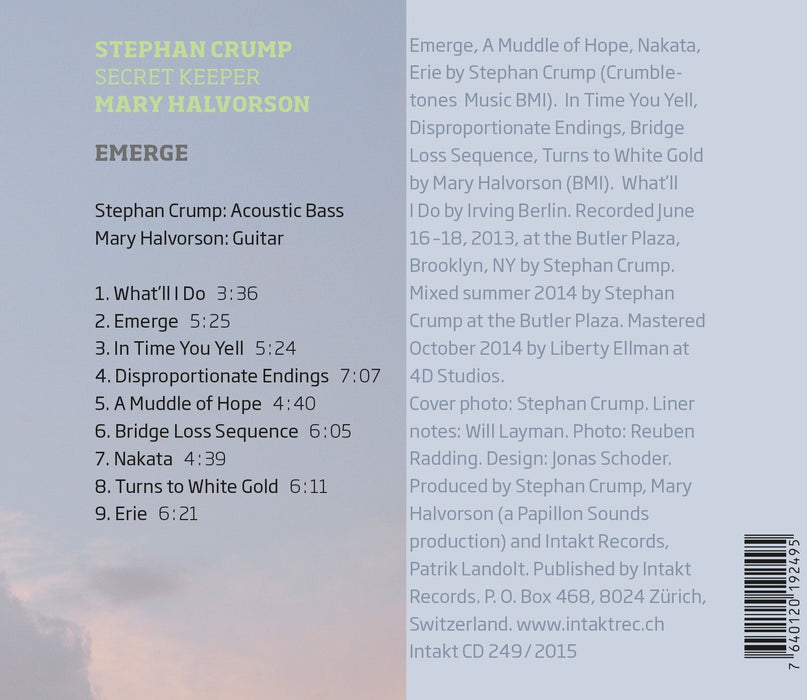

249: STEPHAN CRUMP – MARY HALVORSON – SECRET KEEPER. Emerge
Intakt Recording #249 / 2014
Recorded June 16-18, 2013 at the Butler Plaza, Brooklyn, NY.
Original price
CHF 12.00
-
Original price
CHF 30.00
Original price
CHF 30.00
CHF 12.00
-
CHF 30.00
Current price
CHF 30.00
More Info
Album Credits
J
Et une troisième pour Mary Halvorson, en duo “intimiste” avec le contrebassiste Stephan Crump. Les compositions de l’un ou de l’autre, très contemporaines, se remarquent par leurs qualités mélodiques. Grâce à son utilisation très fine et mesurée de l’amplification, la guitare, sous les doigts de Mary Halvorson, est parmi ce qui se fait de mieux sur l’instrument à l’heure actuelle (avec Joe Morris) : « Secret Keeper »
http://www.culturejazz.fr/spip.php?article2855

S
Fresh sounds from an atmospheric post- rock influenced New York duo of Vijay lyer bassist Stephan Crump and quirkily experimental guitarist Mary Halvorson.

A
Secret Keeper, the duo of acoustic bassist Stephan Crump and electric guitarist Mary Halvorson, started working together about four years ago and released Super 8 (Intakt) in 2012. While that disc empha- sized their spontaneous inclinations in an atypical duo format, Emerge highlights how this musical pairing has evolved together and apart during the past three years.
The big advances on Emerge are the compositions themselves, all but one of which is a Crump or Halvorson piece. On Super 8, mostly brief statements were combined into three thematically linked sections. Here, each tune is more developed, and these structures are ideal for their quietly far-reaching improvisations. But, surprisingly, Emerge begins with the duo's interpretation of Irving Berlin's "What'll I Do." On this opener, Halvorson's bent notes echo lap steel guitar, but her staccato charge is all her own, as is Crump's warm tremolo response. Her remarkable sense of dynamics shape "In Time You Yell" and "Bridge Loss Sequence." She and Crump also emphasize tension, as much as close harmony, and gradually ease into her quietly frenzied solos. While those flights are immediately noticeable when she's in the upper range, what becomes more striking on repeated listens is how consistently clean her lines are-distortion is not a necessary part of her arsenal. Likewise, even her disjointed strumming on "Turns To White Gold" never loses its adherence to the melody. With Secret Keeper making such a leap between these two discs in such a short time, Crump and Halvorson always sound like they're planning a few steps ahead.

P
The concert for Secret Keeper's latest recording Emerge was at the Cornelia Street Cafe - and down in the cozy basement club space, it felt a bit like being in on a well kept secret itself. It was an intimate show as the duo of guitarist Mary Halvorson and bassist Stephen Crump captivated the attentive crowd for the evening.
Emerge is the pair's second recording under the name Secret Keeper and it is a another great example of their sympathetic and telepathic playing. The duo delivers composed and intricate melodies, with nice balanced counter motions, but they also surprise by suddenly throwing caution to the wind and diving into some aggressive passages.
The opener "What'll I Do" begins tentatively, Crump provides a loose foundation and Halvorson slowly drops musical pieces into place. They are building up to something: the squiggles of guitar and the bass runs become stronger and the music denser as the track continues. 'Emerge' starts big with vibrant chords and melody from the guitar and deep sells from the bass and 'In Time You Yell', things become agitated and the playing heavier. Halvorson leans on her inner rocker and uses power chords and purposeful slashing strumming before quickly pivoting to pointy arpeggiated lines and unusual chord voicings. Meanwhile Crump is a often a grounding element, providing a base that sometimes just cracks wide open.
This is a keeper of an album, literally dripping with atmosphere.
https://www.freejazzblog.org/2015/06/secret-keeper-emerge-intakt-2015.html

D
Secret Keeper has served as a collective sobriquet for bassist Stephen Crump and guitarist Mary Halvorson’s musical activities together for the last several years. Independently, the two remain among the busiest New York-based improvisors in the business. Crump holds a standing post in pianist Vijay Iyer’s trio and was a founding member of the Rosetta Trio with guitarists Liberty Ellman and Jamie Fox. Halvorson’s credits continue to accumulate at a near-exponential rate under her leadership and in the company of regular associates like Tom Rainey, Ingrid Laubrock and Marc Ribot. Both musicians are experienced in the art of spontaneous dialogue, a shared affinity that found a wider audience in the spring of 2013 via Super 8, their first record together and a thoroughly improvised affair.
Emerge continues the conversation where the pair left off, but this time in a decidedly more tuneful and composed direction developed in part through a series of concert performances undertaken in the interim. They begin with a rendering of Irving Berlin’s “What’ll I Do” with Halvorson torquing the pitch of her strings like sorghum taffy to keep things from sounding too circumspect. That extreme malleability can sometimes be disorienting as during her dizzying lead on “A Muddle of Hope”, but Halvorson dials down the effect in service of the melody when needed. Crump’s sound is more consistently conventional by comparison, a ripe, woody, resonant boom when plucking and a precise, glissando-rich texturing when brandishing bow. The pieces here may conform closer to the parameters of discrete compositions, but carefully parceled space and silence are just as important to the proceedings.
Documented in Crump’s home studio, the music radiates both immediacy and intimacy. On the Berlin-penned ballad the gentle percussion of rainfall is clearly audible in the background as environmental accompaniment. Four pieces from each of the musicians follow in an interspersed sequence. Sudden stops and slight miscues are discernable on occasion in the interplay, but rather than being redacted by Crump in the post-recording mix they remain indelible parts of the performance. Each player gives over to preserving a personalized sound throughout, Halvorson pulling a variety of warble-etched progressions from her Guild hollow body and Crump releasing thick, rhythm-infused ribbons around her. A loping elastic groove that materializes on the tail-end of the title piece signals a thematic about-face and they even find the occasion to rock out as on the vapor-trail tangled freakout that erupts in the final minutes of “Turns to White Gold”. Different still, the tinkling timbral icicles that coalesce at end of “Erie” touch on the sublime.

A
There's no other electric guitarist working in creative music anywhere in the world right now who is as instantly recognisable as Mary Halvorson. In these spare and economical duets with bassist Stephan Crump, her technique is laid bare and open to scrutiny: by applying elastic swoops and smears, neatly plucked notes are blurred and bent into microtonal shapes implying untapped universes of possibility. Sometimes it's even possible to hear two simultaneous soundings: the note struck cleanly with plectrum and its deformed twin, modified and slippery. Crump comes across as the straight guy but he's a master of extended arco techniques, rolling out rich, vibrating drones that ascend into high, teetering harmonics - while his deft pizzicato navigates territory bordering both sensitive chamber improv and more robust folk forms. The duo seem most concerned with subverting expectations instrumental, compositional and performative. It's nowhere more apparent than on their version of Irving Berlin's "What'll I Do" - twisted and warped like the Great American Songbook left out in the rain.

K
„Emerge" ist bereits die zweite Einspielung der amerikanischen Jazzgitarristin Mary Halvorson mit dem Bassisten Stephan Crump. Crump machte sich u.a. einen Namen als Bassist des Vijay Iyer Trios. Halvorson ist eine der meist beschäftigten und kreativ umtriebigsten jungen Musikerinnen der Ostküste. Sie spielte mit Anthony Braxton, Ingrid Laubrock und Marc Ribot, um nur einige zu nennen. Seit Jahren interessiert sie sich für die Kompositionen von Barney Kessel g oder Jim Hall. Selten hat man eine originellere Gitarre und einen ruppigeren Bass aneinander geraten gehört. Reibung scheint die Energie zu sein, aus der die beiden Repräsentanten einer jungen US-amerikanischen Jazzszene einen Funkenflug generieren, der als Erfüllung des Versprechens gelten kann: „Verschwende deine Jugend, aber verschwende sie nicht an eine Musik, die vorhersehbar ist!" Radikal die Offenheit mit der sich Bei- de aufeinander einlassen. Die Unerschrockenheit, sich ins Nichts fallen zu lassen. Was daraus entsteht „unerhörte Musik".

T
Secret Keeper nennt sich das Duo des Kontrabassisten Stephan Crump und der Gitarristin Mary Halvorson; „Emerge“ ist das zweite Album der beiden. Das erste war das Ergebnis spontanen Miteinander-Improvisierens, ein naheliegendes Prozedere bei der jeweiligen Entwicklung der beiden an die Speerspitze der neuen Frei-Spieler-Avantgarde der Brooklyn-Szene. Der 43-jährige Bassvirtuose lernte sein Handwerk zuerst bei einigen der großen Bebop-Legenden, dann bei zeitgenösischen Meistern und stürzte sich alsbald in das Abenteuer der vitalen neutönerischen New Yorker Szene. Halvorson, die zierliche, examinierte Jazzgitarristin mit der riesigen Full-Body-Gitarre, kommt aus der Free-Music-Schule und pflegt durchaus auch Progrock, Noise und andere Grenzüberschreitungen.
Das neue Secret-Keeper-Album ist jedoch alles andere als eine schrille Noise-Affäre. Halvorson und Crump wollten bewusst ein Album einspielen, das aus speziell für das Duo geschriebenen Kompositionen besteht, die im strukturierten Rahmen Raum für intime Dialoge lassen. In jeweils vier Eigenkompositionen ist ihnen das faszinierend gelungen; der zu Beginn vorgetragene Irving Berlin-Standard ist quasi als Hörerorientierung ganz in diesem Sinne eingerichtet. Die Klangästhetik steht bei diesem Unternehmen dezidiert im Vordergrund. Der Bass erklingt, ob gezupft oder gestrichen, ganz unverfälscht mit großem tiefreichendem Ton und verschränkt sich in einer Art freier Kontrapunktik mit den Gitarrenlinien. Die sind von einer fast lakonischen Langsamkeit und abgründig abstrakt schöner Akkordik. Diese wiederum korreliert mit Halvorsons speziellem Sound, der durch die Überlagerung des nah mikrofonierten Naturtons und den diskret Tonhöhen manipulierenden Delay-Effekten des Verstärkers entsteht. Eine bedächtige und entschlossene Freiheit atmet diese Gitarren-Musik, die erfrischend frei von Jazzklischees ist und eine neue Art des Gitarrenspiels definiert.

U
Von CD zu CD mehr festigt Mary Halvorson mehr ihren Ausnahme- status als aktuell wichtigste Erneuerin der Jazzgitarre. Dies zu tun, braucht es bei ihr nicht das aufgedreht Exaltierte, vielmehr genügt ihre Präsenz in diversen Konstellationen, denen sie mit ihrem viele Elemente von Wes Mongomery bis Derek Bailey zu etwas Neuem zusammenfügendem Spiel manchmal auch nur aus dem Hintergrund die Richtung gibt. Will man das Besondere ihrer Magie auf akustischen und E-Gitarren studieren, sind die in regelmäßiger Zusammenarbeit mit Kontrabassist Stephan Crump entstehenden Duoaufnahmen ideal. Eine intime Kammermusik hört man, die vornehmlich Eigenkompositionen sensibel um und um wendet in immer neuen Klangnuancen und Verfremdungen.

A
O duo de cordas Secret Keeper é um dos projetos mais interessantes em atividade que conta com a participação da guitarrista Mary Halvorson. A seu lado está Stephan Crump (baixo), com quem cria uma música de difícil definição, com seu ar camerístico marcado por muita improvisação e composições de harmonias intrigantes. Neste segundo registro da dupla, há momentos realmente desafiadores aos ouvidos, como “In Time You Yell”, “Nakata” e a incrível “A Muddle of Hope”.
http://www.freeformfreejazz.org/2015/06/play-it-again-novas-variadas.html

F
C’est sur une note étrange que débute Emerge, deuxième rencontre de la guitariste Mary Halvorson et du contrebassiste Stephan Crump. Un détail qui souligne la poésie intimiste nourrissant la discussion entre ces deux symboles de la scène new-yorkaise, déjà aperçue dans Super Eight, leur premier album, déjà pour Intakt Records : alors qu’ils enregistrent « What’ll I Do » (Irving Berlin), seule reprise d’un disque où les compositions sont à parité, la pluie se met à tomber dru à l’extérieur du studio, laissant filtrer un crépitement ininterrompu ; ce déluge impromptu lie en profondeur l’inimitable style serpentin d’Halvorson et l’intensité rugueuse de Crump, et emplit le studio d’un spleen voluptueux. Les tintements et échos de la guitariste rappellent la version de Chet Baker et façonnent à merveille cette atmosphère. Puis, lorsque l’archet la rejoint, on se surprend à écouter cette musique comme on trahirait quelques confidences, avec une curiosité attentive.
Une liberté de ton dont seuls peuvent se targuer les amis proches anime le duo Secret Keeper ; elle s’exprime par exemple sur comme « Nakata », morceau sur lequel on ne sait pas distinguer de prime abord quelles cordes sont caressées, jusqu’à ce que Crump prenne la parole par de robustes pizzicati. Le toucher d’Halvorson fait le reste, reprenant le thème ou s’entortillant chaleureusement autour de la contrebasse. Il ne faudrait cependant pas croire que tout est miel dans cette familiarité. Certains échanges ont la rudesse des franches camaraderies. « In Time You Yell », signé de la guitariste, en est l’illustration. Le jeu durcit soudain et le riff entêtant rivalise avec l’archet. C’est en de rares instants seulement qu’à vifs coups de pédale, Halvorson retrouve ces dissonances qui apportent du relief à l’ensemble.
Si Secret Keeper quitte parfois l’intime pas de deux pour des chicaneries soudaines (« Turns To White Gold », où l’électricité tutoie un rock aussi acide que fugace), c’est souvent aux marges du silence que se situe Emerge. L’univers est assez proche du trio de Crackelknob où Reuben Radding tenait également un rôle massif que la jeune femme venait éroder. La relation privilégiée de l’élève de Joe Morris avec les contrebassistes n’est plus à prouver, ses fréquentations allant de Michael Formanek (au sein de Thumbscrew) à John Hébert dans son septet. Celle qui unit Mary Halvorson et l’indéboulonnable membre du trio de Vijay Iyer paraît sans doute énigmatique et inattendue ; elle n’en est que plus sincère. Ce disque le confirme : il y a des secrets qu’il ne vaut mieux pas garder pour soi. Tendez l’oreille !
https://www.citizenjazz.com/Secret-Keeper.html

R
There are no points of reference for what this duo, Secret Keeper, is doing. You might say that the Jimmy Giuffre trio with Steve Swallow and Paul Bley come to mind in the absolute daring of their recordings and I think there were just three recordings by that iconic trio. Now Secret Keeper, with Stephan Crump and Mary Halvorson are, in fact, making music as audacious as that trio did and path-breaking as well. I don’t think that I will be returning to Jimmy Giuffre’s recordings in a hurry. I have to savour this record first. And I am besotted. Mary Halvorson’s technical command of the guitar and the contemporary improvised idiom is impressive. She understands the underlying rhetoric, musical textures and expressive power of its ornamentation practices. Stephan Crump is no less of a master of his instrument. This is manifested in his imaginative use of dynamics. His is an individual voice, whose ability to surprise the listener, at every turn, is remarkable. His pizzicato playing is sharp and angular. He makes use of colour in a most novel way and it shows in his magnificent arco playing.
The programme on Emerge, the duo’s second disc as Secret Keeper begins with “What’ll I Do”. Opening with a standard and that too one where surprise is the only constant throughout is a stroke of genius. Still nothing could prepare you for what’s in store from one track to another. Music for this duo seems to be like taking a figure that we have just heard and turning it on its head. Case in point: the Irving Berlin classic played a lot slower than any other version that I have heard and yet making it retain all of its tenderness. It’s nothing short of genius. From now on the listener can expect more exquisite work from this duo on this album. And they do not disappoint. Not in the least bit. Ms. Halvorson and Mr. Crump are simply astonishing from one song to the next. Triumphantly so. What a joy it is to hear mysterious pieces such as “Emerge” and “Bridge Loss Sequence” played by fine players such as these, scrupulously attentive to the music, the angularity of the idiom and with nimble technique. Even the more quirky pieces “In Time You Yell” and “A Muddle of Hope” become admirable little gems.
I have enjoyed individual discs by these artists and although Emerge is my first exposure to them as a duo, I find myself enjoying it enormously the more I listen to it. Mary Halvorson and Stephan Crump, the members of Secret Keeper parley with the familiarity of old friends. And yet their playing always retains the feeling that something brand new and exciting is happening every time they are together. Nothing is forced or overly mannered; song tempos, duo playing and balance – all seem effortlessly and intuitively right. The string sound from both guitarist and bassist is lucid and warm. These are, in sum, sincere and poised accounts, fitting tributes to the exciting and faultless character of composers and their music. A disc to die for.

M
Secret Keeper has built its aesthetic on what might be viewed as a contradiction. Stylistically, guitarist Mary Halvorson and bassist Stephan Crump have perfected the art of inhabiting different worlds simultaneously. The former's allegiance to the various forms of creative improvisation remain visible but blurred as her sound has morphed over time. The latter works along similar lines and both have been involved in more musical diversity than can be documented here. Consequently, when they present Irving Berlin's "What'll I Do" as the opening track on their sophomore disc, it is neither wholly unexpected nor predictable. As what sounds like rain in the background, adding a layer of homespun ambiance, the music emerges with a sense of quiet whimsy as it's almost plunderphonically dismembered. Halvorson's trademark pedal work and Crump's frenetic high-register bowing fracture the melody but sometimes present it as a warped mirror image, which almost slides into plain focus before shattering again.
The duo shares compositional credits throughout the rest of the disc, but they also bandy melody and harmonic implication back and forth with humorous dignity. Listen to them trading pointilisms on "In Time You Yell", Halvorson nodding toward bebop for good historical measure even as each tone's double skews the picture. Yet fun and games disappear for the beautifully chamber-like textures of "Disproportionate Endings". The players function as a unit, mirroring the other's subtlest dynamic shifts as the neo-Romantic melody slithers its serpentine way forward.
The recording is close but not claustrophobic, detailed in a way that brings out the harmonies implied by each note. "Nakata" rings with harmonic ramifications as Crump's Scott LaFaro-like sonorities support the intricate chords Halvorson lays down. Crump's overtones on "Erie" are just that and, again, the two instruments merge in the service of triads and unisons that may as well be interchangeable at strategic moments. This blues-inflected track ends an album as diverse as it is enjoyable. Such loose but precise music is difficult to execute well and the fact that the compositions are also uniformly excellent simply adds to the disc's overall effect.

A
Schon ihre Alben „Illusionary Sea" 2013 und Thumbscrew" 2014 ließen aufhorchen. Da wurde ihr Spiel allmählich greif- barer, ihre kreativen Prozesse verständlicher, ja, verbindlicher, ohne dass sie sich selber damit verraten hätte. Dann kam „Super Eight", das Debüt von „Secret Keeper", der zweiköpfigen Gesellschaft zur gegenseitigen Bewunderung von Bassist Stephan Crump und Gitarristin Mary Halvorson. Das war noch instant composing, freies Improvisieren. Dass beider Väter Architekten sind, scheint durchzuschlagen, der Sinn steht, zur Zeit, nach Komponiertem, Struktur, Form, mehr Kommunizierbarkeit.
„Emerge" bietet neun Duo-Stücken inkl. Irving Berlins „What'll I do" von 1924, von Sinatra später zweimal aufgenommen. Die anderen acht stammen fifty- fifty von Mary und Crump. Der Berlin- Song macht den Anfang, sie klingt, als würde sie Bottleneck, Jammerhaken und irgendwelche slack-key-Stimmungen einsetzen und Letztere ständig verändern. Viel Elektronik ist nicht dabei, mal einen Octaver o. ä.. Minimalismus, Witz und Humor regieren den Titelsong und das Gros der Gesamtpalette, ein paar gebrochene Akkorde, rhetorische lineare Wiederholungen überm keller-tiefen Kontrabass, im letzten Drittel ein paar Ausbruchsversuche, vielleicht Abstrahie- rungsprozesse. In time you yell" kommt ähnlich minimalistisch, aber weit span nender und dialogfreudiger: Beide Instrumente erlernen gemeinsam die Gram- matik des Miteinandersprechens. In „A muddle of hope" mutet Komponiertes improvisiert an, nicht, wie üblich, umgekehrt. Und kurz vor Schluss noch „Turns to white gold": Könnten Architekten Balladen malen, dann sähe diese hier aus wie ein kleines, schiefes Haus, das vom Hörerohr gerade gerückt und schön wird. Und man glaubt's kaum: Da stecken Ohrwurm-Qualitäten drin!

P
Die Art, wie Mary Halvorson ihr Gitarrenspiel m dem Pitch-shifting-Pedal zum Wimmern und Jau len bringt, ist so eigentümlich wie faszinierend. Un man beginnt zu rätseln, was genau diese halvorsor sche Eigenheit musikalisch auslöst und was daran irritiert. Das Ton-Bending verfremdet den he kömmlichen Flow eines Single-Note-Spiels, genau so wie es Zwischenräume schafft und auf eine fas charmante Weise das melodiöse Schweben de Tracks erweitern kann. Auch auf ihrem zweiten A bum setzen Stephan Crump und Mary Halvorso sofort auf einem hohen Verständigungslevel ei um aus dieser gemeinsamen Chemie heraus ei paar wunderbare Zwiegespräche zu führen. Nac der spontanen Begegnung auf dem ersten Albun liegen auf "Emerge" Kompositionen zugrunde, d das Duo griffiger und harmonisch bewusster ma chen. Wir hören eine geglückte Verbindung aus Ir tuition und Komposition, formalen Texturen un freiem Spiel, Neugier und Gelassenheit. Crump, de sonst mit Vijay lyer spielt, ist ein äusserst hellhör ger Bassist. Mit seinem erdigen und verankerte Spiel hält er Halvorson fast etwas im Zaum, auc wenn er nie einschränkt. Manchmal verhalten sic die Tracks wie karge Traumbilder zu einer flücht gen Realität. File under pitch jazz.
