
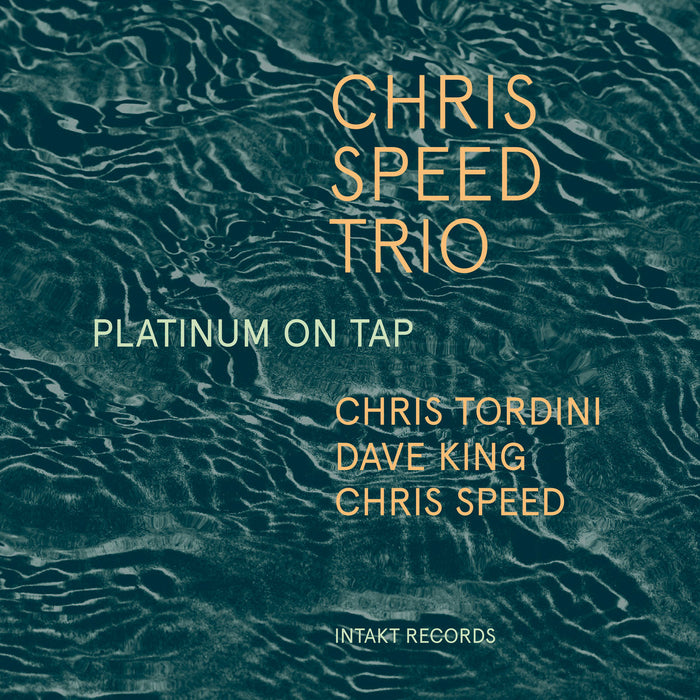
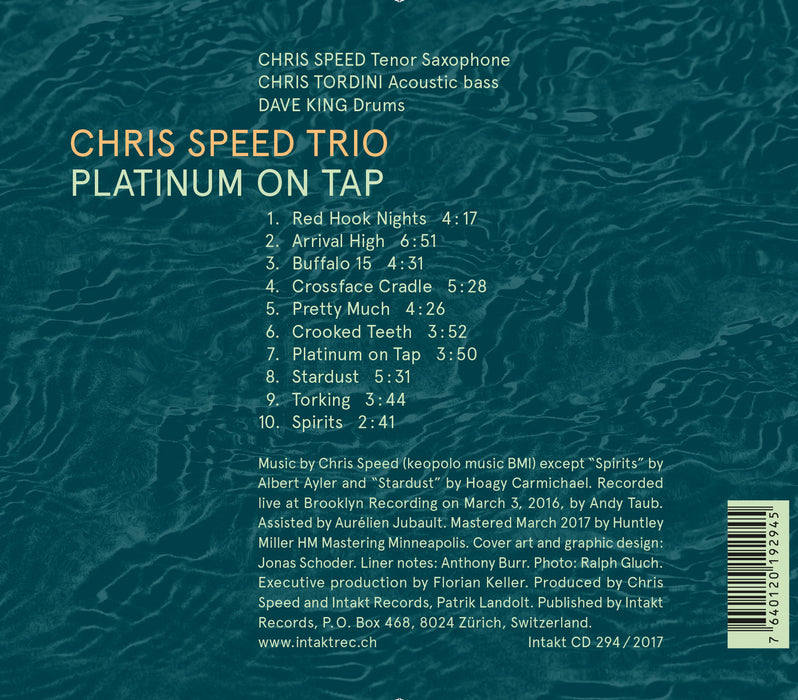
294: CHRIS SPEED TRIO. Platinum On Tap
Intakt Recording #294/ 2017
Recorded live at Brooklyn Recording on March 3, 2016, by Andy Taub.
Original price
CHF 12.00
-
Original price
CHF 30.00
Original price
CHF 30.00
CHF 12.00
-
CHF 30.00
Current price
CHF 30.00
More Info
Album Credits
A
Tenorsaxofonist Chris Speed kennt man vor allem als verlässlichen Sideman von vielen Kapazundern des zeitgenössischen Jazz, von Tim Berne bis Dave Douglas, von Myra Melford bis John Zorn. Dabei verfügt er über ein durchaus spannendes Oeuvre unter eigenem Namen. Jetzt ist bei Intakt die zweite CD seines Trios mit dem Bassisten Chris Tordini und Dave King am Schlagwerk erschienen. Die meisten Stücke sind von Speed, eines von Albert Aylers Spirit und ein anderes von Hoagy Carmichaels Stardust. Das ist vermutlich schon ein Hinweis, worum es Speed bei diesem Tonträger geht, um die Auseinandersetzung mit der Tradition. Ein wenig Respekt schwingt bei Platinum on Tap schon mit. Vieles erinnert an das klassische Trio von Sonny Rollins mit Oscar Pettiford und Max Roach aus der zweiten Hälfte der 50er Jahre. An sich keine üble Referenz. Was aber damals hochmodern war, klingt heute doch ein wenig brav. Dass gut und stimmig musiziert wird, ändert nichts daran, dass nach einigen Nummern die Sounds doch etwas ermüden.

M
Tom Rainey jest od prawie trzech dekad ważnym uczestnikiem nowojorskich zdarzeń na styku jazzu i awangardy ma na swoim koncie albumy m.in. z Timem Berne'em, Ingrid Laubrock, Markiem Feldmanen i Davidem Tornem. Ten doświadczony sideman przed ośmioma laty wydał pierwszą płytę jako lider własnego tria z Laubrock oraz Mary Halvorson. Mówił wtedy magazynowi „Jazz Times", że podjął się tej roli niechętnie, „kopiąc i krzycząc". Widać jednak, że zmienił podejście, bo od 2010 roku autorskich albumów wydał już pięć - trzy z triem oraz dwa z kwintetem Obbligato. Z tym ostatnim nagrał swoją ostatnią płytę „Float Upstream". W ramach kwintetu Rainey stawia sobie za zadanie przede wszystkim eksplorację standardów jazzowych. Na ich poprzednim albumie interpretowali m.in. In Your Own Sweet Way Brubecka, Reflections Monka czy Prelude to a Kiss Ellingtona. Tym razem ar- tyści wzięli na warsztat takie utwory jak Stella by Starlight Younga, What Is This Thing Called Love Portera i I Fall in Love Too Easily Styne'a.
Kolejna konwencjonalna odsłona evergreenów jazzu? Oczywiście, że nie - wszak czy tacy muzycy, jak Ingrid Laubrock, Ralph Alessi, Kris Davis, Drew Gress i Tom Rainey pozwoliliby sobie na sztampowe granie? Właśnie na polu znanych melodii i w kontekście historycznych wersji można zdać sobie sprawę z niezależności, oryginalności i współczesności pracy Obbligato. Na odrębność kwintetu Raineya składa się wiele elementów. Choć perkusista w rozmaite nietypowe projekty się angażował, to w Obbligato jego gra ma charakter jak najbardziej swingujący. Co to jednak jest za swing! Wprost skrzy się od pomysłów: zmian w natężeniu, stawianiu akcentów, czy budowaniu faktury dźwięku. To również dotyczy pracy Gressa, z którym Rainey w bardzo ścisły sposób współgra i razem urozmaicają dynamikę i objętość brzmień. Taki jazz frapuje każdym taktem - niezależnie od tego, czy sekcja jest w danym momencie najbardziej wyeksponowana, czy nie.
Nie ma bowiem w Obbligato nadanej hierarchii instrumentów. Sztuka tworzy się na wielu planach jednocześnie - poza wielobarwnym swingiem Raineya i Gressa mamy na„Float Upstream" do czynienia z błysko- tliwymi pomysłami Laubrock, Alessiego i Davis. Muzycy niemal bez przerwy prowadzą dyskusję, prezentują mikro-wypowiedzi i niedługie improwizacje, w które partnerzy bezpardonowo wkraczają albo płynnie kontynuują myśl poprzednika. Ciekawe, że blisko siebie trzymają się saksofonistka i trębacz ich współpraca przynosi zdumiewające efekty podczas gdy pianistka nieraz włącza się do utworu kilka długich minut po tym, jak pozostali zdążyli się rozegrać, i do tego w całkiem innym duchu! To ciekawy zabieg dramaturgiczny. Jest i kilka innych znakomitych decyzji formalnych: choćby wzruszający duet Davis i Alessiego na po- czątku Beatrice, abstrakcyjne solo Raineya w There Is No Greater Love czy dyskretnie „psuty" przez instrumenty dęte balladowy nastrój w What's New.
Tym, co przede wszystkim urzeka na „Float Upstream", jest wielka swoboda i bezpretensjonalność muzyki kwintetu. Geniusz wykonawców uwidacznia się nie w popisach, a lapidarnej, niczym niewymuszonej grze. Spontaniczne, pełne wyobraźni pomysły są jednak mądrze ujęte w pewien ład - jest to sztuka treściwa, tworzona w sposób efektywny. I to połączenie luzu z dyscypliną stanowi największy atut albumu.

M
Trudno o taką definicję jazzu, która satysfakcjonowałaby każ**** zainteresowanego nim słuchacza. Jedni utożsamiają go z dixielandem, dla innych jego nieodłączną cechą jest swing, niektórzy poszerzają znaczenie tego słowa o wszelką muzykę improwizowaną, a są i tacy, którzy rozumieją jazz raczej jako stan ducha, aniżeli konkretny gatunek. Z tym pojęciowym chaosem wiąże się wielość postaw, jakie prezentują sami muzycy. I oni jazz definiują rozmaicie, różne jest także ich podejście do jego bogatej przeszłości, a przy tym – do jazzowych tradycji i konwencji.
Miło jest przekonać się, że wśród tych, którzy mają sentyment do historii gatunku i wciąż się nią inspirują, nie ma tylko epigonów. Raz na jakiś czas trafia się bowiem płyta, na której obecny jest swing i pewien archaiczny jazzowy feeling, a przy tym – emanuje ona czymś świeżym i odrębnym.
Do takich albumów należy najnowszy krążek tria saksofonisty Chrisa Speeda, gdzie towarzyszą mu Chris Tordini na kontrabasie i Dave King na perkusji. W dziesięciu krótkich utworach prezentują oni swingujące, jazzowe granie w sposób, który ujmuje bezpretensjonalnością. Bliskie są im melodie i pewien kompozycyjny ład, które są ujęte w przyjemną w odbiorze swobodę. Ów styl „niewymuszonego” grania szczególnie słyszalny jest u Speeda, który chwilami jakby dął w saksofon od niechcenia, ale to tylko wrażenie – jest uważny, precyzyjny i kreatywny. Daleki od ekwilibrystyki na pokaz, po prostu bardzo ciekawie, choć niespiesznie, opowiada muzyką.
Płyta została tak wyprodukowana, że sekcja jest wyeksponowana niemal tak samo, jak lider. Całe szczęście, gdyż śledzenie gry Tordiniego i Kinga to radość wcale nie mniejsza. Są pomysłowi w prowadzeniu urozmaiconego pulsu utworów – architektura rytmiczna bywa nieoczywista, ale nie ucieka w abstrakcję spod znaku free.
Jeśli więc chcieć wskazać bardzo dobrą płytę jazzową, na której muzycy kłaniają się tradycji, ale przede wszystkim – z jej pomocą – mówią o samych sobie, album „Platinum on Tap” jest jedną z propozycji.
https://www.jazzarium.pl/przeczytaj/recenzje/platinum-tap-0

P
Avant-garde reedist Chris Speed grows into tradition
With the trio he brings to the Jazz Festival, formed decades into his career, he treads the ground of the old masters without losing himself.
For more than 25 years, reedist Chris Speed has been one of the most fascinating and versatile figures in jazz and improvised music, an individualist who puts ensemble first. He’s occasionally claimed top billing on records by bands he’s led—including with the corkscrewing Yeah No, which translated IDM rhythms into hyperactive acoustic grooves—but for the bulk of his career he’s been subsumed in a group identity or playing as a sideman.
Speed, 51, is a founding member of Human Feel, the group that introduced the world to guitarist Kurt Rosenwinkel in the late 80s. He’s translated Balkan traditions into modern jazz settings in Pachora, served as the yin to Tim Berne’s yang in Bloodcount, enabled John Hollenbeck’s new-music ambitions in the Claudia Quintet, goosed the rhythmic throttle of Endangered Blood, and pursued daring extroversion in the Clarinets. He’s worked in support of trumpeter Dave Douglas, pianists Craig Taborn and Uri Caine, and bassist Michael Formanek, to name just a few. “Jazz is impossibly hard,” Speed says. “As much as I work on the music, I find myself working harder than ever trying to unravel the mysteries of so much I’ve listened to all of my life.” He’s recently spent hours, he explains, reengaging with the 1966 Sonny Rollins classic East Broadway Run Down. “You realize you’re never going to be able to do a better job, but that’s not the point. The point is to move people, and I’m just trying to constantly be a better musician.”
Speed has his roots in the avant-garde, but in 2013 he finally dived headfirst into straight-up jazz, forming a trio with bassist Chris Tordini and Bad Plus drummer Dave King—the lineup he’s bringing to the Jazz Festival on Friday. That band has made two excellent albums, and last year’s Platinum on Tap (Intakt) showcases the exquisite tenor saxophone tone Speed has developed over the years, velvety and aspirated. Speed says he knew who he wanted to play with in this trio before he knew what they’d try to do together, but their mission revealed itself soon enough. “It’s definitely a conscious decision on my part to really make this as jazz as it could be,” he says. “I love jazz, and I’ve been playing and listening to it most of my life. Most of my projects have some sort of other bent to them, whether it’s more improv heavy or more rock heavy or, with Pachora, really trying to focus on folk music.”
In the projects for which he’s written music, the proclivities of his colleagues have often changed the complexion of his songs, resulting in what he calls a “hybrid sound.” In the trio, however, King and Tordini are committed to helping Speed pursue a classic jazz sound, albeit one filtered through his melodic idiosyncracies. “They’re both great musicians who can do anything, but they’re both totally down to play tunes and keep it in those parameters,” Speed says. “We’ve done some things that venture out a little bit, but the stuff that moves people are the ballads.”
In his writing for the group, he uses bridges, blues, and standard jazz progressions—including the ubiquitous “rhythm changes,” a 32-bar progression from George Gershwin’s “I Got Rhythm” that’s been a jazz building block since the 1930s. “In the trio I can really focus on swing and a compositional side of me that’s more songful,” Speed says. “I don’t want to say it’s a tribute—it’s just what I’m going for in this moment with those guys, and I’m wanting to stay there. Those guys sound so good swinging.” He says Platinum on Tap isn’t a record he could’ve made 20 years ago. “I feel confident that, even if I do play a blues, at least I’ll be playing myself and not a bastardized or lamer version of one of my heroes.”
In 2015 Speed moved from New York to Los Angeles—where he lives with his wife, flutist Leah Paul, and their daughter, Marnie—but even before he left the nerve center of North American jazz, he was often overlooked by the listening public, seemingly a perpetual musician’s musician. He continues to work with multiple long-running projects, including Human Feel and Endangered Blood, and he has a thrilling new quartet called Broken Shadows with his old bandmate Tim Berne, which is devoted to the music of Ornette Coleman, Julius Hemphill, and Dewey Redman. The Chris Speed Trio, though, allows him to explore his full range in a single context, while also saluting the musicians he grew up listening to. “I’m trying to dig deeper into this world of Trane and Sonny and Joe Henderson and all of those amazing, inspiring heroes,” Speed says, “and kind of be there unapologetically instead of trying to color it somehow.”
https://chicagoreader.com/music/avant-garde-reedist-chris-speed-grows-into-tradition/

J
Avec son quintette Obbligato, le batteur Tom Rainey nous propose une seconde série de standards (cf. Culturejazz « C’était en 2013 : 2e séance de rattrapage » 14/01/2014) qu’ils proviennent de Broadway (Cole Porter par exemple) ou d’une thématique jazz plus moderne (Sam Rivers). Il est entouré de la fine fleur des musiciens new-yorkais, le trompettiste Ralph Alessi, la saxophoniste allemande Ingrid Laubrock, la pianiste canadienne Kris Davis, et le contrebassiste Drew Gress, compagnons familiers qui se retrouvent souvent ensemble, tant sur les disques de Rainey que ceux de Laubrock. Ces standards sont complètement déconstruits/reconstruits, preuve qu’ils n’entravent aucunement la liberté des musiciens qui trouvent leur place instantanément, la musique semblant couler d’elle-même. Du grand jazz, certes sophistiqué et “blanc” – ce qui ne veut pas dire incolore, bien au contraire. Sans aucune rupture de ton, une improvisation collective complète ce programme choisi.
https://www.culturejazz.fr/spip.php?article3360

J
Chris Speed est un styliste du ténor de grande lignée. Sur huit “vrais” thèmes de jazz écrits par lui, auxquels il rajoute Stardust d’Hoagy Carmichael et Spirits d’Albert Ayler, il est accompagné par Chris Tordini à la contrebasse et Dave King à la batterie, soit un trio “brut”, dépouillé, qui renvoie immédiatement aux trios de Sonny Rollins. Cela commence par une ballade où son jeu retenu se remarque, puis c’est une pièce très dynamique qui suit, durant laquelle, tel Lester Young, il semble survoler, ou jouer “au-dessus” de la puissante rythmique. Et ainsi de suite... Chris Speed a compris et intégré toute l’histoire du jazz par l’entremise des grands ténors qui l’ont jalonnée. Sa musique, superbe, est intemporelle, donc toute neuve ! Le classicisme d’aujourd’****. Pour ceux qui voudraient un témoignage vivant du jazz, ce disque est un enchantement. « Platinum On Tap »
https://www.culturejazz.fr/spip.php?article3360

J
A conjugação dos nomes de Ralph Alessi (trompete), Ingrid Laubrock (sax), Kris Davis (piano) e Drew Gress (baixo) sob a liderança do baterista Tom Rainey promete jazz em sua faceta mais improvisativa, experimental e "marginal", mas , surpreendentemente, o quinteto Obbligato tem por vocação a releitura de clássicos do American Songbook. O Obbligato não é o Jazz Messengers, mas, como seu antecessor de 2014, Float Upstream até swinga (ainda que de forma enviesada) e deixa perceber melodias familiares (mesmo que deformadas). É previsível que quer tradicionalistas quer vanguardistas se renderão à perseguição frenética de trompete e saxem "What Is This Thing Called Love" ou ao lirismo intenso de "What's New?" e "I Fall in Love Too Easily".

A
2017年の年間ベ ストにも挙げさせて もらった一枚。小 柄な身体から繰り 出される先鋭的で 歌心あるプレイで 90年代からNYアバ ンギャルド・シーンを 支えてきたクリス・ スピード (ts)。貫 禄と余裕を魅せな がら、ミニマルかつパワフルに突き進む本作はとても 聴き応えある。バラードの「Stardust」 も堪らない。

P
Reedist Chris Speed digs into his deep jazz roots with Bad Plus drummer Dave King and bassist Chris Tordini
I’ve been a huge fan of reedist Chris Speed for decades. He’s an improviser who’s adroitly experimented with various strains of jazz hybridization over his long career, whether transplanting rhythmic ideas from electronica into his avant-garde quartet Yeah No, toying with the music of Balkans in his fusion-heavy ensemble Pachora, or creating new chamber music in John Hollenbeck’s Claudia Quintet. Speed’s rigorous curiosity may take him in varied directions, but he filters all of his endeavors through a deep jazz foundation. In recent years he’s let that core of his musical personality glisten in a trio featuring bassist Chris Tordini and Bad Plus drummer Dave King. Last year the group dropped their second album, Platinum on Tap (Intakt), a gorgeously melodic affair that toggles between exquisite balladry on tunes such as the sensual opener, “Red Hook Nights,” and off-kilter swing, as on the seductive, jagged “Crooked Teeth.” Speed sticks exclusively to tenor saxophone, unleashing his velvety, beautifully muted tone on a dazzling set of tunes, and though he wrote most of the music, he expresses himself just as much on its two covers. He dances through Hoagy Carmichael ballad “Stardust” as if he’s reinvented its melody and shrouded it in darkness, and sprints through a killer version of Albert Ayler’s “Spirits” as though it were a bebop theme—departing from the composer’s gospel-steeped vibe in order to break the melody apart and reassemble it into mosaiclike abstraction. Throughout the record, the trio blur the line between intricate blues and breathy tenderness. There are few working bands in jazz that excite me as much as this one; this is their overdue Chicago debut.
https://chicagoreader.com/music/reedist-chris-speed-digs-into-his-deep-jazz-roots-with-bad-plus-drummer-dave-king-and-bassist-chris-tordini/

S
Da queste parti, si sa, nutriamo profonda ammirazione per Tom Rainey, percussionista geniale sia nelle cornici convenzionali che nelle ampie libertà della post-avanguardia.
Il suo quintetto Obbligato da qualche tempo si occupa di affrontare gli standards da un punto di vista si potrebbe dire cool-free ---se ci si passa l'azzardata etichettatura —innervandoli di sconfinato amore e, insieme, rigenerandoli con rara finezza. La qualità delle tessiture strumentali è garantita da solisti di magnifico livello, che ad ogni occasione si dimostrano capaci di congiungere conoscenza storica e abbandono lirico.
I brani più abusati della scaletta sono interpretati in medias res, optando per una parafrasi iniziale che alluda solamente al materiale tematico, per poi liberarlo al momento opportuno. È una tecnica mutuata da altri grandi narratori jazz, ad esempio Lee Konitz o Martial Solal, la più efficace ci sembra per rivitalizzare, infondere un respiro nuovo al repertorio, ma anche per mettere alla prova il linguaggio del tutto contemporaneo dei musicisti in gioco su di un terreno arduo e praticato da così tanti maestri del passato.
In questa chiave, le caratteristiche dei singoli si fondono con impeccabile amalgama, impastato con acume da Rainey, il cui gioco percussivo non invade neanche per un attimo l'equilibrio musicale.
Il quintetto ama una vaghezza melodico-ritmica squisita, dove i fiati possono andare e venire a piacimento, sia con frasi alternate che con intrecci contrappuntistici: la trama armonica è garantita dal pianoforte di Kris Davis, anch'esso libero di addensarsi in trame politonali o di divagare con volate a note singole, anche a una mano sola. Questa strategia si coglie già nell'iniziale "Stella by Starlight," ma illumina anche i pezzi aperti da cadenze per strumento solo come "There Is No Greater Love" (batteria) o la lunga "What's New" (contrabbasso). Quest'ultima si candida ad essere la migliore esecuzione del disco, per le brillanti soluzioni di arrangiamento come il rubato costante del pianoforte, commentato dal sax soprano che annuncia un toccante intervento della tromba di Ralph Alessi, sempre in grado di piegare al suo lirismo ora acre ora tenue, con venature klezmer, ogni tipo di materiale.
L'unico vero tempo veloce e concitato del disco è riservato a "What Is This Thing Called Love," una free improvisation fremente, che lascia spazio alla melodie solo nelle battute finali.
Ottima anche la scelta di ricordare Sam Rivers, con uno dei suoi temi più seducenti, "Beatrice." Notevole ascoltare i sassofoni di Ingrid Laubrock riuscire a combinare una flessuosità alla Archie Shepp con timbri ed esposizioni più languide e accorate; così come sono un lusso il suono ed il fraseggio del basso di Drew Gress. Il tutto, ripetiamo, diretto con intelligenza da Tom Rainey, fino al finale, un classico come "I Fall in Love too Easily," riletto con passione e rispetto, in un mood oscillante tra Chet Baker e Bill Evans.
Bellissimo.
CD della settimana
https://www.allaboutjazz.com/float-upstream-tom-rainey-obbligato-intakt-records-review-by-stefano-merighi

C
Tom Rainey vertraut in seinem Quintett einer vertrauten Schar von Musikerinnen und Musikern. Viel sagen auch schon Bandname und CD-Titel. Obbligato bedeutet Verpflichtung und Float Upstream so etwas wie mit einem Floß flussaufwärts zu fahren. Rainey und seine MitstreiterInnen spielen auf dieser CD Klassiker aus dem American Songbook, von Victor Youngs Stella by Starlight bis Jule Stynes I fall in love too easily. Die Grundstimmung ist melancholisch, das Tempo eher reduziert. Die fünf versuchen, nicht ins Klischee zu fallen, sondern den klassischen Themen mit Großzügigkeit und Offenheit zu begegnen. Das gelingt auch über weite Strecken recht gut, bildet auch einen schönen Kontrast zu den anderen Projekten, die Rainey so betreibt. Also ich mag diese alten Songs, und Obbligato zeigen, dass man sich der Tradition verpflichtet fühlen kann, ohne in Ehrfurcht zu erstarren. Das haben andere auch schon bewiesen, exemplarisch Anthony Braxton oder, wenn auch ganz anders, Keith Jarrett. Das schmälert aber nicht die Qualität dieser Einspielung. Das titelgebende Float Upstream improvisieren Obbligato im Kollektiv, deshalb bildet die Nummer eine kleine Insel, swingt aber auch recht kräftig.

T
There’s no questioning saxophonist/clarinetist Chris Speed’s value as a sideman: in the last few years alone, he’s made essential contributions in support of many of the leading lights in today’s creative jazz scene. Records like Matt Mitchell’s Vista Accumulation, Michael Formanek’s The Distance , or most recently, Craig Taborn’s Daylight Ghosts wouldn’t be the same without Speed’s distinctive combination of melodic subtlety and carefully-crafted precision. But Speed has made less of a mark when it comes to his own projects. That may be changing, though: starting with 2014’s Really Ok (on his own Skirl Records imprint), Speed seems to be putting more of an emphasis on realizing his own vision, and using a sax-bass-drums trio format to do it. This is a particularly demanding context for a horn player, of course, as the heavy lifting is invariably going to fall on the saxophonist’s shoulders, even when the other components of the trio are top-shelf.
And Speed’s colleagues here are indeed top-shelf, with bassist Chris Tordini and drummer Dave King not only his original bandmates on Really Ok but also folks he worked with on Taborn’s Daylight Ghosts (King) and Mitchell’s Vista Accumulation (Tordini). These are players who know each other exceptionally well, and they have every reason to be able to forge a synergy that will pay rich dividends. It also seems evident that Speed sees this as an opportunity to make a major statement, not only about his technical skills as a saxophonist but in relation to the jazz tradition as a whole: while most of the record’s ten tracks are Speed’s own compositions, the two covers (Albert Ayler’s “Spirits” and Hoagy Carmichael’s “Stardust”) seem strategically selected to draw our focus to the sweeping expanse of the history of this music, thereby allowing Speed to make a unique contribution to it. There are thus some pretty hefty expectations that accompany this music. Does it fulfill them?
Yes and no. There’s an undeniable chemistry between the three musicians, and when they bear down on a groove, as happens especially on hard-driving tracks like “Arrival High” or “Crossface Cradle,” the King-Tordini axis is perfect in catalyzing, sustaining and commenting upon Speed’s extensive skeins of notes, and the energy the three generate is addictive. Speed covers a lot of ground with a tenacious intensity on the freewheeling “Crooked Teeth,” and King too seems especially inspired here, with lots of fluidity and multiple directions he follows in conversation with the others. Even on a less ostentatious track like “Pretty Much,” Speed offers probing phrases that create interest through their imaginative tuneful and rhythmic explorations, while Tordini and King generate a steady swinging tempo that avoids becoming static or monotonous.
But it’s not a flawless record, something that becomes particularly apparent on the covers. On an old standard like “Stardust,” there’s nowhere to hide for a tenor saxophonist in this trio format, and Speed’s delivery and ideas are somewhat lackluster. It’s not a throwaway track, coming in at five and a half minutes, but there’s simply not enough melodic invention or passion there to make it work. The same can be said, perhaps more surprisingly, for Ayler’s “Spirits,” where despite the spark that the trio produces, Speed seems to be going through the motions. It doesn’t help that the track is the shortest on the record at under three minutes—not enough time for the three to dig in and inhabit it fully. It ends just as Speed seems to be starting to catch fire, actually.
Part of the problem may be due to the recording itself, which on some of the tracks places a kind of veil over Speed: he’s too far receded in the mix. Given that Speed’s tone tends to be on the arid side to begin with, he needed to be much more forward in the recording—especially given that it’s his date.
These quibbles aside, this remains a worthwhile addition to Speed’s catalog. In some respects, lofty expectations may themselves be partially to blame for the music’s occasional shortcomings, as the potential here was sky-high. Perhaps the third time around will truly be the charm for this group.
https://www.freejazzblog.org/2018/01/chris-speed-trio-platinum-on-tap-intakt.html

C
Côté américain, le groupe Obligato de Tom Rainey, le batteur qu'on avait découvert dans le trio de Kenny Werner, puis avec Simon Nabatov ou Fred Hersch. Sur l'album Float Upstream, il retrouve le trompettiste Ralph Alessi, la saxophoniste d'origine allemande Ingrid Laubrock (elle a joué avec Anthony Braxton, Dave Douglas ou Kenny Wheeler), le pianiste Kris Davis et le contrebassiste Drew Gress pour revisiter de grands classiques: What's new, Stella by starlight mais aussi Beatrice de Sam Rivers. Autant de mélodies revisitées, à peine évoquées mais tremplins à de longues improvisations.
https://www.jazzhalo.be/reviews/cdlpk7-reviews/various/intakt-records-label-de-zurich-poss%C3%A8de-un-catalogue-qui-d%C3%A9friche-volontiers-les-sentiers-de-traverses/
