
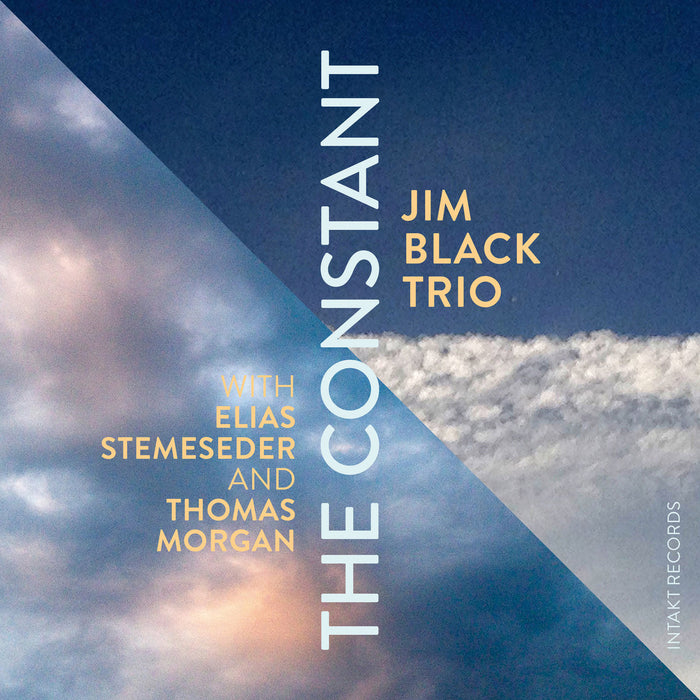
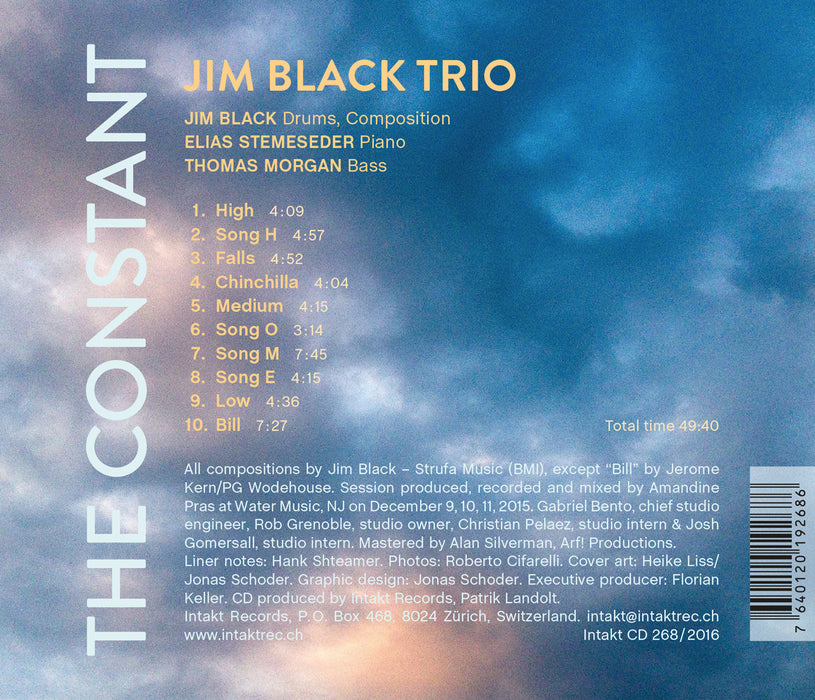
268: JIM BLACK TRIO. The Constant
Intakt Recording #268/ 2016
Recorded at Water Music, NJ on December 9, 10, 11, 2015.
Original price
CHF 12.00
-
Original price
CHF 30.00
Original price
CHF 30.00
CHF 12.00
-
CHF 30.00
Current price
CHF 30.00
More Info
Album Credits
L
Dans l'ombre-lumière de Paul Motian s'ouvre The Constant. L'ex-batteur du Bloodcount, entre apesanteur et suspension serre, resserre son jeu et, de fait, évite la copie du maître, mieux lui offre un cousinage subtil. Plus loin, Jim Black variera les intensités, se jouera de quelques facéties jungle (Song H) ou convoquera Bill, la très belle ballade de Jerome Kern. Le plus souvent, il changera de registre, désaxera ses compositions à force de surimpressions et d'effets de miroirs séduisants. Il ne boudera pas la respiration, encore moins la mise en espace. Et on retrouvera ça et là quelques effluves du regretté Alasnoaxis. La flexibilité légendaire de son leader (Low) fera mouche, tout comme la présence remarquable du pianiste Elias Stemeseder et l'autonomie réjouissante du contrebassiste
Thomas Morgan (art des interstices bien choisis, franchise de la phrase). En résumé, une belle hybridation entre jazz, rock, axes méditatifs et montées harmoniques toujours résolues.

A
ジム・ブラックといえば、フリ ージャズ界隈で、スガガガ、 ドシャメシャ、バスバスン!と 的確な音色とタイミングでブ ッ込んでくる素晴らしいドラ マーですが、このトリオでは、 巧さはそのまま、フリー的暴れっぷりは封印。トーマス・モーガ ン(b)とエリアス・ステメセーダー (p)という強烈な若手を率い た三作目。オススメです。

W
Jim Black was the rocking arsonist who burned down scores of incredible "downtown" recordings in the '90s and early '00s, playing the drums like he wanted to make "jazz" sound much more punk but without sacrificing even a sliver of the swing. Not that he went away, but at some point, Black came to seem less omnipresent on the scene and on recordings. It's my own fault for not seeking him out more aggressively because his recent work is also fantastic.
Hearing him in the most anodyne of all jazz contexts-a piano trio-is proof positive that he has lost nothing on his fastball. Elias Stemeseder is the pianist, and he has to be a true "percussionist" on the keys to keep up, which he does. Thomas Morgan brings to life the strong baselines that are part of every Black composition. There are tunes, such as "Song H" and "Chinchilla", where all of Black's known strengths as a drummer are beautifully on display-mainly the way he combines a rocking funk and some splashing precision with a free-wheeling sense of complexity. But there are also performances here that veer toward history and tradition of a sort. On the opener, "High", for example, it's clear that Black is connected to Paul Motian as a musician.
Many of Black's past projects caught fire at the intersection of freedom and groove. You can hear that on The Constant as well. "Medium" plays on a field of melodic fragments but could almost be in the book of The Bad Plus. On other tunes, Morgan gets his throbbing Bootsy on (though it is all acoustic) and Black and Stemeseder call forth squeaking, scratching sounds whose origins I'm not sure of. But, as on "Song O", everything builds toward a thrilling, explosive, joyous climax. That's not a bad phrase for the bulk of this wonderful recital.
http://www.popmatters.com/column/overlooked-jazz-gems-of-2016/

D
Apprécié au défunt festival de Cugnaux en 2013, ce groupe frappe fort avec "The Constant", qui vient rafraîchir le domaine encombré du trio acoustique: la complémentarité est patente entre un leader-batteur aussi dynamique qu'à ses débuts et ses jeunes partenaires, le circonspect contrebassiste Thomas Morgan et le prodige autrichien Elias Stemeseder (pianiste délicieusement excentrique). Mention spéciale à une production particulièrement soignée. Toute faculté critique a été battue en brèche par la musique paradoxalement très élaborée de Vijay lyer (piano, claviers divers. et électronique) et du trompettiste Wadada Leo Smith, mais qui résiste à l'analyse et invite l'auditeur à remiser la délibération pour céder à la pure ivresse phonique. Ces deux-là auraient-ils trouvé la pierre philosophale que je n'en serais pas surpris.

C
Die Magie des Augenblicks
Der amerikanische Schlagzeuger und Bandleader Jim Black lebt momentan in Berlin und sorgt mit zwei neuen Gruppen für Furore.
Jim Black (Jahrgang 1967) war der Shooting Star im Jazz der 1990er Jahre. Damals ließ er im Trio mit Ellery Eskelin und Andrea Parkins aufhorchen, dazu als Sideman von Dave Douglas, Uri Caine oder Tim Berne. Pachora und Alas No Axis hießen seine eigenen Bandprojekte, mit denen er seinen Ruf zementierte, einer der besten Drummer und kreativsten Musiker der aktuellen Szene zu sein. Jetzt legt er mit zwei neuen Gruppen nach.
Christoph Wagner: Du lebst momentan in Berlin. Wieso?
Jim Black: Ich habe eine Gastprofessur am Berliner Jazz-Institut, wo ich für sechs Monate meinen Freund John Hollenbeck vertrete. Es war der ideale Anlass, einmal nach Berlin zu ziehen und in die dortige Szene einzutauchen nach 25 Jahren in New York.
Christoph Wagner: Hast du vor, länger zu bleiben?
Jim Black: Keine Ahnung. Ich denke, dass sich für mich durch den Ortswechsel nicht allzu viel ändern wird. Ich verlagere nur meine Basis, mein Musikerleben wird das gleiche bleiben. Ideal wäre wohl, mit einem Bein in New York und mit dem anderen in Berlin zu stehen. Ich plane nicht weit im Voraus, sondern lebe mein Leben von einem Monat zum nächsten, weshalb es mir schwerfällt, irgendwelche Prognosen zu machen.
Christoph Wagner: Welchen Eindruck hast du von der Berliner Jazzszene?
Jim Black: Ich habe eine Gastprofessur am Berliner Jazz-Institut, wo ich für sechs Monate meinen Freund John Hollenbeck vertrete. Es war der ideale Anlass, einmal nach Berlin zu ziehen und in die dortige Szene einzutauchen nach 25 Jahren in New York.
Christoph Wagner: Hast du vor, länger zu bleiben?
Jim Black: Ich habe das Gefühl, dass sich die Berliner und die New Yorker Szene nicht so stark voneinander unterscheiden. Es gibt fantastische Musiker in beiden Städten. Was die Auftrittssituation betrifft, gibt es ebenfalls Ähnlichkeiten: Gelegentlich lässt man bei Konzerten den Hut rumgehen. Ein Unterschied ist jedoch: Mit dieser Methode kann man in Berlin ganz gut Geld verdienen - in New York nicht. Darüber hinaus gibt es natürlich in beiden Städten etliche Clubs und Auftrittslokale, wo regulärer Eintritt bezahlt wird und die Musiker eine feste Gage bekommen. Was die Qualität der Musiker anbelangt, gibt es zwischen den USA und Europa keinen Unterschied mehr. Die besten spielen heute weltweit auf gleich hohem Niveau - eine einzige große Party. Christoph Wagner: Das spiegelt sich in deinen verschiedenen Gruppen wider. Du arbeitest häufig mit Europäern zusammen.
Jim Black: Schon immer. Frank Möbus, der Berliner Gitarrist, ging mit mir aufs College und brachte mich danach als Erster nach Europa. Das war 1989. Damals lebte ich mit Chris Speed für ein halbes Jahr in Deutschland. Wir hatten ein Trio mit Möbus und traten überall auf. Wir spielten unsere eigene Musik und wurden dafür auch noch bezahlt, was unglaublich war für drei Burschen, die frisch vom College kamen. Seither war ich wieder und wieder in Europa und habe hier vielleicht mehr Zeit verbracht als in den Staaten.
Alles ist möglich
Christoph Wagner: Gerade ist das Debütalbum deines neuen Trios erschienen.
Jim Black: Zehn Jahre lang komponierte ich die Musik für meine Gruppe Alas No Axis auf der Gitarre. Dann verliebte ich mich ins Klavier. Bei einem Workshop in Salzburg begegnete ich diesem absolut superben jungen Pianisten: Elias Stemeseder. Wir spielten
danach weiter zusammen. Ich besuchte ihn und seine Familie auf ihrem Bauernhof in der Nähe von Salzburg. Er ist der erste Musiker in einer Familie von Bauern, deren Geschich- te 400 Jahre zurückreicht. Stemeseder war der Grund, dieses Trio zu gründen. Ich bin doppelt so alt wie er, aber wir liegen absolut auf der gleichen Wellenlänge. Wir nahmen Thomas Morgan als Bassist dazu. Mit ihm hatte ich zuvor nur ein paar Mal in New York gespielt und suchte nach einer Gelegenheit, die Zusammenarbeit zu intensivieren. Christoph Wagner: Wie funktioniert die Zusammenarbeit über solch weite Distanzen? Jim Black: Ich schreibe die Musik im Wissen, dass zwei bis vier Bandproben genügen, um die Kompositionen auf das Niveau für eine Plattenaufnahme zu heben, derart versiert sind meine Bandkollegen. Wenn man dann auf Tourneen jeden Abend zusammenspielt, entsteht eine zusätzliche Intimität. Unser Repertoire ist völlig offen. Es können meine Kompositionen sein oder Standards, wir können frei improvisieren oder über ein Thema - alles ist möglich. Wir zerbrechen uns nicht die Köpfe darüber, sondern spielen einfach drauflos und sehen, was dabei herauskommt. Das ist das Tolle an dieser Band, dass sie musikalisch äußerst wendig, flink und flexibel ist.
Christoph Wagner: Was unterscheidet dein Pianotrio von den vielen anderen Gruppen in dieser Besetzung?
Jim Black: Es wäre mir im Traum nicht eingefallen, ein Jazzpianotrio zu gründen. Aber ich erinnerte mich an das Trio von Paul Motian mit Joe Lovano und Bill Frisell, was...

F
Bustling yet tidy, rambunctious and relevant, complex but uncluttered - that's Jim Black on his drumkit: whether from late '80s high-energy Seattle-to-Boston start-up Human Feel or today as a Euro-Gotham- centric leader/composer and sought-out sideman. Black-deemed "fluent in all languages" and "wickedly inventive" - at 50 still looks and moves (maybe thinks) like an excitable teenager.
Recently out are Black's 12th leader date pairing loose-limbed originals with Jerome Kern's aw-shucks love song "Bill" and an airy two-saxophone quintet led by Köln bassist Robert Landfermann. Both feature 26-year-old Salzburg pianist Elias Stemeseder, a steady collaborator with Black: it's their third CD since 2010 with bassist Thomas Morgan; Black avows that they are "together rhythmically" in "meaningful conversations". Both dates largely comprise darkling introspective tracks where Black's tidy kit winks as bright spots of color and often contrary motion. The big difference is the working trio glows as if lit from within, whereas Black and Stemeseder seem to be tugging Landfermann's mournful hornmates into sunlight.
The tunes Black wrote for The Constant are subsidiary to how the trio plays together, the music evolving over time between familiar conversants. Thus his simple songs with variants churn forward with good-natured restlessness, serious without sobriety, all three stirring the stew with tireless invention: rethink Paul Bley/Gary Peacock/Paul Motian. Black names his four-minute tunes playfully, for altitudes (high, low, medium), a concept (H, O, M, E) and labials (Chinchilla, Falls); they're just hooks for discussions around genial clatterings, wry moods and sociable taffy-pulls.
Landfermann's Night Will Fall opens with austere horns limning medieval plainsong, softly in high Lee Konitz-ian cooing. Then bass and drums rumble and creak like ship rigging, bleating alto rolls over crystalline piano and Black's kit bashes off-kilter, like sneakers in a dryer. Drum slaps and hammered piano bend 4/4 into 9/8 and 7/8 on "Berg" as horns cry. Bowed bass harmonics on "Katarrh" underlie alto saxophonist Christian Weidner's stasis, which continues à deux on the dreamy title track, as Weidner and tenor saxophonist Sebastian Gille scrawl airy patterns over ostinato 'toy' piano and brushed piques and plaffs. "Randnotiz" rolls a sprawling, slo-mo "Shenandoah" with Black's rippling undercurrents and the snappy rhythm section carries "Zehn und Acht" and Paul Motian's "Arabesque", finally riling up the horns into querulous exchanges.

V
The Constant, ossia la forma canzone come costante nella scrittura che Jim Black mette in campo in questo terzo lavoro del trio completato dal giovane talento Elias Stemeseder al pianoforte e da quello già ampiamente riconosciuto di Thomas Morgan al contrabbasso. Una scrittura ad ampio raggio e di larghe vedute che richiede sensibilità interpretativa sopraffina oltre che disinvoltura nel muoversi tra i piani mobili nascosti nell'architettura consolidata dei brani.
Se la maestria percussiva di Black è nota (la sua presenza nei gruppi di Ellery Eskelin, Dave Douglas, Tim Berne e Satoko Fujii è li a testimoniarlo) sorprende, ma non troppo conoscendo l'imprevedibilità del personaggio, la vena melodica presente nei dieci brani del disco. Niente di sdolcinato o caramelloso, naturalmente, ci pensano gli accidenti disseminati qua e là, le svolte impreviste, le variazioni metriche a trasformare l'ascolto in un viaggio avventuroso.
Il virtuosismo dei tre è nascosto tra le pieghe di ogni movimento, dietro invenzioni dispensate senza parsimonia, negli opportuni momenti di astrazione che fanno risuonare lo spazio circostante, per questo ancor più apprezzato e apprezzabile. E il conclusivo "Bill" di Jerome Kern, unico brano non originale del lotto, non è semplice omaggio ad uno dei più grandi songwriter del secolo scorso ma gioia per le nostre orecchie, con il trio quasi pudico nello svelare il suo lato più intimista e delicato.
https://www.allaboutjazz.com/the-constant-jim-black-intakt-records-review-by-vincenzo-roggero

A
Battitore e bandleader i cui orientamenti saranno argomentati dalle sostanziose frequentazioni (Tim Berne, Uri Caine, Dave Douglas in primis), Jim Black ripropone il proprio stile autoriale associandovi due giovani forze, con cui si cimenta al terzo appuntamento discografico dopo i consistenti Somatic ed Actuality.
Eclettico l’orientamento nell’esposizione stilistica del trio, cui il leader imprime il passo propulsivo appreso e praticato durante gli anni devoluti al prog-jazz (ad esempio le scattanti Chinchilla o Song H), che pure non è la soluzione dominante, attingendo anche a soluzioni informali quale la collettiva improvvisazione Low, e potendosi in buona parte gustare spiccata disposizione cantabile, i cui esiti si giovano dell’apporto del giovane, sensibile pianista Elias Stemeseder, reclutato all’istante (e in età da vivaio) durante alcune perfomance austriache, che non lèsina in ben dispensato co-protagonismo, a suo agio nelle armonizzazioni austere così come lungo le plaghe liriche (al loro culmine nella conclusiva, composta Bill – di più che intuibile filiazione evansiana, ma pur legata al mondo di Paul Motian), parimenti all’efficace, scultorea incarnazione bassistica di Thomas Morgan, che conferisce fianco contrappuntistico e forte alito melodico a passaggi sensibili quali Falls o Song M.
Certamente presente ed ispirativo il ruolo incisivo del batterista, che non mira al tratto levigato e non prevarica le personalità dei partner, coinvolti ben più che nello standard dei casi con ruolo tangibilmente egualitario, così delegandovi anche una personale presa di rischio, osservando come più che alla forma compiuta e alle soluzioni piane, lungo l’album si ricorre in buona parte a rivolgimento scenico e strutturale suspense.
Lavoro sfaccettato e intenso, cui non difetta la griffe autoriale e il vivo senso dell’invenzione, The Constant è più che un rinnovato biglietto da visita per l’inventivo drummer e regista che, pur non attentando ai parametri formali, si arroga con credito un diritto partecipativo all’area di confine, tra linea classica e revisionismo, dell’aggiornata scena del piano-trio.
https://www.jazzconvention.net/2016/12/28/jim-black-trio-the-constant/

J
Esse é o mesmo Jim Black que faz, há 20 anos, parte do trio Azul de Carlos Bica e também é o Jim Black que esteve no Bloodcount de Tim Berne, no Tiny Bell Trio de Dave Douglas, nos grupos de Satoko Fujii, Chris Speed , Jenny Scheinman e Cuong Vu, nos coletivos Human Feel, Pachora, Big Air e BB&C (com Berne e Nels Cline) e em mais ums largas dezenas de projetos, cujos registros se contam, infalivelmente, entre os melhores discos do ano.
Ao lado dessa atividade frenética, Black vem se consolidando como líder, à frente do AlasNoAxis e desse trio com o pianista austríaco Elias Stemeseder e do contrabaxista americano Thomas Morgan, que tanto tem melodias pop límpidas quanto os ritmos convulsivos e quebrados que são típicos de Black. Esse terceiro disco do trio tem a particularidade de incluir uma versão serena e lírica do padrão "Bill", de Jerome Kern, inesperada em um músico que sempre alimentou seus projetos com material de "fabricação própria".
https://observador.pt/especiais/jazz-os-20-melhores-discos-de-2016-e-outros-72-essenciais/

P
Drummer Jim Black has one of the most immediately recognizable styles in jazz-his wonderfully unhinged playing bears the mark of the rock backbeat, but he adds a clanking, disruptive quality that forces his collaborators to sharpen their reflexes. Recently Black has been leading one of the best bands in his busy career, an unlikely trio with bassist Thomas Morgan and Austrian pianist Elias Stemeseder that balances his investments in chaos and melody. Black's ballads are the most effective pieces on the record: 'Song E' is exquisitely tender, complementing the sensitivity and warmth of Morgan and Stemeseder's solos, and Black exercises great restraint while still kicking out firm backbeats.

K
Dit is het derde album van drummer Jim Blacks trio met twee jongere musici, bassist Thomas Morgan en pianist Elias Stemeseder die ook in New York actief zijn. Stemeseder is een jonge Oostenrijker (1990) die de laatste jaren opvalt als nieuwe naam in New York. Het voorbeeld is Paul Bley's trio uit begin jaren zestig waarin vloeiend het grensgebied tussen de postmodalejazz en freejazz werd opgezocht. Op één na zijn alle composities van Black en hij heeft in zijn thema's ook gekozen voor melodielijnen die qua kleur sterk aan Bley doen denken. Het spel van het trio heeft de jaren zestig als uitgangspunt, maar vooral het spel van Black met zijn voorkeur voor harde contrasten en op onverwachte momenten gedempte percussie-interventies geeft het pianotrio een bepaalde urgentie en onrust. De ritmesectie weet dat fraai uit te bouwen tot een stevig en eigen groepsgeluid.

P
Il y a la musique qu'on aime envers et contre tout, la musique qu'on abhorre sans raison, la musique qui intéresse, celle qui énergise, la musique belle, la musique qui intrigue, la musique qui mêle un peu tout, la musique qui spiritualise, celle qui parfaitement exécutée impressionne, la musique qui fait un peu chier, qui énerve, qui transporte, qui geint, qui crisse, qui ouvre, qui se tait... L'infini à la portée des oreilles, et beaucoup trop de ressentis possibles pour ne pas y trouver son compte, ou pour ce qui est du critique ne pas avoir son mot à dire. Le principe même de cette activité étrange de critiquer étant d'ailleurs d'avoir toujours un avis, postulat le moins musical du monde au passage... Au village champignon, il y a un schtroumpf à lunettes et un schtroumpf musicien. Faut pas confondre.
Parfois, il y a aussi les musiques qu'on ne comprend pas. The Constant, du Jim Black Trio rentrerait – très subjectivement – dans cette catégorie. Non pas parce qu'on ne perçoit pas ce qui est en jeu dans ce répertoire, au moins un peu. Non plus pour la raison que ces musiciens déplaisent dans l'exécution de ces dix ''chansons'', toutes sauf une composées par le batteur et leader. Vraiment pas, tant le pianiste Elias Stemeseder impressionne sur tout l'album par un jeu d'une finesse prodigieuse, mise au service de l'attention mélodique de l'album qu'il enrichit constamment par les nombreuses strates de son vocabulaire trouvant un équilibre toujours précaire et beau entre clarté et profusion, chaos et ordre. Et il n'est pas besoin de préciser que Jim Black assure, et Thomas Morgan contrebasse à merveille.
Alors quoi ? Pas de vrai avis tranché, c'est tout. Un ennui récurrent qui le dispute à une forte impression face à l'interprétation et la construction savante de cette musique souvent à la limite de l'évanouissement de la pulsation. Un entrain pour la fausse simplicité des mélodies qui combat l'impression d'avoir déjà entendu un tel propos. Et pour intellectualiser un brin et se forcer à donner son avis, car c'est dans la nature de tous les schtroumpfs à lunettes, ce serait peut-être cela qu'on se permettrait de dire : comme une impression de déjà-vu dans l'idiosyncrasie entre binaire et métrique quasi non-pulsée, entre mélodies pops et musique non-idiomatique, dans la versatilité virtuose d'un trio qui peut se muer en power trio quelques secondes après avoir caressé le fantôme de Bill Evans, Scott LaFaro et Paul Motian, dans les superpositions de couleurs et de langages de trois musiciens à la grande profondeur apportant chacun des univers féconds (et on n'oublie bien sûr pas la grande carrière de Jim Black outre-Atlantique)...
Toujours pas d'avis, en vérité, parce que cette musique est trop évidemment belle pour pouvoir la labelliser d'un quelconque inintérêt ou s'autoriser à la taxer d'échouée. Et sans doute qu'on trouve les limites de tout schtroumpf à lunettes qui se respecte, lorsqu'arrive ce moment où son babil se tarit dans son absurdité pléthorique. Ce schtroumpf-là a bien perçu, en tout cas, le succès critique remporté par The Constant, dans l'Ancien comme dans le Nouveau Monde, et il se demande s'il n'a pas affaire à une musique spécialement faite pour les schtroumpfs à lunettes d'ici ou d'ailleurs ; mais dont les multiples traditions et conceptualisations ne toucheront peut-être pas au-delà du monde des nécessiteux d'ophtalmologie, petits êtres bleus au doigt levé sur toute beauté musicale.
Ah, au fait, le grand schtroumpf a dit que le jazz c'était mieux avant.
http://www.djamlarevue.com/blog/2016/9/15/jim-black-trio-the-constant?rq=intakt

T
The Constant is living proof that the piano trio, "the minimum complete jazz orchestra," is still a dynamic, vital format. Granted, the band here is not exactly a piano trio. The leader, composer and auteur is the drummer, Jim Black. The bassist and pianist are Thomas Morgan and Elias Stemeseder, respectively-two of the most gifted young artists in jazz.
Bill Evans is most often credited with liberating the bassist and drummer within the piano-trio format. But Black's ensemble takes it all the way, to a tripartite endeavor among equals.
Black has been on the leading edge of the progressive scene for more than 20 years. In person he is fun to watch because he is theatrical in his movements, a ballet dancer. On record, the drama and diversity of his percussion content still comes through.
When Morgan leads, on a piece like "Falls," he is as melodic as a pianist, but in a darker language fraught with ambiguity. Stemeseder is a 25-year-old with the highly developed reflexes to play music as fluid and elusive in the moment as Black's. In the liner notes Black says he "likes songs," but his nine originals are unstable forms that aggregate to a suite like a network of hard turns and contradictions. There is a haunting motif that recurs across the nine movements, usually entrusted, however fleetingly, to Morgan. "Song M," like most of these pieces, stops and starts over. Stemeseder veers from delicate treble ascents to ringing trills. He hovers, then plunges into hammering grooves. No groove lasts for long.
After the wild collective creativity of the suite, the last thing you expect to hear is Jerome Kern's "Bill," from the 1927 musical Show Boat. It really is "Bill," all of its tenderness intact, but now with suspenseful hesitations and revelatory releases. Irregular, mutable lyricism is this trio's chosen domain.

R
Auf den ersten Blick ist es ein Klavier- Bass-Schlagzeug-Trio. Doch hier ist nicht das Klavier im Mittelpunkt, obwohl es exzellent beherrscht wird, sondern der Schlagzeuger. Neun Stücke hat Jim Black seinem Trio auf den Leib geschrieben; als Schmankerl gibt es abschließend noch Jerome Kerns „Bill" aus dem Musical „Show Boat". Das Trio harmoniert glänzend, kein Wunder, denn dies ist nach vierjährigem Bestehen bereits die dritte CD. Sie fügt Blacks Stücke suitenartig zusammen. Motive des einleitenden Tracks „High" ziehen sich wie ein roter Faden durch das gesamte Album und weichen feste Songstrukturen immer wieder sanft auf. Es entsteht, so die liner notes, eine „Erzählung konkurrierender Strömungen". In all seinen von Bandleader Black forcierten rhythmischen Gegensätzen findet das Trio zu schlüssigem Ganzen dank nicht zuletzt der exzellenten Mitspieler Elias Stemeseder, p, und Thomas Morgan, b.
