
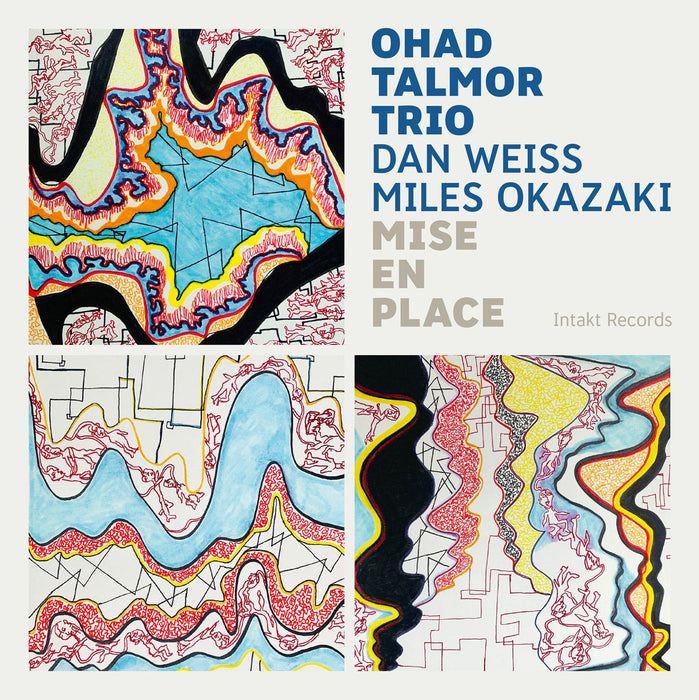
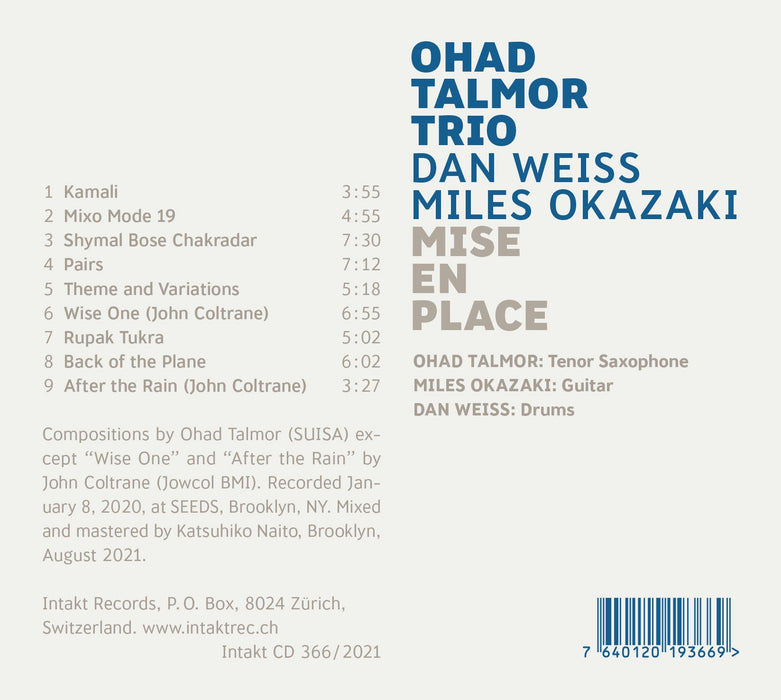
366: OHAD TALMOR TRIO. Mise En Place
Intakt Recording #366/ 2021
Ohad Talmor: Saxophone
Miles Okazaki: Guitar
Dan Weiss: Drums
Recorded January 8, 2020, at SEEDS, Brooklyn, NY.
Sale
Sale
Original price
CHF 12.00
-
Original price
CHF 30.00
Original price
CHF 30.00
CHF 12.00
-
CHF 30.00
Current price
CHF 30.00
| /
More Info
Saxophoneophonist and composer Ohad Talmor follows up his album Long Forms with the Ohad Talmor Newsreel Sextet (Intakt CD 341) – a trio recording with his closest musical friends in Brooklyn: guitarist Miles Okazaki and drummer Dan Weiss.
Ohad Talmor is the very definition of a cosmopolitan artist, holding three passports – American, Swiss and Israeli – while being based in the polyglot borough of Brooklyn, New York. Although mentored by the late, great altoist Lee Konitz, Talmor has musical obsessi- ons that range far and wide. From iconic tenor Saxophoneophonists like Sonny Rollins and Wayne Shorter to such disparate European composers as Bruckner and Ligeti to theintricacies of Hindustani classical music.
Talmor has taken this album’s title, Mise en place, from a French phrase often used to refer to the preparation and organization of all ingredients and implements ahead of cooking although, more pertinently, it’s also a colloquial French term for rhythmic accuracy in jazz. A fluent, precise “time feel” is a prime trait of his trio with Okazaki and Weiss.The trio plays as one, lithe and muscular. “Despite the technical demands of these pieces,” Talmor says, “our goal is to eschew stock licks, to really listen, to really impro- vise – to always be in the moment with the music.”
Album Credits
Cover art: AvikArt Design
Graphic design: Jonas Schoder
Liner notes: Bradley Bambarger
Compositions by Ohad Talmor (SUISA) except "Wise One" and "After the Rain" byJohn Coltrane (Jowcol BMI). Recorded January 8, 2020, at SEEDS, Brooklyn, NY. Mixed and mastered by Katsuhiko Naito, Brooklyn, August 2021. Produced by Ohad Talmor and Intakt Records, Patrik Landolt, Anja Illmaier, Florian Keller. Published by Intakt Records except "Wise One" and "After the Rain".
- 5 stars: 19 (100%)
- 4 stars: 0 (0%)
- 3 stars: 0 (0%)
- 2 stars: 0 (0%)
- 1 star: 0 (0%)
J
Jean Buzelin Ohad Talmor est un saxophoniste suisse-israélien-américain, et ce cosmopolitisme épouse bien celui du jazz. Il conduit un trio très ouvert avec deux musiciens de la scène de Brooklyn, Mike Okazaki (guitare) et Dan Weiss (batterie). Sur sept compositions personnelles et deux belles ballades de John Coltrane, il affirme son jeu sinueux et plein d’autorité. Un jazz actuel très tendu.
https://culturejazz.fr/spip.php?article3852
F
Frederico Lyra Le livret en anglais accompagnant l’album, dont le titre Mise en Place est en français, souligne une double idée que recouvre cette expression : elle peut faire référence à l’organisation des ingrédients et ustensiles culinaires pour la préparation d’un plat ; elle est aussi d’un usage familier dans le monde du jazz pour parler de précision rythmique d’un musicien ou d’un groupe. Même si cela réduit son champ sémantique, il nous semble que le passage de la cuisine au rythme illustre parfaitement la musique du saxophoniste Ohad Talmor, interprétée avec le guitariste Miles Okazaki et le batteur Dan Weiss. Nous écoutons un trio qui possède un entendement, une précision et une sensibilité rare et pour lequel le rythme est le paramètre central dans les neuf morceaux du disque. Le résultat musical est à la fois d’un très haut niveau et comme un défi à l’écoute. Ceci n’est possible que parce que le saxophoniste est accompagné de deux musiciens excellents sur leurs instruments respectifs et qui se surpassent par l’agilité rythmique et leur connaissance mutuelle. Comme dans le cas du trio composé par Paul Motian, Joe Lovano et Bill Frisell, l’absence de contrebasse ouvre des possibilités et des demandes nouvelles aux musiciens. Néanmoins, si l’un primait par la respiration et la couleur sonore, l’autre, celui de Talmor, Okazaki et Weiss, se caractérise par l’intensité de la musique.
« Kamali », « Shymal Bose Chakradar » et « Rupak Tukra » forment une constellation de compositions inspirées de la musique indienne. De manière générale, la saveur indienne se déploie dans la construction de cycles rythmiques très complexes qui prennent la forme de contrepoints mélodiques et rythmiques entre le saxophone et la guitare, reliés par la batterie. Signalons un moment rock, plein d’humour, dans « Shymal » et le passage de « Rupak » dans lequel le leader sort de scène pour laisser place à la relation télépathique entretenue par Okazaki et Weiss. « Kamali » est, de son côté, une belle et dense ouverture pour l’album. « Mixo Mode 19 » suit plus ou moins la même structuration, mais se caractérise par le jeu très anguleux du guitariste.
L’improvisation de Talmor est particulièrement remarquable, en raison de sa capacité à jouer de manière espacée tout en insistant sur la variation d’idées motiviques qui entrent en contradiction avec le schéma rythmé du morceau. « Pairs » est une sorte de ballade d’une large amplitude mélodique, calquée sur des intervalles symétriques, tandis que l’écriture et l’enchevêtrement des différentes ambiances musicales prévalent sur l’improvisation dans « Thème et Variations ». « Back to the Plane » prend la forme d’un rock énergétique, construit sur un riff autour duquel Talmor improvise et dans lequel Dan Weiss est encore plus à l’aise qu’ailleurs dans le disque. Le trio a enregistré deux ballades de John Coltrane traitées différemment l’une de l’autre. Le saxophoniste ouvre « Wise One » de manière à évoquer son compositeur. Au moment où l’accompagnement d’Okazaki se met en place, celui-ci transforme le morceau en un type de bossa nova, ce qui permet au saxophoniste de montrer sa facette plus lyrique, inspirée de son mentor Lee Konitz. Conclure avec une ballade intime pourrait s’avérer risqué, pourtant la relecture de « After the Rain » est un choix judicieux parce qu’il permet à l’auditeur de se remémorer toute la complexité des titres antérieurs. Notons, pour conclure, qu’à certains endroits Ohad Talmor réussit l’exploit rare d’improviser mélodiquement dans des contextes extrêmement rythmés.
Mise en Place demande plusieurs écoutes et, surtout, donne envie d’une suite, car ce trio a encore beaucoup à dire, étant donné la richesse du matériau enregistré ici.
https://www.citizenjazz.com/Ohad-Talmor-Trio.html
T
Troy Collins A true cosmopolitan, Ohad Talmor is an Israeli born in Lyon France, who grew up in Geneva, Switzerland, and now resides in Brooklyn, New York, a naturalized American. A classically trained pianist, Talmor picked up the saxophone while attending High School in Florida. Fostering his dual interests in composition and improvisation, Talmor was mentored early on by the legendary Lee Konitz, with whom he eventually worked, co-leading, composing, arranging, and playing in three distinct projects: the Lee Konitz Nonet; the Konitz-Talmor String Project; and the Konitz-Talmor Big Band.
As a bandleader, Talmor leads several ensembles that reflect his multi-faceted musical persona: The Newsreel Sextet features trumpeter Shane Endsley, guitarist Miles Okazaki, pianist Jacob Sacks, bassist Matt Pavolka, and drummer Dan Weiss; The Newsreel Trio features Okazaki and Weiss; The Ohad Talmor Grand Ensemble is a big band featuring many of New York’s leading improvisers; and The Mass Transformation Nonet specializes in the Music of Anton Bruckner, among other composers. It features Austria’s Spring String Quartet, singer Judith Berkson, Endsley, guitarist Pete McCann, and drummer Mark Ferber.
As a sideman, Talmor is currently a member of drummer Adam Nussbaum’s Leadbelly Project featuring guitarists Steve Cardenas and Nate Radley and is also part of a collaborative trio with Nussbaum featuring bassist Steve Swallow. Other collaborators include, but are not limited to Jason Moran, Joshua Redman, Fred Hersch, Kurt Rosenwinkel, Chris Cheek, Carla Bley, Joe Lovano, Chris Potter, and Billy Hart.
Talmor’s longstanding interest in combining improvisation with through-composed music has found him involved in writing for various jazz, electronic, and contemporary classical projects. His music has been performed by an international array of ensembles, including: Portugal’s OJM Big Band; Germany’s WDR Big Band; Brazil’s SoundScape Orquestra; European Radio Jazz Orchestra; and Belgium’s Bruxelles Jazz Orchestra. His contribution to the contemporary classical genre includes music composed for pianist Martha Argerich, Austria’s Spring String Quartet, Porto’s “Casa da Musica” Orchestra, and Sao Paulo’s Symphonic Band. Talmor’s Double Concerto for Piano/Drums and Double Orchestras was premiered in February 2010 by Porto “Casa da Musica” Orchestra and the OJM Big Band, with Moran and Weiss as featured soloists.
Talmor holds a composition degree from the Manhattan School of Music and is the recipient of several Awards, including the SUISA 2012 Swiss Musician of the Year and the 2015 European Broadcasting Union Composer of the Year Award. He currently teaches composition at the Geneva Conservatory (CPMDT/AMR) and serves as an adjunct professor at the New School and the City University of New York. His latest release is Mise En Place, by the Newsreel Trio. I interviewed Talmor in the winter of 2021, concurrent with Intakt’s release of the album.
* * *
Troy Collins: Some early biographical information might be of interest to readers unfamiliar with your background, which seems fairly complex. How did you get your start playing music?
Ohad Talmor: I come from a family and am myself an emigrant of Jewish origin. I am the fifth generation born in a country and emigrating to another one. In my case, the United States.
One of the links tying this lineage together is a cultural bind. In my family, with its educated, left-wing intellectual background, learning an instrument was not a luxury, but almost a necessity. Classical music was on in the house, as well as some more traditional music from my parents’ respective backgrounds. My dad was a Sephardic Jew from Bulgaria/Turkey speaking Ladino with his family (Judeo-Espanol) and he loved the music from this tradition. My mother is Ashkenazy from Romania and had a more formal upbringing – she loves opera and could sing along with the great classics. So, I started early on the piano and my studies led me through the classical path of the conservatoire in Geneva, Switzerland, eventually getting a degree at the age of 19. But piano was always problematic. Even though I am grateful I have it now as a tool for composing, it was burdened with all kinds of expectations. Typically, for my family, to “be a musician” you had to either be a virtuoso, or nothing. There was no other path. To add to this, the parents of my then girlfriend were world famous classical musicians; pianist Martha Argerich and conductor Charles Dutoit. Martha, in particular, I grew close to and remain so to this day. Besides her incredible musical gifts, she is a generous woman willing to share. 20 years later I was invited to perform and conduct at some festivals in Japan and Switzerland which she led, but back then, she was another huge weight in the musical universe I was dealing with. Piano was simply never an option, especially when you heard it all day long played by Martha or the folks she’d have over non-stop at her magic...
F
Florian Bissig Die drei in New York ansässigen Musiker haben schon in verschiedenen Ensembles zusammengearbeitet. Nun hat der Tenorsaxophonist Ohad Talmor den Gitarristen Miles Okazaki und den Schlagzeuger Dan Weiss zu einer basslosen Trioaufnahme verpflichtet. Hervorragend eingespielt interpretieren die drei seine eigensinnigen Kompositionen, welche Elemente der modernen westlichen Klassik und der indischen Kunstmusik mit der Jazztradition zusammenführen. Sprunghafte und filigrane Melodien ordnen sich in ein kammermusikalisches Gefüge, wobei rhythmisch komplexe Ostinato-Zyklen für ständige Entwicklung sorgen und die Stimmen immer neu aufeinandertreffen lassen. Das klingt keineswegs konstruiert, sondern vielmehr flüssig und zuweilen kühn vorwärtstreibend. Ausserdem können's Weiss und Okazaki auch groovig und rockig. Doch der Energielevel wird selten mit blosser Amplitudensteigerung erhöht, sondern durch eine elastische Dynamik und ein sich immer enger verwebendes Interplay. Einen weiteren Kontrast bieten die zwei ruhigen Coltrane-Stücke "After the Rain" und "Wise One". Hier zollt Talmor offenkundig einem Vorbild Tribut, zeigt aber zugleich auch einen eigenständigen Ton von grosser Reife und Wärme.
F
Filipe Freitas Ohad Talmor Trio
Mise en Place
Intakt Records
"This is a work of pure dedication and focus, impressive in its sheer physicality and complexion."
https://jazztrail.net/best-jazz-albums-2021
F
Francis Davis The 2021 Jazz Critics Poll: Only the Best
HONORABLE MENTION:
Silke Eberhard Trio, Being the Up and Down (Intakt)
Amir ElSaffar Rivers of Sound, The Other Shore (Outnote)
Christopher Hoffman, Asp Nimbus (Out of Your Head)
Joe Lovano & Dave Douglas Soundprints, Other Worlds (Greenleaf Music)
Francisco Mela, M.P.T. Trio: Volume 1 (577)
Hafez Modirzadeh, Facets (Pi)
Steph Richards Supersense (Northern Spy)
Martial Solal, Coming Yesterday: Live at Salle Gaveau 2019 (Challenge)
Ohad Talmor Trio, Mise En Place (Intakt)
Throttle Elevator Music, Emergency Exit (Wide Hive)
Thumbscrew, Never Is Enough (Cuneiform)
Umlaut Big Band, Mary’s Ideas (Umlaut)
https://artsfuse.org/244710/the-2021-jazz-critics-poll-only-the-best/
K
Ken Weiss Ken Weiss (Cadence, Jazz Inside)
NEW RELEASES
Ohad Talmor Trio, Mise En Place (Intakt)
Wadada Leo Smith's Great Lakes Quartet, The Chicago Symphonies (TUM)
James Brandon Lewis Quartet, Code of Being (Intakt)
Sara Schoenbeck, Sara Schoenbeck (Pyroclastic)
Henry Threadgill Zooid, Poof (Pi)
The Vinny Golia Quartet, Left, Outside . . . ! (Nine Winds -19)
Harold Danko, Spring Garden (SteepleChase)
Rich Halley-Dan Clucas-Clyde Reed-Carson Halley, Boomslang (Pine Eagle)
Gordon Grdina's Square Peg, Klotski (Attaboygirl)
Alister Spence Trio With Ed Kuepper, Asteroid Ekosystem (Alister Spence Music)
https://hullworks.net/jazzpoll/21/ballots-08.php
F
Frank von Niederhäusern Überraschend möbliert
Für einmal wird das Zürcher Label Intakt seinem programmatischen Namen nicht gerecht. Ohad Talmor ist zwar ein verspielter Improvisator, gestaltet seine Musik aber klar getaktet. Mit seinen Freunden in Brooklyn - Gitarrist Miles Okazaki und Drummer Dan Weiss - errichtet der Saxofonist rhythmisch fundierte Klanggebäude von wundersam wuchernder Architektur. Das Trio lädt in überraschend möblierte Räume mit betörenden Aussichten.
P
Pat Youngspiel Concerto Magazine
G
George Grella Guitarist Miles Okazaki is central to three new releases this fall: Mise En Place (Intakt), where he is part of saxophonist Ohad Talmor's Trio along with drummer Dan Weiss; Hive Mind (Tzadik), a fully improvised session with Okazaki and Weiss joined by bassist Trevor Dunn; and Music for Drums and Guitar (Cygnus Recordings), which pairs the guitarist with Weiss once more.
More than just the same name appearing on each release, the underlying tie that binds them together is the specificity of Okazaki's clear and compelling voice. His clear, fat attack and voicings push through every conceivable texture and his strong rhythmic placement means no one will miss a bass player on the Talmor and duo albums. The albums, especially Hive Mind, do not have the same style of melodic and harmonic counterpoint and polyrhythmic modulations heard on the albums released under his own leadership, like the three albums from his Trickster band on Pi Recordings (the most recent, Trickster's Dream, a digital-only release from 2020), or his Mirror trilogy of albums (the first self-released, the second two on Sunnyside). But the new records are all just more facets of his musical approach and the bridge between the compositional explorations and the focus on simply playing is his monumental Work, Thelonious Monk's complete music, played on solo guitar across six volumes.
"I have different compositional ideas for different groups," Okazaki explains. "With Dan, we have certain ways of cueing each other, certain ways of changing tempos, certain ways of developing materials on the spot." That is less about freedom than it is about taking spontaneity and organizing it.
He elaborates by pointing out that, "Most everything that I've done, even free improvisation, is in some kind of form. I'm the type of player who thrives in some structure rather than non-dimensional space. I started playing songs with singers. The whole Trickster concept started with the idea of a square, how many ways can you unfold it?" That makes for music that has pulses that shift the downbeat and backbeat, with complex, odd meters swirling around and above. It could be described as the unofficial house sound of Pi, especially with musicians like Okazaki who have spent time working with Steve Coleman and his M-Base concept (Trickster shares the rhythm section of bassist Anthony Tidd and drummer Sean Rickman with Coleman's Five Elements band).
Music somewhat in the shape of a square sounds organic to Okazaki's approach to his instrument, which emphasizes distinct articulation and intervallic playing, rather than shaping longer, curved lines. "The great legato players," Okazaki says, "like Pat Metheny and Alan Holdsworth, Lage Lund, I love them. But I treat the guitar more like a drum, hitting notes... I just want to be able to have each note have a sound, rather than a combination of notes."
That approach is built on classic forbears who Okazaki studied and found inspiration in: "Charlie Christian, Grant Green, George Benson. I learn a lot, I transcribe a lot from classic records, especially teaching. Articulation, I work on that a lot. I think that's a neglected topic. It's about details. I would like to have enough vocabulary and inflection to say something without stumbling." Put a bunch of articulations together and you have polyphony, even counterpoint. Okazaki points out that at the time of his 2011 Figurations album, "I was studying counterpoint, putting one melody against another. I like layers."
Where Trickster can push the borders of comprehensible complexity, the new albums, even Hive Mind, are pared-down. Music for Drums and Guitar has a John Zorn connection. As Okazaki describes it, Zorn asked for some music as part of his Stone Commissioning Series, "back in the before times", which meant that guitarist and drummer would each write a piece and premiere it at National Sawdust. "Mine made it to February 2020, but we were cancelled for March," says Okazaki.
On both the duet album and Hive Mind, the music has little about it that is conceptual; it is about Okazaki and Weiss playing with and for each other in time, the guitarist strumming chords against rhythmic patterns, almost like a Jamey Aebersold record rhythm section. In this case though, the two shape complete songs through nothing more than harmonic rhythm. More than just a new album, it is the first release on a label that the two started to release experimental projects.
Hive Mind is unsurprisingly more abstract. What is surprising is that, following the path of listening and group improvisation, the results are so often delicate, atmospheric, impressionistic, gestural. There is probably no guitar/bass/drums album on Tzadik that is this quiet, which is built so much around details rather than tunes and sheer power. Recorded in June of this year, the music-making seems as immediate as the production turn-around: "I did prepare some material," Okazaki says, "but we didn't use it in the end...
U
Ulrich Steinmetzger Schnell und windungsreich flirrt das voran. Ohad Talmors verschränkt seine Tenorsaxophonlinien engstens mit der E-Gitarre von Miles Okazaki, wozu Schlagzeuger Dan Weiss in die Labyrinthe dieses in Brooklyn verwurzelten Trios immer neue Richtungsfährten legt. Musik entsteht so, deren Abstraktionsgrad doch pulsierend bleibt und die der Bandleader seinem Mentor Lee Konitz widmete. Die neun Stücke, darunter zwei von Coltrane, sind sehr enggeführte Kompositionen von Talmor, die auch Monk, Elemente der E-Musik und des Indischen aufnehmen. So arbeitet der in Frankreich geborene Israeli konsequent an seinen Alleinstellungsmerkmalen. Die Elemente fließen in seiner ausgekochten Musik farbenreich und rhythmisch vertrackt zusammen zu einem überzeugen-den Ganzen. Das lebt von Details, Forcierungen und Präzision. Von Ferne grüßt das Trio von Joe Lovano, Bill Frisell und Paul Motian, doch wird hier bei allen instrumentalen Parallelen nichts kopiert. Dieses Trio lebt von seiner Originalität, die weit ausholend eingekreist wird zu sehr konzisen Ergebnissen, die das Großformatige von Talmors >>>Newsreal<< im kleineren Trio-kontext neu kalibrieren.
K
Kevin Le Gendre One half of the Newsreel sextet, this trio is a classic case of a band emerging from a band. Any chemistry that tenor saxophonist Ohad Talmor, guitarist Miles Okazaki and drummer Dan Weiss may have created in the larger ensemble certainly carries over to this more exposed, spacious setting in which the players are heard with added clarity, making the point that the absence of other instruments is not something they are actively trying to offset. The stark, hefty funk of 'Back Of The Plane' is a prime example of how effectively horn and kick drum can cover the low register normally occupied by bass, and the snarling nature of the terse riffs very loosely recalls the milder moments of UK millennial tearaways Trio VD while at the other end of the spectrum the reprises of Coltrane's 'Wise One' and 'After The Rain' highlight the bewitching, almost dream state quality of the band, drawing favourable comparisons to the iconic Lovano-Frisell-Motian group. In any case Talmor takes his compositions into anything from Indian rhythms, also a source of inspiration for Weiss and Okazaki, to provocatively fragmented, fizzing grooves that provide both smart overlaps of lines and tricky playfulness with time. All three are capable soloists but Talmor, who has also studied bansuri flute, imbues his tenor with a gorgeously misty quality, slightly á la Charles Lloyd on the ballads, that really
An enjoyable venture from a trio that has drive and restraint in equal measure.
K
Ken Waxman Dealing with contrasting ethnic sound concepts, New York guitarist Miles Okazaki’s adaptable playing contributes to the outcome of each of these trio session. This side of straight-ahead Jazz, Mise en Place combines the talents of the guitarist and his long-time associate drummer Dan Weiss in a program of nine mostly original compositions by Swiss-Israeli tenor saxophonist Ohad Talmor. Nocturne is more distinct. It was conceived by India-born American alto saxophonist Aakash Mittal to join sonic samples recorded in Kolkata with Hindustani-influenced improvised music. Besides his saxophone and Okazaki’s guitar, the nine tracks are rhythmically amplified by mridangam and kanjira beats from Rajna Swaminathan, who moves among the areas of traditional and popular South Asian musics plus Jazz and Western creative music
While the subcontinental streetscape clamor provides a jangling, thumping authentic and boisterous backdrop, Nocturne’s definition is expressed in the integration of distinct geographic sound properties. Succinctly showcased beginning with “Nocturne II”, the narrative defines itself as Swaminathan’s splayed patterning and Okazaki’s distinctive bass-string strums maintain a pulsating groove with some timbral detours. Meanwhile Mittal’s split tones and smears break up the continuum. Yet by the track’s final minutes a Jazz-identified exposition is reestablished with horizontal string frails harmonizing with sax tongue clicks over a flowing Western-like drum r
This east-west equivalence is maintained throughout the session, with some motifs listing towards traditional Indian scales and others accepting the melodies and stresses of Euro-American tones. With interludes of verbal cross-talk, infants cries and street orchestras thumping and tooting, the same strategy is adapted to less frenetic material. One such is “7. Nocturne IV”, which comes across as a slender variant on a Coltrane ballad. Linear and bright, the relaxed reed theme projection is interweaved with multi-string concordance from the guitarist and playful percussion bounces. Although the suite evolution sometimes speeds up to tightened intensity, melodic overlay is maintained. This consistency is confirmed on the concluding “Street Music Part III” in spite of stop-time guitar riffs and a suggestion of ney-like qualities emanating from Mittal’s reed. With Swaminathan’s percussion asides again encompassing a mixed Carnatic and North American beat, multiple sonic traditions are celebrated.
Lacking the underlying percussive drone of the other session, Mise en Place sounds sparser and more obviously western. The faint Coltrane illusions on Nocturne are given full reign here since the trio plays two Coltrane compositions, But the relaxed, almost folksy gentleness the three bring to these reinterpretation is secondary to their illuminations of the Talmor originals.
Despite a full kit Weiss’ crumpled ruffs and cymbal cranks aren’t overly intrusive, joining with assertive guitar frails and carefully arranged reed trills to move the performances forward. Another common trope is for Okazaki and Talmor to harmonize so it appears as if they’re playing identical, usually high pitches at the same time. Along with consistent string vamps and dips into the lowest region of the saxophone, a connective beat is maintained with rat-tat-tats and asides from the drummer. This is put into clearest focus on mid-set affiliated tracks: “Pairs “ and “Theme and Variations”. Oddly enough the latter tile seems more appropriate for the first tune as the performance moves from adagio to allegro and back again. The concentrated introduction is elaborated through pinched guitar stops and vibrating reed slurs with accompanying drum volleys; and then via strums and picks from Okazaki, sax honks and irregular drum beats that speed up and slow down to the end. The real “Theme and Variations” follows a less rigid paradigm with hip hop-like drumming, short, emphasized reed bites, harder string strokes and a double-timed ending.
What fully defines the trio and the program are the emotions and urgency expressed throughout and especially on the penultimate tracks. “Rupak Tukra” makes space for limitless theme variations from Talmor and equivalent slurred fingering variations from the guitarist until the piece ends abruptly with Weiss’ hard drum beats. Even harder and heavier, “Back of the Plane” suggests avoiding air travel in that part of the vehicle since the turbulence appears to include a clashing backbeat and is encouraged by honking choruses from the saxophonist.
As ethically mixed as the players are each group has come up with a provocative take on the trio form from a western or eastern perspective. Plus Okazaki’s adaptable playing allows each band to realize its goals.
https://www.jazzword.com/reviews/ohad-talmor-miles-okazaki-dan-weiss/
M
Mark Corroto The cry was heard, "nobody said there was going to be math involved!" Sorry kids, the music heard on saxophonist Ohad Talmor's Mise En Place is in fact related to the abstract science of number, quantity, and space, and this is an upper level course on the intricate. Seven of the nine compositions were penned by the French-born, raised-in-Switzerland, Israeli saxophonist now living in Brooklyn.
A student of Lee Konitz and both Hindustani and Brazilian musics, he found two sympathetic partners in guitarist Miles Okazaki, an alumni of Steve Coleman and Five Elements, and drummer Dan Weiss, who has a deep knowledge of Indian Classical music. The mathematics are evident in the complex and odd (to Western ears) time signatures of "Kamali," "Shymal Bose Chakradar," and "Rupak Tukra." The trio's adaption of Indian music into an improvisational context demonstrates the the skill of these talented artists, but the music doesn't trade precision for soul.
The music rocks out on "Back Of The Plane" much like Weiss' heavy metal/prog rock band Starebaby does. And, as they say in TV commercials, "wait there's more." Talmor gives us sly encoded "Pairs," delivered as a most enigmatic ballad, complex yet soulful. His tenor saxophone sound is lavish without being pretentious. This is further evidenced by the trio's covers of Coltrane's "Wise One" and "After The Rain." Both compositions are delivered in a reverential and straightforward manner making for a most luxurious sound.
https://www.allaboutjazz.com/mise-en-place-ohad-talmor-trio-intakt-records
P
Piercarlo Poggio La dedica a Lee Konitz, scomparso poco dopo il completamento di "Mise en place", non poteva mancare. Talmor non ha mai nascosto l'influenza su di lui esercitata dall'altosassofonista, con il quale si è prodotto in molteplici occasioni dal vivo e su disco ("Old Songs New", Sunnyside 2019, il più recente). Il nuovo album è stato registrato in poche ore, sull'onda d'entusiasmo scaturita da un breve tour europeo; i compagni d'avventura sono Dan Weiss (batteria) e il chitarrista Miles Okazaki, strumentisti di riferimento della scena newyorkese, dimostratisi pronti a recepire le indicazioni del leader. I temi riflettono un interesse manifesto verso la composizione, da intendersi metaforicamente alla stregua di una zona franca, di una striscia di territorio da rispettare senza precludersi la possibilità di compiere rapide incursioni.
Talune asimmetrie nello svolgimento dei brani paiono appunto rispondere alla necessità di stare allo stesso tempo dentro e fuori le convenzioni fissate da Talmor in sede di scrittura. Una sfida che il trio risolve con inventiva, uscendo dal canone in virtù di spunti individuali fecondi. Okazaki e Weiss formano una sezione ritmica piuttosto singolare e si completano a vicenda nel mettere a punto dinamiche fluenti e insieme leggermente spigolose. A volte il loro allontanamento dalle strutture jazzistiche ordinarie potrebbe risultare persino eccessivo. In realtà è proprio nello sforzo di rendersi liberi, nell'emanciparsi da una linea tracciata, che lo spirito del jazz rivive in modo pieno. Il sax tenore di Talmor si propone in un linguaggio ugualmente evoluto e pregnante anche in un paio di rivisitazioni dal repertorio di John Coltrane ("Wise One" e "After The Rain").
J
Jan van Leersum Als vervolg op Long Forms, zijn album met het Ohad Talmor Newsreel Sextet (Intakt CD 341) heeft saxofonist/componist Ohad Taylor een trio album gemaakt met zijn grootste muzikale maatjes in Brooklyn, gitarist Miles Okazaki en drummer Dan Weiss. Ohad is een echte kosmopolitische artiest, hij heeft drie paspoorten, Amerikaans, Zwitsers en Israëlisch, woonachtig in het meertalige stadsdeel van Brooklyn, New York. Wijlen Lee Konitz, een van de grote altsaxofonisten was de mentor van Ohad, maar zijn muzikale obsessies zijn uiterst veelzijdig. Ze variëren van iconische tenorsaxofonisten als Sonny Rollins en Wayne Shorter tot zulke verschillende Europese componisten als Bruckner en Ligetti en de verfijningen van de Hindoestaanse klassieke muziek. De titel van het album “Mise en Place” komt van de Franse uitdrukking die vaak gebruikt wordt bij de voorbereiding en organisatie van alle ingrediënten en werktuigen voor het koken, hoewel het ook in informele zin een Franse uitdrukking is voor de ritmische accuraatheid in de jazz. Een vloeiend, precies gevoel voor timing is het exacte karakter van het trio met Talmor, Okazaki en Weiss, het trio speelt als één instrument, lenig en krachtig en altijd met de nadruk op de improvisatie, altijd daar zijn met de muziek, het vermeiden van standaard licks, aldus Talmor.
Het openingsnummer “Kamali” en later “Rupak Tupak” en Shymal” zijn voorbeelden van Ohad’s interesse in de Indiase ritmische cycli. Mij ontbreekt de benodigde technische kennis om dit te duiden, het leidt in ieder geval wel tot intrigerende muziek die de luisteraar meevoert in een hallucinerend muzikaal landschap met een steeds wisselend klankbeeld, dat is vooral het geval in “Shymal Bose Chakradar”. De invloed van John Coltrane, iemand die ook constant bezig was met de toon, laat zich hier gelden door de aanwezigheid van twee van zijn nummers “After the Rain” en “Wise One”, beide ballads die hier een subtiele atmosferische uitvoering krijgen van het trio. Hier valt ook het warme geluid van Ohad’s tenorsaxofoon op, dat wordt mede veroorzaakt door het instrument zelf, het is een Conn uit 1922, een vintage New World Series 1 “that makes you work hard for every note, but it’s worth it” aldus Ohad. Hij gebruikt ook een zeldzaam houten mondstuk, dat hij kreeg van een van zijn collega’s tenorist Chris Speed, het “Has an enormous opening, one that leads to a darker, warmer tone” verklaart Talmor “It doesn’t make projecting easy, so you have to really concentrate on molding each note. But, again, that focus has its own rewards”. Het warme donkere geluid dat het teweeg brengt is ook goed te horen in het lyrische “Pairs” een compositie toegewijd aan de Deense componist Per Norgard. Het rockende “Back of the plane” en gruizige nummers als “Theme and variations” en “Mixo mode 19” verspreiden de muzikale geur van een avondje uit in New York City.
Dat dit trio klinkt als ware het één instrument heeft alles te maken met het feit dat ze elkaar al jarenlang kennen, ze spelen ook in Talmo’s Newsreel Sextet en Dan speelt ook in Talmor’s Grand Ensemble big band. Bovendien delen ze veel intellectuele interesses evenals dezelfde waarde als het op het maken van muziek aankomt. Kortom dit is weer zo’n album dat hoge ogen gooit voor het eindejaar lijstje.
https://rootstime.be/index.html?https://rootstime.be/CD%20REVIEUW/2021/OKT1/CD90.html