
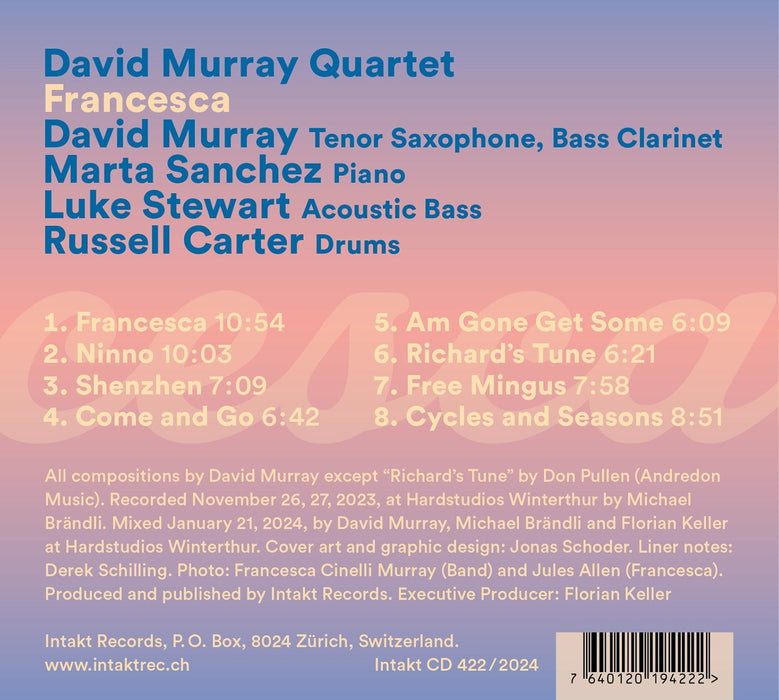
422: DAVID MURRAY QUARTET. Francesca
Intakt Recording #422 / 2024
Recorded September 8 and 9, 2023, by Ryan Streber at Oktaven Audio, Mont Vernon, New York.
Original price
CHF 12.00
-
Original price
CHF 30.00
Original price
CHF 30.00
CHF 12.00
-
CHF 30.00
Current price
CHF 30.00
More Info
Album Credits
G
https://daily.bandcamp.com/lists/david-murray-album-guide
Murray spent many years in Europe, but in the last few years has returned to America. That was announced to the world with his new Quartet, Murray surrounded by the superb young talent of pianist Marta Sanchez, bassist Luke Stewart, and drummer Russell Carter (with Kassa Overall often substituting for him). Words like “renewed” and “revived” are wrong for this album; it’s us who have missed out on what he was doing for so long, so there should be no surprise that Murray is as exuberant and emotive as always. That’s who the man is.
from the article: David Murray is History
Progress in the arts—the way new ideas and possibilities are incorporated and keep things moving concurrently with societal changes—generally follows a formula: the avant-gardist stakes out territory beyond the contemporary boundaries of a tradition, then that tradition eventually catches up. Repeat, repeat, repeat.
Then there are the rare artists who are both avant-gardists and traditionalists, who single-handedly move things forward with the force of their artistic personalities, bringing the tradition into the avant-garde and thereby hauling tradition with them to whatever aesthetic space they happen to occupy. And that is a good single-sentence description of the masterful contemporary jazz musician David Murray.
Born in Oakland, Murray grew up and came of age in California before moving to New York City in the mid-1970s and joining the loft jazz scene. In that decade, jazz music was dying off in record company offices—if you weren’t Miles Davis or Herbie Hancock, nobody was making any money. But the world, and especially New York, was still full of phenomenal musicians. New York was also full of decaying, post-industrial loft buildings without amenities or even working plumbing, but the rents were cheap. That’s essential to the story of post-punk and no wave, but also to new and avant-garde jazz, which not only survived but thrived during the 1970s because musicians found cheap places to live and play (often the same place).
Murray quickly became such an important player with such musical gravity that when the jazz business regained a little life in the 1980s (thanks in large part to the Black Saint/Soul Note labels), Murray was its single most important musician—we’re talking the history of post-WWII modern music and the central story of jazz in the ‘80s. He wasn’t just playing and touring and recording; he was a founding member of the World Saxophone Quartet and the organizer of a little big band that maintained a regular residency at Sweet Basil on Seventh Avenue South. The musicians who cycled through that ensemble included Henry Threadgill and Butch Morris.
In the 1970s, it was almost impossible to find a young tenor saxophonist who wasn’t closely following John Coltrane’s sound, if not his path. Murray was and remains the exception, putting together a sound and style that boils down to a single word: romance. That made for an unlikely fusion of Albert Ayler and Ben Webster, the former the great free-spiritual, neo-primativist, the latter a monumental, traditional, buttery balladeer. But both men were playing about love, for God and Jesus and for romantic partners, and thus for life itself, spiritual and sensual, inseparable. And Murray, first and always, is a deeply expressive, personal player who is telling you about life, loving, living.
That voice, coming through Murray’s tenor saxophone and bass clarinet, is one of the most distinctive in jazz history, bar none. There is no one who has ever sounded or played like him. He has few peers in terms of versatility—Murray is at home playing ballads, free jazz, and also slow jams, funk, Latin music, songs from the Grateful Dead catalog, and more—and while his musical career is strewn with multiple generations of close collaborators, no one has come forth to play like him. The musical personality is perhaps too singular to have an influence that doesn’t sound like imitation. Hear this voice on Bandcamp.

K
Apparently there comes a time when avant garde tenor saxophonists turn into Coleman Hawkins. They don't become slavish imitators, but although exploratory impulses remain, swing, melody and a deeper sound become paramount. That transformation first affected Archie Shepp, who transitioned to blues and ballads by the late 20th century. Now the same metamorphosis has affected David Murray. Unlike Shepp, who arguably changed to mask a failing lip, Murray's skill is still on full display and Francesca is a high-quality mainstream release. One reason for that is the New York-based saxophonist-bass clarinetist (who returned to NYC in 2016) surrounds himself with younger, accomplished musicians, as heard in the last few years on tour and on the quartet's new album: Marta Sanchez (piano), Luke Stewart (bass) and Russell Carter (drums).
Murray also continues to play bass clarinet, and on "Richard's Tune" he takes out that horn and balances chalumeau burps and clarion squeaks. Interestingly enough, the Don Pullen composition, which also features Sanchez' leaping piano chording and Stewart's slithering double bass thumps, mixes wallowing reed scoops and vibrations plus what seems to be a contrafact of "Jitterbug Waltz". On tenor, the passion and power Murray has always displayed is still upfront, alongside slurs, splashes and smears -sometimes expressed unaccompanied -as on the title track. More often than not he plays in tandem with Sanchez' keyboard bounces and swirls, measured drum smacks that take on bop and Latin articulations and occasionally the bassist's string slides. Among the allusions, Murray's expositions encompass interludes where he stutters, swallows and stings tones into expanded doits that meet piano stops and trade fours with the drummer as on "Am Gone Get Some". Torque linear altissimo motions into clenched snorts speed up as they squeal into a nearly endless exposition on "Come And Go". Murray also ups the excitement as constant overblowing and triple tonguing introduce Carter's ruffs and cracks on "Cycles and Seasons". Throughout the album foot-tapping rhythms mostly recap the heads.
Francesca can be heard as one of the most outside mainstream albums or, conversely, the most inside avant garde session. And it can and should be appreciated by those who favor one or both of these genres.
K
Apparently there comes a time in their career when avant-garde tenor saxophonists turn into Coleman Hawkins. They don’t become slavish imitators, but although exploratory impulses remain, swing, melody and a deeper sound become paramount. That transformation first affected Archie Shepp who transitioned to blues, ballads and singing (!) by the late 20th century. Now the same metamorphosis has affected David Murray. Unlike Shepp, who arguably changed to mask a failing lip, Murray’s skill is still on full display and Francesca is a high quality mainstream disc.
One reason for that is the New York-based Californian surrounds himself with younger, accomplished musicians: Spanish pianist Marta Sanchez, who also leads her own groups and Washington D.C.’s bassist Luke Stewart and drummer Russell Carter. Murray also continues to play bass clarinet, and the track on which he takes out that horn balances chalumeau burps and clarion squeaks within a context that includes phrase quotes. Interestingly enough Don Pullen’s “Richard’s Tune”, which also features leaping piano chording and slithering double bass thumps mixes wallowing reed scoops and vibrations plus what seems to be a contrafact of “Jitterbug Waltz”.
On tenor sax, the passion and power Murray displayed earlier s is still upfront, alongside slurs, splashes and smears – sometimes expressed unaccompanied, as on the title tune. More often he plays in tandem with Sanchez’ keyboard bounces and swirls, measured drum smacks that take on Bop and Latin articulations and occasionally the bassist’s string slides. Among the allusions, Murray’s expositions encompass interludes where he stutters, swallows and stings tones into expanded doits that meet piano stops and trade fours with the drummer (“Am Gone Get Some”); torque linear altissimo motions into clenched snorts that speed up as they squeal into a nearly-endless exposition (“Come And Go”; or ups the excitement as constant overblowing and triple tonguing introduce Carter’s ruffs and cracks, (“Cycles And Seasons”).
Throughout the tracks still possess foot-tapping rhythms and mostly recap the heads. Francesca can be heard as the most outside mainstream disc or the most inside avant-garde session – and can be appreciated by those who favor one or both of these genres.
https://www.jazzword.com/reviews/david-murray-quartet/
P
David Murray’s New Century
David Murray is a musician who looms large in my personal history. His brilliant 1983 octet album Murray’s Steps (Black Saint) was the first jazz record I ever bought and not long after I fully internalized all of the music, including the remarkable solos, I saw a version of the band live in Philadelphia, making him the first jazz artist I witnessed live. At that point in my life I had only seen rock bands, which led me to expect to hear the same exact solos from the recordings on stage. Murray’s killer band, which included Baikida Carroll, Craig Harris, and a very young Steve Coleman, disabused me of that expectation. I was fucked up in the best way. For the next 15 years or so I religiously collected every Murray recording I could find. Over time his music became less central to my listening, and I found his recordings in the 21st century inferior to his earlier work. As much as I loved his playing and indelible themes like “Flowers for Albert” and “Morning Song,” I lost interest in keeping up. That all changed a couple of years ago when I heard him perform with Tarbaby at Big Ears in 2023. He sounded better than he had in ages, and that renaissance has proven both real and sustained.
Earlier this year he released a strong new album called Francesca (Intakt) with a new quartet featuring pianist Marta Sanchez, bassist Luke Stewart, and drummer Russell Carter. That agile ensemble not only nails the buoyant energy and melodic generosity of his newer compositions, but they give the leader the kind of springy, brisk support on which he thrives, unleashing solos on both tenor saxophone and bass clarinet that seem as though they could carry on for eternity. You can hear the title piece below. The vibe of this band definitely harks back to the excellent quartets Murray led in the 90s, where masters like John Hicks, Ray Drummond, Idris Muhammad, Wilber Morris, Dave Burrell, Fred Hopkins, and Ralph Peterson Jr., routinely played alongside him. And the tunes are as catchy as ever.
I’m hoping that his quartet eventually makes it to Berlin in the near future. But the other combo Murray has been working with in recent years—a trio with the Norwegian rhythm section of bassist Ingebrigt Håker Flaten and drummer Paal Nilssen-Love—makes its first performance in Berlin this Friday, November 29 at the Institut Francais. Håker Flaten and Nilssen-Love have worked together for decades, particularly in Atomic and the Thing, and Murray’s music was also a key guidepost for them, and when the Thing folded a few years ago they began working with the elder reedist. They’ve yet to release any recordings, but you can check out this fiery performance from the Bimhuis in Amsterdam from September of 2023.
https://petermargasak.substack.com/p/horns-and-more-horns
J
On Francesca, veteran reedman David Murray revisits the classic jazz quartet format which figures so conspicuously in his discography. It represents the debut of a band of younger talent comprising already established leaders in their own right: bassist Luke Stewart (Irreversible Entanglements, jaimie branch), pianist Marta Sanchez (Maria Grand, Oscar Noriega) and drummer Russell Carter (the oldest of the newcomers at 41 and already an alum of Murray’s Class Struggle outfit). Although Murray’s ascent to prominence began in the ferment of Lower East Side lofts, he soon revealed a deep appreciation of the tradition. Traces of both can be discerned in his rendition of the eight pieces here, although he leans heavily towards the latter, only mildly pushing the boundaries albeit without ever compromising direct communication and accessibility.
Right from the get-go, Murray’s bravura display on the warmly effusive title track, dedicated to his wife, very much sets the scene. He adorns a tenor sound as rich as a full-bodied red wine with ecstatic tenor whoops, cries, and trills edging into a falsetto flourish. He’s at his most unfettered on “Come And Go” where, after a churning start resolves into a stop time line, he spins off on increasingly wild detours. But even here Sanchez, Stewart, and Carter’s energetically swinging accompaniment provides a safe landing for the reedman’s flights. Murray wields bass clarinet on two numbers, settling into a light Latin groove on “Shenzhen,” and on the sole non-original, erstwhile partner Don Pullen’s “Richard’s Tune” (dedicated to Muhal Richard Abrams), his throaty bubbling accentuates the Monkish aspects of the tune. That same cut is also notable for a playful introductory duet with Sanchez, hinting at the waltz to come.
Indeed, you could dance after a fashion to much of this program, and you might find yourself humming some of Murray’s catchy themes to boot. Happily, those themes also provide the basis for much of the ensuing development. Sanchez and Murray enjoy the majority of the solo time, with carefully meted allotments for bass and drums. Sanchez navigates the changes in unexpected ways, and shines particularly building upon the earthy angular zigzag of “Am Gone Get Some” (reprised here from 2022’s Seriana Promethea).
If you like your horses frightened, then this may not be for you, but if you prefer your steeds to be thoroughly put through their paces then this could fit the bill.
https://www.pointofdeparture.org/archives/PoD-87/PoD87MoreMoments4.html
W
Wenn es im Jazz ein Synonym für Powerplay gibt, dann ist das David Murray. 1955 geboren, wurde er schon mit 20 Jahren als nächster John Coltrane gefeiert. Doch Murray wollte immer seine eigenen Wege gehen. Sein Spiel ist von berauschender Intensität, weil er immer gegen den größtmöglichen Widerstand ankämpft, was ihm eben die Aura eines gnadenlosen Powerfighters verleiht. Auf seinem neuen Album „Francesca" (Intakt/Harmonia Mundi) klingt er jedoch überraschend elegant.
Eine Liebesgeschichte
Wenn man den ersten Song auf „Francesca" hört, mag man kaum glauben, dass es sich hier um denselben David Murray handelt, der vor viereinhalb Jahrzehnten mit dem World Saxophone Quartet eine Revolution auslöste. Die Geschmeidigkeit seiner Linien auf dem Tenorsaxofon erinnert an eine Liebeser klärung, und genau das ist sie auch, denn hinter dem Namen Francesca verbirgt sich niemand anderes als die Frau des Weltsaxofonisten. „Das ist ja auch eine lange Liebesgeschichte", verrät Murray, der im Gespräch wesentlich nahbarer ist, als er auf der Bühne wirkt. Oft ist es so, dass die Musik selbst dich lehrt, wie du einen Song spielen musst. Das war hier der Fall. Ich schrieb den Song vor vier Jahren, aber es dauerte bis zu den Aufnahmen dieser Platte, bis er mich informierte, wie er gespielt werden wollte. Ich hatte verschiedenste Versionen ausprobiert. Er sollte diese Liebesgeschichte zum Ausdruck bringen, aber ich wollte ihm auch Kanten verleihen. Denn Francesca ist eine komplexe Person. Ich spielte das Lied unentwegt auf meinen Tourneen, es veränderte sich und wuchs. Als die Aufnahmen dann fertig waren, sagte ich meiner Frau, wir nennen das Album, Francesca, weil es der heißeste Song ist. Es ist ein Tribut an die vielen Facet ten ihrer Persönlichkeit."
Im Lauf des Albums vollzieht David Murray eine erstaunliche Wandlung. Von Song zu Song nimmt er mehr Fahrt auf. Der elegante Tänzer auf dem Saxofon verwandelt sich gelegentlich wieder in den einstigen Extremisten, der mit Murrays anderer Per sönlichkeit, dem sensiblen Geschichtenerzähler, in Verhandlung tritt. „In den Seventies war die Revolution ein Teil unserer Exis tenz", leitet Murray ein. „Doch die Zeiten haben sich verändert. Mein Leben ist eine Reflexion meines Reifeprozesses in den Sixties und Seventies. Ich werde oft mit dieser Intensität assoziiert, aber ich habe auch stets Balladen gespielt. Selbst in den komplexesten und intensivsten Stücken habe ich immer auch versucht, ein gewisses Maß an Zärtlichkeit auszudrücken. Kategorien bedeuten mir nicht viel, aber für ein anderes Album, das noch nicht veröffentlicht ist, habe ich mir den Begriff,Avantgallad überlegt. Ich spiele Balladen, aber ich spiele sie immer noch auf eine sehr avantgardistische Weise. Mir geht es um eine sanfte Ausdrucksweise mit scharfen Kanten. Warum sollte ich in einer Ballade keine Multiphonics spielen dürfen? Dann wird mir oft vorgeworfen, ich würde die Ballade zerstören. Aber das ist eben die Art, wie ich sie spiele. Manchmal denken die Leute, wenn ich besonders druckvoll spiele, bin ich wütend. Aber ich bin nicht wütend, sondern eigentlich glücklich. Das ist nur die Art, wie ich das zum Ausdruck bringe."
Tiefe Töne, hohe Töne
David Murray möchte sich lieber selbst definieren, als von anderen Menschen definiert zu werden. Das trifft insbesondere auch auf sein Spiel auf der Bassklarinette zu. Es gibt nicht viele herausragende Bassklarinettisten. In seinem neuen Quartett mit Pianistin Marta Sanchez, Bassist Luke Stewart und Drummer Russel Carter kommt sein Timbre auf dem schwarzen Rohr besonders gut zur Geltung. Man braucht nur zwei Töne von ihm auf der Bassklarinette zu hören, um sie mit David Murray zu identifizieren. Dafür hat Murray selbst eine ganz simple Erklärung. „Es ist einfach so, dass niemand die Bassklarinette so spielen will wie ich. Ich bin sicher kein Vorbild für Bassklarinettisten. Für mich ist Don Byron der größte Bassklarinettist auf der Welt. Kürzlich gaben wir gemeinsam ein Konzert. Ich fühlte mich nicht wohl dabei, neben einem solchen Meister die Bassklarinette zu spielen, und beschränkte mich aufs Tenorsaxofon. Don spielt auch Tenorsaxofon, aber er fühlte sich unwohl, neben mir auf dem Instrument zu spielen. So blieb er bei der Bassklarinette und ich beim Saxofon, und es wurde ein großartiges Konzert. Wir beide waren glücklich."
Trotzdem, auf der Bassklarinette offenbart Murray ein ganz anderes Temperament als auf dem Tenorsax. Während er auf dem Saxofon den Himmel anschreit, zieht er den Ton auf der Bassklarinette direkt aus dem Innersten der Erde. Dieser Beobachtung stimmt Murray vorbehaltlos zu. „Der Ton der Bassklarinette wächst unmittelbar aus der Erde. Sie wirkt wie ein Baum, und eigentlich ist sie sogar ein Baum. Auf dem Tenorsaxofon habe ich absolute Freiheit. Ich spiele es seit meinem zehnten Lebensjahr. Es wahrscheinlich mein bester Freund. Ich kenne es länger als sonst irgendjemanden. Die Bass-klarinette kam später in mein Leben. James Newton machte mich mit...
M
Auf seiner Europatournee im November 2023 zeigte sich der US-amerikanische Tenorsaxo-phonist David Murray (*1955) in der Form seines Lebens.
Begleitet wurde er von einem Trio, dessen Mitglieder alle eine Generation jünger sind als er:
Marta Sanchez am Klavier, Luke Stewart am Kontrabass, Russell Carter am Schlagzeug.
Zum Glück ging er mit dieser Formation auch noch ins Studio, um das in den Konzerten erprobte Material einzuspielen.
Das Resultat liegt nun vor:
»Francesca«, ein Album, das eine gute Stunde herrlicher Musik umfasst. Sieben der acht Kompositionen stammen von Murray, ergänzt werden sie durch »Richard's Tune« von Don Pullen. »Francesca«, das
Titelstück, ist Murrays Frau gewidmet, der Designerin Francesca Cinelli. Es ist fröhlich, schnell, energiegeladen, es steht im Dreivierteltakt, und der Saxophonist spielt mit einer Autorität auf, die an sein großes Vorbild Sonny Rollins erinnert.
Der kraftstrotzende Ton, die melodische Erfindungskraft und das Timing sind umwerfend, auch die mittels Zirkularatmung erzeugten Klangbänder sind nicht bloß virtuose Schleifen, sondern Teil der inhaltlich stringenten Improvisation. Weitere Höhepunkte des Albums sind der 5/4-Brummer »Come and Go«, »Free Mingus« mit seinem R&B-Gospel-Sound sowie »Am Gone Get Some«; letzteres Stück war in einer langsameren Version bereits auf dem Album
»Seriana Promethea« von Murray mit seinem Brave New World Trio (Intakt) zu hören. Der Saxo-phonist, der eine Schlüsselfigur der Avantgardeszene in den 1970er-Jahrs war und mit dem World Saxophone Quartet Geschichte schrieb, reißt seine Mitmusiker mit, lässt sich aber auch von ihnen inspirieren.
Nicht ganz auf der Höhe der übrigen Stücke sind, obwohl als Kompositionen interessant,
»Shenzhen« und »Richard's
Tune«: Hier spielt Murray Bass-klarinette statt Tenorsaxophon.
Zwar leistet er auch auf diesem Instrument Beachtliches, aber wenn man einen Eric Dolphy zum Vergleich heranzieht, bemerkt man doch die Unter-schiede: weniger in der Technik als im Ausdrucksspektrum.
H
フレッシュなミュージシャンと結成した新カルテットが、ヨーロッパ・ツアー後にスイスで録音したお披露目作
自己規制をせず、自由に演奏してよい,とマレイがメンバーに伝えたバンドの運営方法と、サウンド全体のバランス感覚を全員が体得しているからこそ、この成果に繋がったのだろう。1曲を除くすべてを自作で固めたマレイは来年、古希を迎える年齢などまったく関係ないとばかりに、これまで同様の最高音域を連発しながらエネルギッシュにブロウ。先般,やはりIntaktからのトリオ・リーダー作で進境著しい才人ぶりを発揮したサンチェスが充実のプレイで、⑥の作曲者ドン・プーレンを想起させる④も興味深い。強力作だ。(杉田)A
The new quartet, formed with fresh musicians, recorded this debut album in Switzerland after a tour of Europe.
The band's management method, in which Marei told the members to play freely and without self-imposed restrictions, and the sense of balance in the overall sound, which they have all mastered, have led to this successful result, He blows energetically, hitting the highest registers as he has done in the past. Sanchez, who recently showed his remarkable talent in a trio leader album on Intakt, also plays well, and the fourth track, which reminds us of Don Pullen, the composer of the sixth track, is also interesting. This is a powerful work.
L
FRANCESCA / Francesca. Ninno. Shenzhen. Come and Go. Am Gone Get Some. Free Mingus. Cycles and Seasons (David Murray). Richard’s Tune (Don Pullen) / David Murray, t-sax/bs-cl; Marta Sanchez, pno; Luke Stewart, bs; Russell Carter, dm / Intakt CD 422
David Murray is, in my estimation, the most diversely talented of the members of the former World Saxophone Quartet; at least, I can tell you that I have more recordings by Murray in my collection that me made after he left that group than any of the others, good as they were. And the reason is that he is, quite simply, a much more creative and interesting jazz composer than the others. I was first hooked on his music many years ago, in another century, when I heard his album 3D Family, and I’ve been a Murray fan ever since.
On this, his latest recording, he is joined by an exceptionally talented quartet of musicians who understand his aesthetics and are thus sympathetic to his approach. Evaluating Murray strictly as a saxophonist, I would also say that he had, and still has, the most interesting timbre of the WSQ members: it is simultaneously dark, rich, and biting, sort of a cross between Coltrane, Coleman Hawkins and Illinois Jacquet; and interestingly, his style of improvisation combines elements of these three tenor players as well. As a result, you never know where a Murray solo is going to go, but the journey is always interesting and rewarding. He is, I’d also add, a constructionist, by which I mean that all of his solos have direction and form; even when he goes off the deep end with “sheets of sound” or high-register squeals, the notes are always part of a larger pattern that, when you analyze it, makes logical musical sense. And that is another reason why I value him so highly as an artist, and always will as long as both of us are still around and active.
Nor am I exaggerating when I call this group exceptionally talented. Although I admit to not having heard bassist Luke Stewart before, I was utterly bowled over by his playing. He has a big, rich sound, similar to Charles Mingus, much of Mingus’ imagination but an even wilder sense of imagination when he solos…sort of a hybrid of Mingus and Eddie Gomez with a touch of Thomas Fonnabæk, the great European modern jazz bassist whose work I have also praised on this blog. Nor is pianist Martha Sanchez far behind Murray in her wildly creative solos, which skirt tonality while still retaining a sense of structure. And on top of it all, this quartet really swings, even when, as in the final chorus of the opener, bass and drums are fracturing the beat behind Murray, at least until his coda which is played a cappella and is every bit as good as the classic series of cadenzas that Bunny Berigan played on I Can’t Get Started nearly a century ago. That’s just how good Murray still is. He never seems to run out of ideas and seldom, if ever, repeats himself.
The third reason I value Murray so highly is that, even in his wildest outbursts, he always swings, thus he never loses touch with one of the basic elements of jazz. This is especially evident in Ninno, which swings hard from start to finish. If I have any caveat about this band, it is that drummer Russell Carter sometimes overpowers the others with his sound, fracturing the beat in a way that is sometimes interesting but also sometimes distracting, but that is a common style among modern jazz drummers.
Another small caveat that I have is that Murray is simply such an overpowering presence that no matter how good his bandmates are, he always seems to dominate the proceedings. You might say that I feel that way because he is a horn player with an exceptionally powerful tone, which is certainly true, but I would counter that it’s also because he dominates the solo space. Sanchez’ second and third choruses on Ninno are nearly as wildly creative as Murray’s, but her range of dynamics simply isn’t as wide or as arresting as his. Carter takes an excellent drum solo on this one, showing off his multifaceted technique, but to be honest his solo goes on a bit too long and repeats certain licks.
Yet another thing I liked about this recording is the way it was recorded, with the whole band being close-miked in such a way that they are always well-balanced without resorting to too much reverb. This gives the quartet a strong audio presence; they sound as if they are right in your living room. On Shenzen Murray switches to bass clarinet and proves once again what an absolute master of reed instruments he is. In addition to playing in the hard, loud style pioneered by Eric Dolphy on this instrument, he also pulls back on the volume by reducing his breath pressure to just a little above a whisper, which produces the loveliest sound in the middle range I have ever heard on that instrument. His extended solo uses a great many 16th notes in what is basically a medium tempo, yet his control of the instrument is always impeccable. (In addition to all of his other talents, I get...
A
Co w jazzie piszczy [sezon 2 odcinek 25]
https://donos.home.blog/2024/07/11/co-w-jazzie-piszczy-sezon-2-odcinek-25/
C
NO OTHER saxophonist has so mastered the jazz tradition, while simultaneously playing out of it with such musical freedom, as David Murray. Born in Oakland, California, in 1955 he became a nonpareil of jazz saxophone within the post-John Coltrane, post-Sonny Rollins generation and, as he approaches his 70th year, he is still making wondrous sounds of fire, compassion and verve, as his newest album Francesca testifies.
Murray’s mother Catherine was pianist and musical director of the Missionary Church of God in neighbouring Berkeley. His father Walter was head deacon and played guitar.
Murray became president of the Junior High School in Telegraph Avenue, Berkeley, in 1969 when the police used tear gas to disperse the mass demonstrations supporting the People’s Park in which he took part. Later, he became a Black Panther and campaigned for Bobby Seale to become Mayor of Oakland.
All this activism was central to his education as a young musician, “but the church and my mother’s brilliant music inspired me more than any politics,” he says. “I was inspired too by the great trumpeter and Ornette Coleman alumnus Bobby Bradford. When I went to Pomona College near Los Angeles my English teacher was the jazz critic Stanley Crouch. At that time I wanted more than anything to be a writer — the new Ishmael Reed!”
“I had learned piano from my mother at nine. Then I learned alto sax, but when I heard Sonny Rollins at the Berkeley Jazz Festival in 1967, I changed to tenor. I loved the saxophone playing of older players like Coleman Hawkins, Ben Webster and Paul Gonsalves, but to me Rollins was the most complete saxophonist. I liked Coltrane too but I didn’t study him too much because every young saxman was trying to be Coltrane No 2.”
When he was 20 he went to New York. “Some great musicians took me under their wing and inspired me — pianist Don Pullen and John Hicks and drummers Billy Higgins and Ed Blackwell.”
I ask him about his love of melody, so powerfully and movingly expressed on the new album’s title tune to his wife, Francesca,https://intaktrec.bandcamp.com/track/francesca,. “I love melody. I always wanted to be known as a songwriter. Give me a poem and I’ll write a song with it. The song form is at the heart of my love of structure in music, the structure that brings freedom. Yet I want to construct and de-construct through my improvisations at the same time.”
Inside and outside musical structure simultaneously — the true Murray musical power.
What about his use of the bass clarinet, such as on the track Richard’s Tune, composed by Don Pullen? “My bass clarinet gives my listeners a chance to breathe. The constant sound of the tenor saxophone can be overwhelming, exhausting. With the bass clarinet, particularly on slower numbers, you can really hear the wood of the instrument. And the great oceanographer, Jacques Cousteau, once telephoned me after hearing, he said, just 30 seconds of one of my bass clarinet solos. He told me the sound was like the song of the whales and it was if they were talking to him.”
The track Free Mingus, dedicated to his son and released following the great bassman’s centenary, remembers how he and his music would have been at the centre of all the protest and resistance following the Minneapolis death of George Floyd. “That kind of thing goes on every day in America,” he explains: “Thank God for those kids who witnessed it, and their phones.”
What about his young quartet-mates from a new generation of young virtuosi? “Marta Sanchez is a very powerful pianist, one of the finest of her generation. And I've played with so many great bass players — Art Davis, Wilber Morris, Fred Hopkins. Luke Stewart is in their tradition and reminds me very much of the wonderful Hopkins. Drummer Russell Carter plays like all the drummers I really like — Max Roach, Billy Higgins, Ed Blackwell. I hear bits of all of them in him.”
Who would he pick out among British musicians? “There are a lot of great ones. If I was to name them all, we’d be here a while! There’s saxophonists — Denys Baptiste, Tony Kofi — he was a student of mine, I’m so proud of him. And Soweto Kinch, I love him! And looking back there were Ronnie Scott, Trevor Watts and drummer John Stevens. They’re great, and a part of jazz history itself.”
And what is it about the qualities of the greatest jazz music? “To me it’s undefinable. It inspires its listeners and players to wonder, but it’s a science too, you can do so much with it. It excites me that I can reflect human life and emotions — some moments in our lives, sometimes tragedy, sometimes happiness!”
It’s all in Murray’s beautifully creative and relentlessly energetic sound. Give Francesca a spin and you will know.
Francesca is released by Intakt Records
https://morningstaronline.co.uk/article/give-me-poem-and-ill-write-song-it
B
David Murray’s playing has always contained a dialogue between jazz’s vanguard and its canon, but as befits an artist who has sustained a music career since the 1970s, he’s not immune to the lure of practicality. These impulses converge in this quartet, which includes drummer Russell Carter, pianist Marta Sanchez and bassist Luke Stewart. It’s capable of containing moments of combustion within a framework sufficiently swinging that you could book the band into the Village Vanguard. The material is mostly original, save a waltzing interpretation of Don Pullen’s “Richard’s Tune” that contrasts the popping ebullience of the leader’s bass clarinet against Sanchez’s sumptuous piano, and if you have followed Murray in recent times, you’ve heard some of them elsewhere. Thus the record becomes a chance to appreciate Murray’s bold tenor sax tone and full-to-bursting phrasing within an idiomatic context.
https://dustedmagazine.tumblr.com/post/754541867706744832/dust-volume-10-number-6-part-i
P
Mit Swing und Freigeist Wer liebt nicht den US-Saxer
David Murray mit seinem mächtigen Sound und seiner Spielfreude? Mit dem neuen Quartett ist nun die junge Generation am Drücker: Marta Sanchez (Piano), Luke Stewart (Bass) und Russell Carter (Drums). Das Album ist Murrays Frau Francesca ge-widmet, holt die Jazztradition ins Jetzt und überblendet sie mit afrokaribischen, bluesi-gen, auch avantgardistischen Einflüssen. Die Musik packt mit Swing und Freigeist.
J
Nul doute que David Murray a trouvé chez Intakt la compagnie qui lui permet de poursuivre sa riche et longue carrière dans les meilleures conditions. Après quelques invitations et un disque en trio (avec Brad Jones et Hamid Drake), il se présente en quartette, comme il l’a si souvent fait pour le meilleur. Pour cela il s’entoure d’une paire rythmique de Washington et d’une pianiste madrilène (qui vient d’enregistrer à son tour pour Intakt). Murray se situe au centre de cette filiation qui part de Coltrane et Rollins, brièvement Ayler, passe par Archie Shepp et se poursuit par Lewis : la voie royale du ténor pourrait-on dire qui conduit chez lui à un post free mainstream résultat d’une longue maturation. Alternance de belles compositions variées, mélodiques, bien construites et rythmées, amplitude et accents du discours, envolées vers les suraigus du sax, alternance des solos et organisation “classique” du déroulement musical. Le disque de l’évidence du jazz. https://www.culturejazz.fr/spip.php?article4209#james_brandon_lewis_quartet_transfiguration