
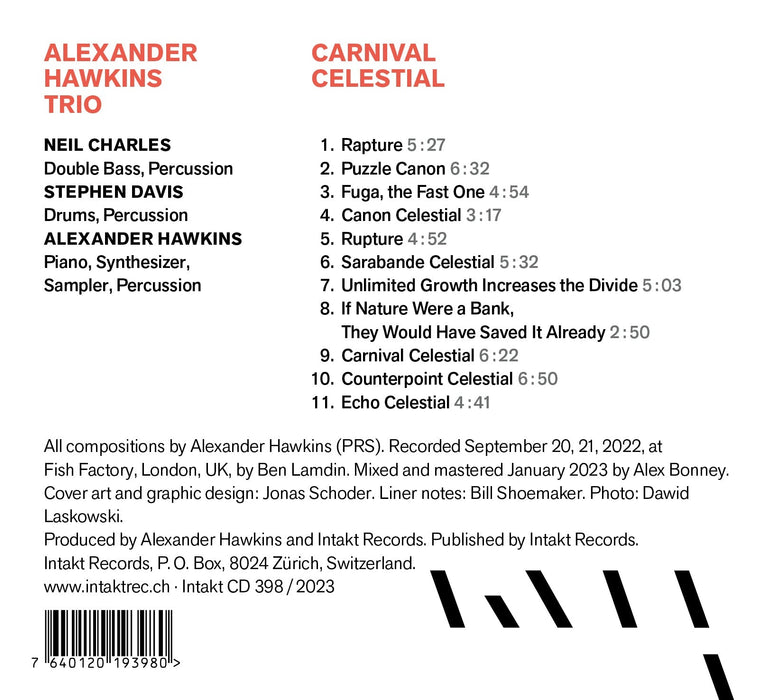

398: ALEXANDER HAWKINS TRIO with NEIL CHARLES and STEPHEN DAVIS. Carnival Celestial
Intakt Recording #398 / 2023
Ursprünglicher Preis
CHF 12.00
-
Ursprünglicher Preis
CHF 30.00
Ursprünglicher Preis
CHF 30.00
CHF 12.00
-
CHF 30.00
Aktueller Preis
CHF 30.00
More Info
Album Credits
A
BEST OF 2023
HONORABLE MENTIONS-NEW RELEASES
Alexander Hawkins Trio - Carnival Celestial (Intakt)
Angelika Niescier - Beyond Dragons (Intakt)
Anna Webber - Shimmer Wince (Intakt)
Michael Formanek Elusion Quartet - As Things Do (Intakt)
Sylvie Courvoisier - Chimaera (Intakt)
Trance Map+ - Etching The Ether (Intakt)

K
NEW RELEASES
1 Steve Lehman & Orchestre National de Jazz Ex Machina Pi Recordings
2 BlankFor.ms/Jason Moran/Marcus Gilmore Refract Red Hook Records
3 Robert Mitchell/Neil Charles/Mark Sanders Towards The Flame Vol.1 577 Records
4 Matthew Shipp The Intrinsic Nature of Shipp Mahakala
5 Nite Bjutie Nite Bjutie Whirlwind Recordings
6 James Brandon Lewis Red Lily Quintet "For Mahalia. With Love" Tao Forms
7 Joshua Redman where are we Blue Note
8 Ambrose Akinmusire Beauty Is Enough Origami Harvest
9 Alexander Hawkins Trio Carnival Celestial Intakt
10 Mark Turner Live At The Village Vanguard Giant Step Art
REISSUES & ARCHIVE
1 Sam Rivers The Quest Red Records
2 Stan Tracey Quartet Jazz Suite Inspired By Dylan Thomas' Under Milk Wood Resteamed
3 Woody Shaw Blackstone Legacy Contemporary/Jazz Dispensary Top Shelf Series
4 Pharoah Sanders Pharoah Luakabop
5 John Carter & Bobby Bradford Self-Determination Music Flying Dutchman/BGP
6 Dorothy Ashby. With Strings Attached 1957-65 New Land
7 Grupo Um Starting Point Far Out
8 Nimbus Sextet Live In Lotusland Nimbus
9 Norman Connors Dance Of Magic Buddah
10 Yusef Lateef Detroit Arc Records

B
Jazz Recordings of the Year - Finalists 2023
What a terrific year it's been for new music from the jazzosphere! We've had the privilege of listening to and reviewing a whole heap incredible recordings to have been released by the most wickedly talented contemporary artists around. Over the course of the past 12 months, the team here have been whittling down our favourite new albums from across the globe, each of which has made its way to our Leamington Spa office for us to sink our teeth into and wrap our ears around.
With a wide variety to choose from, the task was never going to be easy... but, with the help of our trusty reviews and weekly new release round-ups, we've revisited some of the most impressionable records from this year — ones we think deserve to take their newly-minted place in the jazz canon.
The shortlist for this year's Presto Awards celebrates the veritable breadth of the current jazz scene both at home and abroad, which we hope you will see reflected in our choice of nominees. You can browse through the finalists below, and until 29th January 2024 we're offering discounts of up to 15% on almost all of the featured titles. As always, stay tuned for our winners announcement along with prizes for Label of the Year, Archive/Reissue and Newcomer in Jazz on the evening of Thursday 7th December!
Jazz Recording of the Year - Nominees
Alexander Hawkins Trio - Carnival Celestial (Intakt)
"...The synergy throughout the album’s dance-like structure exhibits the musicians’ playfulness in their adventurousness as they rise and fall in perpetual freeness."
https://www.prestomusic.com/jazz/articles/5629--awards-jazz-recordings-of-the-year-finalists-2023

U
Entdecken
Alexander Hawkins Trio:
Carnival Celestial (Intakt) Ein Klaviertrio! Geht ja nicht ohne im Jazz. Aber der britische Pianist findet neue Wege im Vertrauten

C
Strutture forse troppo organizzate
Alexander Hawkins, pianista quarantenne, spicca fra i jazzisti britannici più avventurosi. Quasi un concept album, Break a Vase (Intakt) presenta il suo nuovo sestetto Mirror Canon, che comprende il noto sassofonista Shabaka Hutchings. É musica densa, ritmicamente avvolgente, forse un po' troppo pianificata ma di tutto rispetto. In fondo anche le <> di Cecil Taylor, cui sembra ispirarsi, erano assai organizzate.

J
Oxford-based pianist Alexander Hawkins’ trio, completed by bassist Neil Charles and drummer Stephen Davis, has been integral to much of his recent activity. They appeared alongside him and vocalist Elaine Mitchener on UpRoot, and also formed the bedrock of last year’s sextet outing on Intakt, Break A Vase. Furthermore, their inside/outside facility made them the natural choice to round out Anthony Braxton’s ensemble, captured at length on Quartet (Standards) 2020. So, it’s no surprise that they work so hand in glove at times on Carnival Celestial. What’s more unexpected is the way Hawkins deliberately pitches himself against them at certain junctures, to generate an unsettling off-balance effect. Clearly, as you would expect from someone with Hawkins’ forward-looking streak, this isn’t a straightforward piano trio session.
Since Togetherness Music, where Matthew Wright manipulated the circuitry, Hawkins has also been delving into the potential of electronics to augment his conception, and here they play their most prominent role in his work to date, even though this remains predominantly acoustic music. Glitchy crackling is almost the first thing heard on the album at the start of “Rapture,” along with a percolating bass pizzicato and jangly percussion, before Hawkins layers prepared piano tinkling, darting synth beeps, an annunciatory line, and a rumbling bottom end against the increasingly busy drums. This is the first of several selections where spacey textures and fragmented beats punctuate or supplement the program.
In the liners, Bill Shoemaker, publisher of this parish, alludes to Hawkins’ obsessive practice of Bach and perhaps it is the time he spends on those devilish two-handed masterpieces which informs his breathtaking pianistics here. Certainly “Puzzle Canon,” where Hawkins draws inspiration from the classical form, constitutes one of the highlights, with notable contrapuntal interplay both in the theme and the dazzling improvisation that follows as Davis and Charles launch a lurching groove. Another peak comes on the title track with its interlocking piano and bass which breaks out into spacious conversation, and the following “Counterpoint Celestial,” where Hawkins does what it says on the tin with yet more sparkling independent limbed dexterity.
Charles’ nimble surefootedness and Davis’ stuttery hip hop inflected cadences create an absorbing mesh which the pianist can either insert himself into, as he does on say “Sarabande Celestial” or juxtapose against. That’s the case on the woozy “Canon Celestial,” where the pianist recalls Craig Taborn in his pomp, obliquely intersecting with a repeated (looped?) bass/drum/electronics pattern. He rarely utilizes conventional song structure, tilting closest on the spare “Unlimited Growth Increases The Divide.” Indeed, in some cases cuts end once the seemingly composed segments appear, job done, without further resolution.
In performance Hawkins often favors unbroken sets where one piece transitions into the next, and in that setting the textural cuts here make perfect sense as both change of pace and linking episodes when interspersed among the more propulsive numbers. Perhaps this is the studio as laboratory, but as with similarly adventurous stablemates Punkt. Vrt. Plastik, the threesome of pianist Kaja Draksler, bassist Petter Eldh, and drummer Christian Lillinger, a live album m
https://www.pointofdeparture.org/PoD83/PoD83MoreMoments3.html

K
Hawkins – who must now vie with Shabaka Hutchings as the most ubiquitously hard-working man on the UK jazz scene – returns to the Intakt label for his second trio album for the Swiss imprint.
As Bill Evans consistently demonstrated over a number of decades, the piano/keyboard trio format is one of the most flexible and expressive in all of jazz. There's so much you can do with it, providing you have the imagination. On this showing, Hawkins and his longtime rhythmic companions Neil Charles and Stephen Davis possess this quality in spades.
Carnival Celestial begins quietly, and contemplatively, with the light watercolour wash of ‘Rapture’ but from then on in this is a tempting selection box of styles and textures, ranging from the distinctly uncarnival-esque title track (it's rather like a copper going up to a happily parping Sonny Rollins and saying "Stop that carnival right now!"); via the woozy, storm-tossed ‘Sarabande Celestial’; to the upbeat romp of ‘Counterpoint Celestial’; before returning to the beginning with the synth-dominated wisp of ‘Echo Celestial’.
What is particularly enjoyable about this album, despite its occasional asperities, is the tangibly telepathic link between the three players, with Charles and Davis able to respond to the various caprices of Hawkins’ compositions, as happy with a synth gibber as with a piano trill.
https://www.jazzwise.com/review/alexander-hawkins-trio-with-neil-charles-and-stephen-davis-carnival-celestial

J
Alexander Hawkins, le voici, entouré de deux fidèles comagnons que l’on rencontre souvent avec lui depuis une bonne dizaine d’années, Neil Charles (contrebasse) et Stephen Davis (batterie) [1]. Une fois de plus, le pianiste (et musicien) imprévisible nous a concocté un disque virevoltant et consistant où la musique rebondit, danse, s’engage dans plusieurs pistes, fouille au cœur de la substance, de la texture musicale. Onze pièces très libres, signées par Hawkins, composent ce disque éclaté et pourtant cohérent. Comme quoi on peut renouveler et poursuivre l’histoire du trio piano-basse-batterie, même si l’on y ajoute, sans hiatus, quelques phrases de synthé, quelques samplers et percussions légères. Passionnant. « Carnival Celestial »
https://culturejazz.fr/spip.php?article4049

C
Der englische Jazzmusiker und Komponist Alexander Hawkins ist als virtuoser Tasteninstrumentalist bekannt, der in seinem Trio nicht nur Piano, sondern auch Synthesizer spielt, dazu noch einen Sampler bedient, und das alles gleichzeitig mit größter Präzision und in souveräner Manier. Hawkins' Pianospiel besitzt eine ambidextere Qualität, was bedeutet: Man könnte meinen, es würden zwei Pianisten unabhängig voneinander agieren, so eigenständig und kontrapunktisch spielt die linke Hand in den tieferen Regionen im Unterschied zur rechten in den höheren Registern. Es macht auf einmal Sinn, wenn Hawkins erzählt, dass er seine tägliche Übungsstunden mit Johann Sebastian Bach bestreitet.
Seit einiger Zeit erlebt das Piano-trio ein Comeback im Jazz, doch schwebt Hawkins anderes vor. Dem 42-Jährigen aus der Universitätsstadt Oxford geht es weniger um die Erneuerung einer bestimmten Jazztradition als um das Ausloten musikalisch unbekannter Zonen, die im Grenzbereich von modernem Jazz, experimenteller Musik, Minimalismus, avanciertem Rock, Musique concrète und Electronik liegen. So ist das Hawkins Trio einerseits im Jazz verwurzelt, gleichzeitig zielt die Musik darüber hinaus und lässt sich deshalb einer aktuellen Tendenz zurechnen, die unter dem Schlagwort <> firmiert.
Der Rhythmusgruppe aus Neil Charles (Bass) und Stephen Davis (Schlagzeug) kommt eine tragende Rolle zu. Ihr Spiel ist dicht und vorwärtstreibend, wobei der Groove oft eher einem Puls gleicht, der unter dem Klangschleier von Metallbecken und Trommelfellen pocht. Ein paar Stücke weiter, und die beiden schlagen ganz andere Töne an. Da wird dann ein Bassriff von Kontrabass und Synthesizer loopartig wiederholt und von einem staubtrockenen Drumbeat unterlegt, der dem motorischen Trommelspiel des Can-Drummer Jaki Liebezeit alle Ehre gemacht hätte.
Solche Ostinati legen die Basis für weitausgreifende Piano-Improvisa-tionen, die sich über elektronischen Einwürfen oder knisternd-knirschenden Geräuschfeldern in ekstatische Höhen schrauben, um dann plötzlich, ganz jäh und unvermittelt, einfach abzureißen, als hätte jemand den Stecker der Bandmaschine gezogen. Eine solche Praxis bricht mit jeder Konvention und ist nicht die einzige Tabuverletzung, die Hawkins unternimmt, um aus Komponenten des musikalischen Baukastens der Moderne einen hybriden Stil zu kreieren, der voller Eigenheiten und Überraschungen steckt.

C
“ALTHOUGH I also value the piano as a harp in a box, I love to think of it as 88 tuned drums.”
So says one of the true nonpareils of British piano jazz, Alexander Hawkins.
Born in Oxford in 1981, his mother was in charge of pastoral care in a local school, and his father a university professor. “We always had a piano in the house,” he told me, “so I started to play piano as soon as I could reach the keys, having my first piano lessons at the age of six.
“As a teenager my musical obsessions were jazz and classical music. They were the musics I had always loved, as far back as I can remember. I didn’t want to be swayed by mainstream opinions, but by a contrarian streak. At school these musics were ‘mine’, and not what my peers were listening to.”
His earliest memories radiate music: “I don’t remember a time when I wasn’t fixated by this music. My very earliest memory was getting lost in a supermarket, my second was of listening to the Duke Ellington composition, Saturday Night Function — and then a programme about Art Tatum in the car. I can even recall the precise track listing, even at a distance of 35 years: Tiger Rag, Dvorak’s Humoresque and Ellington’s Sophisticated Lady. I also remember being in a trance when I first heard Eric Dolphy. I simply loved what I could hear.”
He pays tribute to the great pianists on whose shoulders he stands: “The Tatum Trio record with bassist Red Callendar and drummer Jo Jones is a touchstone for me. Bud Powell's trio on the Blue Note album Time Waits would be a Desert Island pick, Max Roach and the Legendary Hasaan is a stone classic, Sun Ra’s God is More than Ever Love should be, and I couldn’t be without the work of Mary Lou Willams and Geri Allen, two more seminal figures.”
Yet the musician who has influenced him most is the last survivor of the South African Blue Notes, octogenarian drummer Louis Moholo-Moholo, with whom he toured and recorded both as a member of his band, Five Blokes, and as duet partner in the momentous album Keep Your Heart Straight (2012) on Ogun Records.
Hawkins says of his time with Louis: “It would be impossible to overstate how important he has been to me. The energy that band could produce was absolutely electric, a revelation to me how the power of music communicates and galvanises — music that felt powerfully political and vital, while being music that felt nothing more or less than ‘the sound of joy,’ to quote Sun Ra. For Louis, music was really a matter of life and death, something that a musician from the relative privilege of this country would do well to remember.”
Hawkins asserts what every listener came to know on their ears: “Anything was permissible in that band, with one exception. It would have been unforgivable not to give every performance absolutely everything.”
His new record is, like hundreds of others in the century of jazz, but not like any of them, a jazz trio album, with bassist Neil Charles and drummer Stephen Davis. I asked how the title, Carnival Celestial, arose.
“It came about almost by accident, in the rehearsal room. I was trying to suggest a rhythmic feel for that track, trying to get a calypso-type thing — if heavily refracted in a Sun Ra prism. I came out with this phrase and the title stuck.”
Hawkins explains that the album’s music comes from a combination of certain ideas. “It’s important for me never to have in the background an idea of an x/y/z group/album. That is a problematic path that sends the sound towards the conservative and derivative. There’s a duty to guard against these tendencies, in music as elsewhere.”
“Second: several of the compositions make use of structural and harmonic devices developed in my larger ensemble, now newly applied in a trio setting. Thirdly, I use electronics, and because I’m not terribly competent with them in an orthodox sense, they behave in ways that surprise me, and are juxtaposed with my piano playing where I’m much more in control of what's going on.”
I asked him about the track titles, and the contradictions between the “celestial,” otherworldly concept and titles stemming from a much more politically realist perspective, like If Nature Were a Bank, They Would Have Saved it Already and Unlimited Growth Increases the Divide.
“I thought hard about this, and the jarring between two modes of titling was deliberate. There’s a responsibility to speak about social issues, but as musicians we’re much, much further from the front line than many of us would like to think. We try to be provocative, but must be aware that this is a long way from direct action, even though I want to spotlight the people on the ground who are trying to change things in a more direct way — strikers, charities, researchers and such. But ultimately the ‘otherworldly’ is related to the ‘worldly.’ We need to safeguard those who every day struggle with the right to imagination and escapism.”
What about his trio-mates, Charles and Davis? “When you play with friends you understand there i...

S
English pianist Alexander Hawkins, like contemporaries Kris Davis, Kaja Draksler, Eve Risser and Cory Smythe, is a historically-informed radical, here pressing the traditional jazz piano trio into new terrain. His working trio of Neil Charles (bass) and Stephen Davis (drums) accompanied Anthony Braxton during an epic European tour that has been preserved on the 13 CDs of Quartet (Standards) 2020. And here they extend their sonic palette, with Charles adding percussion to his role and Hawkins augmenting his piano with synthesizer, sampler and additional percussion.
Given that Hawkins carries history lightly and with a fleet touch, it's remarkable just how much of it he carries at all. In his liner notes, Bill Shoemaker mentions Hawkins once, naming Ellington's Money Jungle trio (bassist Charles Mingus and drummer Max Roach) and Art Tatum's 1956 recordings with bassist Red Callender and Papa Jo Jones as his favorite piano trios, an appreciation of both deep history and the special energy of collisions. His lineage as pianist/composer includes Andrew Hill ("Fuga, the Fast One") and Paul Bley ("Canon Celestial"), demonstrating an acuity about the ways that intervals of pitch and time can together shape a complex line's identity.
Beyond that compound sense of tradition as playground and library-Hawkins is both a thoroughly in-the-moment creator and a thoughtful composer, with a lively sense of detail and subtle linear movement. His compositions come in sets: several canons, a few "Celestials". The canon is a particularly tight contrapuntal form, and it goes to the heart of the trio's music, often a rapid three-way slicing-up of time that emphasizes Charles' and Davis' incisive attention to detail. The eleven tracks vary widely, but each is layered and multi-directional. The opening "Rapture" levitates on Charles' slightly exotic bass line and the ethereal burbles of Hawkins' synthesizer and sampler, reminiscent of Sun Ra, before piano assumes the foreground. On "Rupture", Hawkins' left hand doubles Charles' bass line, fraught with cinematic dread. Hawkins' sense of orchestration similarly serves an uneasy social vision in "If Nature Were a Bank, They Would Have Saved It Already" and an ethereal anxiety in "Echo Celestial".

M
On that most rare occasion when a piano-bass-drums trio transcends its instrumental limitations, magic can, indeed, ensue. Such is the case for Carnival Celestial (Intakt Records, Switzerland), by the Alexander Hawkins Trio (all three add percussion) wherein composer Hawkins adds synthesizer and samples to his mellifluous piano.
https://www.theaquarian.com/2023/07/31/rant-n-roll-eight-eccentric-records-to-discover/

P
In questi anni Alexander Hawkins non si è fatto mancare nulla: dal solo al duetto e all'orchestra, passando per la rilettura di ben sessantasette standard al servizio di Anthony Braxton, ma ha evidenziato le sue indubbie qualità. In "Carnival Celestial" ha puntato con spregiudicatezza a spostare i confini e le possibilità del trio, la formula più celebre e purtroppo malmenata dell'intera storia del jazz. Per tale impresa ha scelto per compagni Neil Charles (contrabbasso) e Stephen Davis (batteria), con i quali per la Intakt aveva inciso in precedenza "Uproot", insieme alla cantante Elaine Mitchener, e agito nel monumento braxtoniano citato. L'affinità fra i tre era dunque già collaudata e ha giovato non poco sia nella messa a fuoco dell'album sia nell'esplicitazione di trame esecutive mai effimere e semplificate.
Il fatto è che il pianismo di Hawkins - percussivo, ostinato, mai arrotolato su un fraseggiare scialbo - non ammette cali di concentrazione né in chi suona con lui né in chi ascolta. Nel "Rapture" d'avvio si nota l'impiego del synth e di campionamenti gorgoglianti, una pratica che ritorna in alcuni brani successivi e connota l'elettronica in funzione di quarto uomo, sorta di convitato di pietra inquietante e imprevedibile. "Puzzle Canon" è un'istantanea di frammenti che non si ricompongono mai in un insieme definito, benché si possa intravedere nella base di partenza lo schema di un canone classicamente inteso. Ne scaturisce però una forte energia e qualcosa di simile, pur in una chiave più distesa, avviene anche in "Canon Celestial". Di maggiore libertà godono "Sarabande Celestial" e "Fuga, The Fast One", che per certo sarebbero piaciute anche a Monk e Tristano.
