
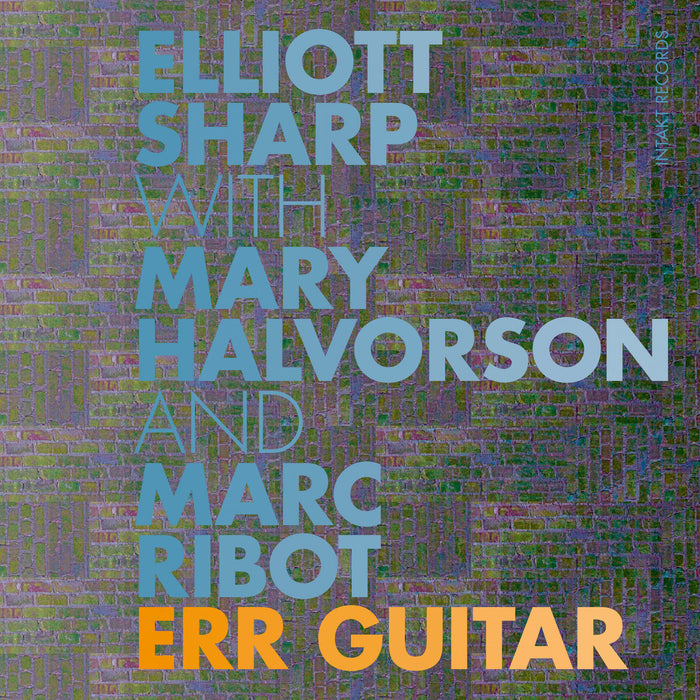
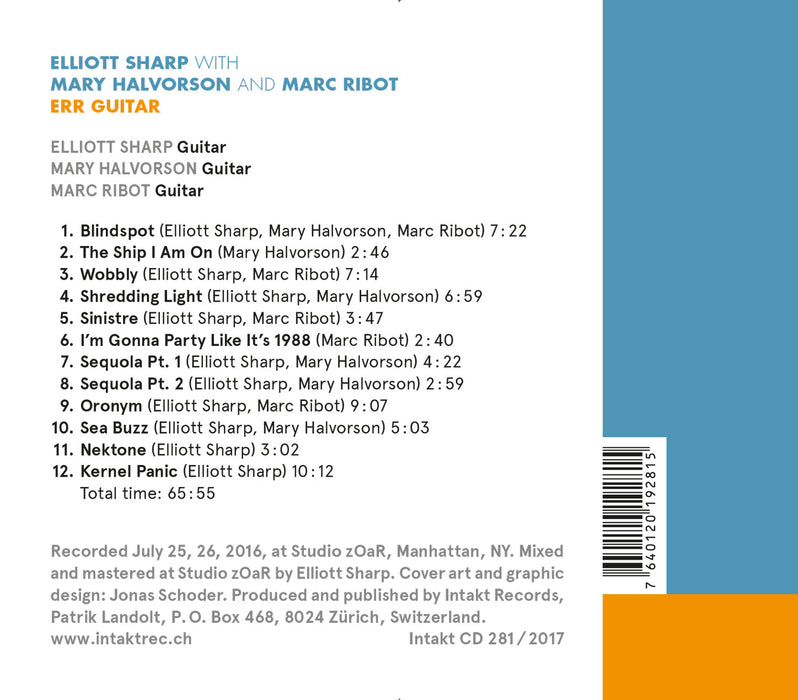
281: ELLIOTT SHARP with MARY HALVORSON and MARC RIBOT. Err Guitar
Intakt Recording #281/ 2017
Ursprünglicher Preis
CHF 12.00
-
Ursprünglicher Preis
CHF 30.00
Ursprünglicher Preis
CHF 30.00
CHF 12.00
-
CHF 30.00
Aktueller Preis
CHF 30.00
More Info
Album Credits
J
Guitar summits can be awfully dull affairs. But with G the right players - understanding the possibilities of effects and percussive techniques as well as chords, color, and line - they can be dazzling. Like this one. But even before you listen, you know from a glance at the players here that we're a long way from McLaughlin, DiMeola, and DeLucia, sisters and brothers. That's not just because of the quirky recording method, which featured one duo per day, with conscious effort to leave room for the third player to record their contribution subsequently. It has more to do with the way each player here exults in idiomatic properties of the guitar, without being constrained by the instrument's expectations.
The opening trio sets the table, with a full strings ecosystem of wild little buzzes and scuffles. Halvorson is unmistakable at this point, with her cosmic effects and earthy lines contrasting masterfully. And indeed, taking Sharp's flinty playing and Ribot's quirky twang into the equation, counterpoint takes on new meanings here. Instead of mere notes and chords, these pieces are overstuffed with anything sonic that the guitar can produce but with a musical logic that makes intuitive sense and grabs you if your ears are open enough. Chiming, resonant repetitions dot the multi-tracked Halvorson piece "Ship," all loops stacked up and toppling over. There's a fine feature for Ribot and Sharp on acoustic, "Wobbly," with loads of rough woody slashing contrasted with sudden introspection and dynamic shifts. But generally things tend towards the more cosmic ("Shredding Light") or the noisy ("Sinistre" or "I'm Gonna Party Like It's 1998"). Sharp makes nifty use of his Ebow on the resonant "Sequola," where Halvorson plays with an unmediated, emphatic lyricism on her acoustic. And there's a monster drone on "Oronym," which also crawls with little electronic insects
struggling to stay alive under the sonic weight. The final trio returns to the vibe of the opener, darting and slashing everywhere. Lots of settings like this can sound clinical and overly technique-obsessed. These three use the guitar as a springboard to pure, shared invention.

M
Avec ses confrères Eliott Sharp et Marc Ribot, Mary Halvorson mêle son jeu à celui de deux personnalités singulières avec lesquelles elle partage le travail de composition. Elle est parfaitement à son aise dans cet environnement masculin où la six cordes électrique est traitée de façon orchestrale et dans tous ses états. La guitariste s’affirme ainsi comme une des meilleures représentantes de cette approche ouverte d’un instrument dont l’histoire dans le jazz — parallèlement à la tradition qui se perpétue — continue à s’écrire de la façon la plus aventureuse. Soit un panel d’instrumentistes qui dépasse largement le rôle de chanteuse ou de pianiste ordinairement réservé aux femmes dans le monde du jazz.
Il n’est pas étonnant qu’un label indépendant suisse leur accorde une place aussi importante. C’est en effet des marges qu’on peut attendre une telle ouverture, et les grands labels restent à ce niveau très timides et traditionnalistes.
Bravo donc à Intakt et à ses producteurs — dont l’une est une femme, Anja Illmaier, ce qui est loin d’être courant dans la jazzosphère internationale.
https://blogdegarenne.blogspot.com/2020/10/gender-stories-2.html

L
Dans cet antre du brumeux où chacun aurait pu se dissimuler, les voici, au contraire, se dévoilant. Bien sûr, Elliott Sharp mine l'arpège, Marc Ribot broie le texte et Mary Halvorson détériore l'harmonie: en cela, on ne les changera pas.
Si Mary Halvorson se démultiplie en solo, si le Sharp soliste amalgame les angoisses et si Ribot croise à merveille le rouillé de ses cordes, ce sont les duos qui, ici, attirent l'oreille.
Sharp-Ribot d'abord en acoustique pointilleuse tailladant l'harmonique d'un proto-folk malade puis invitant saturation et anamnèse à se réconcilier. Le duo Sharp- Halvorson est une ruche électrique où s'accomplissent des duels soniques sans vainqueurs; ruche- astre aux sonorités lunaires bien vite oubliée quand leurs acoustiques guitares s'envolent en des vélocités encombrantes. Evidemment, si vous n'aimez pas les guitares..

J
Le grand guitariste américain Elliott Sharp (cf. Culturejazz « C’était en 2013 : 2e séance de rattrapage » 14/01/2014) a réuni deux autres guitaristes américains non moins grands, Mary Halvorson et Marc Ribot, pour une série de duos (plus quelques trios et solos). Depuis les débuts de la guitare dans le jazz (Lonnie Johnson & Eddie Lang), les duos ont toujours été pratiqués et appréciés. Parfois, les registres voisins de l’instrument peuvent s’embrouiller ou bien c’est la musique qui tourne dans le vide, des écueils souvent difficiles à éviter. Ici, les discours s’entrelacent, s’entremêlent, mais gardent leur lisibilité malgré leur complexité (pas de soliste ni de rythmique). Pas non plus d’effets sonores faciles et superflus, les jeux et phrasés sont résonnants mais évitent toute saturation, même lors de moments intenses. Et surtout, pas de clichés ! Alors, amateurs de belle guitare et de chemins aventureux, ce disque est pour vous.
https://www.culturejazz.fr/spip.php?article3360

R
Na prossecução do seu desejo de construir uma utopia da guitarra, ou seja, uma música guitarrística que tenha as suas lógicas nela própria e em mais nada, e que ao longo do tempo foi ganhando expressão em projectos a solo, à frente de vários grupos ou até encomendando peças a outros músicos para a criação de compilações (caso da série “I Never Meta Guitar” na Clean Feed), Elliott Sharp convidou outros dois guitarristas inventivos da actualidade, Mary Halvorson e Marc Ribot, para verificar o que acontecia – o resultado é este “Err Guitar”, com a fonia a sugerir a designação Air Guitar para as mimetizações gestuais com que se “toca” um instrumento que é apenas imaginário. O seu propósito era que «se desse um passo num futuro desconhecido, mas nascido do passado mais profundo», resolvendo todas as contradições inerentes por via da improvisação, esse «caminho sónico transcendente do agora». O que não quer dizer que os solos, duos e trios constantes neste disco tenham sido integralmente improvisados no seu estúdio de Nova Iorque: Sharp transmitiu as premissas do projecto aos seus parceiros de ocasião e cada peça deriva de um conceito, uma estrutura ou uma composição (a uma, duas ou três mãos). O homem que já interpretou / transfigurou a escrita para piano de Thelonious Monk numa seis-cordas não acredita que possa existir uma improvisação totalmente livre e por isso não só não a pratica (salvo algumas excepções) como desconfia de quem o faz. O que aqui se ouve é improvisação emoldurada, na justa medida que permite a cada um dos intervenientes deixar a sua própria marca individual.
O passado é convocado pela adopção de técnicas que vêm dos confins históricos da folk, dos blues, do rock e do jazz, como por exemplo o “fingerpicking” e o uso de “bottlenecks”, e o futuro a que se pretende chegar surge nos processos inovadores, nos parâmetros estéticos (e daí que alguns críticos já tenham comentado que esta é uma música «de outro planeta») e nos usos deveras criativos dos pedais de efeitos, do “looping” e do “sampling”, regra geral parecendo que não são guitarras que estamos a ouvir. Mas se a guitarra que está para além da guitarra, a guitarra utópica, atravessa todos os 12 temas, em todos os momentos também é confrontada por elementos da guitarra tradicional, como se se tivesse ampliado a um nível macro os contrapontos desenvolvidos. Às tantas, deixamos de perceber onde termina um tipo de abordagem e começa o outro, tão simultaneamente presentes e tão em osmose ambos vão ocorrendo, o que passa, inclusive, pelo esbatimento das distinções entre eléctrico (electrónico) e acústico. Eis, pois, um álbum que, para além de agradar ao ouvido, nos põe a pensar.
https://www.jazz.pt/ponto-escuta/2018/01/25/elliott-sharp-mary-halvorson-marc-ribot-err-guitar-intakt/

K
Composer, bandleader, multi-instrumentalist, Elliott Sharp is a musician hard to classify, with equal proficiency in blues-rock, improvisation and new music. Here he concentrates on his main instrument, the guitar, on a dozen solos, duos and a trio with fellow pickers Mary Halvorson and Marc Ribot. Oddly enough, Sharp and Ribot, who specialize in more agitated sounds, both turn almost folksy in duets on Wobbly, Sinistre and Oronym. Although their chess game-like moves are both subtle and spiky on Sinistre, it’s the last track which is most distinctive. Here, one guitarist’s legato finger-picking tries to surmount the other’s canine yapping-like plucked onslaughts, until relaxed string undulations are replaced by a multiplicity of crying buzzes. Blanketing drones dominate the three Halvorson duets, with the strokes on Shredding Light so thin they break into electronic flanges. Slurred fingering and guitar-neck taps enliven both parts of Sequola, although a blanket of buzzes can’t disguise intricate dual connections.
Sharp’s solo work, however, is the most representative. Nektone for instance swiftly unites Delta bottleneck picking and outer-space-like multiphonics without fissure. Meanwhile, Kernel Panic knits together so many passing chords that it’s almost opaque. Then suddenly, with no hint of overdubbing, there seem to be two guitar lines travelling in opposite directions – one with rumbling organ-like ostinato, the other snapping out arena-sized distortion. That he manages to tame these opposites into a reassuring ending that is true to narrative, logical and conclusive, is another tribute to Sharp’s multi-talents.
https://www.thewholenote.com/index.php/booksrecords2/jazzaimprovised/27339-err-guitar-elliott-sharp-with-mary-halvorson-and-marc-ribot

C
Deze ludieke opname in trio behelst in werkelijkheid een reeks duo's tussen gastheer Elliott Sharp en zijn 2 gasten. 2 trio's zijn ontstaan door studio-indub- geen bezwaar bevat. Trippelende, hakkelende en zwevend verbogen gitaarklanken vloeien en brokkelen in en uit mekaar. Effectieve melodiëen worden niet nagestreefd en zijn geen uitgangspunt van deze wonderlijke, onaardse gitaarwereld. Effectpedalen en alternatief gebruik van de snaren en electronica leggen een vreemd, doch nooit schreeuwerig of agressief kleurenpalet bloot. Men kan hier de woorden noise en sounds- capes makkelijk gebruiken, doch gaat het in wezen veel meer om spontane gesprekken waarbij de alchemisten in elkaar kruipen.

A
Im Sommer 2016 lud Virtuoso Elliott Sharp die beiden Gitarristinnen Mary Halvorson und Marc Ribot in sein Manhattaner Studio ein, um ein Album aufzunehmen, das einerseits dem Instrument an sich gewidmet sein sollte, andererseits dem jeweils einzigartigen Sound der beiden Musikerinnen. Sharps Wahl fiel auf Halvorson und Ribot, weil – so schreibt er im Begleittext zum Album – beide ihren eigenen und unverwechselbaren Ton auf ihrem Instrument zu erzeugen in der Lage sind und ihr Spiel darüberhinaus einerseits um Traditionen Bescheid weiß, dabei aber schon am Weg in die Zukunft sei. Perfekt, um sich mit den beiden zu treffen, um im Hier & Jetzt zu improvisieren. Dem Ergebnis muss man Zeit geben, um seine Wirkung zu entfalten. Es geht um Sounds, das Ausloten von Möglichkeiten und um das Sich-treiben-Lassen. Und die drei driften gekonnt durch periphere Klanglandschaften von abseitiger Ästhetik, ohne Angst vor exzentrischen Oberflächen zu haben, deren Kern, die meisterhafte Kommunikation der Musikerinnen, eine subtil-bizzare Schönheit zutage fördert. Material, das in vielen Produktionen in Gefahr laufen würde, ausgemistet zu werden, türmt sich hier zu einem erdabgewandten Ausblick in eine Zukunft des Gitarrenspiels.

A
Gipfeltreffen der Gitarrenfreigeister: Elliott Sharp, Pionier der New Yorker Downtown-Szene, lud im letzten Sommer Mary Halvorson und Marc Ribot je einen Tag in ein Studio in Manhattan zu musikalischen Erkundungsreisen. Tausendsassa Ribot, omnipräsent von Tom Waits bis John Zorn, ist nicht nur Weggefährte von Avantgarde-Ikone Sharp, sondern hat auch die aufstrebende Gitarristin Halvorson schon zu mehreren gemeinsamen Projekten eingeladen. Seelenverwandtschaft ist also über die Generationen hinweg garantiert. Die Persönlichkeiten der drei Musikabenteurer sind, wenn etwa Ribots Spiel wie auf Spinnenbeinen daherkommt, unüberhörbar. „Err Guitar" ist keine leichte Kost, aber für geduldige Hörer ein spannendes Dokument dessen, was auf sechs Saiten alles möglich ist.

U
Äh, Gitarre
Stian Westerhus, Ronny Graupe, Jacob Bro, David Torn, Kalle Kalima, Nels Cline, Christian Fennesz, um nur mal ein paar Namen zu nennen. Will sagen: Der Gitarre in der improvisierten Musik geht's so gut wie lange nicht. Auf welchem Abstraktionsniveau, jenseits von Konvention, Song und Groove, mittlerweile agiert wird, zeigt sehr eindrucksvoll und durchaus nicht ohne Humor das Duo-Trio-Album >>Err Guitar<«, das an zwei Tagen im Juli 2016 in Elliott Sharps Zoar-Studio in New York entstanden ist.
Sharp, Jahrgang 1951, ist seit Jahrzehnten eine äußerst produktive Größe der New Yorker Avantgarde. Marc Ribot, Jahrgang 1954, spielte einst bei den Lounge Lizards und in diversen Bands von John Zorn, veredelte die Platten von Tom Waits mit allerlei komischen Sounds und schüttelte immer wieder irrwitzige Projekte aus dem Ärmel. Zuletzt etwa The Young Philadelphians, eine Band, der das erstaunliche Kunststück gelingt, sich gleichzeitig vor Ornette Colemans Prime Time und dem Phillysound der Siebziger zu verbeugen. Bei den Young Philadelphians ist auch Mary Halvorson, Jahrgang 1980, mit von der Partie, die seit ihren Arbeiten mit Anthony Braxton und Ches Smith als originellste Gitarristin ihrer Generation gilt.
Und jetzt also eine Art Gipfeltreffen: zwei Tage in New York. Kein Schwanzvergleich wie damals in der Freitagnacht von San Francisco, sondern eine Reihe von Gesprächen unterschiedlichen Temperaments. Die Sache mit der angedachten Triokonstellation ließ sich aus Termingründen nur virtuell herstellen, wurde dafür aber sehr aufregend gemeistert. Alles scheint möglich im Zwiegespräch, auch Dissens. Mitunter dauert es nur wenige Takte, bis sich aus Klängen, die an eine blubbernde Wasserquelle denken lassen, ein Reggae-Rhythmus schält (>>Shredding Light<<). Dann wieder lugen Blues, Ragtime oder Bluegrass verstohlen ums Eck >>(I'm Gonna Party Like It's 1988<). Geradezu unheimlich wird es bei >>Sea Buzz<«, wo zur Slide-Guitar Geisterstimmen, ja, echt jetzt, Kindergeisterstimmen zu hören sind.
Es hilft ungemein, wenn man zu verges- sen versucht, dass man gerade dabei zuhört, was drei Musiker den ihnen zur Verfügung stehenden 18 Saiten abzuringen wagen - und einfach die Ohren öffnet.

B
No note is a mistake if the next one redeems it, right? This gets especially challenging in a setting where you don't know what the other players are playing; the best you can do is guess what the next good note should be. This two- day session hosted by Elliott Sharp, who invited fellow string-slingers Mary Halvorson and Marc Ribot to his studio, was originally envisioned as a series of duets culminating in a trio. It became a next-level music-plus-one situation when scheduling mandated that Sharp and Ribot play without Halvorson, forcing them to imagine what he she might play and requiring her to respond without seeing the players she was playing "with." Never mind jamming, such a setting is more of a test of a player's ability to think their way out of a jam-ergo, Err Guitar.
The outcome is a series of tense tangles, some fully acoustic, some subject to the influence of circuitous circuit chains. Each player gets one baseline-establishing solo. Halvorson's delay-enabled passage points out that even solos can be conversations between what the soloist thought and what the soloist is thinking. Ribot signals that he finds the situation a bit comic by opening his solo selection, "I'm Gonna Party Like It's 1988," with a snippet of "Three Blind Mice." Sharp flies between processed and pure tonal options like a caffeinated gibbon swinging through the rainforest canopy; it's undeniably skilled and quite spectacular, but a bit exhausting to follow. The most densely knotted duets compound this experience, but there are also moments where the players ease back and let the music breathe.
Credit is due to Sharp for his engineering, which captures the session in radiant, three-di- mensional detail.

R
A black hole is a region of spacetime exhibiting such strong gravitational effects that nothing—not even particles and electromagnetic radiation such as light—can escape from inside it. Stephen Hawking observed a phenomenon that now bears his name – Hawking radiation – that a faint energy emission is created right at the edge of a black hole’s event horizon, or the point beyond which even light cannot escape. This led to the theory that purports that these objects are not entirely dark. In other words Black Holes are not black holes. However, just as the colour “Black” best describes the colour “White” and vice versa, the name suits the phenomenon. Curiously and remarkably this phenomenon also describes this music by Elliott Sharp, Mary Halvorson and Marc Ribot on Err Guitar.
The play on the words “Black Hole” us almost an exact fit for the title of this album: namely, Err Guitar in which the brilliantly Quixotic “wrongness” of the aural palette, almost as if the music was represented by a series of invisible ~ symbols (to describe “non-notes”) together with a series of ! symbols to describe values of non-negation, both of which nestle cheek-by-jowl and describe things like “transitory feelings” “dissonance” and “consonance” instead of regular musical “notes” with fixed values. Of course, the music was surely played (and recorded) without any such thing, which leaves us to marvel at the seemingly indescribable nature of this music by Elliott Sharp, Mary Halvorson and Marc Ribot unless it is perceived as being the pure energy at the edge of a black hole’s enormous and limitless event horizon.
Consider therefore listening to “Blindspot” with eyes wide shut as opposed to open and looking behind your shoulder. Listen to the dangling, drawling conversations-as-counterpoint played by the guitarists on “The Ship I Am On” while allowing the sound and effect of its pitch and yaw to dazzle the fluid in your inner-ear and create a series of ebbs and flows in your mind’s ear and jump – if you like – to “Sea Buzz” for added sound effects with or without the memory of “The Ship I Am On”. “Wobbly” is a distinct reminder to hold onto something with one hand with a glass of something “tall and deadly” in the other. Meanwhile “Sinistre”, “Sequola”s two parts, “Oromyn” and “Nektone” could easily become a soundtrack for your own brain waves and synapses as you click your fingers at random, stamp your feet arrythmically and dance madly at Marc Ribot’s event described as “I’m Gonna Party like it’s 1988”.
Mercifully, production notes do not ascribe individual parts to individual guitarists. That would surely diminish the enjoyment of the music for aficionados who are apt to read liner notes before or while listening to the music. The music of Err Guitar is best enjoyed holistically, which means that if you can – again with eyes wide shut – allow the music to impact your senses in a kind of gelatinous state of pure energy then it will, like “Shedding Light” become the elusive entity that it is, crowning the visceral excitement of experience the delicate magic of Mary Halvorson’s wonderfully natural ebullience, the limpid vocalise with the insouciant runs of Marc Ribot’s liquidness and dizzying, airborne grace of Elliott Sharp as a contiguous whole in the exhilaration of this black hole of music.
https://jazzdagama.com/music/elliott-sharp-mary-halvorson-marc-ribot-err-guitar/

G
Avventure latin in Svizzera
Nuove uscite per la Intakt, etichetta della Svizzera tedesca assai attenta a quanto si muove nei bordi più avventurosi del jazz, quelle linee di faglia che possono aprirsi da un momento all'altro mettendo in crisi equilibri consolidati. Ad esempio tutto ciò che consideriamo «latin jazz», una zona della musica che associamo spesso a rassicuranti atmosfere danzerecce. Non è così, per estetica, per maturità di tocco, per concezione totale della musica il pianista Aruán Ortiz, che dopo una bella prova in trio esce ora con Cub(an)ism, per piano solo. Certo, si sente anche il pulsare della «clave», ma ci sono anche Paul Bley, John Taylor e echi di Abdullah Ibrahim nella sua musica. Silke Eberhard invece suona, assai bene, contralto e clarinetto basso. Con il suo Trio in The Beein Inn la jazzista mostra un livello di interplay favoloso con i suoi musicisti, e la musica (radici in Mingus, Dolphy, Ornette Coleman) va potente e decisa. Il veterano delle corde elettriche Elliott Sharp con i colleghi Mary Halvorson e Marc Ribot in Err Guitar. brani nati da duetti, con l'aggiunta poi del terzo convocato. Sorprendenti e intensi.

G
Drie gitaristen samen in de studio en toch geen egotripperij of een clash van decibels. Het gaat hier dan ook om Elliott Sharp, Mary Halvorson en Marc Ribot, muzikanten die al jaren experimenteren met de meest diverse stijlen en daarbij steeds oor hebben voor hun ‘partners in crime’.
Sharp kent Ribot al meer dan dertig jaar. Halvorson behoort sinds een tiental jaren tot zijn vriendenkring. Hun gemeenschappelijke uitvalsbasis is New York. Basisidee voor deze cd was een reeks duo-opnamen en eventueel wat trio-stukken als kers op de taart. Wegens drukke agenda’s en tijdsgebrek lukte dit laatste niet, althans live. Daar werd een mouw aangepast dankzij de moderne studiotechnieken. Concreet: Sharp ging een dag de studio in met Ribot en een dag met Halvorson. Ze speelden telkens met in het achterhoofd het feit dat er nog een derde partij aan toegevoegd ging worden. Ver gezocht? Zelf omschrijven ze het als “the transcendent sonic path of the now”.
Meer dan een uur lang glijden plectrums en vingers over de snaren van de verschillende gitaren en wordt er geschraapt en geplukt. Volledig uitgewerkte melodielijnen krijg je niet te horen, wel compacte clusters die even te voorschijn getoverd worden maar al even snel verschuiven naar een nieuwe eenheid. Doorgedreven inventiviteit gekoppeld aan gedurfde improvisatie, al dan niet met een partituurschets als vertrekpunt. Nu eens claustrofobisch, dan weer uiterst suggestief. Soms klinkt het allemaal alsof ze de principes van Jean Tinguely zijn kunstwerken Méta Matics vertalen naar hun muzikaal idioom.
Niet meteen een klankband om te onthaasten, eerder voer voor gitaarfreaks om technische discussies te starten. En toch klinkt het nooit te hermetisch en valt er ook voor de (gevorderde) improvisatieliefhebber heel wat te genieten en te leren.
http://www.jazzenzo.nl/?e=3725
