
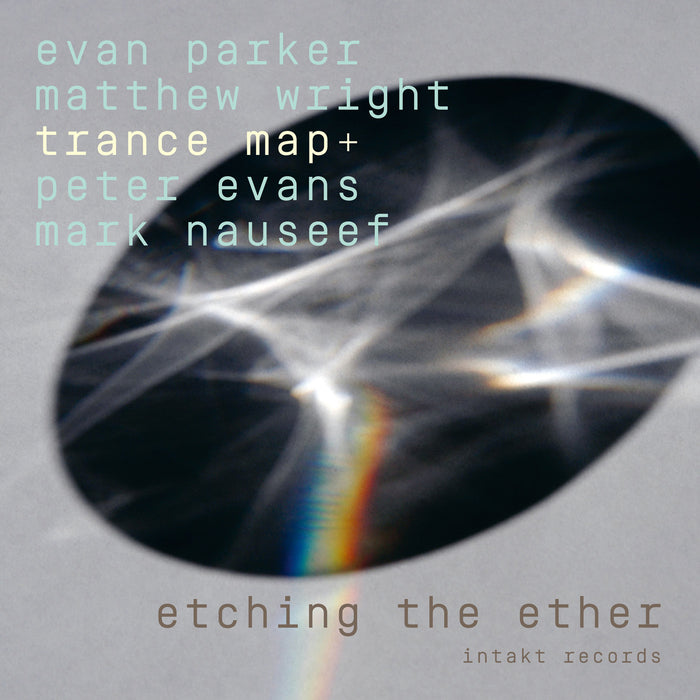
409: EVAN PARKER MATTHEW WRIGHT: Trance Map+ with PETER EVANS and MARK NAUSEEF. Etching The Ether
Intakt Recording #409 / 2023
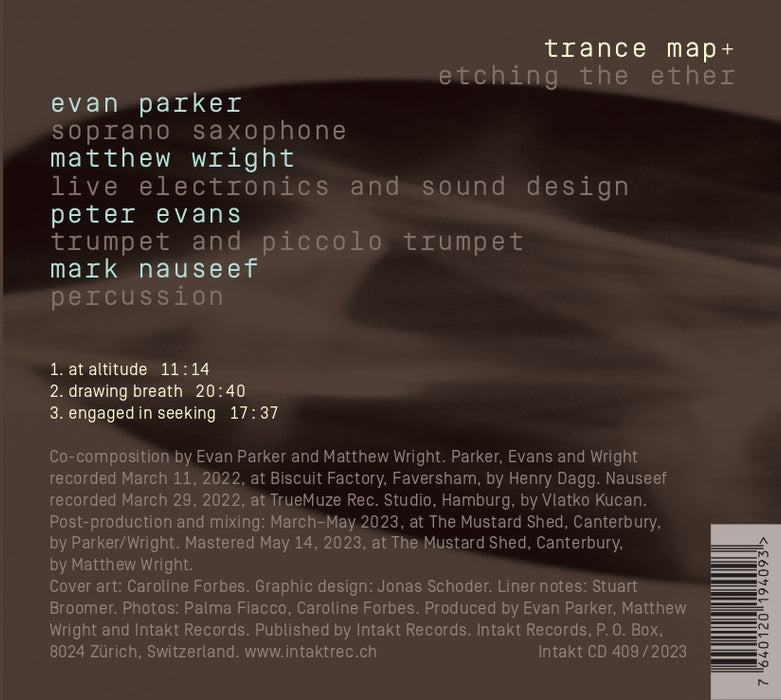
Evan Parker: Soprano Saxophone
Matthew Wright: Live electronics and Sound design
Peter Evans: Trumpet and Piccolo Trumpet
Mark Nauseef: Percussion
Recorded March 11, 2022, at Biscuit Factory, Faversham.
Verkauf
Verkauf
Ursprünglicher Preis
CHF 12.00
-
Ursprünglicher Preis
CHF 30.00
Ursprünglicher Preis
CHF 30.00
CHF 12.00
-
CHF 30.00
Aktueller Preis
CHF 30.00
| /
More Info
Trance Map+ is an electro-acoustic formation in constant motion. Founded by electronic musician, turntable player and sound designer Matt Wright and Saxophoneophonist Evan Parker, the band is in a constant process of transformation, renewal and expansion, both conceptually and also due to fluctuations in personnel. Etching the Ether features star trumpeter Peter Evans and percussionist Mark Nauseef. This new musical adventure began with a trio recording by Parker, Wright and Evans, with Evan Parker asking Mark Nauseef for “intro, interludes and a coda”, material which was added in post-production. “What arises in the process is a determinedly plural space, a temporal cubism, a dream time that’s omnidirectional. Reverb is less an effect than a new relationship, echoing ‘back’ as it moves forward”, writes Stuart Broomer in the liner notes.
Album Credits
Cover art: Caroline Forbes
Graphic design: Jonas Schoder
Liner notes: Stuart Broomer
Photos: Palma Fiacco, Caroline Forbes
Co-composition by Evan Parker and Matthew Wright. Parker, Evans and Wright recorded March 11, 2022, at Biscuit Factory, Faversham, by Henry Dagg. Nauseef recorded March 29, 2022, at TrueMuze Rec. Studio, Hamburg, by Vlatko Kucan. Post-production and mixing: March–May 2023, at The Mustard Shed, Canterbury, by Parker/Wright. Mastered May 14, 2023, at The Mustard Shed, Canterbury, by Matthew Wright. Cover art: Caroline Forbes. Produced by Evan Parker, Matthew Wright and Intakt Records. Published by Intakt Records. Intakt Records, P. O. Box, 8024 Zürich, Switzerland.
- 5 stars: 17 (100%)
- 4 stars: 0 (0%)
- 3 stars: 0 (0%)
- 2 stars: 0 (0%)
- 1 star: 0 (0%)
M
Marcello Lorrai Fra i pochissimi capiscuola dell'improvvisazione radicale europea ancora in attività, il 5 aprile Evan Parker compie ottant'anni: ma al di là di questo compleanno, che è un motivo in più per festeggiarlo, la sua musica, che non si è mai fermata e che ha continuato ad essere estremamente attuale, è una ragione più che sufficiente per occuparsi di lui. In questa puntata (ma presenteramo
un'altra novità di Evan Parker nella puntata del 19 febbraio) ascoltiamo il sassofonista in due album molto distanti per i momenti in cui sono stati registrati e per il carattere della musica, ma entrambi di grande interesse.
L'etichetta newyorkese Relative Pitch ha meritoriamente pubblicato una registrazione che, oltre ad offrirci una testimonianza in più della maestria di Parker nella dimensione del solo (sei mesi prima Parker aveva inciso in solo il suo capolavoro Monoceros), ha un grande valore storico, perché documenta la prima esibizione
newyorkese di Parker, nel corso della sua prima tournée in Nord America, nell'autunno del '78. Meritorio anche che l'etichetta svizzera Intakt dia un seguito discografico al progetto Trance Map + di Evan Parker e Matthew
Wright (elettronica), dopo un primo album pubblicato qualche anno fa (ce ne eravamo occupati in una puntata del novembre 2019). In tre ampie sequenze, fra improvvisazione e dimensione minimalista, i partner di Parker e Wright sono questa volta il trombettista Peter Evans e il percussionista Mark Nauseef, due fuoriclasse della scena radicale.
https://www.radiopopolare.it/puntata/?ep=popolare-jazzanthology/jazzanthology_29_01_2024_22_59
G
Glenn Astarita "Trance Map+" is a collaborative project involving some incredibly talented musicians exploring the realms of avant-garde jazz and experimental sounds. Etching the Ether features three extended pieces, treated with Matthew Wright's live electronics and sound design. It is a production that embarks on a sonic journey, pushing the boundaries of improvisation and musical exploration.
The album delves into intricate soundscapes, where each track is an evolving entity. The musicians known for their prowess in improvisation, create an enticing tapestry of sound that feels both well-defined and free-flowing, yet expansive and luminous, amped by soprano saxophonist Evan Parker's legendary circular breathing techniques and his foil, trumpeter Peter Evans' multidimensional sense of direction. Whereas Mark Nauseef executes the asymmetrical and often-colorful percussion parts.
Etching the Ether captures the essence of investigative spontaneous improv, embedded in cultivated experimentation, utilizing a diverse range of instruments and electronic elements to craft far-reaching landscapes that are deeply immersive. The musicians' ability to communicate through their instruments is astounding, as they navigate through layers of sound, creating atmospheres that range from hauntingly ambient to dynamically intense.
Their collective strength lies in transporting audiences to unexplored musical realms. The intuitive, group-focused interactions resonate throughout, forming a captivating dialogue embellished with ethereal overlays that evolve dynamically. More than a mere album, this set offers an immersive auditory journey challenging conventional musical norms. A treasure for enthusiasts of experimental jazz and seekers of sonic adventures beyond traditional structures, its emotive prowess and vivid aural landscapes make it a riveting addition to the avant-garde jazz realm.
https://www.allaboutjazz.com/etching-the-ether-trance-map-intakt-records
T
The New York City Jazz Record THE NEW YORK CITY JAZZ RECORD BEST OF 2023 BEST OF 2023 BEST OF 2023
HONORABLE MENTIONS-NEW RELEASES
Alexander Hawkins Trio - Carnival Celestial (Intakt)
Angelika Niescier/Tomeka Reid/Savannah Harris - Beyond Dragons (Intakt)
Anna Webber - Shimmer Wince (Intakt)
Michael Formanek Elusion Quartet - As Things Do (Intakt)
Sylvie Courvoisier - Chimaera (Intakt)
Trance Mapt - Etching The Ether (Intakt)
G
Guy Peters De voorbije vijftien jaar kwamen rietblazer Evan evona Parker en elektronica-expert/sounddesigner Matthew Wright regel- etch2ng、tha、わされ。 matig samen voor geim-proviseerde sessies die even cerebraal als radicaal de wereld van de elektroakoestische mogelijkheden verkenden. Regelmatig was dat ook met extra gasten, vaak muzikanten met een heel eigen persoonlijkheid. Zo was er bvb. al Toma Gouband, een percussionist die graag gebruikmaakt van natuur- elementen (stenen, twijgen, takken...), en deze keer was hun partner de virtuoze Peter Evans. De trompettist zou je kunnen beschouwen als Evan Parkers gelijke op de trompet: een met een fenomenale techniek gezegend genie die de grenzen van het onmogelijke voor zich uit blijft schuiven. (GP)
K
Karl Lippegaus Trance Map +: Etching The Ether; Evan Parker (ss), Matthew Wright (efx), Peter Evans (tp), Mark Nauseef (perc); Intakt
„Toward The Margins" von Evan Parkers Electro-Acoustic Ensemble (ECM,
1997) zeigte, wie aufregend kollektive Improvisation in Verbindung mit Live-Elektronik und Sound-Processing sein kann. Diese Saat von damals geht noch immer auf, Mr. Parker ist seiner Vision weiterhin auf der Spur. In dem Trompeter Peter Evans fand er den idealen Dialogpartner für dieses Riesenaben-teuer. Umwerfend, wie sie sich die Bälle zuwerfen und Matthew Wright die Impulse auffängt und umwandelt. Großartig passend dazu die Schläge von Mark Nauseef - wie aus einem Zen-Kloster.
K
Ken Waxman Constantly seeking novel sonic areas in which to explore, Trance Map, UK saxophonist Evan Parker’s newest disc raises the question of when are four musicians not a quartet. That’s because this cornucopia of synthesized expression was first recorded by Parker, American trumpeter Peter Evans and British sound designer Matthew Wright. Figuring that the textures from his soprano saxophone, oscillations from Wright’s electronics and Evans’ brass extensions needed more zest however, American drummer Mark Nauseef’s percussion interludes were added in post-production.
Nauseef, whose playing experience encompasses ethnic music, hard rock bands and free improv, was sensitive enough to the idea so that his intermittent idiophone attachments merely embellish the program. So is this a quartet or a trio plus one session? That’s actually a moot question Since the bell-like tolling, marimba-like echoes and drum kit thumps are no more prominent than the saxophonist’s frequent circular breathing exercises; the trumpeter’s bitten off triplets or brass flatulence; and the sound designer’s voltage undulations and whizzes.
Seemingly divided into an introduction, elaboration and conclusion, the first track is thickened by brass growls and reed flutters as electronic timbres and responsive clangs hang in the air. Before concluding with a coda of gong-like tolling and occasional electronic shudders, the final track gives the horn players space to conclude the dynamic intensity both exhibit on “Drawing Breath “, the central and longest improvisation. As the two elaborate the exposition, polyphonic miasma evolves and detours into extended techniques which encompasses Evans’ bugling advances, plunger snarls and mewling cries plus Parker’s tongue stops and strained trills. This doesn’t preclude reflective melodic interaction from both, further intensified by idiophone clashes and wave form crunches.
Working down the scale, piccolo trumpet peeps and low-pitched reed split tones slide against one another as tambourine-like slaps and electronic twitters gradually fade into the background. The result produces timbral reciprocity which clearly leads to the climax and coda. No matter the number of musicians involved what has been etched during the program is an instance of propound improvisation , live and programed.
https://www.jazzword.com/reviews/trance-map/
T
Thierry P. Benizeau NOUVEAUTE. Figure historique du free jazz britannique et européen depuis les années 1960, Evan Parker s'est réinventé aux côtés de Kenny Wheeler, Peter Brötzmann, Paul Lovens, Alexander Von Schlippenbach, Barry Guy ou Paul Lytton et a marqué de son empreinte la pratique instrumentale et l'improvisation spontanée.
Trance Map, groupe fondé en 2008 avec le compositeur et sound designer Matthew Wright, est le laboratoire où le saxophoniste et compositeur Evan Parker expérimente de nouvelles formes d'expression musicale par l'adjonction, en live, d'effets électroniques. Avec "Etching The Ether", Parker, Wright, Peter Evans et Mark Nauseef combinent recherche musicale et interplay, façonnant un univers où les notions mêmes
'improvisation et de composition se confondent. Les trois titres de ce disque repoussent encore les limites du jeu instrumental, la technologie multipliant voix et espaces temporels. Ainsi At Altitude où un bourdon dédouble le son du saxophone soprano, ou la composition originale
Drawing Breath dont le traitement électronique démultiplie les parties du soprano et de la trompette.
Avec Engaged In Seeking, les voix de Parker et Evans s'harmonisent dans l'électronique, générant en un continuum rythmique des motifs de micro secondes, créant un effet de décalage temporel, la percussion de Mark Nauseef semblant même invoquer le rituel de cérémonies religieuses. Evan Parker atteint avec "Etching The Ether" un pic d'intensite mystique dans son œuvre.
P
Pirmin Bossart Als ein Gigant des Solo-Spiels mit Zirkular-atmung und ausgefeilten Blas- und Intonations-techniken ist der englische Saxophonist Evan
Parker bekannt geworden. Seit langer Zeit arbei-tet er mit Multiphonics. In den frühen 1990er-
Jahren begann er, mit Live-Elektronik zu experi-mentieren, und gründete mit dem ElectroAcous-tic Ensemble eine wegweisende Formation. Mit dem Elektronik-Spezialisten Matt Wright, den
Parker 2008 kennenlernte, ist schliesslich Trance Map+ entstanden, eine Duo-Konstellation mit
wechselnden Gästen. Auf dem aktuellen und dritten Album sind Peter Evans und Mark Nau-seef an Bord. Während Parker, Wright und Evans ihr Material live einspielten, sind die Spuren von
Nauseef separat entstanden und erst in der Post-Produktion eingefügt worden. Nauseefs perkus-sive Beiträge, oft mit hellen Glockenschlägen und Gongs, machen diese Musik erst richtig zum Genuss, genauso wie die herausragenden
Soundtexturen von Matt Wright. So virtuos Par-ker auf dem Saxophon bläst und Evans mit sei-nem Piccolo-Geschmetter scharwenzelt, sind es immer wieder die Elektronikflächen und die ritu-alartigen Perkussions-Interventionen, die mit ih-ren Klängen aufhorchen lassen, essenzielle Ak-zente setzen und uns an diesem energetischen
Soundstream dranbleiben lassen.
U
Ulrich Rudenauer Bei elektronischen Musikformen ist die Technik kein Hilfsmittel, sondern ein Instrument, das sich auch für intuitive und improvisatorische Soundexplorati-onen nutzbar machen lässt; mal mehr. mal weniger kontingent. mal algorithmischen Prinzipien gehorchend, mal wie ein frei verfügbares Tool. Auch wenn das keine Neuigkeit ist, man sollte es sich beim Hören der jüngsten Zusammenarbeit des verdienten Free Jazz-Saxopho-nisten Evan Parker und des Laptop-, Sampling- und Turn-table-Virtuosen Matthew Wright als Trance Map noch einmal klar machen. Der zur ersten Generation des europäischen Free Jazz gehörende Parker forscht seit langem im Grenzbereich elektro-akustischer Geräusch-verdichtungen, zusammen mit Wright seit 2008. Diesmal sind wieder - wie auch schon bei früheren Projekten der beiden - Trompeter Peter Evans und Perkussionist Mark Nauseef mit von der Partie. Wie genau die Prozesse des Zusammenagie-rens, die verschiedenen Er-arbeitungsverfahren und die Postproduktion abgelaufen sind, das lässt sich in prägnanter Form in den Liner Notes von Stuart Broomer nachlesen. Wichtig ist vielleicht, dass diese Musik sowohl als aktuelle Interaktion von Mensch (Instrument) und Maschine (Laptop) ent-steht, die Zeitdimension aber erweitert wird, indem manche Teile später hinzugefügt, weggenommen oder am Computer verwandelt werden. Das darf allerdings nicht mit üblichen produktionstechnischen Studio-verfahren verwechselt werden, sondern ist Teil des kreativen Spiels am Stück. Dass sich dabei ein organisches Ganzes formt, ist das wunderlich Schö-ne: Über pulsierende, sich behutsam transformierende Klangschichten legen sich die freischwebenden, atmenden Bläserimprovisationen; Ebenen verschieben sich im Laufe eines Tracks und verschwimmen mit-einander, es gibt gemeinsame Schwingungen und auch Ab-stoßungen. Die minimalistisch flirrende Eloktronik echoint wiederum das Spiel von Evans und Parker einzusaugen und weiter-zuführen, so entsteht zuweilen etwas Chorisches, Sphärisches; darüber legt sich eine filigrane perkussive Stimme, die punktu-oll kommentiert odor bostimmte Sequenzen durch einen exquisit feinziselierten Mitteleinsatz be-tont. Was Komposition ist, was Improvisation - es verflüchtigt sich im Hin und Her von Direktheit und Nachträglichkeit. Diese Musik, sagt Stuart Broomer, soi ein entschieden pluraler Raum, ein zeitlicher Kubismus, eine Traumzeit, die omnidirektional ist«. Man kann, scheint's, besser in poetischer Abstraktion davon sprechen. Dazu passt freilich der rätselhaft-ange-messene Titel des Albums: Etching the Ether« - den Äther ätzen? Ja, so könnte man nennen, was die vier da ma-chen.
T
Thierry Giard J’ai lu le livre de Jean-François Foucault, "La valise de Jean Schwartz". Autant l’annoncer d’entrée de jeu, je ne suis pas un grand lecteur de livres sur le jazz et la musique en général. Je préfère, de loin la matière sonore aux longs écrits qui l’entourent. Si je me suis arrêté sur celui-ci et que je me suis laissé porter au fil des pages, c’est qu’il vient résonner de façon particulière dans ma vie avec et autour du jazz. L’auteur et moi avons un point de rencontre dans nos cheminements dans l’organisation de concerts : le trio Humair-Jeanneau-Texier en 1980.
Bien que je n’aie pas le souvenir d’avoir rencontré Jean-François Foucault, je connaissais le "tourneur" (comme on disait), plus exactement l’agent d’artistes. Il a figuré et figure encore dans les carnets d’adresses aujourd’**** obsolètes que je conserve précieusement, reliques de l’époque révolue où j’œuvrais bénévolement dans l’organsiation d’un festival. Si mes souvenirs sont exacts, c’est ce même J-F Foucault qui avait démarché auprès de Gérard Houssin, directeur du Centre d’Animation de Coutances (Manche) pour "placer" le trio Humair-Jeanneau-Texier dans une saison théâtrale multi-disciplinaire naissante.
J’ai eu l’occasion de raconter par ailleurs comment "germa" le festival Jazz sous les Pommiers que l’on ne présente plus aujourd’**** (Cf. Zarbalib.fr - 3 mai 2022). Le concert (excellent !) du trio Humair-Jeanneau-Texier fut la première pierre dans la construction du projet de festival puisque le public avait "mordu l’hameçon". Jean-François Foucault y est évidemment pour quelque chose mais le sait-il seulement ?
Il faut dire qu’après avoir gagné la confiance de Daniel Humair l’agent hyper-actif a passé l’Europe au peigne fin pour faire jouer ce trio qui gagna rapidement une notoriété enviée (page 163). Il fallait avoir du flair pour supposer qu’à Coutances, sous-préfecture vieillotte et cité épiscopale de la Manche, ce trio contemporain pourrait trouver un point de chute.
L’année suivante, deux de ses protégés de l’époque, Patrice Caratini et Marc Fosset étaient à leur tour au programme de la saison du théâtre de Coutances. Jean-François Foucault avait trouvé une ouverture et creusait son sillon...
Mais qui est vraiment Jean-François Foucault ? Vous le saurez évidemment en lisant ce livre. Même s’il se défend qu’il s’agisse d’une autobiographie, on y trouve quand même le récit d’une vie avec et autour de la musique. Né à Paris en 1947, il avait également des attaches à Auxerre par son père, un ancrage bourguignon qui explique peut-être son lien d’amitié avec Franck Tortiller puisque le vibraphoniste-chef d’orchestre a rédigé la préface de cet ouvrage. Jean-François Foucault a vécu la musique recto-verso, musicien côté scène (au piano, aux claviers après le violon des débuts) pour le recto et acteur dans la diffusion de la musique, l’organisation de concerts, agent de musiciens puis diverses missions et fonctions pour le verso. C’est bien de ce côté là qu’il a établi sa réputation, n’ayant jamais acquis de vraie notoriété dans les formations plutôt rock ou pop dans lesquelles il a joué.
En 209 pages, l’ouvrage s’organise en deux parties. Après un récit des années d’enfance (la famille, l’image du père, l’apprentissage du violon...) puis de l’adolescence marquée par la découverte du rock des années 60, de Salut les Copains (importance de Daniel Filipacchi), l’envie de jouer le jeu des "musiques de jeunes", on en arrive à l’entrée de pied ferme dans l’univers du jazz qui va occuper la seconde moitié du livre.
La lecture est agréable, l’auteur adopte un style léger, souvent drôle qui rend ce récit attachant. Évidemment, il est difficile de ne pas y voir cette forme de narcissisme propre aux autobiographies mais Jean-François Foucault sait aussi poser sur lui un regard distancié et montre surtout qu’il ne s’est pas "fait lui-même". Sa vie est un heureux maillage de rencontres, d’amitiés, d’apprentisages au contact des autres entre réussites, essais et échecs. De savoureuses anecdotes apportent parfois un éclairage différent sur les musiciens que l’on connaît, apprécie ou vénère parfois. Il est ainsi beaucoup question parmi tant d’autres de Daniel Humair mais aussi de l’énignatique et insaisissable Michel Portal, des tournées et concerts avec les uns et les autres ou encore de... la maman très possessive de Martial Solal !
On le sait, le milieu du jazz est resté très masculin et le reste toujours même si les choses changent vite depuis au moins une décennie. Par contre, les femmes ont tenu un rôle essentiel dans la diffusion de la musique et l’activité professionnelle des artistes. Jean-François Foucault le souligne en évoquant, parmi d’autres "trois filles" qui étaient sur la "même trajectoire" que lui dans le jazz : Marie-Claude Nouy (toujours hyper-active dans la communication [1]), Geneviève Peyrègne (à qui Joachim Kühn doit beaucoup ainsi que d’autres) et Martine Palmé (à l’exigence on ne peut plus bienveillante. Cette dernière fut aussi...
P
Peter Margasak Even at age 79, British reedist Evan Parker continues to embrace new tools to enrich and provoke fresh strains of improvisational thinking. He's maintained several ensembles that process spontaneous sounds with analog and digital means, including Trance Map+, his nimble duo with electronics maven and turntablist Matt Wright. On Etching
The Ether (Intakt; **** 49:35) the pair
are joined by trumpeter Peter Evans for three extended improvisational pieces,
with the
horn players leaping in and out of Wright's gurgling, fractal hall-of-mirrors manipula-tions. On its own the trio delivers thrilling, quicksilver interactions that spin, splat and slide forward, each high-velocity sally de manding full concentration, with Evans and Parker responding to Wright's machinations as he spins sparkling, motion-smeared transformations of their lines. Parker and Wright then invited percussionist Mark Nauseef to add sounds in postproduction. His highly me tallic contributions fit masterfully. If the listener didn't know better, it would seem he was part of the initial session.
Ordering info: intaktrec.ch
The British quartet of saxophonist John Butcher, pianist Pat Thomas, bassist Dominic Lash and drummer Steve Noble serves up a more familiar strain of collective impro-
visation on Fathom (577;* ** 38:00),
but even if the method is more conventional the results are hardly commonplace. The multi-generational ensemble deftly toys with density and gesture, and this 2021 performance from London's Café Oto finds the quartet proceeding as one even as the four individuals push and prod, with little solois-tic outgrowths emerging and receding along the way. Butcher toggles between elliptic, full-bodied phrases obliquely rooted in post-bop and more abstract utterances, especially on the second track where the piece opens with heady saxophone sibilance echoed by Lash's low-end groans, which sound as much like some primordial animal as a musical in-strument, while Thomas reaches inside of the piano to alter the timbre of his probing chords and brittle phrases and Noble turns his drum kit into a texture machine. There is an unmissable rapport on display, elevating the music into something special.
Ordering info: 577 records.bandcamp.com
On the second album from Gard Nils-sen's Supersonic Orchestra, the Norwegian drummer oversees a wildly celebratory vibe from a veritable Scandinavian all-star band.
Much of the music on Family (We Jazz;
**** 66:49) has been road-tested by some of his smaller combosMette Rasmussen is a whirling dervish on the frenzied opener
"The Space Dance Experiment," soaring ever higher into the alto saxophone's upper regis-ter, with the tightly coiled tripled-up rhythm section injecting ever more propulsion. This piano-free big band complements three bassist-drummer pairs with 11 horn players, but Nilssen carves out space within the good time maelstrom, generally opting for only one of the rhythm teams at any given time. The album title's sentiment is genuine, a quality that definitely comes through on this spirited performance, recorded live at the Hague in the Netherlands in the fall of 2022.
Ordering info: wejazzrecords.bandcamp.com
Swedish bassist Vilhelm Bromander has been an increasingly important and versatile part of Stockholm's creative music scene for years, and his various interests and abilities coalesce with staggering power on In This Forever Unfolding Moment (Than-
atosis Productions: 33:24 ).It's
a large-ensemble endeavor with a brilliant Scandinavian cast. The three-movement suite opens with a haunting alap sung by dhrupad master Marianne Svasek. Too often when Indian classical tradition mixes with post-bop it feels like window dressing, but the singer actually implants the work's central melodic theme. When the group begins to join in on the title composition they meticulously build and flesh out the skeletal melody, transforming the singer's subtle swoops and cries with almost symphonic power.
Bromander is at home in several worlds beyond jazz and improvised music, and his investment in transformative sounds runs deep. One can sense the influence of Charlie Haden's Liberation Music Orchestra, which explored a similar kind of freedom and fight through the medium of sound. Bromander convincingly serves notice here - ignore these sounds at your own peril.
DB
Ordering info: thanatosis.org
H
Hiroki Sugita フリー系重鎮サックス奏者のエレクトロ・アコースティック・プロジェクト続編
2008年にライトと出会ったパーカーは、2011年にデュオ作『Trance Map』を発表。以降、随時メンバーが入れ替わる体制で活動を続けて、本作に至った。テクニック、エネルギー、スピードにおいて互角にアンサンブルを構築できるエヴァンスとの即興的な“シーツ・オブ・サウンド”に、ナウシーフのパーカッションを重ねてライトがデザインする音作りは、リアルタイムでの編集かと思わせるスリリングな展開があって、その手際にも感嘆。3曲は11~20分の長尺ながら、そう感じさせないほど濃密。
T
There Stands the Glass After being buffeted by frigid winds and crisp sunlight while traipsing on the soft sand of an Oregon beach for several hours last Sunday, I recovered by sinking into a couch with Evan Parker’s latest release for Intakt Records.
Mentally settled and bodily exhausted, I experienced all 50 minutes of Etching the Ether without a single distraction or chemical enhancement. Completely immersed in sound, I was transported to an elevated dimension.
How did I get there? Most people never acquire a taste for improvised new music, but I consume the often harsh form as if it were candy. A moment on Live in Brooklyn 2011, a new release documenting Sonic Youth’s final concert in the United States, supplies a clue.
Thurston Moore, the loudest member of one of the most transformative bands of my youth, informs the audience that Weasel Walter is slated to perform at the concert’s afterparty at The Stone. The name-check affirms the connection between Sonic Youth’s art-punk free jazz.
The aside also brought me full circle. Since performing with a group including local standout Seth Davis in Kansas City last year, Weasel Walter is featured on the exhilarating March release Branches Choke. Etching the Ether is even better.
The quartet of Parker (soprano saxophone), Peter Evans (trumpets), Matthew Wright (electronics) and Mark Nauseef (percussion) draw on the most refined developments from Tokyo, Philadelphia and the International Space Station. As Sonic Youth might put it, it’s a late-life riot.
https://www.therestandstheglass.com/reviews-and-commentary/midliferiot
M
Mark Corroto Humans have seemingly always feared new technologies. We're not even talking about AI and ChatGPT. When the first electric light bulb was invented, folks worried it would end civilization as they knew it. Artificial light certainly changed how late one stayed up at night. On the other hand, it also allowed people to find their keys after the sun had set. Any new technology can be either a master or a servant, a tool or a tyrant. The programmable drum machine Miles Davis employed for the making of Tutu (Warner, 1986) is so antiseptically sterile it made the music mostly bland and characterless.
The duo of Evan Parker and Matthew Wright known as Trance Map is conscious of this problem. They have solved it by mastery of the technology, here being live electronics and sound design in post production. Parker, a virtuoso of free improvisation, sacrifices nothing creatively by collaborating with Wright's turntables, software, and processing/sampling. The pair released Trance Map (psi, 2011) and have expanded their lineup to include guests such as Adam Linson, John Coxon, and Ashley Wales who appeared on the previous release Crepuscule In Nickelsdorf (Intakt, 2019). Here Parker and Wright recorded live with trumpeter Peter Evans and at the request of Parker, added sounds from percussionist Mark Nauseef to be reworked in post production by Wright and Parker.
The concepts of composed vs. improvised, source material vs. sampling, human vs. software are present here. That is if one is reading the fine print. Otherwise the music fits within the continuum beginning with Parker's electronic experiments heard on The Music Improvisation Company (ECM, 1970), his various Electro-Acoustic ensembles, and collaborations with Grutronic, Sam Pluta, and Jeremiah Cymerman.
The music here is strange but utterly beautiful. It is both electronic and anthropomorphic. Parker's trademark snaking soprano sound is complemented by Evans' use of extended technique on trumpet and piccolo trumpet. Interwoven throughout is Wright's live electronics and live manipulation of his partner's sounds. Post performance, the sounds are supplemented by Nauseef's percussive interventions and Wright's production. None of which are apparent unless of course, you've been informed in advance.
https://www.allaboutjazz.com/etching-the-ether-evan-parker-matthew-wright-trance-map-with-peter-evans-and-mark-nauseef-intakt-records
R
Rigobert Dittmann 2007 ist Peter Evans zum Evan Parker Electro-Acoustic Ensemble gestoßen und „Scenes In The House Of Music" zeigt ihn 2009 mit Parker, Guy & Lytton, dem Kern, aus dem es 1993 hervorging. Bei Etching the Ether (Intakt CD 409) involviert er sich nun auch in TRANS MAP+, Parkers 2008 begonnenem Live-Electro-Projekt mit dem Sounddesigner Matthew Wright, mit noch 'singendem' Metall, klirrendem Holz und tönenden Gongtupfen von Mark Nauseef als weiterem Plus. Auch wenn vieles erst im Studio seine finale Gestalt fand, sind die mirakulösen Dauerwellen von Parkers zirkularbeatmet sprudelnden Sopranosax-Multiphonics und Evans' ultrastupentes Trompetenspiel ein Optimum an bläserischer Virtuosität, die den Wonnen der Multiplicity - Vielfalt, Fülle - huldigt. Über Virtuosität als bloßem Selbstzweck und Spektakel steht ein Ideal, das auf Diversität, Pluralität und Überschuss abzielt.
Wright umspinnt das mit Spinnweb, Dröhn- und Silberfäden oder tuckernden Spuren, und legte auch im The Mustard Shed-Studio in Canterbury so mit Hand an, dass die Postproduction der Lebendigkeit zugute kommt. Nauseef, im Juni 70 geworden (Parker will nächstes Jahr 80 werden), betont die Fülle gerade durch die sublime Reduktion seiner in Hamburg eingespielten Akzente. Was ich, mehr noch als seinem Erfahrungshorizont von lan Gillan und Jack Bruce über Markus Stockhausen und Rabih Abou-Khalil bis Walter Quintus und Ikue Mori und bei „Near Nadir" (2010), „As the Wind" (2012) und „Warszawa 2019" auch schon mit Parker, seiner selbstgewählten Rolle als Medium 'himmlischer Musik' zuschreibe. Evans lässt derweil Luftgeister durch sein Rohr pfeifen, zirpen, quäken, Kobolde auf seiner Zunge in Brausepulver baden und umeinandertoben in den Wellen über Wellen, die aus
Parkers Füllhorn quellen und quirlen. [BA 121 rbd]
W
WAYO fm Radio / Other Aspects Other Aspects 7/30/23
Feature: "3D@Paris" (2023) composed and performed by Cecile Broche and her trio.
Glass Key Trio - Killer Capitalism
HIIT - Gliss Glass
Lantskap Logic - River Rises and Falls
Marek Pospieszalski - Dlugoszewski
Carlos Bica - Kids See Ghosts Sometimes
Lukas Ligeti - Chimaeric Procession
Trance Map + - Drawing Breath
Steve Tromans & Mark Sanders - Silver Mountain
Cecile Broche - 3D@Paris
Hunter/Hanslip/Brice - Divisions @ Part 1
Joseph Bertolozzi - A Thousand Feet of Sound
Domen Cizej Duo - Composition Nr. 7
Matthew Shipp & Frode Gjerstad - About Silence
Crump/Laubrock Smythe - A House Alone
Glass Key Trio - Healing Balm
Show:
Other Aspects
Airdate:
Sunday, July 30, 2023
https://wayofm.org/node/12510