
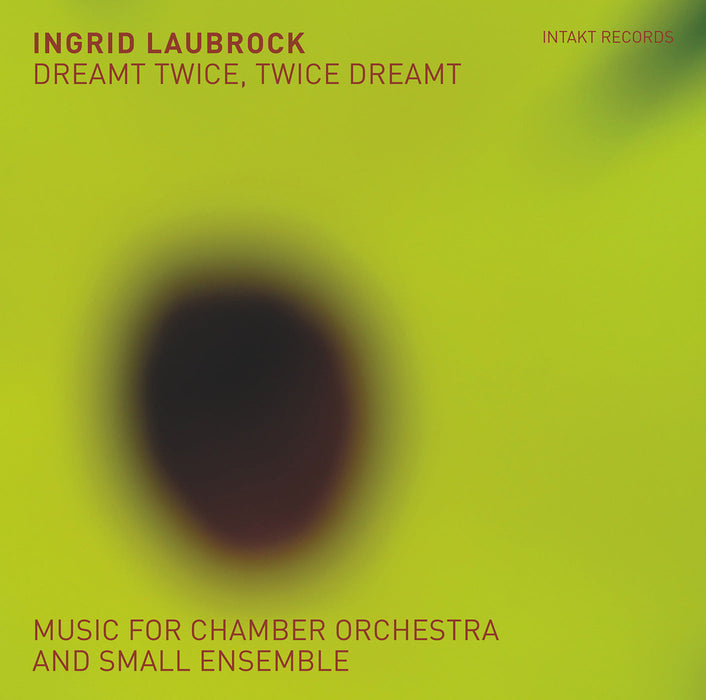
355: INGRID LAUBROCK. Dreamt Twice, Twice Dreamt – Music For Chamber Orchestra And Small Ensemble (Double Album)
Intakt Recording #355/ 2020
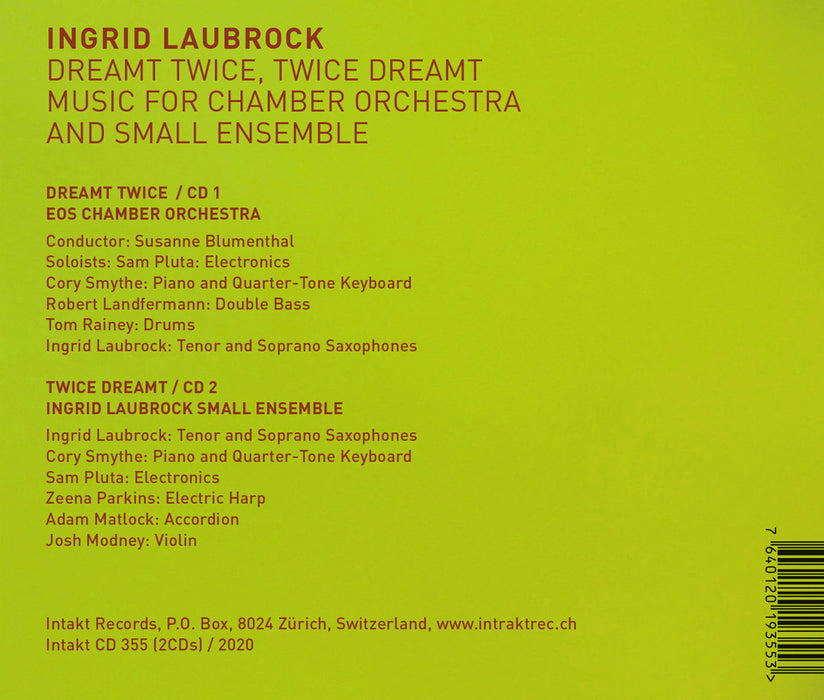
DREAMT TWICE CD 1
EOS CHAMBER ORCHESTRA
SOLOISTS:
Sam Pluta: Electronics
Cory Smythe: Keyboard
Robert Landfermann: Double Bass
Tom Rainey: Drums
Ingrid Laubrock: Saxophone
TWICE DREAMT CD 2
INGRID LAUBROCK SMALL ENSEMBLE
Ingrid Laubrock: Saxophone
Cory Smyhte: Piano
Sam Pluta: Electronics
GUESTS:
Adam Matlock: Accordion
Josh Modney: Violin
Zeena Parkins: Electric Harp
Verkauf
Verkauf
Ursprünglicher Preis
CHF 17.00
-
Ursprünglicher Preis
CHF 39.00
Ursprünglicher Preis
CHF 39.00
CHF 17.00
-
CHF 39.00
Aktueller Preis
CHF 39.00
| /
More Info
Das Doppelalbum «Dreamt Twice, Twice Dreamt» folgt auf Ingrid Laubrocks wegweisendes Orchesteralbum «Contemporary Chaos Practices» von 2018 (Intakt CD 314). Auf «Dreat Twice, Twice Dreamt» präsentiert Laubrock fünf Kompo- sitionen in doppelter Ausführung. Auf der ersten CD interpretiert das neunzehnköpfigen EOS Kammerorchester Köln Laubrocks Kompositionen. Als Solisten wirken Cory Smythe (Piano), Sam Pluta (Elec- tronics), Robert Landfermann (Bass), Tom Rainey (Schlagzeug) und Ingrid Laubrock (Saxophon). Auf einer zweiten CD des Doppelalbums spielt ein filigranes Ensemble um das Kerntrio von Ingrid Laubrock, Cory Smythe, Sam Pluta und den Gästen Adam Matlock, Josh Modney und Zeena Parkins die gleichen fünf Kompositionen. Die beiden CDs mit Laubrocks Werken kontrastieren, divergieren und ergänzen sich. Ingrid Laubrock schreibt: «Die Versionen für das Small Ensemble habe ich zuerst komponiert. Ich habe diese Stücke aber nicht einfach für das Orchester umarrangiert, sondern sie vielmehr neu erfunden. Oft zoomte ich auf ein Detail, um ein materiell anderes Werk zu erzeugen. ” Als Ganzes malen die beiden CDs faszinierende musikalische Panoramen, inspiriert von den Traumwelten der Komponistin, gekennzeichnet von Laubrocks Kompositionsfähigkeit und den individuellen Färbungen und Schattierungen der SolistInnen.
Album Credits
Cover photos: Ingrid Laubrock
Graphic design: Paul Bieri
Photos: Mimi Chakarova (Small Ensemble), Falko Alexander (EOS Chamber Orchestra)
Liner notes: Ingrid Laubrock
DREAMT TWICE CD 1
EOS CHAMBER ORCHESTRA
Recorded December 5 and 6, 2019, by Brigitte Angerhausen at Riverside Studios, Köln. Assisted by Nick Benoy. Mixed May 11-16, 2020, by Ron Saint Germain, at Saint’s Place. Mastered by Scott Hull at Masterdisk, Peekskill, NY.
TWICE DREAMT CD 2
INGRID LAUBROCK SMALL ENSEMBLE
Recorded December 22 and 23, 2019, by Ryan Streber at Oktaven Audio, Mount Vernon, NY. Mixed February 27-29, 2020, by Ron Saint Germain, at Saint’s Place. Mastered by Scott Hull at Masterdisk, Peekskill, NY.
CD 1 and CD 2: Compositions and copyright by Ingrid Laubrock (PRS/MCPS). Recording produced by David Breskin and Ingrid Laubrock. CD produced by Intakt
Records, Patrik Landolt, Anja Illmaier, Florian Keller.
- 5 stars: 49 (100%)
- 4 stars: 0 (0%)
- 3 stars: 0 (0%)
- 2 stars: 0 (0%)
- 1 star: 0 (0%)
J
Jean Buzelin D’une tout autre envergure se présente le nouveau projet de la saxophoniste (ténor et soprano) et compositrice Ingrid Laubrock, désormais bien connue des amateurs curieux et éclairés. Renouvelant l’expérience de Contemporary Chaos Practices, Laubrock a écrit une suite, Dream Twice, en cinq parties basée sur les “rêves”, en l’occurrence le souvenir de la rencontre avec un médium anglais qui communiquait avec certains morts. Opération risquée et ambitieuse qu’elle a réussi de main de maître en convoquant le EOS Chamber Orchestra, dix-huit musiciens placés sous la baguette de Susanne Blumenthal, et en invitant quelques solistes, dont elle-même, Sam Pluta (electronics), Cory Smythe (piano et clavier en quarts de tons), Robert Landfermann (contrebasse) et son mari Tom Rainey (batterie) qui s’intègrent parfaitement à l’ensemble. Le résultat est somptueux. Son travail d’écriture/organisation très fin et ouvert joue sur l’espace, les nuances, les couleurs, la profondeur de champ grâce à l’articulation, l’association des timbres et la répartition des masses sonores, et se déploie en nappes qui se superposent. Aucune lourdeur, aucune emphase, bien au contraire, la musique respire et nous entraîne vers des horizons inouïs.
Les mêmes compositions se présentent dans un ordre différent dans un second disque, Twice Dreamt, en version trio (Cory Smythe et Sam Pluta) avec trois invités : Adam Matlock (accordéon), Josh Modney (violon) et Zeena Parkins (harpe électrique), tandis que la saxophoniste fait courir son jeu sinueux et extrêmement maîtrisé, notamment au niveau du son. Si l’on voulait absolument simplifier les choses, on dirait que le premier disque présenterait une œuvre de musique contemporaine, et le second, sa version jazz. Mais ne me faites pas dire ce que je n’ai pas dit. Pour ma part, c’est un (double) disque comme on n’en entend pas souvent. Magnifique!
https://www.culturejazz.fr/spip.php?article3689
J
John Fordham Ingrid Laubrock, the German-born, New York-based saxophonist and composer, set out a new marker for the lively relationship between contemporary orchestral music and jazz-rooted improvisation with Intakt's thoughtfully-titled 2018 release, Contemporary Chaos Practices. Now comes Dreamt Twice, Twice Dreamt, an adventure born of that encounter, in which Laubrock presents five pieces played in two versions - on CD1 by Cologne's EOS Chamber Orchestra plus improvising soloists, and on CD2 by the composer and the same improvisers operating as the Small Ensemble.
Laubrock has long been drawn to that shifting interface between through-composed music, jazz, and sound-bending experimentation, and this might be her most satisfying fusion of those volatile ingredients yet. The orchestral 'Dreamt Twice' accelerates from pattering percussion, horn-blurts and Cory Smythe's tumbling free-piano whirls to big-ensemble chordal surges and back to pensively probing tenor sax reflections, and 'Snorkel Cows' similarly emerges from torrential piano streams and skittering abstract sounds to sax reflections against soft strings glimmers. 'I Never Liked That Guy' arrives in woodwind murmurs and isolated percussive chord-exclamations in the orchestral version, hovering piano trills and startled soprano sax outbursts in the Small Ensemble, while 'Down The Mountain, Down The Mountain' is solemnly searching and deep orchestrally, electronically slithery and then tentatively and sometimes anxiously dreamy for the small group. Laubrock seems to be turning composition from improv vocabularies, and improv as outcrops of intricate written materials, into new languages with this impressive release
M
Marcello Lorrai Dopo le puntate che abbiamo dedicato a novità dell'etichetta svizzera in agosto-settembre, torniamo sulla Intakt con uscite degli ultimi mesi dello scorso anno. Tra i musicisti che nella Intakt hanno trovato un interlocutore che li ha valorizzati in maniera sistematica c'è la sassofonista tedesca e newyorkese di adozione Ingrid Laubrock (a sue uscite con la Intakt avevamo dedicato anche tutta una puntata di Jazz Anthology del dicembre 2019): della Laubrock la Intakt ha adesso pubblicato il doppio cd Dreamt Twice, Twice Dreamt, il cui gli stessi brani sono interpretati sia da un piccolo gruppo che da una orchestra da camera più alcuni soliti. Con registrazionei dal vivo fra il 2009 e il 2017, The Deceptive 4 è il sesto album del gruppo Snakeoil del sassofonista Tim Berne, da una decina d'anni a questa parte una delle proposte più consistenti e coerenti del jazz più avanzato. In It's About Time, rivive Om, quartetto svizzero formato da nomi ben noti dell'avanguardia svizzera (Urs Leimgruber, Christy Doran, Bobby Burri, Fredy Studer), che con una musica sospesa fra jazz e rock ebbe un bel momento fra anni settanta e primi ottanta. Registrato dal vivo al festival Unerhoert nel 2019, Zurich Concert è un avvincente live che ci fa apprezzare la brillante intesa - malgrado si trattasse di una prima volta - del trio del chitarrista svizzero Dave Gisler con la trombettista americana Jaimie Branch, una delle figure di punta dell'avanguardia di oggi.
https://www.radiopopolare.it/podcast/jazz-anthology-di-lun-01-03-21/
G
Guy Peters Er zijn artiesten die blij-ven rondhangen in ver-trouwde oorden en daar voldoening uit halen. Daar is niets mis mee. Er zijn ook artiesten die beperkingen voor zich uitschuiven, alsof het alternatief geen optie is. Ingrid Laubrock is er zo eentje. Haar recente parcours krijgt stilaan Braxton-allure. Dreamt Twice, Twice Dreamt is een poging om een droomdag-boek vorm te geven, hoe eigenaardig dat ook is. 2 schijfjes, 2 verschillende versies, met verschillende bezettingen (klein ensemble vs. orkest) en verhakkelde struc-tuur. Een uitdagende balans van vrij en gecomponeerd/hedendaags, soms wat droog, met sleutelrollen voor o.m. Sam Pluta, Zeena Parkins en Tom Rainey. Er gebeurt veel, heel veel. Te veel om uit de doeken te doen. Laat dit volstaan: het album vergt een forse investering, maar betaalt die dubbel en dik terug.
B
Ben Taffijn Saxofoniste Ingrid Laubrock maakte vorig jaar een duo album met de pianiste Aki Takase: ‘Kasumi’. De start van wat een serie moet worden, want in het boekje van het eveneens bij Intakt Records verschenen ‘Blood Moon’, het album dat ze maakte met pianiste Kris Davis, lees ik “for the second installment of Laubrock’s duo series on Intakt…” We zijn dus benieuwd. Vrij kort daarna verscheen een tweede album, ‘Dream Twice, Twice Dreamt’, een dubbelalbum met vijf dezelfde stukken, de ondertitel geeft uitsluitsel: ‘Music for Chamber Orchestra and Small Ensemble’. En over duo’s gesproken, via Bandcamp lanceerde ze met partner Tom Rainey in lockdown de ‘Stir Crazy Episodes’.
Maar eerst Laubrock en Davis. Wie beiden de laatste jaren heeft gevolgd, weet dat hun muzikale taal grote overeenkomsten kent. Hun beider muziek is altijd onderhoudend, maar met een speelse kwinkslag, balancerend tussen abstractie en lyriek. En hoezeer ze soms ook kunnen verdwalen in een woud van ongepolijste noten, ineens is daar dan de uitgang, een meeslepend melodisch fragment, een krachtige ritmische frase. Een tweede kenmerk van dit prachtige album is het samenspel van deze twee. Aan alles is te merken dat ze niet voor het eerst samen op het podium staan – ze spelen onder andere samen in Paradoxical Frog – , dat ze dezelfde taal spreken en dus van elkaar haarfijn aanvoelen wat de ander gaat doen. Neem het langzame titelstuk, ‘Blood Moon’ en luister naar de wijze waarop hier wordt samengespeeld, of wellicht is ‘Flying Embers’ een nog mooier voorbeeld. Davis’ spel klinkt hier als een klokkenspel in de wind, terwijl Laubrock zachte, vibrerende klanken uit haar saxofoon laat ontsnappen.
Laubrock heeft zich de afgelopen jaren ook sterk ontwikkeld als componist. Ik gaf er reeds hoog van op bij haar uit 2014 stammende ‘Zürich Concert’ en kan dat nu weer doen aan de hand van dit ‘Dreamt Twice, Twice Dreamt’. Vijf composities die Laubrock baseerde op dromen die ze bijhoudt in haar dromendagboek. Ze schreef ze eerst voor kleine bezetting, vervolgens voor orkest, om daarmee direct die voor kleine bezetting weer aan te passen. Naast Laubrock horen we natuurlijk een keur aan musici, in het orkest tel ik er vijfentwintig, met twee vaste waarden op beide Cd’s: Sam Pluta op elektronica en Cory Smythe op toetsen. Ik beluisterde eerst dit kleine ensemble, Cd 2, met twee stukken voor trio, twee voor kwintet en één voor sextet. Abstractere muziek dan op ‘Blood Moon’, het gaat er al net zo gestructureerd aan toe als in onze dromen. Dat we deze stukken allereerst als serieuze composities moeten zien, blijkt het beste uit ‘Drilling’, tevens ook het langste stuk. Het is vooral de combinatie van elektronica en accordeon, een gastrol van Adam Matlock, die hier opvalt en het disruptieve, spookachtige klanklandschap dat hier wordt ontvouwd. En dan het luisterrijke duo Laubrock – Smythe verderop, waar Pluta letterlijk zo mooi doorheen piept. Tot slot moet hier de heftig ontsporende elektronica in ‘Twice Dreamt’ worden genoemd, in combinatie met de elektrische harp van Zeena Parkins.
En natuurlijk, het compositorische vernuft van Laubrock komt verreweg het best tot zijn recht in de uitvoering door het EOS Chamber Orchestra, onder leiding van Susanne Blumenthal. De grote diversiteit aan klankkleuren geeft Laubrock optimaal de gelegenheid haar dromen gestalte te geven. Als voorbeeld mag bijvoorbeeld dat ‘Snorkel Cows’ dienen dat qua subtiliteit en vormgeving met kop en schouders uitsteekt boven die voor trio. Maar nog mooier is deze versie van ‘Drilling’, een stuk dat gewoon onder de hedendaags gecomponeerde muziek valt. Bijzonder spannend is ook ‘I Never Liked That Guy’, Laubrock horen we hier met een mooie melodie op sopraansax, prachtig ingebed in een wonderlijke klanknevel.
Tot slot noem ik hier nog de ‘Stir Crazy Episodes’ die Laubrock samen met Rainey plaatst op Bandcamp. Tot nu toe zijn er achtenveertig (!) stukken verschenen, te downloaden van haar pagina. Genoeg voor uren en uren heerlijke spontane improvisatie. Beluisteren kan en downloaden ook, wat je ervoor betaald, mag je zelf weten.
Van ‘Blood Moon’ en ‘Dreamt Twice, Twice Dreamt’ zijn fragmenten te beluisteren via Bandcamp. De ‘Stir Crazy Episodes’ zijn allen te beluisteren via Bandcamp en hier ook te downloaden:
https://www.nieuwenoten.nl/ingrid-laubrock-kris-davis-blood-moon-ingrid-laubrock-dreamt-twice-twice-dreamt-ingrid-laubrock-tom-rainey-stir-crazy-episodes-cd-download-recensie/
C
Christoph Haunschmid Die Tenorsaxofonistin Ingrid Laubrock hat für ihre neues CD-Doppel fünf Stücke komponiert und diese in zwei unterschiedlichen Besetzungen für Intakt eingespielt: die erste mit dem EOS Chamber Orchestra unter der Leitung von Susanne Blumenthal, wobei die solistischen Beiträge von bewährten Musizierkumpanen wie Sam Pluta, Cory Smythe, Robert Landfermann und Tom Rainey stammen, die zweite in einem kleinen Ensemble mit Pluta und Smythe, dem Akkordeonisten Adam Matlock, Geiger Josh Modney und Harfenistin Zeena Parkins. Es beginnt mit einem schönen freien Klaviersolo, das immer stärker vom Orchester ummantelt wird, bis Laubrock am Tenor zur Befreiung antritt. Das Orchester spielt fest arrangiertes Material, fängt die Solisten immer wieder ein, fügt zusammen, beruhigt und rundet ab. Manchmal schweben engelschorhafte Geigen über dem Ganzen, Oboen, Fagotte, englische und französische Hörner machen die Sounds üppig und bringen schillernde Farben zum Klingen. Beim zentralen Stück Drilling verharren die Streicher zunächst lange in einer Art Schwebezustand, um den Smythe zauberhaft lyrische Pianosounds legt. Bei der „kleinen" Version auf der zweiten CD produziert das Akkordeon diesen wie im Äther hängenden Klang. Naturgemäß funktioniert das Small Ensemble ganz anders als das größer inszenierte, auch wenn da ebenfalls viel notiert ist. Die Kommunikation ist doch spontaner, freier. Aber auch da dominiert das kammermusikalische, es fehlen die beim Jazz häufig obligaten Instrumente Bass und Schlagzeug. Die kleine Besetzung klingt unmittelbarer, weniger konstruiert. Aktion und Reaktion erfolgen direkter, berührender. In jedem Fall ein gelungener Versuch, Improvisation und Klänge der klassischen Moderne zusammenzuführen. Musiziert wird selbstredend großartig. Ein weiterer Höhepunkt im Schaffen einer der faszinierendsten Musikerinnen der letzten Jahre.
H
Hans-Jürgen Schaal Jahrelang hat die Saxofonistin Ingrid Laubrock ihre nächtlichen Träume aufgeschrieben. Nun hat sie versucht, sich in die Notate einzufühlen und „aus diesem Zustand zu komponieren“. Entstanden ist eine beklemmende „Traummusik“ im tiefenpsychologischen Sinn: surreal, vielschichtig, unberechenbar, irritierend. „Die Träume befreiten mich von allen Zwängen konventioneller Form“, erklärt Laubrock. Ihre Traumstücke gibt es in zwei Versionen – CD 1 im großen Format mit dem EOS Kammerorchester, CD 2 mit kleiner Band. Die Kerngruppe in beiden Aufnahmen bildet Laubrock selbst (an Tenor- und Sopransaxofon) zusammen mit Cory Smythe (Klavier) und Sam Pluta (Elektronik). Zum Teil unterscheiden sich die beiden Versionen der Stücke stark – einzelne Teile wachsen an, andere schrumpfen. Alle Abläufe und Episoden hier klingen im Jazz-Sinn „frei“, folgen aber spürbar kompositorisch-konzeptionellen Ideen. Da trifft Halbtonskala auf Mikrotonalität, dann wieder spielt das Orchester in drei Tempi parallel. Einmal mehr erweist sich Laubrock als große Visionärin der Gegenwartskunst. In ihren Klang gewordenen Träumen rumort viel absurde Realität. Man sollte sie hellwach hören.
https://www.jazzthing.de/review/ingrid-laubrock-dreamt-twice-twice-dreamt/
H
Hiroki Sugita 現代フリー・ジャズ界で顕著に活躍するサックス奏者の2CD
ラブロックが過去10年間で見た夢を素材にCD2の小編成版を作曲。さらに2017年の共演で意気投合したドイツの指揮者から1時間のオーケストラ曲を委嘱されて、単なる小編成版の拡大版編曲ではなく、18人の楽団に2リズムと両編成に共通するソロイストも加えた再創造曲としてCD1を完成。一見、編成の異なる合わせ鏡のような2枚組は、それぞれが独立した作品とも聴ける。リモートによる編集作業を含めて、キャリア屈指の力作。
F
Franpi Barriaux Une œuvre majeure se reconnaît parfois à la première écoute ; il ne faut pas longtemps. Bien sûr, il y a la personnalité des auteurs, et Ingrid Laubrock appelle souvent un a priori positif ; il y a le choix des musiciens, et de ce point de vue des individualités comme le pianiste Cory Smythe ou Zeena Parkins sont déterminantes. Mais donner à la routine ses plus beaux atours ne la rend pas plus attrayante. Il faut la transcender. Offrir de nouveaux espaces. Et c’est ce que la saxophoniste réussit avec son Dreamt Twice, Twice Dreamt, disque ambitieux qui confirme son talent de compositrice qui trace sa propre voie. On l’avait entendue dans Two Works for Orchestra with Soloists ; on le subodorait déjà depuis son Octet ou même Ubatuba : la musique d’Ingrid Laubrock est une sacrée mécanique de précision complexe et ingénieuse qui fait taire avec le temps toute crainte de froideur, comme une lente et charnelle mise à nue. « Snorkel Cows », enregistré avec l’EOS Chamber Orchestra dirigé par Susan Blumenthal, rencontré au Moers Festival, en est le parfait exemple. Le travail de Smythe tout en douceur, bataillant avec un basson, l’activité lointaine de Tom Rainey comme on crayonne les perspectives d’une aquarelle, sont autant de gestes imprévisibles qui se libèrent de tous liens tout en restant implacablement précis, à l’image de la contrebasse de Robert Landfermann qui évoque le chant des baleines.
Car s’il est question de mécanique ici, c’est bien celle des chimères. Pendant plusieurs années, Ingrid Laubrock a noté ses rêves. C’est davantage une interprétation, une tentative d’en rechercher le climat qu’un récit. Elle ne raconte pas ici, elle lie les songes entre eux, comme un fil invisible qui animerait le réel, ou leur donnerait vie, jusque dans les recoins les plus étranges. On le constate avec « Drilling » où sur la version enregistrée avec le Small Ensemble, délesté de l’EOS mais accompagné de l’accordéon méphitique d’Adam Matlock, l’électronique de Sam Pluta (aperçu déjà dans Serpentines ou avec Braxton) apporte une forme de noirceur, relayée par le violon de Josh Modney. Un sentiment de malaise bruitiste s’insinue, qui va droit à l’âme, comme ces rêves incommodes dont on peine à sortir et où on revient toujours. Les songes ne sont pas forcément roses, et le tour de force de Laubrock, qui s’offre parfois quelques instants songeurs au saxophone (« I Never Liked That Guy », version Small Ensemble, où elle propose une mouture brute du luxe de détails qu’offrait l’orchestre), c’est d’arriver à donner, avec deux formations, des points de vue différents, comme des miroirs convexes ou concaves où pourraient se mirer à tour de rôle Berio ou Stockhausen, discrètes influences.
Voilà bien une gageure que réalise Ingrid Laubrock avec Dreamt Twice, Twice Dreamt ! Elle livre une musique pleine et accomplie sans emphase, qui doit tout autant à sa connaissance de la musique écrite occidentale contemporaine (on notera quelques rhizomes braxtoniens dans sa relation à l’orchestre, notamment dans le mouvement général de « Down The Mountain, Down The Mountain » avec l’EOS) qu’à sa propre liberté. On appréciait chez Laubrock cette capacité à laisser de la place aux solistes et à l’imprévu au sein d’une finesse d’écriture incontestable, servie par des personnalités idéales pour ce genre de biotopes, l’intenable Smythe en tête, notamment lorsqu’il explore les quarts-de-tons. Avec cette lecture en miroir, entre un EOS empli d’une touffeur nébuleuse et un Small Ensemble plus cru et plus direct, plus anguleux aussi, la saxophoniste livre un panorama de son savoir-faire. En décembre 2018, Ingrid nous disait avoir une œuvre de musique de chambre dans les cartons avec Smythe et Pluta. Le confinement aura été propice et aura propulsé jusqu’à nos oreilles cette musique de rêve. Stricto sensu.
https://www.citizenjazz.com/Ingrid-Laubrock-3479133.html
G
Guido Festinese Punte radicali
Novità in casa Intakt, l'etichetta svizzera che documenta con sagacia e perseveranza le spinte della musica creativa che incorpora anche le punte radicali del jazz. I cd della label sono tutti in cartonato, per evitare sprechi di plastica: bella scelta. Iniziamo con Dreamt Twice, Twice Dreamt, Music for Chamber Orchestra and Small Ensemble ad opera della sassofonista e compositrice tedesca Ingrid Laubrock: cinque brani onirici presentati nel primo cd con la Eos Chamber Orchestra, e nel secondo dal suo <> in azione, e il rinforzo degli d'archi del Riot Ensemble, cui era destinata questa partitura visionaria divisa in sei sezioni. La pianista giapponese Aki Takase in trio su Auge con Christian Weber e Michael Griener: un triangolo che già mette in luce strepitose potenzialità.
J
John Fordham Also out this month
Former Avishai Cohen pianist Shai Maestro, a Jarrett-inspired artist with correspondingly sharp intuitions for hooks that evoke haunting songs, releases his best album yet with Human (ECM), a set of tender and tempestuous originals and one reworked standard that puts his group, with bassist Jorge Roeder, drummer Ofri Nehemya, and downtown New York trumpet original Philip Dizack in the jazz-polls driving seat. Berlin-based drummer Diego Pinera’s Odd Wisdom (ACT) is a quirkily creative contribution to global jazz with David Bowie/Maria Schneider saxist Donny McCaslin, guitarist Ben Monder and bassist Scott Colley, and New York-based saxophonist Ingrid Laubrock’s Dreamt Twice, Twice Dreamt (Intakt) shows just how creatively, colourfully – and even catchily – jazz, improv, and contemporary classical music can converse.
https://www.theguardian.com/music/2021/jan/29/joe-lovano-trio-tapestry-garden-of-expression-review-a-jazz-unit-with-total-empathy
R
Rudolf Amstutz Mary Halvorson sei es gewesen, die sie aufgefordert habe, doch mit einem Traum-Tagebuch zu beginnen. Dies verrät Ingrid Laubrock im Booklet ihrer neuen Doppel-CD "Dreamt Twice, Twice Dreamt", auf der nun ihre vertonten Aufzeichnungen gleich in zweifacher Ausführung zu hören sind. CD 1 wurde eingespielt mit dem EOS Chamber Orchestra aus Köln - neben Laubrock mit von der Partie auch Sam Pluta, Cory Smythe, Robert Landfermann und Tom Rainey. Auf CD 2 wird das fünfteilige Werk von einem kleineren Ensemble präsentiert, wiederum mit Laubrock, Pluta und Smythe und zusätzlich mit Zeena Parkins, Adam Matlock und Josh Modney. Die beiden Versionen unterscheiden sich nicht etwa nur durch andere Arrangements und eine andere Reihenfolge der Stücke. Laubrock spielt auf der Zeitebene mit der Komposition, dehnt Passagen in der einen Fassung aus oder verdichtet sie. Damit werden auch die relative Wahrnehmung eines Traums und dessen Nacherzählung musikalisch gebrochen. Es sind wundervolle Klangmalereien im Span-nungsfeld zwischen freier und Neuer Musik, die Laubrock mit diesem Werk geschaffen hat. In der Ensemble-Fassung klingt das Ganze, als würden die Noten den Musikern folgen, während beim Orchester die Wahrnehmung gerade umgekehrt ist. In der Summe ist das Werk eine schillernde, vielschichtige Reise in die Traumwelten einer der begnadetsten Komponistinnen unserer Zeit.
F
Francis Davis The 2020 NPR Music Jazz Critics Poll
Below are the results of NPR Music's 8th Annual Jazz Critics Poll (my 15th, going back to the poll's beginnings in the Village Voice). These are the jazz albums that lit up a dark, unsettling year. Maria Schneider's Data Lords was the critics choice — no surprise, though relative unknown Sara Serpa's victory in the Vocal category in a year when both Kurt Elling and Gregory Porter released new albums was. A Thelonious Monk concert recorded at the unlikeliest of venues — a Northern California high school auditorium — in 1968 was voted the year's prize rara avis (my catch-all designation for reissues and never-before-issued finds), and the 23-year-old alto saxophonist Immanuel Wilkins's Omega ran away from the pack in Debut.
We're again including a capsule review of each album in the Top 10 by a critic who voted for that album as the year's best. And as a bonus, we've added capsule reviews of a few solitary No. 1s: albums appearing only on a single ballot, but as that critic's top pick, plus capsules on a pair of albums that finished outside the Top 10 but received an impressive amount of No. 1 votes.
Meanwhile, you can read my thoughts on a year that couldn't end fast enough here, along with my own Top 10. The ballots of all 148 participants are here, through the tireless efforts of my associate Tom Hull.
30. James Brandon Lewis Quartet, Molecular (Intakt) 61 (13)
45. Ingrid Laubrock, Dreamt Twice, Twice Dreamt (Intakt) 42 (8)
49. James Brandon Lewis & Chad Taylor, Live in Willisau (Intakt) 40 (6)
https://www.npr.org/2021/01/14/956649529/2020-best-jazz-albums-critics-poll?fbclid=IwAR0N1BgEYjqsDdNyx1ARKOCJe1Zg7p4JQ571UsX5pBFc3aX1XsFf-KQ_B5Y
C
Christian Carey Dreams can be a potent force for creators. Saxophonist Ingrid Laubrock has harnessed her subconscious to make her strongest work yet. Dreamt Twice, Twice Dreamt is a double album, the first CD featuring a chamber orchestra and the second CD small ensembles, both performing the same dream-based compositions, with the second CD’s versions “turned upside down and inside out,” according to Laubrock.
Laubrock’s 2018 orchestral album, Contemporary Chaos, hinted at the skills she would bring to bear when writing for large ensembles. Dreamt Twice, Twice Dreamt goes even further towards an impressionist concept of sound. While I wouldn’t want to trade either disc for the other, it is also fascinating to hear the pieces reworked for a smaller group in lithe arrangements that feature electronics by Sam Pluta as well as contributions from Laubrock, Cory Smythe, Adam Matlock, Josh Modney and Zeena Parkins.
Atmospheric, harmonically complex, and filled with eloquent solos and intricate charts, the recording is one my favourite releases from this year. Best Jazz 2020.
https://www.sequenza21.com/2020/12/best-of-2020-ingrid-laubrock/
M
Michael Schell Music from behind a mask: Schell’s picks for 2020
Two years ago, Noah Creshevsky, a committed advocate of fixed-media composition, and one of the musical voices lost to us in 2020, asserted that “today’s best seats are in our own homes or wherever we may be, listening to music through speakers or headphones, in chairs of our choosing, with or without extramusical diversions.” It’s a sentiment reflective of both the mobility available through digital devices and the Internet, and the advancements in recording engineering over the past generation. Most music just sounds better in state-of-the-art recordings than in concert halls, and such modern accoutrements as Web searches and streaming media offer a degree of choice and immediacy unattainable through traditional means.
Creshevsky could not have anticipated how drastically his proposition would be tested from March 2020 onward, as COVID lockdowns suddenly quashed most in-person concertizing. It turned out that people badly missed the social aspects of traditional concerts, whatever their logistical costs or acoustic inferiorities. And though ensembles and opera companies valiantly tried to substitute livestreamed performances for the real thing, this seemed a poor substitute to most listeners, dissatisfied with the technical limitations of real-time content delivery using home computers as a terminus. Urbanites, the medically responsible ones anyway, have leaned on things like social media to help replace in-person socializing, while favoring existing, non-real time channels (CDs, broadcasts, downloads, and platforms like Spotify, Bandcamp and YouTube) for their music consumption, which remains centered on conventionally published albums and songs.
Production cycles being what they are, the lockdowns haven’t produced an overwhelming decline in actual releases, as record labels continue to issue previously recorded content alongside new smaller-scale (and sanitary) recording projects. Intriguing material continues to flow into the Radio Eclectus inbox, and if a drought does hit, the biggest impact will likely come a year or two down the line. One of the few positive trends of 2020 was the retrieval of compelling older work, both the resuscitation of dormant projects and the rescue from producers’ vaults of valuable cultural documents that had long been unavailable. High-end opera companies were especially prominent in this effort (e.g., Metropolitan Opera’s nightly video streams of past Live in HD productions), leading to the ironic result that in a year that saw the shuttering of opera houses, it’s newly-mediated operatic projects that have risen to the top of my opinionated list of the past year’s most noteworthy new releases in the domain of contemporary Western art music.
Ingrid Laubrock: Dreamt Twice, Twice Dreamt (Bandcamp) Saxophonist, composer and Braxton alum Laubrock connects with a line initiated by Michael Mantler’s Jazz Composers Orchestra Association records from the 1960s and continued by her own 2018 Contemporary Chaos Practices: Two Works for Orchestra with Soloists album. In this double CD, five Laubrock compositions are performed two times, once by a sextet comprised of Laubrock, Cory Smythe, Sam Pluta, Adam Matlock, Josn Modney and Zeena Parkins, and once by a big band that features several of the aforementioned musicians as soloists. Laubrock is of the most forward-looking musicians working in the large-ensemble-with-improvisors genre
https://www.sequenza21.com/2021/01/music-from-behind-a-mask-schells-picks-for-2020/
S
Steve Smith 2020, on the record.
Several lists celebrating some of the most extraordinary contemporary and classical recordings and archival releases that arrived in 2020, making the year more resonant and harmonious.
Prelude
Making a list of any year’s most memorable recordings is a foolhardy endeavor, not least because no one could hear all of the releases that come out in any given calendar year (even this one), nor even all of the consensus buzz titles. Besides, as I wrote somewhere else a year ago: Is consensus what we’re after? Isn’t discovery more important, more useful, more compelling?
You won’t catch me referring to my year-end lists as the Best Records of 2020. It also would be imprecise to say favorite, but it’s closer. Basically, here are three lists of records that came out this year, representing three very broad, slightly slippery categories, each including 10 exceptional records that affected me most—the ones that lingered and called to me time and time again, yielding new rewards each time I revisited them. Following those is one more list: an honor roll of 50 more outstanding, wholly worthy recordings, all of which contributed to making 2020 a better year.
Another Timbre, Astral Spirits/Astral Editions, New Focus, and Pyroclastic were my labels of the year in 2020. And in case you missed yesterday’s newsletter, I cited AMPLIFY2020: quarantine – by any reckoning the most extensive recording project of 2020 – as one of the year’s most significant musical events.
Honor roll.
Ingrid Laubrock - Dreamt Twice, Twice Dreamt (Intakt)
https://nightafternight.substack.com/p/2020-on-the-record?utm_source=substack&utm_medium=email&utm_content=share