
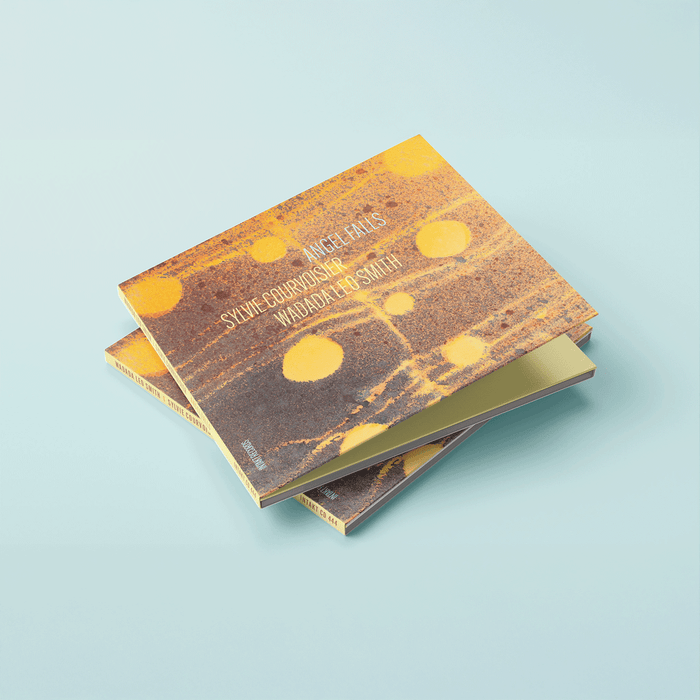
444: SYLVIE COURVOISIER – WADADA LEO SMITH. Angel Falls
Intakt Recording #444/ 2025
Wadada Leo Smith: Trumpet, Composition
Sylvie Courvoisier: Piano, Composition
Recorded and mixed on October 12, 2024, at Oktaven Audio, Mount Vernon, NY, by Ryan Streber.
More Info
Die aus der Schweiz stammende Pianistin und Komponistin Sylvie Courvoisier ist seit 20 Jahren eine prägende Figur der zeitgenössischen Jazz-Szene und ein Epizentrum der New Yorker Musikszene. Soeben mit dem renommierten Schweizer Grand Prix Musik 2025 ausgezeichnet, legt sie nun nach den jüngsten gefeierten Veröffentlichungen ihres Solo-Albums To be Other-Wise und dem atmosphärisch vielschichtigen Sextett-Album Chimaera das Duo Album mit dem legendären Wadada Leo Smith vor. Ein Ausnahme-Musiker, stets am Puls der Zeit, der – die musikalische Diversität und Kreativität zelebrierend – sich gegen jede Etikettierung sei- nes Schaffens ausspricht und die Musikentwicklung in unterschiedlichen Kontexten der letzten 50 Jahre mitschreibt. Angel Falls atmet den Zauber der musikalischen Freiheit, besitzt eine verblüffende Unmittelbarkeit und hat einen be- stechenden Sinn für schillernde Klangarchitekturen. «Sie klingen beide großartig. Sie ergänzen sich gegenseitig, ohne auf offensichtliche Schachzüge zurückzugreifen. Es gibt kein ‚Comping‘, keine Effekthascherei, nur ein ständiges Gefühl der kontinuierlichen Kalibrierung, schräge Elemente, die irgendwie perfekt im Gleichgewicht stehen. Wie machen sie das?», schreibt John Sharpe in den liner notes. Ein musikalisches Erlebnis!
Album Credits
Cover and Booklet Art: Sophie Bouvier Ausländer
Graphic design: Paul Bieri
Liner notes: John Sharpe
Photo: @Ogata_Photo
All compositions by Sylvie Courvoisier and Wadada Leo Smith (SUISA, ASCAP). Published by Sylvie Courvoisier Music (ASCAP) and Kiom Music (ASCAP). Recorded and mixed on October 12, 2024, at Oktaven Audio, Mount Vernon, NY, by Ryan Streber. Mastered in January 2025 at Skye Mastering by Denis Blackham. Recording produced by Sylvie Courvoisier, Wadada Leo Smith. CD produced by Intakt Records, P.O. Box, 8024 Zürich, Switzerland.
In ogni musica d'avanguardia, per parafrasare il pensiero di Claudio Magris, si incontrano e si scontrano due tendenze antitetiche e complementari: quella a un raffinato tecnicismo linguistico, che lavora sul suono per strapparlo al suo logoramento sociale e renderlo così capace di poesia, e quella a procedere al di là o di rimanere al di qua del suono stesso, per ritrovare la poesia pura nella vita ancora non contaminata dalla falsità. La musica di Wadada Leo Smith e Sylvie Courvoisier si può ascrivere alla prima, benché il loro operare contempli anche tracce della seconda. I due artisti hanno modi di suonare diversi - più contorto e fluido quello della cinquantacinquenne pianista, più essenziale quello dell'ottantaquattrenne trombettista - che si combinano perfettamente anche grazie a una collaborazione pluriennale: si erano conosciuti nel 2017 in un concerto organizzato da John Zorn e già l'anno dopo avrebbero suonato insieme in un trio.
Negli otto brani di "Angel Falls", scaturiti dal metodo della composizione istantanea che volutamente non prevede alcuna partitura scritta, la Courvoisier orna con una ragnatela geometrica di suoni sempre educati le note spesso lunghe e lancinanti di Wadada, che si fanno pulsazione nitida, pausata, vivida e piena della massima tensione. Le linee astratte, che fanno però sentire la concretezza del loro essere pienamente parte del mondo, si accampano a piacimento, rispettando principi di equilibrio e di musicalità interni alle leggi dell'opera stessa. I brani respirano, si espandono, si contraggono e scivolano verso risoluzioni inaspettate; la musica si dispiega come una danza, alternativamente melodica e intricata, giocosa e solenne, rivelándosi infine luminosa, limpida e maestosa. Raggiungendo vette di alta poesia.
EN
In all avant-garde music, to paraphrase the thinking of Claudio Magris, two antithetical yet complementary tendencies meet and clash: one toward a refined linguistic technicalism, which works on sound to wrest it from its social wear and tear and render it capable of poetry, and another that moves beyond or stays on this side of sound itself, to rediscover pure poetry in a life not yet contaminated by falsehood. The music of Wadada Leo Smith and Sylvie Courvoisier can be placed in the first category, although their work also contemplates traces of the second. The two artists have different ways of playing — more intricate and fluid that of the fifty-five-year-old pianist, more essential that of the eighty-four-year-old trumpeter — which combine perfectly, also thanks to a long-standing collaboration: they first met in 2017 at a concert organised by John Zorn, and already the following year they would play together in a trio.
In the eight tracks of "Angel Falls", born from the method of instantaneous composition that deliberately requires no written score, Courvoisier adorns Wadada's often long and piercing notes with a geometric web of always refined sounds, turning them into a pulse that is clear, measured, vivid and full of the utmost tension. The abstract lines, which nonetheless convey the concreteness of being fully part of the world, settle freely, respecting principles of balance and musicality internal to the laws of the work itself. The pieces breathe, expand, contract and slide toward unexpected resolutions; the music unfolds like a dance, alternately melodic and intricate, playful and solemn, ultimately revealing itself as luminous, limpid and majestic. Reaching the heights of great poetry.
Ce n’est pas la première fois – et pas la dernière espérons-nous – que la pianiste suisse Sylvie Courvoisier croise le fer avec le vétéran de l’AACM Wadada Leo Smith. Mais c’est leur premier duo sur Intakt. En fait il ne s’agit pas d’un duel, bien au contraire, car ces deux fabuleux musiciens donnent l’impression de s’émerveiller l’un à côté de l’autre des possibilités qui les conduisent à tisser ensemble une telle tapisserie musicale. Allez voir ce qu’écrit Yves Dorison, il vous fera sentir mieux que moi l’absolue beauté de leur musique. (Cf.Culturejazz, L’Appeal des Nouveautés, 01/11/2025). Mais comme j’y souscris totalement, je ne vais pas me priver de m’extasier à mon tour devant leur œuvre commune.
https://www.culturejazz.fr/spip.php?article4517
Gespräch über wichtige Dinge
Sylvie Courvoisier hat mit dem Trompeter Wadada Leo Smith das Album „Angel Falls" eingespielt. Von Hans-Jürgen Linke
Die Aufnahmen für das Album haben nicht sehr lange gedauert. „Wir haben", sagt Sylvie Courvoisier, „beide keine Note zu viel gespielt." Sie haben sich im Studio getroffen und dort genau die Menge Musik in genau der Reihenfolge gespielt, wie sie auf dem Album erscheint. Danach haben sie die Aufnahme abgemischt und dabei keine weiteren Änderungen vorgenommen. Am Tag danach haben sie die Titel für die Stücke gefunden und festgelegt. Fertig. Perfekt. „Angel Falls", zugleich der Titel des Albums und des längsten Stücks darauf, sei der Name eines Wasserfalls, sagt sie. Es gibt mehrere davon an verschiedenen Orten, und der Titel sei nicht geografisch gemeint, sondern poetisch, vielleicht metaphorisch.
Sylvie Courvoisier, in Lausanne aufgewachsen, spielt Klavier, seit sie sechs ist. Ihre Musik ist für sie eine Art Sprache, die sie in lebhaftem Kontakt mit ihrer Umwelt, mit anderen Musikern und ihren Hörerinnen und Hörern hält. „Ich muss viel spielen", sagt sie, „und am liebsten auch viel aufnehmen."
Einen wiedererkennbaren Personalstil hat sie nicht entwickelt, eher eine Intensität, der man kaum ausweichen kann. Wie und was sie spielt, hängt vom Kontext ab. Jeder Augenblick braucht eigenen Ausdruck.
Sie war längst eine viel beachtete Pianistin in der improvisierten Musik, die sie mit Spielarten, die in europäischer Kammermusik bis zur zeitgenössischen Avantgarde wurzeln, bereichert hat. Kurz vor der Jahrhundertwende ist sie nach New York gezogen und hat noch einmal von vorn begonnen. Nicht bei null, sondern in einer schnell wachsenden Umgebung von Projekten mit kleineren Formationen, solistisch und in Duo-Besetzungen.
Mit dem Violinisten Mark Feldman, ihrem Ehemann, ist sie oft zu hören, zuletzt hat sie mit der Gitarristin Mary Halvorson gespielt. Seit Jahren war sie immer wieder mit dem Trompeter Wadada Leo Smith auf der Bühne zu erleben. Die Initiative dafür ging von ihm aus, aber erst jetzt haben die beiden das gemeinsame Album eingespielt.
Kein Small Talk
Zwischen der Studio- und einer Bühnen-Situation, sagt Sylvie Courvoisier, gebe es mit Smith keinen großen Unterschied, außer der An- beziehungsweise Abwesenheit von Publikum. Das Zusammenspiel mit ihm sei wie ein Gespräch. „Und zwar über wichtige Dinge. Wir plaudern nicht, wir probieren nicht etwas aus und gehen dann zu etwas Anderem über. Wir arbeiten konzentriert. Das liegt auch daran, dass wir beide Small Talk ablehnen. Es gibt immer etwas Wichtiges zu besprechen."
Es gibt in ihrer Duo-Arbeit keine Partituren, keine schriftlichen Skizzen, nicht einmal Absprachen über Spielverläufe, Stimmungen, Klangstrategien. „Nichts steht fest, bevor es gespielt wird", versichert sie. „Wir komponieren", sagt sie, „und zwar in Echtzeit. Wir fangen an, wir warten nicht aufeinander, wir reagieren miteinander."
Und dann sagt sie noch: „Ich nehme mich zurück." Wer Sylvie Courvoisier auf der Bühne erlebt hat, wird vielleicht erstaunt darüber sein, denn Vorsicht oder Zurückhaltung ist normalerweise nicht der Eindruck, den ihre Präsenz als Musikerin auf der Bühne hervorruft. Aber Wadada, sagt sie, sei so ein singulärer Musiker, dass man sich selbst etwas Gutes tut, wenn man genau hört, was ihn am besten klingen lässt.
Allerdings unterscheidet sich das Zurücknehmen klar von der Haltung eines Abwartens-was-Kommt. Abwarten, das würde beide nur langweilen.
Im Herbst hatten sie mehrere Duo-Konzerte in Ost- und Südosteuropa, jetzt sind beide wieder in New York. Wadada Leo Smith ist 84 Jahre alt und wird wohl keine Europa-Tournee mehr unternehmen. Sylvie Courvoisier wird ihn weiterhin öfter treffen und mit ihm arbeiten. Es gibt so viel zu spielen.
# 6: 20 Melhores Discos Internacionais 2025
Angel Falls é nome da catarata ininterrupta mais alta do mundo, na Venezuela. O local, de um poder natural espantoso, foi inspiração para o primeiro encontro em disco do duo formado pela pianista Sylvie Courvoisier e o trompetista Wadada Leo Smith. Em Angel Falls ficam claros um profundo sentido de partilha e uma ligação muito especial que se estabelece entre os dois, fruto de uma longeva admiração mútua. Um momento crucial aconteceu quando a pianista sugeriu que evitassem partituras. O resultado é uma música orgânica e com um sentido de urgência que impressiona mais ainda se atentarmos nas intrincadas construções sonoras. Cada peça é uma troca vivaz e inquieta de sons e texturas, diálogos íntimos tão depressa frágeis como assertivos, abstratos como melódicos, abertos como circulares. (AB)
https://jazz.pt/artigos/discos-internacionais
2017年にジョン・ゾーン主宰の公演で初共演したクールヴォワジェとスミスは、デュオ、トリオ、ピアノ2台といった編成でライヴを継続し、スミスがクールヴォワジェの2023年発表作『Chimaera』に参加するなど、本作へと至る流れは必然だったと言える。全8曲は録音順の配置になっており、内部演奏やプリペアード仕様を含むピアノと、ロング・トーンに衰えないエネルギーが漲るトランペットによる超世代対話は、想像以上にスムーズ。①を助走とするならば、②はいきなり緊張感が溢れる丁々発止のやり取りで、スリリングな空間を現出する。
https://pjportraitinjazz.com/playlists/20251230_9253/
While improvised piano-trumpet duets go back to Louis Armstrong’s and Earl Hines’ “Weatherbird” of 1928, balancing the four valves and 88 keys is a delicate challenge. The 21st century iterations here could be linked to abstract paintings. American trumpeter Wadada Leo Smith’s and Swiss pianist Sylvie Courvoisier’s Angel Falls creates a subtle version of abstract expressionists’ splashes of color canvases, whereas Japanese, pianist Satoko Fujii and Natsuki Tamura’s Ki is more like a monochrome painting which demands closer scrutiny to discern musical nuances
Courvoisier and Smith are experienced duo performers. Smith, whose career goes back to the late 1960s, has worked with pianists as different as John Tilbury and Vijay Iyer. Almost three decades younger, Courvoisier’s duet partners include Ned Rothenberg and Mark Feldman, but never a trumpeter until now. The two have been linked in large ensembles as part of Smith’s extensive catalogue though. Interestingly enough among those sessions was a quartet with Fujii and Tamura. Ki is the 10th duo the other two have recorded and while Tamura usually records with Fujii, on her own she has recorded duos with everyone from Otomo Yoshihide to Joe Fonda.
While also maintaining a painterly straight line, Courvoisier and Smith append numerous splashes of improvisational color as their disc evolves with extended techniques such as the pianist twanging the instrument’s inner strings and Smith creating brassy triplets, half valve slurs and protracted flutters. Occasionally as on “Sonic Utterance” light brass pitches and delicate formalist key glissandi are emphasized. But most tracks are rougher and more intense.
The title track for example evolves as additional reverb from string strums meet breezy brass slurps that slowly inflate to full force romanticism before energetically fragmenting into thinning trumpet squeaks and stinging keyboard clips. In contrast the probing aural brush strokes which shade “Line Through Time” extend short wavering brass bites and piano key probes that with gouache-like effects widen the line into full keyboard emphasis and smeared brass notes.
Reflecting and completing the overall design, the open horn brass portamento and thematic key-and-string decorations from Courvoisier on the final “Kairos” reflect similar sketching on the introductory “Olo’Upnea and Lightning”.
If jagged lightning define much of Angel Falls, then Ki is more of a light rain by a married couple. Minimalist in artistry, the simple musical geomatric shapes were drawn by Tamura, who composed seven of the eight tracks. The results aren’t static however. Although overall Fujii’s touch is more serene and reflective than Courvoisier’s and Tamura’s solos are more fully rounded and horizontal than Smith’s, digressions include pointillist textures and half-valve squeaks from the trumpeter as well as dips into pedal point emphasis and jagged key slashes from the pianist.
Experience plus marriage means that tracks like “Kusunoki” include moderated antiphonic connections with every key stroke carefully outlined and portamento echoes combining into trumpet grace notes and restful piano comping. Other such as “Arakashi” and “Icho” reflect the dispassionate lyricism that moves with warm reverberating keyboard pumps and vibrating trumpet grace notes duets closer to delicate brush painting than abstract art’s scattershot washes. Yet even those tunes that emphasize widening keyboard sweeps and low pitch tremors plus wallowing immersive breaths encompass relaxed linear evolution.
Like broad visual art awareness, the individual and distinct ways each duo illustrated its program demands respect and recognition.
https://www.jazzword.com/reviews/sylvie-courvoisier-wadada-leo-smith/
ANY jazz listeners have affirmed, that in the long wake of the John Coltrane Quartet, the foursome that has since most touched their brilliance is the English quartet, Mujician. Composed of the Bristolian pianist Keith Tippett, the south London tenor and soprano saxophonist Paul Dunmall, Luton-born seven-string bassist Paul Rogers and the Shropshire drummer, Tony Levin.
Between 1990 and 2005 they waxed six memorable albums on the US Cuneiform label, but now a triple CD has been created by Jazz in Britain, recorded from concerts in Cheltenham (1993), Vienna (2003) and Birmingham (2010). It is a beautiful sonic triptych called Mujician in Concerts, with the four members playing at their unified peak.
Sometimes haunting and hymnal as if coming from ancestral spirits — as in the opening message of Dunmall and Tippett in Cheltenham, othertimes rhapsodic and joyous: “We never spoke about the music beforehand,” declared Dunmall, “we just walked on stage and trusted in the music and each other.”
Rogers is a virtuoso bassist like no other, playing an instrument like no other, and Levin’s sense of time and moment is deeply empathetic, knowing instinctively the musical minds of his quartet-mates. Tippett and Levin are gone, but thanks to devoted and skilled travelling recordists, Andy Isham and Steve Trent, these long and precious musical instants are still with us, throbbing with life and artistry.
Between 1959 and 1970, Washingtonian tenor saxophonist Charlie Rouse (1924-88) was the featured horn of Thelonious Monk’s Quartet, and his husky, quasi-adenoidal tone became the companion sound to Monk’s genius melodies and “brilliant corners.” But he showed another sphere when he recorded Cinnamon Flower in 1977, an album full of sounds of Brazil. The new reissue on Resonance Records includes this release with some overdubbing, plus the tracks in their undubbed, original form.
So we have a Latin feast of Rouse with Brazilian compadres trumpeter Claudio Roditi, pianist Dom Salvador and drummer Portinho, plus the great Michigan-born bassist Ron Carter, late of the Miles Davis Quintet. Rouse is joyous, in another element, on Cinnamon Flower, buoyed up by a relentless rhythmic upsurge and melodic beauty, for example on Desencontro (Disenchantment), and his notes leap up blissfully on Alvorada. It’s a powerful reissue, racked with elation and flair.
The great Mississippi-born trumpeter Wadada Leo Smith is 84 this year, but it hasn’t curtailed his mighty breath. His new album is Angel Falls (Intakt Records), partnered with the Swiss pianist Sylvie Courvoisier, whose pianism he describes as “advancing as if she’s going there to save creation.” In the destructive era of Trump and Musk that is certainly what they are both doing, with power and beauty too. Wadada’s horn talks fire and Courvoisier’s keyboard words make a palaver of freedom. No wonder one track is called Sonic Utterance, for that is what the entire album is.
Finally there is the burning saxophonist of Canterbury, the late Tony Coe. In 1977 his quintet, Axel, recorded the tracks of What Say We Play Today? (Jazz in Britain Records) at the Camden Jazz Festival. It’s taken 48 years, but now it’s there for us.
Pianist Gordon Beck, guitarist Phil Lee, bassist Chris Laurence and drummer Bryan Spring join Coe for a gripping performance, with the final title track reaching 28 minutes. Throughout, sheer musicianship excels, with the luminous, underrated Lee taking on the prominence of a second horn, and Coe playing clarinet, bass clarinet, soprano and tenor saxophones as if he were born to each. The fivesome create their own inventive sound, driven by uniqueness.
https://morningstaronline.co.uk/article/best-2025-jazz-albums
Pianist Sylvie Courvoisier teams up with trumpeter Wadada Leo Smith for a collection of duets composed by the pair, seemingly on sight, judging by the spontaneity of the tunes. Smith has an immediately identifiable tone, strong and clear, and expresses it in a variety of ways here. He goes ito subtones around the pouncing chords on ”Sonic Uttereance” and squeezes out ideas like spitting out grapefruit seeds on ”A Line Through Time”. A muted horn gets Miles Davisy on “Whispering Images’ while he slurs and sputters around Courvoisier’s eerie twinkles during “Kairos”. Courvoisier probes darkly with the strings during “Ol’upnea and Lightning” and tinkle tinkles like a star under Smith’s popping declarations of “Vireo Bellii”. Musical volleys.
https://jazzweekly.com/2025/12/sylvie-courvoisier-wadada-leo-smith-angel-falls//
Putting the Accent on the 2
Piano and trumpet is not a common jazz format, though it draws a prestigious lineage back to the 1928 Louis Armstrong/Earl Hines matchup "Weatherbird." The best trumpet-and-piano duos here, however, range far from tradition.
One is Angel Falls (Intakt; ★★★½; 59:17) by Swiss pianist Sylvie Courvoisier and trumpeter Wadada Leo Smith. The album features eight succinct, vitally engaging pieces that, per the title, often recall the architectural natural beauty Smith explored on his album America's Natural Parks. Both players draw from large vocabularies, the trumpeter coursing through clarion calls, stutters, multiphonics, squirts, smudges, chortles and harmon-muted sighs and Courvoisier preparing the keyboard, sometimes sounding like a marimba or tinkling glass, and playing inside and outside the piano box. Silences and space define the music as much as the sounds it encloses. "Olo'Upnea And Lightning" manages both grandeur and delicacy. Minor and blue, "A Line Through Time" hangs in space, and "Vireo Belli" invokes the chattering bird of its namesake.
Sylvie Courvoisier & Wadada Leo Smith
Angel Falls
Intakt CD444 (CD, DL)
★★★★ EDITOR'S CHOICE
Sylvie Courvoisier (p) and Wadada Leo Smith (t). Rec. 2024
Trumpeter Wadada Leo Smith has had significant pianist-duet partners in Amina Claudine Myers, Anthony Davis and Vijay Iyer – and now Swiss legend Sylvie Courvoisier joins that illustrious list.
As two artists who are at a 'later years peak', with each producing excellent work in many settings, Courvoisier and Smith sound entirely assured and receptive as they probe their way through a set that excels for both the breadth of ideas as well as the skill of execution.
On one hand the understatement, or rather strength of subtext, of a piece such as 'Whispering Images' is notable. Courvoisier's opening tremolo is like a ripple under Smith's muted cries, together evoking a vividly outdoor space but the arrival of offbeat string plucking and gravelly chords slant the atmosphere towards something dreamily sub-aquatic.
On the other hand, the variety of tempo and attack on 'Naomi Park', where the eighth and sixteenth motifs splutter and spurt, lends a rousing vigor to stop time traditions, while Courvoisier's independence of left and right hand lines simply adds to the structural whirlwind.
Electronic effects and prepared piano rustlings are deployed with finesse on occasion, bringing imaginary wind chimes into the air, but a single open note from Smith or a stark, densely voiced chord from Courvoisier are enough to bring intense emotion and grand virtuosity into alliance. Captivating music by two modern masters.