
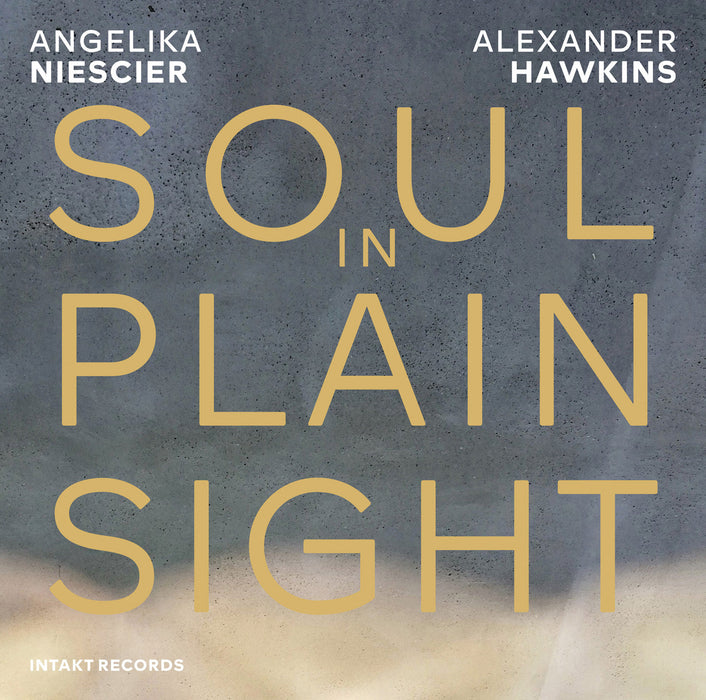
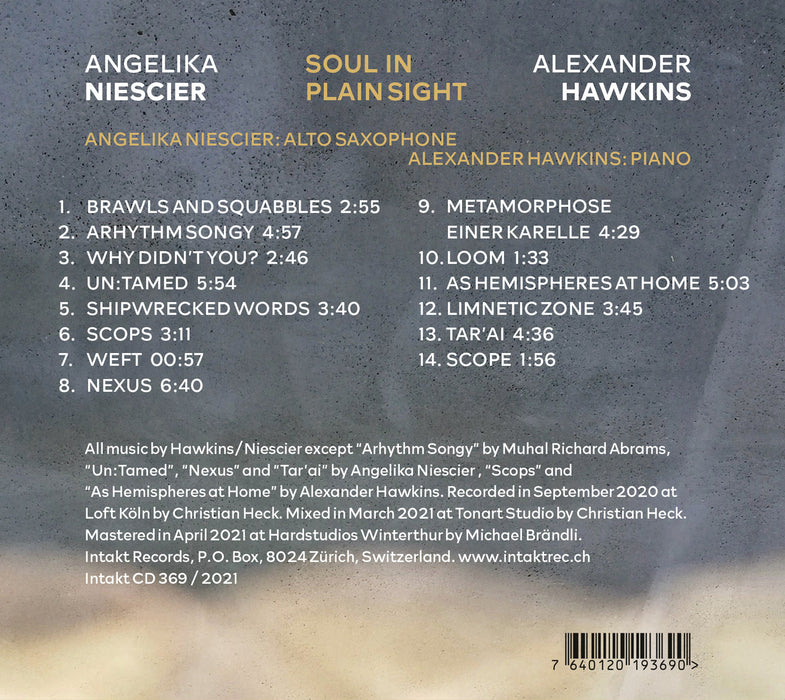
369: ANGELIKA NIESCIER – ALEXANDER HAWKINS. Soul In Plain Sight
Intakt Recording #369/ 2021
Angelika Niescier: Alto Saxophone
Alexander Hawkins: Piano
Verkauf
Verkauf
Ursprünglicher Preis
CHF 12.00
-
Ursprünglicher Preis
CHF 30.00
Ursprünglicher Preis
CHF 30.00
CHF 12.00
-
CHF 30.00
Aktueller Preis
CHF 30.00
| /
More Info
In Europa tritt eine junge, höchst spannende Generation von inter- national aktiven JazzmusikerInnen ins Rampenlicht. Ein Jazzkritiker schreibt: «von Grossbritannien aus erobert der 40-jährige Komponist, Organist und Pianist Alexander Hawkins gerade Europa im Sturm. Der smarte Schnelldenker hat vieles zu erzählen.» alexander Hawkins’ Terminkalender ist gefüllt mit Konzertdaten mit dem südafrikanischen Schlagzeuger louis Moholo, Shabaka Hutchings, Mulatu Astatke, der Flötistin Nicole Mitchell oder der Cellistin Tomeka Reid. als Hawkins am Jazzfest Berlin im Duo mit dem amerikanischen Trompeter Wadada leo Smith spielte, lernte er die Saxofonistin Angelika Niescier kennen. Niescier brillierte am gleichen Festival mit ihrem New York Trio mit dem Bassisten Christopher Tordini und dem Schlagzeuger Tyshawn Sorey. Der live-Mitschnitt erschien unter dem Titel «The Berlin Concert» bei Intakt Records. Niescier wurde in Berlin gerade mit dem Albert-Mangelsdorff-Preis, dem bedeutendste Jazzpreis Deutschlands, geehrt. Hawkins ist fasziniert vom Saxofonspiel Niesciers, und diese wiederum begeistert von seiner Musik. Sie stehen auf gleichem Grund. beide haben ihre Wurzeln im Jazz, beide lieben die Jazzavantgarde eines Ornette Coleman oder Cecil Taylor. Zwei technisch versierte InstrumentalistInnen mit sprühendem Temperament, Drive und Freude am Experiment. Nach mehreren Duo-Konzerten liegt nun das Studioalbum von Niescier und Hawkins vor, aufgenommen im loft in Köln. Die amerikanische Jazzkritikerin Stephanie Jones schreibt in den liner Notes: "Das album ‘Soul in Plain Sight’ pflegt ein Zusammenspiel, das durch Kontraste entsteht. Indem sie sich gemeinsam herausfordern, bewegen sich die Musikerin und der Musiker im gemeinsam entwickelten klang mit Leidenschaft und Raffinesse. "
Album Credits
Cover photo: Anja Illmaier
Graphic design: Paul Bieri
Liner notes: Stephanie Jones
Photo: Viktoria Sophie Conzelmann
All music by Hawkins/Niescier except "Arhythm Songy" by Muhal Richard Abrams, "Un:Tamed", "Nexus" and "Tar'ai" by Angelika Niescier , "Scops" and "As Hemispheres at Home" by Alexander Hawkins. Recorded in September 2020 at Loft Köln by Christian Heck. Mixed in March 2021 at Tonart Studio by Christian Heck. Mastered in April 2021 at Hardstudios Winterthur by Michael Brändli. Produced by Angelika Niescier, Alexander Hawkins and Intakt Records, Patrik Landolt, Anja Illmaier, Florian Keller. Published by Intakt Records.
- 5 stars: 26 (100%)
- 4 stars: 0 (0%)
- 3 stars: 0 (0%)
- 2 stars: 0 (0%)
- 1 star: 0 (0%)
F
Franpi Barriaux, Nicolas Dourlhès Pianiste anglais né en 1981 à Oxford, Alexander Hawkins connaît un parcours ascensionnel. D’abord initié en parallèle à l’orgue dans ses jeunes années puis passé quasi exclusivement à la pratique du piano, il commence par l’apprentissage de la musique classique avant de se tourner vers le jazz. Se dégageant des conventions académiques, il se met tôt à la recherche d’un style propre en multipliant les collaborations.
Après avoir enregistré des disques en trio au format basse/batterie avec des partenaires anglais, il participe au Convergence Quartet dès 2007 au côté de Taylor Ho Bynum, Dominic Lash et Harris Eisenstadt. En 2012, son travail au côté du batteur sud-africain Louis Moholo-Moholo élargit plus encore son champ d’investigation et lui permet de développer un rapport fort au corps. Il joue aussi avec Mulatu Astatke.
Il s’intéresse autant au travail en configuration réduite qu’en formation plus étoffée : dès 2009, il dirige un ensemble et, en 2012, il est choisi par le London Symphony Orchestra pour participer à un programme destiné à l’émergence des jeunes compositeurs. Son duo avec Evan Parker publié chez Clean Feed est remarqué ici mais c’est son entrée dans le catalogue du label Intakt qui le fait passer dans une autre dimension. Que ce soit en quartet avec la vocaliste Elaine Mitchener ou pour deux duos qui marquent les esprits (avec Tomeka Reid et avec
Angelika Niescier
avec qui il entretient une relation étroite, ou encore avec Anthony Braxton pour une splendide relecture de standards. Creusant une pratique soliste qui n’en est vraisemblablement qu’à ses débuts, il continue les expérimentations en grand format dans une approche contemporaine.
Si Alexander Hawkins manifeste le souci d’une vision intellectuelle de la musique qui le conduit à échafauder des montages harmonico-rythmiques complexes, il est attentif toutefois à maintenir une dimension physique et spontanée à son jeu. “Body and Soul”, comme l’ont toujours fait les grands jazzmen dont il participe à renouveler l’histoire.
Avec toutes ces qualités, n’était-il pas indispensable de lui poser quelques questions ?
- Alexander, pouvez-vous vous présenter en quelques mots ?
Je suis pianiste et compositeur et, très occasionnellement, je joue aussi de l’orgue. Je suis né dans un foyer mélomane à Oxford, au Royaume-Uni, et j’ai donc eu la chance de découvrir la musique dès mon plus jeune âge. Mon père est un grand fan d’Ellington et en fait, mon deuxième souvenir le plus ancien est d’avoir entendu la composition de Duke Ellington « Saturday Night Function » (mon tout premier souvenir est de m’être perdu dans un supermarché au Texas, où nous avons vécu pendant une très courte période, ce qui est évidemment une histoire beaucoup plus banale).
J’ai commencé à prendre des cours de piano à l’âge de 5 ou 6 ans et j’ai continué jusqu’à l’âge de 18 ans environ (une parenthèse : vers l’âge de 10 ans, j’ai également commencé à jouer de l’orgue, une expérience qui a développé mon amour de Bach et ma fascination pour la technique et la structure d’une part, et, via Messiaen, de nombreux modernistes du vingtième siècle d’autre part). À 18 ans, j’ai pris la décision quelque peu naïve de commencer à étudier par moi-même, et j’ai choisi de ne pas aller étudier la musique à l’université ou dans un conservatoire. Au lieu de cela, j’ai décidé qu’il était important de me dépasser sur le plan académique, et donc - même si je n’ai jamais voulu être autre chose que musicien, et que je n’ai jamais travaillé ailleurs que dans la musique - j’ai choisi d’étudier le droit (dont la sociologie était bien plus fascinante que la doctrine).
J’ai donc obtenu un diplôme de premier cycle en droit, puis un doctorat, avant de commencer à travailler à plein temps sur la musique. Peu de temps après avoir commencé à travailler comme pianiste, j’ai eu la chance de rencontrer des musiciens de la scène d’Oxford tels que Dominic Lash, Pat Thomas et Pete McPhail, qui m’ont aidé à me perfectionner.
Peu de temps après, j’ai eu la chance de me voir offrir des opportunités par des musiciens comme Evan Parker et Louis Moholo-Moholo. Jouer avec des musiciens comme ceux-là a évidemment été profondément formateur, mais aussi, en termes pratiques, m’a été extrêmement bénéfique en m’aidant à commencer à voyager pour jouer, et à faire des enregistrements - toutes ces étapes qui aident un jeune musicien à s’établir dans ce qui est, parfois, un écosystème précaire.
- Pourquoi avez-vous choisi de jouer du piano ?
Je me rends compte que la réponse traditionnelle à cette question, c’est quelque chose de l’ordre du romantisme : « Je n’ai pas choisi le piano, c’est le piano qui m’a choisi », mais je ne peux pas dire ça. Simplement, nous avions un vieux piano droit à la maison, et donc, comme j’aimais déjà la musique tout petit, c’était comme dans les livres policiers : j’avais l’occasion et le mobile.
- Vous avez étudié les grands pianistes (les pièces classiques de Bach ou Chopin, les grands ...
C
Claude Loxhay Ce duo entre le pianiste anglais Alexander Hawkins et la saxophoniste d'origine polonaise Angelika Niescier est né d'une rencontre lors d'un Jazzfest à Berlin. Hawkins venait de jouer en duo avec le trompettiste Wadada Leo Smith et la saxophoniste avait présenté son New York Trio, avec Christopher Tordini à la contrebasse et Tyshawn Sorey à la batterie.
Tous deux sont animés d'une admiration réciproque et partagent la même passion pour le jazz d'avant-garde, pour Ornette Coleman et Cecil Taylor. Ils donnent plusieurs concerts en duo avant d'enregistrer cet album au Loft de Cologne.
Hawkins, à la fois pianiste, organiste et compositeur, mène une carrière féconde: il a fait partie du quartet d'Anthony Braxton, a joué avec Evan Parker, Han Bennink et le saxophoniste italien Roberto Ottaviano, avec qui il a enregistré plusieurs albums. Il a fondé le groupe Decoy, au sein duquel il joue de l'orgue, avec, en invité, Joe McPhee ("Spontaneous Combustion"), a formé un duo avec Evan Parker ("Leaps in Leicester") et avec Louis Moholo ("Keep your heart straight"). Pour Intakt, il a enregistré "Iron into the wind" en solo et "Togetherness Music" avec un ensemble de 16 musiciens.
Née en Pologne, Angelika Niescier a suivi sa formation de saxophoniste alto à Essen et s'est fixée à Cologne. Elle a formé le New York Five avec le trompettiste Ralph Alessi, a enregistré, a enregistré "Sublim III" avec le pianiste Florian Weber et formé un premier trio avec le batteur Gerald Cleaver, avec en invité Jonathan Finlayson, trompettiste de Steve Coleman.
A l'exception de Arhythm Songy du pianiste Richard Muhal Abrams, les deux compères ont composé les 11 autres titres: 'Un:Tamed', 'Nexus', 'Tar'ai' composés par la saxophoniste, 'As hemispheres at home' de Hawkins et les autres titres cosignés par les deux compères.
Une cascade de notes, en rafales du piano, un alto à la sonorité rauque ('Brawns and squabbles'), la plupart du temps toujours incisif ('Why didn't you') mais parfois plus paisible ('Another songy', 'Scops', 'Metamorphose einer Karelle'), avec des tendances parfois bruitistes. Un duo atypique et virevoltant comme sur 'Nexus' ou 'Scope'.
https://www.jazzhalo.be/reviews/cdlpk7-reviews/a/angelika-niescier-alexandre-hawkins-soul-in-plain-sight-cl/?fbclid=IwAR1fGRx5eDCXjRVfuE0X1khcEE4Qi3WlFR3-7UHr9gu2vASu8KnuDSWZhe8
B
Bill Kautz PLAYING TRACKS BY
"Angelika Niescier, Christopher Tordini & Tyshawn Sorey Kundry.
TAGGED
#interview
#cologne
#jazz
#saxophone
#creative music
My conversation with the composer, bandleader and saxophonist Angelika Niescier based in Köln, Germany.
Originally aired 5.18.2022
We dig in to her most recent record with Alexander Hawkins, Soul in Plain Sight and her 2018 release The Berlin Concert with Tyshawn Sorey and Christopher Tordini.
Angelika was a pleasure to speak to and provided great perspective as an artist as well as her perspective on the ongoing dire situation in the Ukraine.
https://www.mixcloud.com/bill-kautz/angelika-niescier-something-else-kbga-interview/
J
John Sharpe Some of pianist British Alexander Hawkins' most potent outings have been in the intimate duo setting. Think, for example, of Leaps In Leicester (Clean Feed, 2016) with Evan Parker or Shards And Constellations (Intakt, 2020) with cellist Tomeka Reid. To that list can be added this richly-detailed double act with the Polish-born, German-resident saxophonist Angelika Niescier. The set had its genesis in a meeting at the 2016 Berlin Jazz Festival where Hawkins had performed with trumpeter Wadada Leo Smith and Niescier was about to go onstage with her quintet co-led by pianist Florian Weber and featuring three storied US names in trumpeter Ralph Alessi, bassist Eric Revis and drummer Gerald Cleaver.
Just those facts suggest a lot about the music here: that it is informed by an active involvement in partnerships at the highest level, that it is the product of two questing minds and that any perceived demarcations are likely to be seen as challenges not constraints. And so it proves. Two strong and distinctive voices intertwine across 14 cuts, three from Niescier, two from Hawkins, eight joint inventions and one cover. While the tracks clock in at between 57 seconds and over 6 minutes, it is the compositions which tend to promote the lengthier explorations with their compelling mix of structural keystones and wayward inspiration.
At times the highly attuned interchange recalls the classic encounter between Anthony Braxton and Muhal Richard Abrams on Duet 1976 (Arista, 1977), particularly in some of the spikier written elements, but also in terms of the tonal palette, and the wide-ranging material. Hawkins, of course, toured with Braxton in early 2020, as documented on Quartet (Standards) 2020 (New Braxton House), and it may be at his behest that with Niescier they include Abrams' "Arhythm Songy" (a tune which spotlighted Braxton when it first appeared on 1-OQA+19 (Black Saint, 1978)). At first listen, the caffeinated theme seems to erupt unheralded at the very end. But subsequent spins reveal hints of the eventual destination in the introductory dialogue. That sense of playfully blurring boundaries is one which pervades the album.
They spend almost the entire duration in close consort. Hawkins provides the perfect blend of responsive form-seeking gambits and sweeping imagination, while Niescier confirms an arresting presence as she swerves between a classically pure-tone and a plethora of unconventional textures which defy pithy description. Highlights include the opening improv "Brawls And Squabbles" where Hawkins' jerky piano buttresses Niescier's corkscrewing alto, the saxophonist's fast morphing "Un:Tamed" where Hawkins breaks loose with exuberant runs which increasingly reach the extremes, and her boppish "Nexus" which passes in a welter of dashing lines. While the mutual confections generally thrive on contrasts, the penultimate "Tar'ai" offers the biggest change of pace with its focus on spacious serenity.
Soul In Plain Sight stands as a worthy addition to the burgeoning discographies of two players who are rapidly going places.
https://www.allaboutjazz.com/soul-in-plain-sight-angelika-niescier-alexander-hawkins-intakt-records__29082
G
Glenn Astarita Saxophonist Angelika Niescier (Poland) and pianist Alexander Hawkins (UK) share mutual admiration amid a meeting at the Berlin Jazz Fest. As we fast forward to this duet outing by these increasingly prominent Euro improvisers who recast their respective goods here, think of Language A communicating with Language B, simply using the emotive aspects and non-verbal interactions with their instruments. Here, the output solidifies into a spiritual union of rapid interpretations, cunning contrasts, and orbital characteristics where spoken word really wouldn't matter.
There's an undulating flow throughout. For example, on pianist/composer Muhal Richard Abrams' "Arhythmsongy" the duo enacts dainty unison phrasings with a chamberesque vibe, yet the next piece "Why Didn't You" is designed with Niescier's swirling cadenzas as Hawkins navigates through all registers. Here, a slew of contrapuntal mechanisms leads to turbulence and inferred melodic constructions.
Semi-structured compositions are fabricated with crafty interludes, a hodgepodge of mini-motifs and multi-directional currents, shaded with harmonious overtones and fluent interactions. The tide approaches land a little faster during "Nexus," where the saxophonist's rippling bop lines are countered by the pianist's comping, rapid responses, and reverberating block chords. Once again, they step on the gas via linear and unison breakouts, nestled into weaving passages: you'll need to buckle up for the ride.
"As Hemispheres At Home" starts with Hawkins' sullen and ethereal progressions, offset by Niescier's hooting and breathy notes. But they raise the pitch with torrid, circular movements, and fluctuating moments of solitude offset with temperate hellraising. Indeed, the stars were in alignment during this simpatico musical relationship that accentuates the musicians' collective creative faculties, often executed at a nanoseconds notice.
https://www.allaboutjazz.com/soul-in-plain-sight-angelika-niescier-intakt-records
C
Chris Searle THIS duo partnership of Oxford-born pianist Alexander Hawkins and Poland-born alto saxophonist Angelika Nescier is a true mutual voyage of sonic discovery. It is as if everything is new and unleashed even their astonishing recreation of Muhal Richard Abrams's improvisation anthem, Arhythm Songy.
They delve so deep inside each other's artistry that what seems entirely new is simultaneously classic and ancient. The album becomes a shared tale of two European griots.
Listen to the gathering exultation of Un:Tamed before its sudden cut-off, the exploratory finesse of Nescier's horn on her composition Shipwrecked Words or the way Hawkins's underfelt notes absorb her lyrical beauty on Scops.
Nescier swoops into the opening phrases of Nexus like a gull skimming water, above Hawkins's sheer excitement of creation. This encounter in a Cologne studio makes a timbral newfoundland in the very heart of Europe, on the very borderlands of improvised sound.
https://morningstaronline.co.uk/article/c/album-reviews-kevin-bryan-ben-lunn-and-chris-searle
N
Nicolas Dourlhès La réunion de deux des personnalités les plus stimulantes de la scène jazz internationale actuelle est une heureuse nouvelle. Alors qu’il jouait en duo avec Wadada Leo Smith au Jazzfest Berlin , le pianiste anglais Alexander Hawkins découvre le trio de la saxophoniste allemande Angelika Niescier et tombe sous le charme de son jeu. La rencontre musicale a lieu et elle a tout de l’évidence. On peut ajouter qu’elle se devait d’advenir, tant les points de convergence entre les deux musiciens sont nombreux..
Solidement armés d’un bagage jazzistique complet qu’ils ont, en effet, pleinement digéré en se confrontant à ce qui a compté d’avant-gardisme dans les décennies passées (Ornette , Coltrane , Cecil Taylor), ils en conservent un goût pour les terres à défricher et le désir d’éviter la redite. Curieux l’un comme l’autre des avancées du langage contemporain, ils pratiquent avec souplesse l’art de la dissonance et de la tension féconde, de même que l’élargissement des formes.
Leur collaboration fonctionne dans l’instant et nul n’est besoin de pénétrer longuement dans le disque pour en saisir l’immédiate saveur. Avec un enthousiasme juvénile, les deux jouent au chat et à la souris avec beaucoup d’espièglerie (le saxophone virtuose de Niescier ravit l’oreille) à partir d’un matériau qui n’a rien de facile.
Se partageant les compositions, ils arpentent avec vitalité des structures complexes, mobiles, constamment changeantes, qui leur permettent de se livrer à un numéro d’acrobatie intellectuelle et sensuelle d’une grande tenue. Rebonds, esquives, lignes brisées, basses puissantes, l’intégralité de la grammaire et du vocabulaire à leur disposition est utilisée pour un échange qui tient de la mécanique de précision et invite à un spectacle réjouissant.
https://www.citizenjazz.com/Angelika-Niescier-Alexander-Hawkins.html
A
Aldo Del Noce Una liaison inedita, che ha attivamente segnato il corrente anno e tuttora espressa anche da svariate esibizioni live, quella tra la alto-sassofonista Angelika Niescier ed il pianista Alexander Hawkins.
Della strumentista di natali polacchi e passaporto germanico rimane indimenticato almeno il notevole tour de force espresso in “The Berlin Concert” (2018), energica testimonianza di neo-incarnazione della legacy coltraniana, laddove delle diversificate esperienze del laborioso pianista di Oxford vorremmo almeno fissare la recente, intensa espressione del piano-solo “Iron into the Wind” (2019) che, tra altre notevoli prove, sembra esser stata quella immediatamente catturante per l’attenzione della solista di Colonia, a sua volta lodata dal pianista per il suo “suono davvero innovativo”.
Con i due partner abbiamo approntato una breve conversazione introduttiva, chiedendo cosa abbiano inteso apportare alla letteratura, o insomma al filone del duo piano-sax, che già conta firme d’eccellenza tra le quali potremmo richiamare, giusto per brevità e con libero criterio, accoppiate quali Braxton & Abrahams, Lloyd & Moran, Mahantappa & Iyer o Laubrock & Davis, oltre all’iconico e storico duo Steve Lacy – Mal Waldron.
“Non credo che spetti a me stabilire quanto la nostra esperienza valga entro il filone del duo” secondo Niescier “Tutto ciò che mi sento di dire, è che siamo alla ricerca dell’ignoto nella nostra musica. La formula in duo richiede un’assoluta onestà e la totale immersione entro il momento musicale: e ci riteniamo sempre pronti a conseguire ciò – nella registrazione così come nell’esibizione live”.
Si ritiene siano analoghe le impressioni del talentuoso pianista britannico, che perviene a tale duo in coda ad un significativo canone di partnership in rosa, dopo aver co-condotto un quartetto avant-jazz in associazione alla vocalist inglese Elaine Mitchener, oltre alle recenti prove con la quotata violoncellista chicagoana Tomeka Reid e la cantante etiope-svedese Sofia Jernberg. “In effetti rilevi una questione interessante” ci raggiunge Hawkins “e per la verità io mi chiedo: sono stimolato dalla musica che faremo insieme? E così Angelika, quindi Tomeka, Elaine e Sofia sono tutte musiciste incredibili, con inconfondibili personalità e di creatività virtualmente senza limiti, in tutti i casi avverto che si crea una chimica che conduce a stimolanti risultati. Certo è la musica la cosa di maggior importanza, e mi trovo nella posizione privilegiata di un ecosistema in cui posso seguire le mie orecchie, ma nemmeno per un momento potrei sostenere che l’ambiente musicale sia del tutto egualitario e rappresentativo a parti uguali. Troppo facile guardarsi intorno ed avvertire disparità e rappresentazioni minoritarie, così è cruciale che ci si continui ad impegnare per affrontare il problema!”
Insomma, non scontate e molteplici le implicite premesse di un tale cimento, espresso sulla piattaforma discografica da quattordici misure, che dall’attacco palesano i distintivi tratti di personalità.
Più segnata dall’urgenza discorsiva, la meditazione istantanea dell’ancia di Niescier fissa un ruolo spesso tracciante nel configurare i caratteri e gli alterni umori del dialogo, così come la magnetica espressione della tastiera di Hawkins appare più connotata strategicamente da un’innovativa espansione della dimensione formale: entrambi partecipano con pari ed egualitario peso ad una sequenza segnata dalla serrata energia polemica come nell’introduttiva Brawls and Squabbles, la poetica urbana e scabra di Arhythm Song o di Scops, la sottigliezza impressionista in Why didn’t You o Metamorphose einer Karelle, l’estrazione di peculiare spirito free in Loom o Tar’ai, il lirismo austero e remoto in As Hemispheres at Home o la conclusiva Scope.
“L’anima in piena vista nutre un rapporto favorito dal contrasto” citando le parole di Stephanie Jones, che forniscono ispirazione non soltanto per il titolo (e che in effetti farebbero progredire l’ecologia dei rapporti umani) e, rifacendoci appunto al commento di Niescier, la piena onestà e la completa immersione nella comune esperienza fungono da alimento spirituale all’esito di un dialogo e un intercambio di notevole efficacia, tra partner di pari caratura partecipativa, e di entrambi amiamo riportare le parole di congedo finale: “Grazie allo unerhört!-Festival e ad Intakt records per il loro fattivo e continuativo supporto alla musica, e a Te, caro amante del jazz, per la tua fedeltà a quest’arte, che in una piccola parte aiuta a rendere questo mondo un posto migliore”.
https://www.soundcontest.com/angelika-niescier-alexander-hawkins-soul-in-plain-sight/
A
Achim Doppler Sollte es Traumpaare auch in der Musik geben, das Duo Angelika Nies-cier und Alexander Hawkins wäre zweifellos diesen zuzuzählen.
Alexander Hawkins in hiesigen Gefilden zuletzt im Jänner 2020 im Welser Schlachthof als Mitspieler des „Standards"-Quartetts von Anthony Braxton zu genießen - und Angelika Niescier sind seit geraumer Zeit Aushängeschilder jener europäischen Avantgarde und Improvisation, die sich von der afro-amerikanischen im Traditionszusammenhang des AACM-Kollektivs inspiriert weiß und als solche für eine Zusammenarbeit prädestiniert ist. Diese Referenz legen sie mit dem einzigen Cover der Einspielung klar: "Arhythm Songy" von Muhal Richard Abrams, 1978 in einer Session, unter anderen, mit Anthony Braxton aufgenommen.
Kein Stück auch ist ein besserer Ausdruck ihres musikalischen Codes. Nicht nur ist die Version von Niescier und Hawkins wesentlich kürzer, das Tempo ihrer Improvisation, die in das Stück führt, ist zunächst auffallend langsam. Niesciers Saxophon-Sound ist ziemlich rein und fast flötenartig, während Hawkins das Stück bis auf einen Kern zerlegt, der erst in letzter Minute als das Hauptthema des Ausgangsstücks erkennbar wird. Alles in allem eine komplette Renovierung des Stückes mit eigener Gültigkeit. Großartig!
T
Thomas Neuhauser Kann es im frei improvisierten Duo-Zusammenspiel noch schöne Überraschungen geben, oder ist da längst alles auserzählt? Ja, kann es, und im Fall dieser CD, die auf dem für solche Überraschungen schon immer guten Schweizer Intakt-Label erscheint, ist es sogar ein herausragendes Beispiel dafür, dass dieses Terrain noch keineswegs ausgeschöpft ist. Die Saxophonistin Angelika Niescier (*1970) war schon Improviser in Residence beim Moers-Festival, u.a. Preisträge-rin des Albert-Mangelsdorff-Preises und hat mehrfach, z.B. im Zusammenspiel mit Tyshawn Sorey (>>The Berlin Concert<<, 2018) ihre außergewöhnliche Bedeutung und Begabung bewiesen. Hier trifft sie nun auf den Pianisten Alexander Hawkins (*1981), der schon seit einigen Jahren als einer der kreativsten unter den vielen guten britischen Jazzmusikern der jüngeren Generation gilt. Die Duo-Platte >>Keep Your Heart Straight<< (Ogun 2012) mit Schlagzeuger Louis Moholo, oder >>Togetherness Music for 16 Musicians<< (Intakt 2021) mit Evan Parker und dem Riot Ensemble sind dafür die besten Belege. Diese Saxophon-Piano-Platte ragt nun noch einmal aus dem schon beeindruckenden Werk der beiden Musiker heraus. Wie immer, wenn die freie Improvisation gut funktioniert, entsteht zwischen den Musikern ein intuitivunbewusstes Zusammenspiel, im besten Fall die Magie des >>spontanen Komponierens<<. Wie hier. Hinzu kommt, dass Niescier und Hawkins nicht nur intuitiv aufeinander hören und reagieren, sondern man den Eindruck hat, dass beide an jeder Stelle sehr genau wissen, was sie warum spielen. Es gibt keine Aylersche >>Ästhetik des Schreis<<, die Freiheit muss nicht mehr erobert werden, die beiden spieler kraftvoll und diszipliniert, manchmal stark kontrastierend, und lassen auch wiedererkennbare, virtuos zwischen Dissonanz und Konsonanz changierende Strukturen zu. Wer sich darauf einlässt, wird belohnt.
M
Martin Schuster "Es muss um dein Leben gehen"
Spätestens seit sie 2017 den renommierten Albert Mangelsdorff Preis bekam, gilt sie als eine der Speerspitzen des deutschen Jazz. Quirlig, temperamentvoll und dringlich in der Aussage stellt die 1970 in Polen geborene Altsaxofonistin den berechtigten Anspruch, auch international wahrgenommen zu werden.
Wenn man sie sprechen hört, stellt sich sofort die Assoziation zu ihrem Saxofonstil ein: sie reißt Sätze an, springt gedanklich hin und her, überholt sich selbst, hält oft kurz inne, um dann aber nach ein, zwei Minuten das gesagt zu haben, was sie ausdrücken wollte - eben auf ihre besondere Art. „Die Welt" beschrieb ihre Musik so: „Die Saxofonistin ist eine furiose Teilchenbeschleunigerin von atomaren Motivketten mit schier unerschöpflichem Atem, Ideenvorrat und kompositorischem Witz." Auf die Frage, was sie antreibt und nach welchen Kriterien sie ihre Mitmusiker*innen wählt, sagt Niescier: „Leidenschaft ist mir zu wenig, es muss um dein Leben gehen, diese absolute Dringlichkeit muss da sein."
Im Lauf der letzten 20 Jahre hat Angelika Niescier mit Kolleginnen wie Joachim Kühn, Gerd Dudek, Achim Kaufmann, Ralph Alessi oder Florian Weber in verschiedensten Kon-stellationen zusammengearbeitet. Ihr Album „sublim III" errang 2009 den Vierteljahrespreis der Deutschen Schallplattenkritik, in letzter Zeit hat die in Köln ansässige Musikerin durch Trioauftritte mit dem Bassisten Christopher Tordini und den Schlagzeugern Tyshawn Sorey bzw. Gerald Cleaver aufhorchen lassen, die auch auf CD dokumentiert sind. Angelika Niescier ist ein wacher Geist, offen nach allen Seiten und immer auf der Suche: „Wir Künstler*innen reflektieren ständig im Sinn von: Wo muss ich jetzt hingehen?
Was ist wichtig für die Kunst, für mich? Man hat ja immer zehn Ideen gleichzeitig, und dann ist es oft schwierig zu selektieren: Was ist im Moment das Wichtigste? Wenn sich ein roter Faden ergibt, plane ich das ja nie."
Von Beethoven bis Black Music
Zwei Projekte der Saxofonistin waren vor kurzem in Saalfelden zu hören und kommen siehe Live-Tipps im Herbst auch nach Salzburg. Das eine ist eine Auftragskomposition zum vergangenen Beethoven-Jubiläums-jahr: „BTHVN" nennt sich Niesciers Auseinandersetzung mit dem Werk des großen Klassikers, namentlich mit seinen späten Streichquartetten. Niescier entschied sich für zwei Vibrafone (die von Evi Filippou und Christopher Dell virtuos gespielt werden), „um der Komplexität der harmonischen Entwicklung, dieser Linearität gerecht zu werden. Das allein war mir dann zu wenig knackig, deshalb kam die restliche Besetzung mit Bass, Schlagzeug, Saxofon und Posaune dazu." Für dieses Sextett schrieb sie ein mehrsätziges Werk, das sich etwa auf op. 133 (Die Große Fuge) oder op. 135 bezieht. Hier und da hat sie eine Melodie für eine Bassline verwendet oder Originalpassagen durch Spiegelung oder Umkehrung in eigenes Ausgangsmaterial umgewandelt, ohne zu vergessen, allen Mitgliedern des Sextetts die Möglichkeit zur solistischen Stellungnahme zu geben.
Den britischen Pianisten/Komponisten Alexander Hawkins und später seine Musik hat Angelika Niescier vor einigen Jahren in Berlin kennengelernt und gleich eine Seelenverwandtschaft erkannt. In Niesciers Worten: „Da geht es um das Leben!" Britisches Understatement trifft hier auf polnisch-deutsches Temperament. Bis auf „Arhythm Songy" von Muhal Richard Abrams stammt die gesamte Musik des gemeinsamen Albums „Soul In Plain Sight" von Hawkins und/oder Niescier, wobei zwischen eher auskomponierten und eher dem Moment verpflichteten Skizzen eine feine Dramaturgie entsteht. Das zentrale Stück „Nexus" ist der Saxofonistin wichtig, denn sie möchte damit den afroamerikanischen Musikern Ehre erweisen, die den Jazz im eigentlichen Sinn geschaffen haben: „Wir Jazzer spielen Black Music, egal wie verkopft oder verspielt wir Europäer das dann interpretieren mögen. Wir kommen aus dieser Tradition. Das heißt, wir leben davon und ernten letztlich die Früchte. Und das Mindeste, das wir machen können, ist die Anerkennung und Wertschätzung dieses Erbes."
K
Ken Waxman Having established herself playing with local musicians and Americans, Polish-born, Köln-based alto saxophonist Angelika Niescier is involved in this egalitarian duo with Oxford-based pianist Alexander Hawkins. An experienced duet partner with Evan Parker Louis Moholo-Moholo and others, he helps divide the 14 tracks among originals by both, improvisations and a cover of Muhal Richard Abrams’ “Arhythm Songy”.
One of the lengthier tracks, the Abrams’ cut doesn’t come across as sui generis. Essentially Niescier slithers through the theme with harsh kazoo-like split tones, while Hawkins’ jumping staccato comping helps harmonize the narrative. Throughout it’s the saxophonist who defaults to multiphonics and extended techniques, as the pianist maintains structure. At the same time his elaborations aren’t commonplace either. Fanning and swelling keyboard textures, his sound development can be as staccato and pointed as reed bites and flutters. Yet, as he shows on tracks such as “Scops” and “As Hemispheres at Home”, injections of unforced meditative key movements are also part of his strategies. His pedal notes and timed pauses keep the processes on an even keel, and let Niescier express a more savory side of her playing.
Moderate reed puffs and shakes and keyboard crinkles and tinkles may be part of the set; however the most excitement is engendered when both let loose. “Un: Tamed” and “Nexus” are instances of this. The first explodes with a tense saxophone yelp, as extended cries soon harmonize with metronomic piano lines which pop and flatten at the same time. Eventually both players create multiple note cascades and emphasis. Connections are more obvious on “Nexus”, the CD’s longest track. A trilling allegro reed introduction is quickly joined by sheets of piano tones with the broken chord improvising emphasizing tandem creativity as well as forward motion. Ultimately timbre stalking from both like neck-and-neck racers opens up into a climax where Niescier’s altissimo flutter tonguing aligns with Hawkins’ negotiating a brief reprise of the opening theme.
Yet more evidence that each player operate in top form no matter the size of the ensemble.
https://www.jazzword.com/reviews/angelika-niescier-alexander-hawkins/
N
Nazim Comunale Evoluzioni e rivoluzioni per sax e piano
Note sparse. Alexander Hawkins e Angelika Niescier nel progetto «Soul in plain sight>>>
Frugano negli spigoli, come da titolo, di un'anima pienamente visibile, Alexander Hawkins al piano e Angelika Niescier al sax alto, in un dialogo nitido e ispirato che riempie le stanze dell'ennesimo disco di ottimo livello pubblicato dalla zurighese Intakt. La musicista di Colonia ed il pianista inglese si sono incontrati anni fa al festival jazz di Berlino; se del quarantenne oxfordiano già si è parlato in abbondanza (sulle nostre pagine buon ultimo ne ha scritto Mario Gamba, a proposito del magnifico Togetherness Music, per largo ensemble), Niescier è invece ancora relativamente poco conosciuta, pur avendo già tre uscite in catalogo con gli svizzeri e collaborazioni con musicisti importanti come il batterista Tyshawn Sorey. Musica urgente e a fuoco, tra risse e battibecchi (l'incipit corrusco di Brawls And Squabbles) e frangenti densi e pensosi (As Hemispheres At Home). Pagando tributo a Muhal Richard Abrams (Arhythm Songy), fondatore dell'AACM, l'associazione per il progresso della musica creativa. Che fortunatamente non ha ancora terminato evoluzione e rivoluzione nel mare aperto del suono (Limnetic Zone) e trova in questo disco un altro luminoso capitolo.
J
Jean-Pierre Goffin C’est au Festival de Jazz de Berlin que la saxophoniste polonaise (installée en Allemagne depuis quarante ans) et le pianiste anglais se sont découverts pour la première fois. Ce dernier se produisait en duo avec le trompettiste Wadada Leo Smith tandis que la pianiste présentait le trio de son dernier album chez Intakt avec le bassiste Christopher Tordini et le batteur Tyshawn Sorey (« The Berlin Concert »). Deux instrumentistes faits pour se rencontrer, tous les deux nourris de la tradition du jazz et de ses aventures free du côté d’Ornette Coleman ou Cecil Taylor. Tous deux aussi férus de rencontres en duo, la pianiste a, par exemple, joué avec Julia Hülsmann qu’on a vu récemment au Gaume Jazz.
« Brawls and Squabbles » – traduisez : « bagarres et querelles » – porte évidemment bien son nom, les deux musiciens semblant partir dans des voies différentes avant de se retrouver dans un quasi chaos, trois minutes virtuoses. « Arhythm Songy » de Muhal Richard Abrams, la seule pièce qui ne soit pas du duo, se calerait volontiers dans l’univers d’Anthony Braxton. On trouve dans plusieurs pièces la sauvagerie musicale, le cri propre à la mouvance de la Great Black Music, les Albert Ayler ou Charles Gayle, la musique du duo s’installant plutôt dans une ligne de combat que dans une vision intellectuelle à l’européenne, avec une charge émotionnelle de tous les instants et une variation de nuances instinctive. « Soul in Plain Sight » porte bien son nom, la « soul à vue » fait à la fois référence à la tradition et à la liberté d’improvisation, un disque qui se révèle passionnant.
https://jazzmania.be/angelica-niescier-alexander-hawkins-soul-in-plain-sight/