
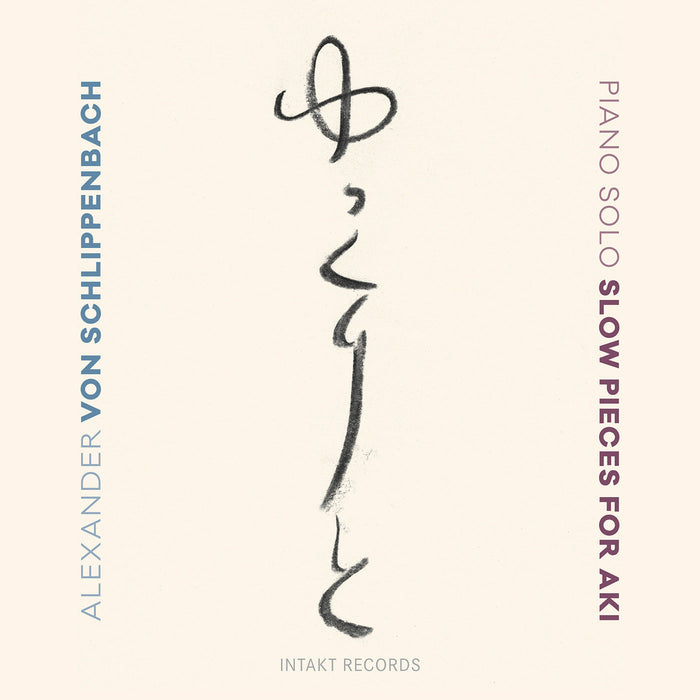
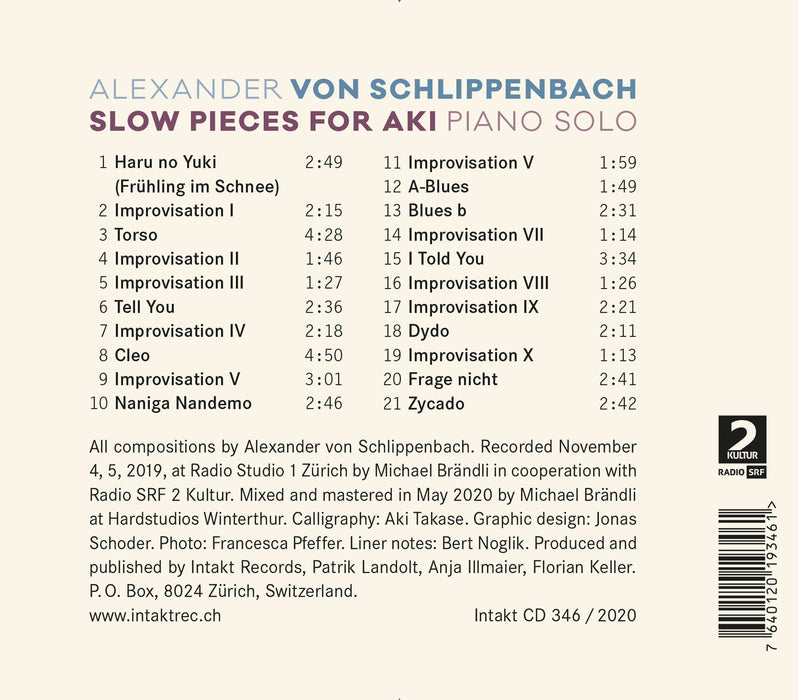
346: ALEXANDER VON SCHLIPPENBACH. Slow Pieces For Aki – Piano Solo
Intakt Recording #346/ 2020
Alexander von Schlippenbach: Piano
Verkauf
Verkauf
Ursprünglicher Preis
CHF 12.00
-
Ursprünglicher Preis
CHF 30.00
Ursprünglicher Preis
CHF 30.00
CHF 12.00
-
CHF 30.00
Aktueller Preis
CHF 30.00
| /
More Info
Der Pianist, zwei Tage im Studio, allein am Klavier. Klausur in Zürich. Konzentration auf das Jetzt, die Aufnahme läuft. Vorbereitungszeit für die neuen Kompositionen: circa ein Jahr. Einstimmung auf die Musik: ein leben lang. Alexander von Schlippenbach, «Slow Pieces For Aki», die Betonung liegt auf dem wort «slow», nicht auf der Wieder- , sondern auf der Neuentdeckung der Langsamkeit – gewidmet seiner Frau, der Pianistin Aki Takase. Bei langsamen Stücken, kurzen Stücken, Kompositionen, bei denen jeder einzelne Ton ein Höchstmass Zuwendung erfahren soll, verlagert sich die Virtuosität vom Technischen auf das inhaltliche, die Vermeidung alles Unnötigen.Töne, die im dunkeln zu leuchten ver- mögen und sich zueinander gruppieren wie Sternzeichen.nicht nur Jazz und neue Musik scheint da von fern her auf, auch klassisches und romantisches, immer reflektiert durch die Persönlichkeit, die lebens- und Spiel Erfahrung von Alexander von Schlippenbach. Auf der ebene subjektiver Wahrnehmung würde ich es wagen, von einem ernsten Lyrismus zu sprechen. langsam, voller Leidenschaft und erfüllt von der Hingabe an die Musik. Bert Noglik, Liner Notes
Album Credits
Calligraphy: Aki Takase
Graphic design: Jonas Schoder
Photo: Francesca Pfeffer
Liner notes: Bert Noglik
All compositions by Alexander von Schlippenbach. Recorded November 4, 5, 2019, at Radio Studio 1 Zürich by Michael Brändli in cooperation with Radio SRF 2 Kultur. Mixed and mastered May 2020 by Michael Brändli at Hard Studios Winterthur. Produced and published by Intakt Records, Patrik Landolt, Anja Illmaier, Florian Keller, P. O. Box, 8024 Zürich.
- 5 stars: 27 (100%)
- 4 stars: 0 (0%)
- 3 stars: 0 (0%)
- 2 stars: 0 (0%)
- 1 star: 0 (0%)
J
Jean Buzelin Le pianiste Alexander von Schlippenbach dédie son nouvel album à sa compagne Aki Takase à travers onze compositions personnelles et dix improvisations – il est difficile parfois de faire la différence car elles s’enchaînent sans hiatus – dans lesquelles il pratique un jeu très intériorisé (mais non pas introverti), réfléchi, pensé et précis, parfois accidenté (Monk qu’il connaît si bien), où chaque note compte. Un parcours musical sur des tempos en général lents qui aboutit à un CD parfaitement bien composé.
https://www.culturejazz.fr/spip.php?article36899
K
Klaus Nüchtern Der deutsche Free-Jazz-Pionier hat sich für zwei Tage an den Flügel gesetzt und eine Reihe von Skizzen improvisiert, die dem Postulat der Langsamkeit unterstellt und seiner Frau, der Pianistin Aki Takase, gewidmet sind. Wobei „langsam“ relativ und keineswegs mit zaghaft gleichzusetzen ist. Groove und Jazz-Idiomatik spielen allenfalls eine schattenhafte Rolle, stattdessen wird die Nähe zur Zweiten Wiener Schule spürbar. Ganze 21 Stücke gehen sich in 52 Minuten aus, langatmig wirkt das Album dennoch.
A
Aldo Del Noce Non difficile decifrare l’identità dedicataria: Aki Takase è sperimentata pianista nativa di Osaka ed esordita trentenne sulla scena europea, insediatasi ormai da decenni nell’area germanica, spirito affine in arte e compagna di vita del titolare della presente incisione.
Il veterano berlinese Alexander von Schlippenbach è, dal suo canto, carismatica figura che può annoverarsi di diritto entro la prima generazione esponente dell’euro-free, notabile animatore di grandi ensemble tra cui la Globe Unity Orchestra, interprete d’eclettica espressione ma peculiarmente votato alle reinterpretazione di Thelonious Monk, cui ha dedicato una incisione individuale ma soprattutto, in quintetto, il ponderoso box in forma d’integrale “Monk’s Casino” (che s’invita a recuperare).
Il sommo pianista tedesco non è dunque nuovo alla produzione solistica, se già il catalogo Intakt ne annovera oltre alla prova ‘monkiana’ una gemellare pubblicazione in solo quale i due volumi di “Twelve Tone Tales”, ma non ci sembra fuori luogo ricordare anche il suggello d’arte con la dedicataria nell’esclusivo duo pianistico “Iron Wedding” del 2008.
La tracklist enumera una successione non strettamente alterna di brani tematici e titolati e ben dieci passaggi in forma (dichiarata) di Improvisation – e come tali denominati; i titoli sono stati apposti, nei relativi casi, ben dopo la registrazione e, di fatto, trattiamo di scrittura fortemente ed ineluttabilmente improntata d’improvvisazione): “Qui non si segue il metodo costruttivo quanto piuttosto delle idee di suono, molto liberamente adattate e personalizzate” secondo le note.
Esordendo con carattere fortemente evocativo del paesaggismo nipponico, Haru no Yuki / Frühling im Schnee (o Primavera nella neve), è il primo della sequenza a titoli, in questo caso suggerito dalla medesima Aki Takase, e molto esplicita il proprio capitale poetico nel dichiarato carattere della “slowness”, ingrediente espositivo di dominante importanza nella costituzione estetica della sequenza, e chiave d’approccio nel prendere in oggetto alcuni ulteriori passaggi per viverne e decrittarne lo sviluppo.
Così s’avvicendano l’incedere solenne e misterico di Tell You, l’interrogativa indeterminatezza di Naniga Nandemo, l’impressionismo scarno e straniante della ‘diade’ A-Blues e Blues b, il tono enigmatico e la torbida luminosità di I told You, fino alla conclusiva Zycado, pulsatoria ed instabile, ma una tale caratterizzazione può riuscire poco più che nominale, tenendo in primo piano sia l’estrema concisione che lo stato di sospensione narrativa dominante. Cosicché lo spirito di buona parte dei passaggi si palesa tutt’altro che compiuto ed autoconclusivo, trovando nella propria cadenza idiomatica e nelle micro-dinamiche dei propri slanci un pervasivo puntamento verso una abissale dimensione interrogativa, che vorremmo assimilare al principio di indeterminatezza e alla profonda dimensione esistenzialista dei Koan.
D’impianto chiaroscurale e ben poco narcisistica, la sequenza degli “Slow Pieces” conduce l’ascolto verso una interiorità a tratti labirintica, più sovente eterea, comunque segnata da un intimismo criptico che potrà trovare analogie idiomatiche anche in espressioni d’eccellenza della letteratura pianistica del Novecento – e non riusciranno fuori luogo i paragoni con le pagine pianistiche di Arnold Schoenberg dalle note di copertina – e rimanendo sulle medesime note non ci sembra da poco la considerazione secondo cui questa prova solistica, rispetto al patrimonio assembleare e alle energie di moltitudine della Globe Unity non rappresenti l’antitesi quanto piuttosto la ‘atomizzazione’ di un tale universo.
Sotto la superficie di quanto offerto all’orecchio si disvelano alcuni importanti tratti di stile, ad esempio la combinazione di bilanciamento delle tensioni ed (apparente) economia dei mezzi interpretativi del vissuto performer, che non mancherà di sorprendere, e a più riprese, per l’adamantina eleganza conseguita in essenzialità di tratto. Il nuovo tematico album configura dunque una estrema e nucleare sintesi ad un polo della complessiva poetica di Schlippenbach, che su tutto suona vivente dei più vitalistici fermenti di un trasfigurato spirito post-jazz, rilasciando materiali di pregio da fissare e recuperare nel tempo.
https://www.soundcontest.com/alexander-von-schlippenbach-slow-pieces-for-aki//
K
Kay Friedrichs Schlippenbach, das ist der alte Wilde am Klavier. Seit 1960 wütet der begnadete Avantgardist mit seinen Free Jazz Formationen gegen alle Konventionen. Ganz anders seine Alleingänge am Piano. Hier übt er sich in traditionelleren Klängen. Inspiriert von Thelonious Monk und Jelly Roll Morton schnuppert er an der oft introspektiven Schönheit der Zwölftöner. „Slow Pieces For Aki" ist eine Liebeserklärung an seine
Partnerin, die Pianistin Aki Takase. Mit 21 Miniaturen, zehn davon sind Improvisationen, widmet er Takase eine Art buddhistische Meditation. Hier stimmt erst einmal gar nichts, aber jede Note offenbart eine in sich ruhende Schönheit. Wer solch ein Kunststück nach 60 Jahren Versuch und Irrtum so überwältigend unvollkommen zu Wege bringt,
der wird, da ich bin mir fast sicher, eines Tages in den Olymp der Pianisten einziehen.
https://www.klenkes.de/epaper#epaper-tile-1027188
G
Guy Peter Pianist Alexander von Schlippenbach (°1938) is een van de architecten van de vrije muziek in Europa en lag aan de basis van enkele van de langstlopende en meest gelauwerde bezettingen van de Europese improvisatie. Partner Aki Takase vond echter dat het tijd was voor een opname die de densiteit en snelle interactie liet voor wat ze was, en zo geschiedde. Slow Pieces for Aki laat de meester in contemplatieve stemming horen, met compacte composities en improvisaties. Zoals gewoonlijk is het uithangen tussen nieuwe muziek, improvisatie en jazzresidu, en is het niet altijd makkelijk om te horen wat gecomponeerd is en wat niet. De muziek is bedachtzaam, sober en soms lyrisch, zonder toegevingen te doen. Het is de synthese van meer dan 50 jaar intense revolutie, maar dan zeldzaam delicaat.
A
Alberto Bazzurro Che Alexander von Schlippenbach non sia più il pianista incendiario e irriverente dei suoi anni d'oro, quando s'impose fra i padri nobili del radicalismo free di marca europea (ma anche per un bel po' dopo), lo sappiamo ormai da tempo. Questo suo nuovo lavoro solitario, dedicato alla moglie Aki Takase, ce lo conferma nella maniera più eloquente.
Anzitutto un po' di date: il disco è stato inciso a Zurigo nel novembre 2019, quando Schlippenbach aveva passato da un po' gli ottanta (è nato il 7 aprile 1938, per cui presto ne farà 83), laddove la dedicataria dell'opera aveva festeggiato l'anno prima i settanta. A tratti incendiaria e irriverente lo è stata, e lo è ancora, la signora Schlippenbach, ma l'omaggio che le viene rivolto dal marito si muove invece convinto lungo un'altra direttrice: quella di un pianismo concentrato, assorto (slow, come da titolo), qua e là anche vivace, ritmicamente pulsante, persino con qualche guizzo (segnaliamo in particolare le dieci "Improvisations" che punteggiano il lavoro, soprattutto la terza, la quinta e le ultime quattro) e comunque sempre calato in tutta la tradizione del pianismo jazz e della sua discendenza diretta dal blues.
Qualcosa di male? Ci mancherebbe. Tuttavia qualcosa ci manca: l'invenzione repentina, il colpo d'ala subitaneo, magari persino imprevisto, l'impennata, lo sgocciolamento nervoso, magmatico, o fate voi quello che vi viene in mente dello Schlippenbachi vecchio stampo. Ci manca non solo in questo disco, si capisce, ma da un po.' Nostalgie vetero-avanguardiste? È possibile. Così come invece è certo che il glorioso pianista berlinese è liberissimo di fare le scelte espressive che preferisce. Gli anni passano e non è detto che ci giochi (non solo, in ogni caso) la vecchia storia dell'incendiario che diventa pompiere. Un po' meno di acqua sul fuoco, tuttavia, pur nella bellezza—ci mancherebbe—di questi cinquanta minuti abbondanti di musica, ci permettiamo di dire che non avrebbe guastato.
https://www.allaboutjazz.com/slow-pieces-for-aki-alexander-von-schlippenbach-intakt-recordss
B
Bert Noglk Um diese Musik spielen zu können, bedarf es einer Konzentration auf das Wesentliche, die sich so wohl erst im fortgeschrittenen Lebensalter einstellt. Alexander von Schlippenbach gestaltet einundzwanzig Miniaturen zu einem von ernster Lyrik durchzogenen Klavierzyklus, in dem sich kompositorische Ideen und Impulse aus der Improvisation trefflich ergänzen. Alles Überflüssige erscheint eliminiert, jedem Ton gilt die gleiche, gesteigerte Aufmerksamkeit. Im Vergleich mit der vom Free Jazz gewohnten Akzentuierung des Schnellen, Lauten und Exzessiven kommen diese Stücke eher bedächtig daher. Doch sie offenbaren - und das ist das Faszinierende - unter der Oberfläche den gleichen Freiheitsdrang. Für die Jury: Bert Noglik
T
Tom Greenland Piano is probably the most versatile instrument for solo performance: besides its considerable harmonic and melodic capabilities it makes a fine drum and can produce a plethora of other timbres via extended techniques. This column reviews solo CDs recorded in Switzerland, Australia and Germany.
Alexander von Schlippenbach's trio and Globe Unity Orchestra is off-the-map energetic, so when his life/musical partner Aki Takase, who turns 73 this month, posited a lower, slower, softer approach, his answer was Slow Pieces for Aki. Short compositions are followed by free improvs, the latter extending or reshaping the former, both unfolding organically from small gestures, blurring any distinction. The pieces share a hesitant yet deliberate quality, as if the pianist, like a chess grandmaster, is weighing future consequences before making his move. On "Torso", "Blues b" and "Improvisation VIII" his ugly/beautiful chords spackle the pensive melodies with iridescent hues. A debt to Monk is heard in his technique of peeling off a finger mid-chord to expose buried pitches, close adherence to the melodic skeleton and use of stabbing cluster chords. The two abstract 'blues' are utterly original, a debt he owes to no one but himself.
Melbourne-based Andrea Keller's Journey Home sounds like a love song to piano, perhaps because it is recorded on three of the largest pianos on earth, two with 102 keys, one with 108, all handmade by Stuart & Sons, each with its distinctive timbre. Keller approaches her free improvs with zen-like openness, eschewing preconceptions. She exploits extreme range contrasts by spread-eagling her arms, educing now rhapsodic, now minimalistic passages hovering around but never fully committing to tonal centers. On "Generations of Leaves", "Tenderly We Weave" and "Consequentially" – all which sound as if they're played on "Big Beleura" (the 108-key piano named for the resort it's housed in) - sopranississimo pitches voiced at the very top of Keller's right-hand chords tinkle just out of hearing range while bassississimo pitches (vibrating as slow as 16 Hz!) rumble in an unearthly manner at the other end of the keyboard.
Suvenýr is Berlin-based pianist Marc Schmolling's second solo album, recorded on two separate sessions. Like Keller he is of Czech heritage-his mother, Inka Machulková, was a prominent beat poet in '60s Prague- and he too comes to the keyboard without a prepared roadmap for improvisation. Like Schlippenbach, he thinks twice (or maybe three or four times) before he plays once, elongating phrase-ends into pregnant pauses. A very unusual and compelling quality of his music is that, although it appears to develop, harmonize, modulate and cadence-all those things one expects of tonal music-it never really does, such that pinpointing a set key or distinct melody proves ultimately elusive. All of which creates an existential ambiance, slightly familiar and yet slightly unnerving at the same time.
N
Nazim Comunale La tradizione è custodire il fuoco, non adorare le ceneri (Gustav Mahler)
A questo giro la rubrica a cadenza eventuale “Notizie dal diluvio” si concentra su cinque uscite del 2020 di una etichetta che mantiene sempre uno standard alto: Intakt, da Zurigo.
Partiamo per una volta dalle note di copertina (non è nostra abitudine farlo): un modo per entrare dentro questa musica senza scendere troppo nei dettagli comincia con la storia della sua creazione. Il pianista da solo con il pianoforte, due giorni in studio di registrazione. Un ritiro a Zurigo. L’attenzione è tutta sul momento, la registrazione sta andando. Un anno per preparare le nuove composizioni, una vita per intonarsi alla musica. Lo stimolo per questo splendido disco nasce dalla partner di Schlippenbach, la pianista giapponese Aki Takase che ha chiesto a se stessa e al compagno se il free debba essere per forza di cose sempre così intenso, rumoroso, veloce. Il musicista tedesco è stato spesso interprete di un approccio di questo tipo, ma qui ci svela una faccia totalmente differente della sua arte, illuminata da un pianismo capace di coniugare l’incedere sghembo di Monk con le asperità di Schonberg, uno swing corrusco e a tratti malmostoso con lampi matematici e nitidi, in un equilibrio perfetto tra astrazione e visione, tra viscere e nuvole. In alcuni frangenti (la magnifica “Tell You”) pare quasi di ascoltare un Duke Ellington alle prese con un allunaggio su un nuovo satellite; lungo tutto il lavoro, ad ogni modo, equamente diviso tra scrittura e improvvisazione, tutto suona necessario, meditato, vero, intatto e delicato come il verde di una foglia circondata da una neve tardiva (l’iniziale “Haru No Yuki”). Come orme di visioni ragtime sepolte dall’inverno della contemporaneità, figure che un tempo sarebbero state colme di groove o di languori blues e ora custodiscono nel silenzio il loro nucleo pulsante, un gheriglio protetto da un guscio austero che svela, ancora di più, nascondendola, proteggendone il cuore intimo, la poesia di un disco luminoso e illuminante.
https://www.thenewnoise.it/notizie-dal-diluvio-6/?fbclid=IwAR2oSZU2uoUaXRWHD9dJ8MG7NWawWvz97Q4BSkcSG-Si51kPsiCDNZRtFjoo
P
Pirmin Bossert Dass Alexander von Schlippenbach, seit über 50 Jahren ein Prototyp für das radikale Free-Play in aller Vehemenz, nun ein Album mit langsamen und ruhigen Stücken vorlegt, ist natürlich eine Überraschung. Und noch mehr ein schönes Geschenk. Vielleicht ist es schlicht auch eine Frage der Zeit und der Konsequenz eines langen Lebens, in dem vieles schon gesagt, aber noch längst nicht alles ausprobiert und reflektiert wurde. Motiviert dazu, für einmal ruhige und langsame Stück zu spielen, wurde er von seiner Lebenspartnerin Aki Takase, die sich fragte, warum denn frei improvisierter Jazz immer so heftig, so laut und so schnell sein müsse. Auf den 21 Kompositionen und Improvisationen nur wenige sind länger als zwei, drei Minuten spielt von Schlippenbach mit herber Lyrik so langsam und behutsam wie noch nie. Seine Tasten-Miniaturen mit dem verwendeten Tonmaterial klingen manchmal nach Neuer Musik, nach Schönberg und der Zweiten Wiener Schule, aber man spürt auch Klassisches und Romantisches und von der Haltung her die Beschäftigung mit Thelonious Monk (Spannungsaufbau und Materialökonomie), wie das Bert Noglik in den Liner Notes treffend ausführt. Aber unabhängig von stilistischen Zuordnungen ist das zuallererst ein Album, das uns mit seiner konzentrierten Atmosphäre anspricht, in welcher einzelne Töne zum Klingen und Zwischenräume zum Schwingen gebracht werden. Eine Meditation, die nicht wegdöst, sondern nüchtern macht.
B
Ben Taffijn In deze laatste bijdrage aan de serie over het pianotrio in de jazz komt het nieuwe trio van pianist Aki Takase, bassist Christian Weber en drummer Michael Griener aan bod: ‘Auge’, tevens de titel van dit album. Vrijwel tegelijkertijd bracht Intakt ook ‘Slow Pieces for Aki’ uit, een soloalbum van Alexander von Schlippenbach, Takases levenspartner. Een mooie gelegenheid om ze ook hier samen te brengen.
Griener hoorde Takase voor het eerst in 1982, toen veertien jaar oud, sinds 2007 spelen ze regelmatig samen en tien jaar later introduceerde hij haar bij Weber. Zijn spel beviel haar zodanig dat ze vrijwel direct met dit trio op de proppen kwam, waarvan ‘Auge’ dus het debuut is. We moeten dit trio dan ook volgens Takase zeker niet als haar groep zien, maar als een samenwerking tussen gelijkwaardige partners. Naast een aantal stukken van Takase bestaat dit album, met veertien miniaturen, dan ook voor een groot deel uit improvisaties. Het meest opvallende aan dit album is de diversiteit. Introverte sfeertekeningen, zoals ‘Last Winter’ en ‘No Tears’, waarin Takase haar noten zorgvuldig doseert, omringt met stiltes en Weber en Griener gerichte accenten plaatsen, worden afgewisseld met heftige, vaak behoorlijk abstracte stukken als ‘Drops of Light’, ‘Face of the Bass’ en ‘Out of Sight’ en tot slot met zeer ritmische, dynamische stukken als ‘Are Eyes Open?’, The Pillow Book’ en ‘Calgagno’. Binnen al die diversiteit is er één gemene deler en dat is het samenspel. Wat Takase zegt klopt: dit is echt een trioalbum in de ware zin van het woord, één zoals je het zelden meemaakt. Prachtig zoals Takase, Weber en Griener hier met elkaar de structuur tot in de kleinste details vormgeven en elkaar versterken. Een zeldzaam mooi album.
Het was Takase die Von Schlippenbach op het idee bracht voor ‘Slow Pieces for Aki’. Zij vroeg zich af waarom vrije improvisatie altijd zo heftig is, met zoveel kracht gepaard gaat. Moet het altijd zo zijn? Het zette de pianist aan het denken en aan het componeren, uiteindelijk leidend tot twee dagen in de studio’s van de radio in Zürich, 4 en 5 november 2019. Elf composities en tien improvisaties, die gelden als een soort van commentaar op die composities, bevat dit opmerkelijke album. Opmerkelijk omdat Von Schlippenbach hier de grenzen van zijn gebruikelijke werk ver overschrijdt en de muziek ons vaak eerder doet denken aan hedendaags gecomponeerde muziek dan aan jazz. Opmerkelijk ook omdat deze pianist hier nadrukkelijk de stilte zoekt, kiest voor een spaarzaam gebruik van noten en de klanken de tijd geeft om uit te waaieren. Soms verlaat hij even dit pad voor wat een wat ritmischer intermezzo, bijvoorbeeld in ‘Improvisation V’ en ‘VIII” om daarna weer terug te keren naar de verstilling. Takase kan tevreden zijn.
Van beide albums zijn een aantal stukken te beluisteren via Bandcamp. De albums zijn daar ook te koop:
https://www.nieuwenoten.nl/aki-takase-christian-weber-michael-griener-auge-alexander-von-schlippenbach-slow-pieces-for-aki-cd-recensie//
G
Gonçalo Falcão Balanço
MELHORES DE 2020
Num ano de salas de espectáculo encerradas, concertos cancelados, projectos adiados e carreiras suspensas, para já não falar dos efeitos da pandemia na sobrevivência de muitos artistas, chegou a parecer que a música se tinha silenciado com a pandemia. Afinal, assim não foi: bastantes discos, e bons, foram editados por todo o mundo e as actuações ao vivo voltaram, a pouco e pouco. Eis aqui o melhor que a jazz.pt ouviu e viu neste annus que conseguiu não ser totalmente horribilis.
É como se a música se tivesse vingado da pandemia e das medidas - em muitos casos erradas - que se tomaram para a combater, numa manifestação de resiliência dos artistas que se traduziu em obras e feitos de enormes qualidade e inventividade. Este balanço poderia ser de excepções, de pálidas tentativas de resistência, mas é bem mais do que isso: uma demonstração de que a alma humana pode mais do que um vírus e do que políticas económicas estapafúrdias.
Ingrid Laubrock: "Sonhei Duas Vezes, Sonhei Duas Vezes" (Intakt)
Kaja Draksler Octet: "Out for Stars" (Clean Feed)
Orquestra Supersónica de Gard Nilssen: "Se ouvires com atenção, a música é tua" (Odin)
Muhal Richard Abrams / Os Guerreiros do Som Maravilhoso: "Sound Path" (Clean Feed)
Dupla Ingrid Laubrock / Kris Davis: "Blood Moon" (intacta)
Lynn Cassiers: "Yun" (alimentação limpa)
Code Girl de Mary Halvorson: "Artlessly Falling" (Firehouse 12)
Carla Bley Trio: "A vida continua" (ECM)
Shabaka e os Ancestrais: “Fomos Enviados Aqui pela História” (Impulso!)
Nubya Garcia: "Fonte" (Concórdia)
Snakeoil de Tim Berne: "The Deceptive 4 Live" (Intakt)
Snakeoil de Tim Berne: "A Fantástica Sra. 10" (Intakt)
Rob Mazurek Exploding Star Orchestra: "Dimensional Stardust" (Hino Internacional / Nonesuch)
Alexander von Schlippenbach: "Slow pieces for Aki" (Intakt)
Maria Schneider Orchestra: "Data Lord" (ArtistShare)
Ballrogg: "Rolling Ball" (alimentação limpa)
Agustí Fernández / Jordina Millà: "Quando as florestas sonham" (Sirulita)
https://jazz.pt/artigos/2020/12/28/melhores-de-2020/
J
John Sharpe At the behest of his wife Aki Takase, fellow pianist Alexander von Schlippenbach presents 21 short unaccompanied tracks on Slow Pieces For Aki. It is only his fourth solo record in a career spanning over 50 years, during which he has blazed trails with both large ensembles, notably Globe Unity Orchestra, and small groups, in particular his trio with Evan Parker and Paul Lovens.
This current work bears the strongest relationship to his two well- received volumes of Twelve Tone Tales (Intakt, 2006), in feel if not in structure and design.
Schlippenbach's three-day stay in a Zurich studio resulted in a mix of 11 concise compositions and ten even shorter improvisations, which are interspersed throughout the 52-minute program. Many of the cuts are indeed slow, but not languid. And reflective, but not sentimental. While they are abstract, dissonance is rare. Bunches of notes hang in the ether, surrounded by the ringing sustain which adorns Schlippenbach's luminous playing. The wonderful sound only serves to accentuate the gravity of his purposeful note choices, as he distils each piece to its essence.
An aura of space and unhurried elegance informs much of the scripted fare. Only "Haru No Yuki (Frühling im Schnee)" comes close to pensive atmospherics, coolly lyrical, evoking snow in sunshine, warm rays piercing the crisp air. Elsewhere the selections triangulate between New Music, free improv and left-leaning jazz. Sudden divergences, such as the occasional crashing clusters which punctuate "Torso," assume greater significance amid austere musing. Neither "A-Blues" or "Blues b" flaunts anything other than the merest hint of azure, though the following "Improvisation VII" toys rather more with the cadences of the form.
Stemming from the confluence of intense practice and concentration, some of the improvisations possess more overt structure than the written material, such as "Improvisation IV" with its reiterated phrases examined and then developed further, only to recur later. Schlippenbach doesn't hedge himself in with his title: with its echoes of stride, "Improvisation III" would not be out of place on an outing entitled Fast And Funky Pieces For Aki. A similar rhythmic impetus animates "Improvisation V" with its scuttling middle register and rolling gait.
Were it needed, the final "Zycado" offers a reconciliation of sorts. Schlippenbach takes an annunciatory two-note pattern which he repeats several times, extends then transforms, until it returns in the opening guise at the end to give a sense of resolution, both to the work and to the album as a whole. It is an enthralling set, understated but swathed in astringent beauty and grace.
M
Michael Rosenstein When thinking of pianist Alexander von Schlippenbach, the first things that may come to mind are fiery sessions like The Living Music, the all-in blast of Globe Unity, or the buffeting three-way intensity of the Schlippenbach Trio with Evan Parker and Paul Lovens. But that overlooks the pianist’s solo catalog (albeit scant), particularly the recordings he’s made for Intakt Records. The two volumes of Twelve Tone Tales, from 2005 or Plays Monk from 2011 reveals Schlippenbach as a consummate, musing pianist with a penchant for distilling harmonic investigations with compositional focus while retaining an innate sense of spontaneous freedom. The impetus of Slow pieces for Aki was a series of conversations the pianist had with his partner Aki Takase about why free improvisation so often gravitates toward loud and fast interactions. Schlippenbach used that as a jumping-off point, spending a year working on this series of eleven compositions and ten related improvisations which explore slower, harmonically open strategies.
With pieces that range from just over a minute to just under five minutes long, there is an overarching concision to this session. But rather than simply spinning off a catalog of sketches, Schlippenbach maintains a flow between the pieces which carries across the recording. The obvious framing convention here is one of pace, thoughtfully voicing themes and variations with a measured sense of timing. What comes out is his ability to embrace this tactic, leveraging it to provide a lose but focused alignment between the pieces. While there is nothing overt, one can hear his fascination with Monk’s structural angularities come through. Kernels of ideas are stated with abstracted deliberation, teased apart, and then tied back together.
Starting out with the quiet, free lyricism of “Haru No Yuki,” the pianist contemplatively wends his way through the program. The compositions display a bit more harmonic formalism than the interlaced improvisations, though even here that serves more as a framework than as a strict strategy. Instead, they provide touchpoints through the program which are then refracted in the improvisations that follow. Each builds off of threadlike motifs that are played out with patience, letting notes sound and hang with a considered ear toward attack and decay which the intimate studio recording captures with warm clarity. The ruminative explosion of blues voicings on “A-Blues” and “Blues B” are good examples of that attentiveness. While a piece like “I Told You” maximizes the deep resonance of the instrument, unfolding with poignant, ethereal melodicism.
The improvisations are a bit more fluid, drawing on jazz phrasings which Schlippenbach deploys with relaxed freedom. Listen to the abstracted stride of “Improvisation No. 5” or the percussive clusters of “Improvisation No. 7” for two examples. But sitting down without charting the titles, the flow back and forth between composition and improvisation is subtle and unassuming, never calling specific notice to the underlying approach. It is amazing to realize that this is only Schlippenbach’s sixth solo release in his five-decade career. Like each of the others that preceded, this one is not to be missed.
https://www.pointofdeparture.org/PoD73/PoD73MoreMoments6.html
C
Christoph Haunschmid Eigentlich, so verrät es das, wie immer bei Intakt, sehr informative Booklet, war es ja eine Idee von Aki Takase, die ihren Lebensmenschen Alexander Schlippenbach fragte, warum sein Jazz immer so schnell, nervös und aggressiv sein müsse. Nun hat er quasi als Antwort eine Solo-CD mit 21 bewusst langsamen Miniaturen aufgenommen, elf Mal Komponiertes und zehn Mal Improvisiertes. Da fließt vieles hinein, natürlich der Jazz und die freie Improvisation, aber auch die hunderts, manchmal vermutet man fast Romantisches. Aber mit billigem Schönklang gibt sich Schlippenbach natürlich nicht zufrieden. Auch das trotzige Aufbegehren hat seinen Platz oder die spröde Eleganz Thelonious Monks. Man will sich ja auf gar keinen Fall nachsagen lassen, ein altersweises, reduziertes Spätwerk geschaffen zu haben. Und wunderschön ist es sowieso.