
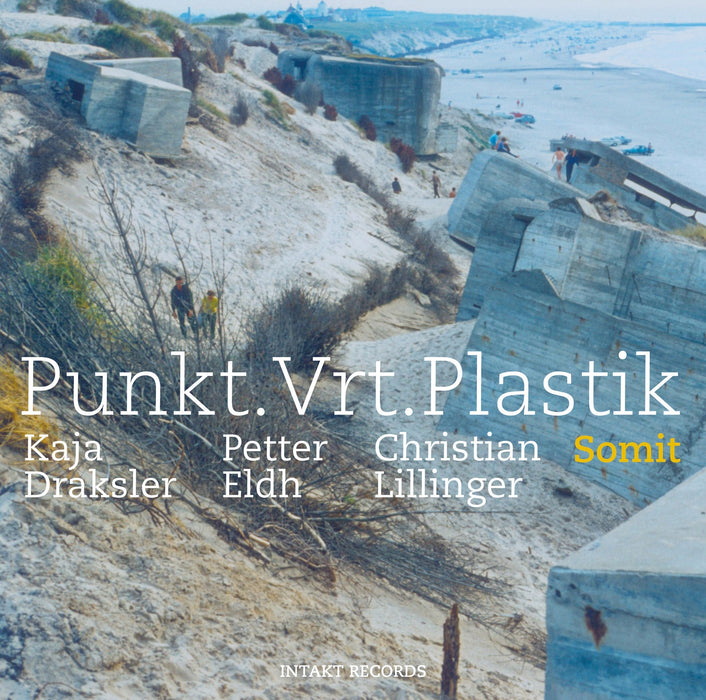
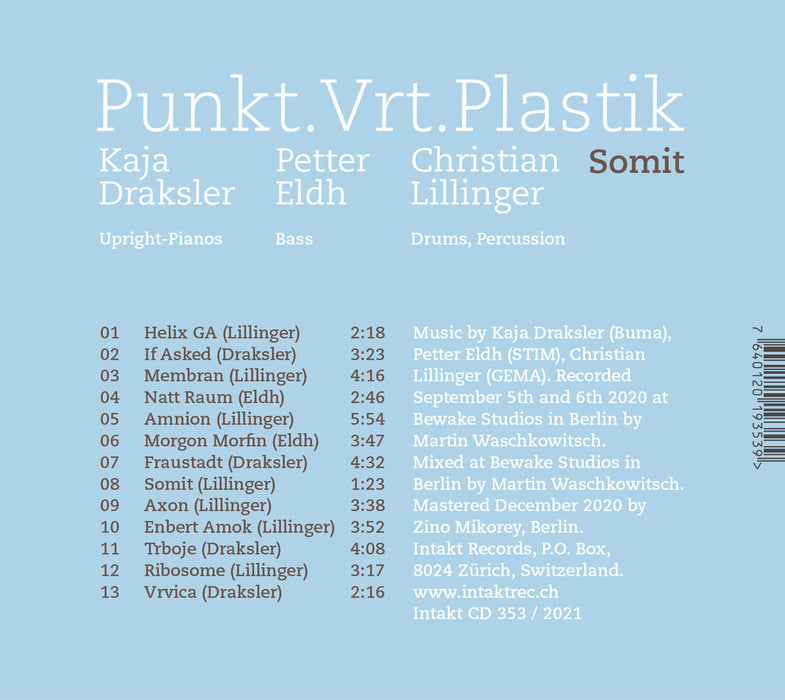
353: PUNKT.VRT.PLASTIK. KAJA DRAKSLER - PETTER ELDH - CHRISTIAN LILLINGER. Somit
Intakt Recording #353/ 2021
Kaja Draksler: Piano
Petter Eldh: Bass
Christian Lillinger: Drums
Verkauf
Verkauf
Ursprünglicher Preis
CHF 12.00
-
Ursprünglicher Preis
CHF 30.00
Ursprünglicher Preis
CHF 30.00
CHF 12.00
-
CHF 30.00
Aktueller Preis
CHF 30.00
| /
More Info
Nach ihrem gefeierten Debut-Album von 2018 legt die Band Punkt.Vrt.Plastik, die mit Katja Draksler, Petter Eldh und Christian Lillinger drei der spannendsten, tiefgründigsten und vielseitigsten MusikerInnen der europäischen Jazz- Szene vereint, einen weiteren Genie-Streich vor. Mit "Somit" führen sie ihr dringliches Ensemblespiel auf neue Höhen und kreieren mit einer ungewöhnlichen Instrumentation (Kaja Draksler spielt zwei unterschiedliche Upright Pianos) und einer ausgeklügelten Postproduktion eine höchst individuelle Soundästhetik, die in einem Vexierspiel zwischen akustischen und manipulierten Klängen gipfelt. „Punkt.Vrt.Plastik haben einen verblüffenden Sound und eine einzigartige Vision“ , schreibt Alexander Hawkins in den Liner Notes.
Album Credits
Cover photo: Edith Ringer
Graphic design: Paul Bieri
Liner notes: Alexander Hawkins
Photos: Sebastian Heidinger
Recorded September 5th, 6th 2020 at Bewake Studios in Berlin by Martin Waschkowitsch 2020. Mixed at Bewake Studios in Berlin by Martin Waschkowitsch. Mastered December 2020 by Zino Mikorey, Berlin. Produced by Kaja Draksler, Petter Eldh, Christian Lillinger and Intakt Records, Patrik Landolt, Anja Illmaier, Florian Keller.
- 5 stars: 39 (100%)
- 4 stars: 0 (0%)
- 3 stars: 0 (0%)
- 2 stars: 0 (0%)
- 1 star: 0 (0%)
A
Anonymous Extended Technique
Mar 30, 2023 3:00 PM – 6:00 PM
Music
Extended Technique, a joint product of the Classical and New Music departments, is dedicated to the elevation, exploration, and advancement of “contemporary” “classical” “music” as understood by WKCR programmers. This show challenges the binary distinction between the "classical" and "experimental" traditions as a dedicated space for the 20th-century avant-garde and “traditional contemporary classical" with an emphasis on the work of present-day composers and performers.
3:01 PM
Kaja Draksler/Petter Eldh/Christian Lillinger - Fraustadt
Kaja Draksler/Petter Eldh/Christian Lillinger Fraustadt
Somit Intakt Records 2021 CH2702004242
3:08 PM
Kaja Draksler/Susana Santos Silva - Moonrise
Kaja Draksler/Susana Santos Silva Moonrise
Grow Intakt Records 2022 Jazz CH2702204891
3:08 PM
Kaja Draksler, Petter Eldh & Christian Lillinger - Somit
Kaja Draksler, Petter Eldh & Christian Lillinger Somit
Somit Intakt Records 2021 CH2702004243
3:09 PM
Kaja Draksler, Petter Eldh & Christian Lillinger - Axon
Kaja Draksler, Petter Eldh & Christian Lillinger Axon
Somit Intakt Records 2021 CH2702004244
3:13 PM
Kaja Draksler/Susana Santos Silva - Moonrise
Kaja Draksler/Susana Santos Silva Moonrise
Grow Intakt Records 2022 Jazz CH2702204891
3:20 PM
Cory Smythe - Smoke Gets In Your Eyes, Pt. 3
Cory Smythe Smoke Gets In Your Eyes, Pt. 3
Smoke Gets in Your Eyes Pyroclastic Records 2022 Jazz QZ3DS2200031
4:00 PM
Agnese Toniutti - Sonata I
Agnese Toniutti Sonata I
John Cage: Sonatas & Interludes for Prepared Piano Neuma Records 2023 QM5CR2317201
4:09 PM
Agnese Toniutti - First Interlude
Agnese Toniutti First Interlude
John Cage: Sonatas & Interludes for Prepared Piano Neuma Records 2023 QM5CR2317205
4:13 PM
Agnese Toniutti - Sonata V
Agnese Toniutti Sonata V
John Cage: Sonatas & Interludes for Prepared Piano Neuma Records 2023 QM5CR2317206
4:22 PM
Agnese Toniutti - Second Interlude
Agnese Toniutti Second Interlude
John Cage: Sonatas & Interludes for Prepared Piano Neuma Records 2023 QM5CR2317210
4:26 PM
Agnese Toniutti - Third Interlude
Agnese Toniutti Third Interlude
John Cage: Sonatas & Interludes for Prepared Piano Neuma Records 2023 QM5CR2317211
4:29 PM
Agnese Toniutti - Sonata IX
Agnese Toniutti Sonata IX
John Cage: Sonatas & Interludes for Prepared Piano Neuma Records 2023 QM5CR2317212
4:45 PM
Agnese Toniutti - Sonata XIII
Agnese Toniutti Sonata XIII
John Cage: Sonatas & Interludes for Prepared Piano Neuma Records 2023 QM5CR2317217
4:49 PM
Agnese Toniutti - Sonatas XIV & XV
Agnese Toniutti Sonatas XIV & XV
John Cage: Sonatas & Interludes for Prepared Piano Neuma Records 2023 QM5CR2317218
5:59 PM
John Coltrane - Soul Eyes
John Coltrane Soul Eyes
The Best of John Coltrane (Spiral Collection) Ultimate Oldies Records 2016 Jazz GBURZ1305487
https://spinitron.com/WKCR/pl/17185205/Extended-Technique
G
Glenn Astarita No doubt, 2021 was a tumultuous year on many fronts, but the jazz world had a spectacular year in the recording studio and beyond, although live appearances were limited. Hence, the following is a top ten list (in no particular order) that highlight some of the superb recordings released during 2021.
Kaja Draksler—Petter Eldh—Christian Lillinger SOMIT
PUNKT.VRT.PLASTIK
Intakt Records
https://www.allaboutjazz.com/glenn-astaritas-best-recordings-of-2021
K
Ken Waxman NEW RELEASES
Joëlle Léandre, Beauty/Resistance (Not Two)
Silke Eberhard Trio, Being the Up and Down (Intakt)
Tom Ward-Martina Verhoeven-Dirk Serries-Cath Roberts, Imaginary Junction (A New Wave of Jazz)
KORR, Tombé De La Voûte (We Insist)
Bertrand Gauguet & John Tilbury, Contre-Courbes (Akousis)
Punkt. Vrt. Plastik [Kaja Draksler/Petter Eldh/Christian Lillinger], Somit (Intakt)
Flow Trio With Joe McPhee, Winter Garden (ESP-Disk)
Umlaut Big Band, Mary's Ideas (Umlaut)
See Through 4, Permanent Moving Parts (All-Set! Editions)
Lao Dan & Deng Boyu, TUTU Duo (NoBusiness)
https://hullworks.net/jazzpoll/21/ballots-08.php
P
Pierre Tenne LES 40 ALBUMS DE L'ANNÉE
2021: ET POURTANT ILS TOURNENT
<< On ne peut que s'étonner que depuis quelques années qu'elle se fait remarquer, la pianiste Kaja Daksler n'ait pas reçu en France un accueil plus massif tant, elle joue si bien des musiques souvent captivantes >>
M
Marcello Lorrai Torniamo sulle uscite della Intakt per tre album molto diversi fra loro pubblicati dall'etichetta svizzera nel 2021. In due puntate del settembre 2020 che si possono trovare in podcast - ci eravamo occupati dei due precedenti album per la Intakt del sax tenore afroamericano James Brandon Lewis, uno dei personaggi più in vista del jazz di oggi: il nuovo album, realizzato con il suo quartetto regolare con il pianista Aruan Ortiz, il bassista Brad Jones e il batterista Chad Taylor si intitola Code of Being. Uno degli album che hanno fatto più effetto quest'anno, e non solo fra le produzioni Intakt, è la seconda uscita del trio Punkt Vrt Plastik, formato dalla pianista slovena Kaja Draksler, dal bassista svedese Petter Eldh e dal batterista tedesco Christian Lillinger: molto appassionante sia il pianismo della Draksler che l'interplay del trio, con il modo non convenzionale di procedere di basso e batteria. Infine un corroborante doppio cd, Road, di Fred Frith, grande chitarrista e sperimentatore: un cd in trio con basso e batteria, l'altro con l'aggiunta al trio della sassofonista danese Lotte Anker o della trombettista portoghese Susana Santos Silva.
https://www.radiopopolare.it/podcast/jazz-anthology-di-lun-22-11-21/
J
Jean Buzelin Second disque du trio Punky.Vrt.Plastik qui réunit la Slovène Kaja Draksler au piano droit et la rythmique allemande Peter Eldh (contrebasse) et Christian Lillinger (batterie, percussions). Les compositions sont partagées : entre quatre pour la pianiste, deux pour le bassiste, et sept pour le batteur, lesquelles, assez répétitives, s’accordent bien au jeu de piano rapide, à la frappe serrée et insistante, et à sa sonorité claironnante. Tantôt, poussé par la rythmique, on avance au pas de course, tantôt on se promène... mais l’on ne s’ennuie jamais à l’écoute de ce disque très original et qui possède son unité. Un parti-pris assumé.
https://www.culturejazz.fr/spip.php?article3689
V
Vincent Cotro Nouveauté. Deuxième album sur Intakt pour ce trio européen né à Amsterdam, au nom énigmatique où Punkt suggère (en suédois) l'idée musicale, Vrt (en slovène) le jardin où les planter, et Plastik (en allemand) la flexibilité des structures. Aux côtés de la jeune pianiste slovène Kaja Draksler, entendue en solo et en duo avec Ève Risser sur le label Clean Feed, le bassiste Petter Eldh et le batteur Christian Lillinger partagent une longue complicité, notamment dans le quartette Amok Amor avec Peter Evans. Il y a quelque chose de fascinant dans le flux installé par cette matière inextricablement collective où cependant le centre de gravité se déplace parfois de l'un.e à l'autre. On aime aussi le contraste entre la précision presque clinique du jeu (à partir d'un matériau souvent très réduit) et l'accueil permanent de l'accident ou de l'imperfection, à commencer par celle de la sonorité: en partageant son jeu entre deux pianos droits, la pianiste participe de cette esthétique lo-fi, comme la variété des sons de la contrebasse, et ceux de la batterie de Christian Lillinger. Natt Raum, par son incroyable mixture de bruits d'où surnage un motif mélodique répété, suggère une mécanique implacable et bancale, comme surgie d'un rêve. Tout implique l'auditeur dans une écoute active et complice, que renforcera la lecture du texte de livret rédigé par le pianiste Alexander Hawkins.
K
Ken Waxman Confirming once again his cooperative skill as a band member and contributing composer is drummer Christian Lillinger. Busy with many of his own bands, the Berlin-based percussionist is also a crucial cornerstone of these trios. Both discs, which ironically feature the same number of tracks, couldn’t be more different in concept and execution. Lillinger has been playing with German vibraphonist Christopher Dell and Danish bassist Jonas Westergaard for years and Beats showcases “Configuration”, a 13-part instant composition. Somit in contrast divides the compositional input among the trio members: Lillinger, Slovenian Kaja Draksler coaxing unique tones from an upright piano and Swedish bassist Petter Eldh.
A musical palimpsest of Anton Webern’s “Six Bagatelles”, only one brief track on Beats reproduces a well-modulated extension of the melody. The object of the other sequences is how the trio uses adumbrations of the root material to create an original thesis. Setting up the program with patterns vibrated through drum ruffs, double bass shakes and concise vibe-mallet strokes, references to the theme are expressed throughout. During the introductory sections it’s expressed in broad and lean motifs, reaching a resolution of sorts with “Configuration VII”. Then Westergaard’s connective string throbs fragment into sul tasto stabs that become as prominent as Dell’s supple multi-mallet framing and Lillinger’s cranking cymbal pitter patter. While higher-pitched echoes and post-production electronic whooshes lead to narrative separation throughout the next few tracks, melody is retained through vibe affiliations. Double bass pulses and drum echoes thicken the output so that by “Configuration XI” even the briefest motifs propel a near-hypnotic effect. Following the Webern interpolation the concluding “Configuration XIII” climaxes with presto pops and echoes extending a harder and heavier metallic crunch that is added to the responsive creation.
Webern-improv creations are replaced by individual musical visions on Punkt.Vrt.Plastik. Interestingly enough it’s Eldh’s composition which provide the most variety. “Natt Raum” is a jerky, jokey line that could be a kids’ ditty, and is based on stretched vibrations from Draksler and Lillinger’s rim shots. Meanwhile “Morgon Morfin” is a moderated, almost mainstream ballad which slides along with multi-fingered affirmations and careful cascades from the pianist plus the composer’s string pops and slides. Draksler’s compositions are more elaborate. “Trboje” for example is a piano-centric stop-time excursion into varied time signatures and pitch and timbre changes that recaps the introduction over the bassist’s fluid pulse. “Fraustadt” concentrates on the piano’s highest register, with the discursive feints and key clipping elaborations kept on track with a sustained double-bass throb. Consciously experimental, “Vrvica”, featuring Lillinger on second piano, concentrates on the percussive pops available from stopped keys. For his part the drummer’s compositions make full use of the piano’s multiple identities as a melodic and percussive instrument. “Axon’ for instance advances a linear keyboard exposition with Monkish detours into between note explorations and is cut off abruptly like many others of the CD’s other tracks. In contrast “Amnion” is crammed with stopped key vibrations and a build up of echoing pressure. The release leads to supple theme variations including pedal pumps from Draksler as well as ringing key clips.
With narratives bouncing along chromatically as well as thrust to explosive allegro development with drum smacks, Lillinger and the other two improvise with the same freedom afforded to the trio on the other disc. Yet the interpretations offer contrary variants of contemporary free music. Each is a testament to the continue creativity of all five players – especially Lillinger.
https://www.jazzword.com/reviews/petter-eldh-kaja-draksler-christian-lillinger/
K
Kurt Gottschalk There's a lot to unpack with Punkt.Vrt.Plastik, but doing so doesn't feel like a struggle. Unfortunately, doing so doesn't quite make things crystal clear.
First the name. "Punkt" is Swedish for dot. "Vrt" is Slovenian for "garden." "Plastik" is German for "plastic." The three words represent the nationalities of the three players: bassist Petter Eldh, pianist Kaja Draksler, and drummer Christian Lillinger. The album's title, Somit, translates as "consequently."
If that's all vaguely suggestive while remaining intriguingly confounding, then we're on the right track. Punkt.Vrt.Plastik is a piano trio. Somit sounds like jazz, but again, it's not as easy as that. The allure is in the way the sounds sound.
What leaps out first on Somit are Kaja Draksler's pianos. She plays two, both uprights. She plays lines in unison, sometimes near-unison in the same octave on the two instruments. The uprights' thin voices differ—they might be siblings, but they're not twins—and they aren't perfectly in tune. That tension isn't always overt, but it's always present, vibrating and refracting. The depth of Lillinger's drums, from the hard snap of the snare to the muted toms farther back, create another sonic illusion. Eldh's bass is deep and encompassing, circling slowly below. Abrupt and tightly executed changes sound like edits, but the acoustic warmth of the sustains speaks to the precision of their playing.
The compositions work in the service of the group. The 13 tracks, between two and six minutes, are bright, taut, and easy to digest. A fascinating listen.
https://www.stereophile.com/content/july-2021-jazz-record-reviews
N
Nazim Comunale Groove e cellule ritmiche
Note sparse. Secondo lavoro per il trio Punkt. Vrt. Plastik dai suoni tesi e vorticosi
<
M
Matthieu Jouan L’album s’ouvre sur un coup de cymbale, ouvert, mouillé et long. Une sorte de point d’orgue, mais au début.
Puis, immédiatement, ça démarre. Toute la mécanique du trio se base sur cette attitude, à ne pas remplir l’espace pour rien ; pas d’intro, ni coda, pas d’exposition du thème, pas de fioriture. Dans le vif du sujet, ici et maintenant. Et quand tout est dit, on s’arrête net. Les digressions épilogues ne servent à rien.
Ce deuxième disque du trio Kaja Draksler, Petter Eldh et Christian Lillinger vient conforter tout le bien qu’on pensait déjà du premier. Deux bonnes années sont passées, une pandémie et des confinements, l’absence de concerts, tout un ensemble d’évènements qui ne laissent pas indifférents, ni l’artiste, ni l’auditeur. Aussi, en septembre 2020 lors de l’enregistrement à Berlin, les musicien.ne.s se sont laissé.e.s porter par une énergie libératrice.
Plus souple, moins tendu, mais toujours aussi précis et dynamique, leur musique est un concentré d’effets, de structures, de rythmes et de nombreuses surprises pour les oreilles. Les trois instrumentistes sont tous au même niveau rythmique, ce n’est pas la batterie qui en a le monopole, c’est une fonction vitale partagée. Kaja Draksler joue sur deux pianos droits, en même temps et alternativement. Cela donne des effets sonores très particulier, des tonalités différentes, des différences de toucher et d’attaque aussi.
Cette vitalité, à la fois dans la musique, même dans les mélodies – l’esthétique minimaliste, très rythmique, très découpée n’empêche en rien le développement de mélodies – que dans l’approche technique, le jeu, l’enregistrement même, est particulièrement sensible à l’écoute.
L’enregistrement capte également les petites scories du jeu (bruit de cordes, claquements). Des preuves de vie.
A de rares moments, les membres du trio s’offrent quelques échappées en solitaire, à l’image du court solo de batterie sur « Enbert amok », une reprise jouée par le quartet Amok Amor.
Hormis les pièces plutôt lentes comme « Morgon Morfin » où le piano déroule une arabesque et « Natt Raum », petite comptine à chausse-trappes qui défie les lois de la gravité rythmique, à cloche-pied sur le fil du rasoir, signés Eldh, les compositions sont de Draksler ou Lillinger. Les notes de pochettes, passionnantes sont du pianiste Alexander Hawkins.
Ce disque, encore plus que le précédent, est le plus sûr moyen d’appréhender l’univers musical de ce trio, univers aisément transposable dans le grand ensemble Open Form for Society, mais en plus organique et avec une forme d’humour décontracté.
Les trois mousquetaires de cet enregistrement magnifique ont le panache des bretteurs assurés.
https://www.citizenjazz.com/Punkt-Vrt-Platik.html
M
Matthieu Jouan Rarement une rythmique jazz n’aura été aussi active et inventive que celle que composent ces trois musicien.ne.s européen.ne.s : la pianiste slovène Kaja Draksler, résidant entre Copenhague et Kranj son village natal, le contrebassiste suédois Petter Eldh, qui est passé par Copenhague avant de s’installer à Berlin et le batteur allemand Christian Lillinger, berlinois également. Tout comme les Trois Mousquetaires, ils ont leur D’Artagnan, nous y reviendrons.
Pourquoi ces trois personnalités sont-elles aussi importante aujourd’**** sur la scène jazz européenne ? Parce qu’elles portent, inventent, représentent une même esthétique, celle d’une musique qui utilise le cadre contraint comme porte vers une totale liberté. Une esthétique qui puise sans ménagement dans la musique contemporaine et dans la musique électronique, dans les formes orchestrales minimalistes, les structures musicales en brisures, en éclats, aux rythmes changeants, aux textures trompeuses. Tous les trois participent aux projets parmi les plus excitants de cette période.
En premier lieu, bien entendu, leur propre trio Punkt.Vrt.Plastik. trois mots (un dans chacune de leurs langues natales) qui signifient Point. Jardin. Plastique.
Ce trio, après un album très remarqué en 2018, vient de sortir Somit, toujours chez Intakt Records le label suisse qui n’a pas froid aux yeux.
Dans ce trio, leur musique se condense, cherche l’essentiel. L’interaction est mise dans les micros tensions qui relient les éléments, un peu comme la transmission synaptique d’un ensemble neuronal. Avec ce trio, ils déploient une approche musicale qu’ils vont ensuite mettre à profit dans les autres projets auxquels ils participent.
https://www.citizenjazz.com/Eldh-Draksler-Lillinger-Die-drei-Musketiere.html
H
Holger Pauler Die drei Musiker*innen muss man nicht mehr vorstellen. Das hieße, die berühmten Eulen nach Athen usw. Auch das Trio Punkt.VRT.Plastik hat bereits seine Spuren hinterlassen. Die erste Aufnahme aus dem Jahr 2018 und auch der wunderbare Auftritt beim Welser Festival music unlimited haben Maßstäbe für den Post-Freejazz gesetzt. Drei Jahre später zeigen Draksler, Eldh und Lillinger nun eindrucksvoll, wie man sich frei und gleichzeitig wohlstrukturiert durch die unendlichen Weiten der Improvisation weiterbewegen kann. 13 Stücke erwarten uns (sieben Mal taucht der Name Lillinger auf, vier Mal Draksler und zwei Mal Eldh). Doch sind es tatsächlich Kompositionen, mit denen wir es zu tun haben? Wohl eher Ideen, Fragmente oder Absprachen. Der Rest ist zudem: Intuition, Vertrautheit und die Fähigkeit, miteinander zu sprechen und aufeinander zu hören. Deshalb kommt es permanent vor, dass alle drei wild und frei improvisieren, um im nächsten Moment in gemeinsame Themen (oft angedeutet) oder vertrackte Rhythmen zu wechseln, Themen zu wiederholen und minimalistisch zu variieren, wie etwa im Stück Enbert Amok, das von Draksler stammt, dem Namen nach aber auch dem Eldh-Kosmos entsprungen sein könnte. Die Grenzen sind halt aufgehoben. Natt Raum (Eldh) beginnt mit einer naiven Melodie, die auch als Ballett-Thema durchgehen könnte. Zum Tanzen eignet sich das Ganze allerdings wegen der rhythmischen und metrischen Verschiebungen eher nicht, es sei denn, man steht darauf, sich die Beine zu verrenken. Für das Draksler-Stück Vrvica setzt sich Lillinger zwischendurch sogar ans zweite Klavier, um Drakslers eh schon hektische Betriebsamkeit zu verstärken. Dass das Stück am Ende etwas unvermittelt abbricht, passt zu der Herangehensweise: the future is unwritten. Wer übrigens nicht nur hören, sondern tiefer in die Materie eintauchen möchte, sollte unbedingt die ausführlichen und überaus hilfreichen Liner Notes von Alexander Hawkins lesen.
M
Mischa Andriessen Natuurlijk zie je de muzikanten niet wanneer je een cd opzet, maar bij Somit heb je als luisteraar toch voortdurend dat gevoel, en daarbij het aan zekerheid grenzende idee dat het drietal pal op elkaar zit. Wat deze plaat zo aantrekkelijk maakt, is de levendigheid die precies door die nabijheid wordt gerealiseerd. Tegelijk, en ook dat is aantrekkelijk, lijkt het trio te willen klinken als een mechaniek. Door enerzijds bewonderenswaardig hecht en punctueel te spelen en anderzijds constant te vertragen of te versnellen, ontstaat het intrigerende effect van een zich telkens vastdraaiende en dan weer op gang komende machine. Op die manier slagen de muzikanten erin om elke vorm van cerebrale abstractie te vermijden. Somit leeft en Somit bruist, Somit klinkt warm als een kloppend hart. Een stuk als Natt Raum is bovendien even geestig als dat het pakkend, om niet te zeggen, hitgevoelig is. Top.
J
John Sharpe The follow up to the acclaimed debut by Punkt. Vrt. Plastik boasts the same virtues of wayward complexity executed with energy and exactitude but achieves them by subtly different means. The prodigiously talented threesome of Slovenian pianist Kaja Draksler, German drummer Christian Lillinger and Swedish bassist Petter Eldh strips everything back to the bare bones in thirteen necessarily succinct cuts in a 45-minute program brimming with ideas. While everyone writes, anyone listening would be hard-pressed to make attribution without prior knowledge.
Each selection teems with interlocking parts, to such a degree that the emphasis falls primarily on ensemble delivery rather than solo opportunities. By this point the established tandem of Lillinger and Eldh, perhaps best known for helming the potent clamor of Amok Amor with Peter Evans and Wanja Slavin, is so together it sometimes seems the product of a single over-caffeinated brain. Eldh, a forceful and muscular presence, drives relentlessly but almost never directly, as he melds with Lillinger’s precise stutter and dislocated accents. Although they bring a hip-hop flavor to non-metric playing and improvising, with the glitchy, perpetually morphing beat, these are no foot-tappers. Even at their most repetitious, as on the bombastic “Natt Raum”, they constantly warp and stretch the meter.
Draksler gives herself almost wholly to the group ethos, albeit with a wry restraint. Indeed, with her spare repeated figures she’s the cool pivot around which the others gyrate, most obviously on the urgent yet static title cut or the whoozy reiterations of “Axon,” but often pitches the vaguely sour melodies into the gaps and crevices left between the bass and drums axis. On this date she opts for upright pianos, turning the slightly out of phase tuning of two of the instruments to her advantage, most notably to conjure a spectral eeriness during the lilting refrain of “Amnion.” Multiple instruments also surface on the jerky tumbling closer “Vrvica,” where Lillinger juxtaposes the extremes of one keyboard against Draksler’s ongoing flow on another.
The rush of concise tracks creates a suite like feel. Some appear entirely complete, like “Morgon Morfin,” which with its whiff of more conventional piano trios serves only to accentuate the distinctiveness of the rest. By contrast others seem truncated or barely sketched with minimal development before we are onto the next. Unsurprisingly the most fully realized pieces tend to be those of longer duration, like “Membran” shaped from the intersection of a series of jittery motifs across the band, and “Fraustadt” which seems to operate at three related, but rarely synchronizing, levels.
Punkt. Vrt. Plastik flaunts an intriguingly original sonic signature, but one in which although the components are crisply delineated, the gears and sprockets remain mysterious, even after countless spins.
https://www.pointofdeparture.org/PoD75/PoD75MoreMoments6.html
G
Guido Festinese La storia del piano trio in jazz, negli ultimi anni, è stata in buona parte riscritta da musicisti del Nord Europa. Tra questi i lussemburghesi Reis, Demuth & Wiltgen, che con Sly, per l'italiana CamJazz, portano in dote una conoscenza delle più nobili ricerche nel campo dell'art rock, ottima dimestichezza con la storia del jazz, attitudine alla sperimentazione così come volontà di puro canto lirico. Arriva dalla Slovenia, ma è di stanza ad Amsterdam, Kaja Draksler, leader dei Punkt.Vrt.Plastik. In Somit (Intakt) il suo piano verticale tintinnante, il basso di Petter Eldh e la batteria di Christian Lillinger si incastrano in un gioco di interazione che quasi non prevede <> ed ha la stessa brutale luminosità dei pentagammi di lyer. È musica spietatamente lucida. In Italia il pianista Danilo Blaiotta ha messo assieme il suo trio con gli ottimi Jacopo Ferrazza e Valerio Vantaggio. Il risultato è nel notevole Departures (Filibusta), che parte con i 5 minuti incalzanti di note e accordi in staccato di Claude, transita per un tango di Paolo Conte e prende il volo, con sapienza e controllo perfetto
della materia.