
365: SILKE EBERHARD TRIO. Being The Up And Down
Intakt Recording #365/ 2021
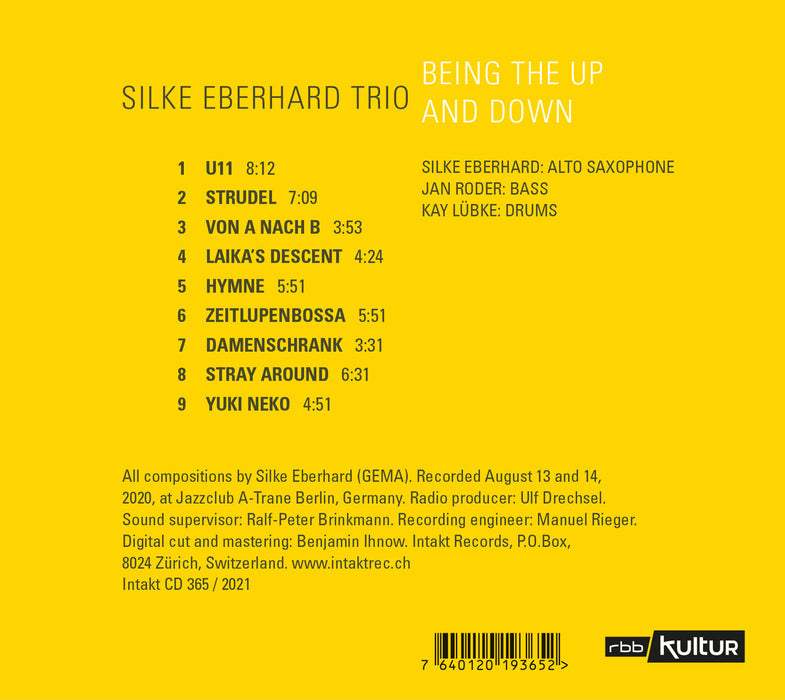
Silke Eberhard: Alto Saxophone, Bass Clarinet
Jan Roder Bass
Kay Lübke: Drums
Verkauf
Verkauf
Ursprünglicher Preis
CHF 12.00
-
Ursprünglicher Preis
CHF 30.00
Ursprünglicher Preis
CHF 30.00
CHF 12.00
-
CHF 30.00
Aktueller Preis
CHF 30.00
| /
More Info
"Being the Up And Down», Silke Eberhard’s neue CD mit ihrem Trio mit Jan Roder am Bass und Kay Lübke am Schlagzeug, wurde sowohl im Studio als auch bei einem Live-Konzert imA-Trane in Berlin aufgenommen. Als Gewinnerin des Jazzpreis Berlin 2020 hatte Silke Eberhard die Ehre, ein Konzert zu spielen und Aufnahmen zu machen. So hört man auf diesem Album eine nahtlose Mischung aus Studio- und Live-Aufnahmen. Das Artwork auf dem Cover stammt, wie schon auf ihrer vorherigen Intakt-Veröffentlichung «The Being Inn», von Roman Signer, einem der renommiertesten Schweizer Künstler der Gegenwart. Die amerikanische Jazzkritikerin Lynn René Bayley schreibt in den Liner Notes: «Ob sinnlich oder kantig und experimentell, es gibt so viel zu mögen und zu hören in Silke Eberhards Spiel, sowohl solo als auch im Zusammenspiel mit dem Trio, dass man von der ersten bis zur letzten Note in den Bann gezogen wird. Kein Wunder, dass sie in der deutschen Jazzwelt ein so hohes Ansehen geniesst!»
Album Credits
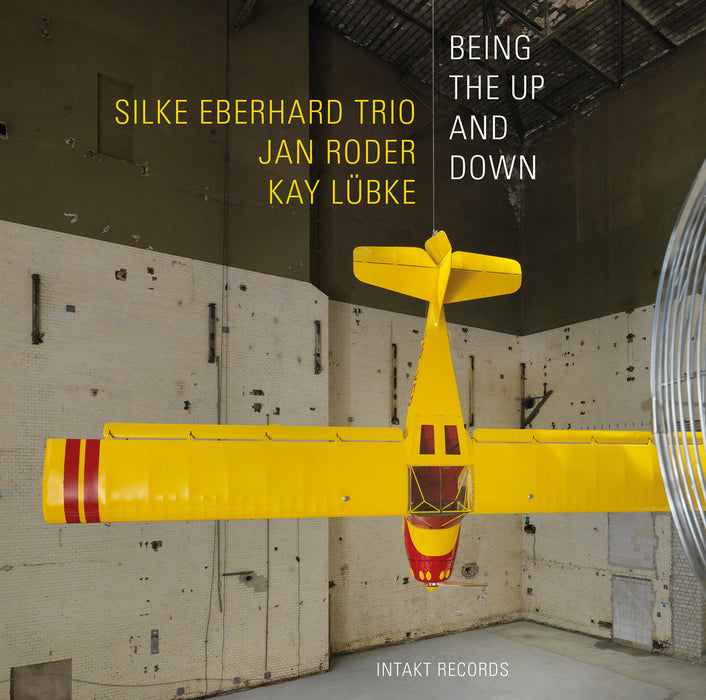
Cover art: Roman Signer
Installation. Kitfox Experimental, 2014. KINDL – Zentrum für zeitgenössische Kunst, Berlin
Graphic design: Paul Bieri
Liner notes: Lynn René Bayley
All compositions by Silke Eberhard (GEMA). Recorded August 13, 14, 2020, at Jazzclub A-Trane Berlin, Germany. Radio producer:
Ulf Drechsel. Sound supervisor: Ralf-Peter Brinkmann.
Recording engineer: Manuel Rieger. Digital cut and mastering: Benjamin Ihnow. Produced by Silke Eberhard and Intakt Records, Patrik Landolt, Anja Illmaier, Florian Keller. Published by Intakt Records.
- 5 stars: 26 (100%)
- 4 stars: 0 (0%)
- 3 stars: 0 (0%)
- 2 stars: 0 (0%)
- 1 star: 0 (0%)
M
Maxi Sickert Die Triebfeder ihrer Arbeit sieht die Saxofonistin/Komponistin in einem nachhaltigen Umgang im Alltag wie in ihrer Kunst. Immer wieder hat sie sich großen Komplexen gewidmet, wie dem Gesamtwerk Eric Dolphys, für das sie wertvolle Forschungsarbeit geleistet hat. Die Kompositionen für ihr Trioprojekt sind ihren Überlegungen während des Lockdowns in Berlin gewidmet, wie der U-Bahnlinie „U11", der Weltraumhündin in „Laika's Descent" oder dem „Zeitlupenbossa".
Verlangsamte Zeit, traumverloren. https://fonoforum.de/rezensionen/rezension/silke-eberhard-trio-being-the-up-and-down/back/10923
M
Marc Medwin There is an elusive but audible unity to German alto saxophonist/clarinetist Silke Eberhard. Her approach inhabits a universe equal parts exotic and playful, as if the seriousness pervading it was simultaneously on the point of being dispelled. Each ensemble also speaks to that dualistic unity, referencing Eberhard's musical past as it intersects with the historical narratives she has done so much to champion.
A greatly expanded Potsa Lotsa ensemble, the group that committed Eberhard's expertly conceived and executed Eric Dolphy projects to disc beginning more than a decade ago, is joined by Korean gayageum (plucked zither) virtuoso Youjin Sung on Gaya. Its five pieces, named for the first five Korean numbers, demonstrate the Dolphy-esque whimsy is still present but somehow both expanded and deliciously distilled.
The third piece lopes forward with a grandeur soon usurped by episodic jollity in the service of kaleidoscopic sound straddling various cultural lines in joyful recalibration. The second piece enters life with similarly fanciful gusto, gayageum in a setting conjoining blues and chamber music but with Taiko Saito's muted vibraphone and piano innards plucked for all they are worth (courtesy of Antonis Anissegos) as quiet brass surfaces like minnows over a vast ocean of pointillistic and Protean harmony. The album's cyclic conclusion reintroduces the grandeur, allowing the various comic interludes a context of depth and maturity.
In contrast to the luxuriously jasmine-scented flavors emanating from the enlarged Potsa Lotsa project, the Takatsuki Trio Quartett's At Kühlspot dives deep into Eberhard's diverse improvisations in a very different context. At 9:53 and beyond in this single-track album, her daredevil interregistral leaps doff the hat toward the quasi-theatrical irreverent fun of Charles Mingus and even toward those not usually associated with such lightheartedness, like the similarly inclusive freedoms of Jimmy Lyons. The unusual combination of Antti Virtaranta's acoustic bass and Joshua Weitzel's shamisen complement Rieko Okuda's especially brassy piano, punching Monk-ishly through the layers of rhythmic intricacy. A word about Okuda's pianism: her penchant for unique contrapuntal textures complements the melodic intrigue of Eberhard's playing, bringing a bit of chamber music to a hard-edged session. Okuda's vocalizations raise the ante by introducing a linguistic layer, again referencing syntaxes unknown but almost and elementally familiar as the marshes, flats and hill-and-dale juxtapositions roll on.
Being The Up and Down, the newest offering from Eberhard's trio, affords the best of both previously described worlds. Only dig into the serenely unisoned opening of "Zeitlupenbossa" to be transported east again in a haze of rapturously rolled and sustained percussion seasoned with bass harmonics. That vibe continues as Eberhard's gorgeously serpentine melody is supported by drummer Kay Lübke's delicate brushwork and bassist Jan Roder's slow walk and droning repetitions. All is spacious implication and dreamy interaction in the ballad world. Not so with the spasmodic whiplash and laugh-out-loud sarcastic wit of "Strudel". Lübke and Roder's swing and stamina are both wondrous to behold as Eberhard sails through register and timbre shifts with ease, blasting those oft-cited improvisation and composition boundaries to smithereens. The mix of studio and concert performances is so tastefully done that the obviously
'live' drum solo in "Laika's Descent" may lead the listener to anticipate applause at track's end, to no avail. Beyond all allusion and synthesis,
as
with every ensemble hosting this extraordinary performer and composer, Eberhard's trio blends familiarity and novelty with the stunning clarity of a veteran who has never lost the innocence of pure enjoyment through exploration.
B
Ben Taffijn Twee saxofonistes, ze delen hun initialen, delen de altsax als primair instrument en delen de meer experimentele jazz als uitingsvorm. Ik heb het over de Duitse Silke Eberhard en de Deense Signe Emmeluth. Ik haal die namen nog wel eens door elkaar en daarom geef ik ze nu maar allebei een podium. Vandaag Eberhard, morgen Emmeluth. ‘Being the Up and Down’ van Eberhards trio, met verder bassist Jan Roder en drummer Kay Lübke verscheen vorig jaar bij Intakt Records. Verder verscheen er deze maand bij Trouble in the East Records een nieuw album van haar bigband Potsa Lotsa XL, ‘Gaya’ en is ze als gast te horen op het bij 577Records verschenen ‘At Kühlspot’ van het Takatsuki Trio.
Ruim een decennium heeft ze dit trio en dit ‘Being the Up and Down’ is het vierde album, deels live opgenomen en deels in de studio. Haar kenmerkende stijl klinkt voor het eerst in ‘Strudel’. Flitsend snelle, moeiteloos meanderende patronen weeft ze door het overdonderende ritme van Roder en Lübke. Dit is hardcore jazz. In ‘Von & Nach 8’ maakt abstractie plaats voor een rafelige melodie, zeker zo charmant, verder mag hier Lübkes dwingende drumsolo worden genoemd. Maar het is niet allemaal onbegrensde hectiek wat we hier horen, in het middendeel gaat het er beduidend rustiger aan toe Zo is ‘Laika’s Descent’ is een prachtige ballade, waarin we Eberhard opvallend ingetogen horen, mooi ook in combinatie met dat toch stevige ritme, iets dat ook geldt voor ‘Zeitluppenbossa’. Nog verstilder klinkt Roders solo in ‘Hymne’, een moment van rust in een verder sterk ritmisch stuk. De laatste drie stukken zijn weer wat dynamischer, met als hoogtepunt het heerlijk stroeve ‘Damenschrank’.
Potsa Lotsa bestaat sinds 2010 en wisselt van vorm al naar gelang Eberhards behoefte. Meer dan haar trio is deze bigband, voor ‘Gaya’ bestaand uit elf leden, een vehicle om haar eigen composities uit te kunnen voeren, al is ze ook zeker als solist aanwezig. Eind 2019 ontmoette ze Youjin Sung, actief op de gayageum, een Koreaans snaarinstrument. Eberhard schafte er zelf één aan en sloeg aan het componeren, wat weer resulteerde in de LP ‘Gaya’. En natuurlijk, dit instrument geeft een bijzondere kleur aan dit album, maar dat is niet alles, de klank blijkt ook nog eens zeer goed te passen bij de muziek die Eberhard voor dit ensemble schreef: een boeiende en over het algemeen vrij ingetogen combinatie van experimentele jazz en hedendaags gecomponeerd. En soms ontspoort het geheel op grootse wijze, zoals halverwege ‘셋 (sed)’, iets waar vooral Eberhard zelf, met een hoog piepende altsax, debet aan is. Eén stuk waarin die diverse muzikale werelden prachtig samen komen is het ritmische ‘넷 (ned)’, met prachtige solo’s van trombonist Gerhard Gschlößl en bassist Igor Spallati.
In de tweede helft van 2020 organiseerde het Takatsuki Trio, bestaande uit pianist Rieko Okuda, bassist Antti Virtaranta en gitarist Joshua Weitzel een maandelijks concert in de Berlijnse Kühlspot Social Club, met iedere keer een andere gast. In augustus was dat Silke Eberhard, het resultaat is een bijna veertig minuten durende improvisatie. Eberhard mag beginnen, sputterend, onderzoekend, ongewone klanken uit haar instrument persend. De anderen voegen zich erbij, leidend tot een ietwat hectisch en bijzonder abstract klankspel, waarin vooral Eberhard en Weitzel mooi buiten de lijntjes kleuren, tot Okuda middels zijn solo even de melodie zoekt. En verderop zitten prachtige duetten, van Okuda met Virtananta en van Eberhard met Weitzel, waarin de musici het grensgebied tussen klank en stilte verkennen. Op andere momenten is de muziek heerlijk spontaan, rijk aan klanken en onverwachte vondsten en het is juist dat wat vrije improvisatie zo de moeite waard maakt.
https://www.nieuwenoten.nl/?p=13957
C
Chris Searle SILKE EBERHARD is a German alto saxophonist much influenced by the great Eric Dolphy but absolutely with a sound of her own.
Her new album, Being the Up and Down, was recorded live in Jazzclub A-Trane in Berlin.
With bassist Jan Roder and drummer Kay Lubke, she creates a record of lightning sounds.
Hear her on her opener, U11, how her horn jumps between her notes creating a leaping timbral pattern with Roder and Kay with her on every levitating step.
The album radiates all the excitation of live performance. On Laika's Descent, named after the Soviet space-dog, Lubke's drums create an ironic grounding sound, while Roder's bass booms out the canine heartbeat and Eberhard's elegiac and striving notes stream from her horn.
After the deft lyricism of Zeitlupenbossa, Eberhard's galloping choruses in the rampaging Damensschrank hardly touches the ground in this moving album of constant change and inventiveness.
https://morningstaronline.co.uk/article/c/album-reviews-steve-johnson-ben-lunn-and-chris-searle
F
Francis Davis The 2021 Jazz Critics Poll: Only the Best
HONORABLE MENTION:
Silke Eberhard Trio, Being the Up and Down (Intakt)
Amir ElSaffar Rivers of Sound, The Other Shore (Outnote) Christopher Hoffman, Asp Nimbus (Out of Your Head)
Joe Lovano & Dave Douglas Soundprints, Other Worlds (Greenleaf Music)
Francisco Mela, M.P.T. Trio: Volume 1(577)
Hafez Modirzadeh, Facets (Pi)
Steph Richards Supersense (Northern Spy)
Martial Solal, Coming Yesterday: Live at Salle Gaveau 2019 (Challenge)
Ohad Talmor Trio, Mise En Place (Intakt)
Throttle Elevator Music, Emergency Exit (Wide Hive)
Thumbscrew, Never Is Enough (Cuneiform)
Umlaut Big Band, Mary's Ideas (Umlaut)
https://artsfuse.org/244710/the-2021-jazz-critics-poll-only-the-best/
K
Ken Waxman Ballots 2021
1. Joëlle Léandre, Beauty/Resistance (Not Two)
2. Silke Eberhard Trio, Being the Up and Down (Intakt)
3. Tom Ward-Martina Verhoeven-Dirk Serries-Cath Roberts, Imaginary Junction (A New Wave of Jazz)
4. KORR, Tombé De La Voûte (We Insist)
5. Bertrand Gauguet & John Tilbury, Contre-Courbes (Akousis)
6. Punkt. Vrt. Plastik [Kaja Draksler/Petter Eldh/Christian Lillinger], Somit (Intakt)
7. Flow Trio With Joe McPhee, Winter Garden (ESP-Disk)
8. Umlaut Big Band, Mary's Ideas (Umlaut)
9. See Through 4, Permanent Moving Parts (All-Set! Editions)
10. Lao Dan & Deng Boyu, TUTU Duo (NoBusiness)
http://www.jazzword.com/one-review/?id=130825
T
Troy Dostert It's a challenge to keep up with the manifold projects of Eberhard, whose potent alto saxophone seems to require expression in as many different contexts as possible. Here we have one of her best, in a trio formation with bassist Jan Roder and drummer Kay Lübke. The focus is on Eberhard's capacious compositions,
featuring plenty of rhythmic vitality and crafty detours that allow all three players to thrive. https://www.allaboutjazz.com/troy-dosterts-best-releases-of-2021
G
Giuseppe Piacentino Musica Jazz
H
Harry Schmidt Auch auf dem vierten Album mit ihrem Working-Trio - seit
12 Jahren spielt die Altsaxo-fonistin und Klarinettistin mit dem Bassisten Jan Roder und dem Schlagzeuger Kay Lübke
- verfolgt Silke Eberhard einen Free-Jazz-Ansatz, der Expressives mit Lyrischem konfrontiert.
Wie zuletzt bei The Being Inn operiert Eberhard auch auf Being the Up and Down vorzugsweise mit Kontrastbildun-gen und Gegensätzen, wirkt nun aber mehr an der organischen Gestaltung der Übergänge und Zwischentöne interessiert. Das Material auf dem mit dem Gewinn des Jazzpreiss Berlin 2020 verknüpften Album wurde teils an zwei Abenden im A-Trane im August vergangenen Jahres, teils im Studio aufgenommen und zeigt das Trio auf dem Höhepunkt seiner Möglichkeiten - phänomenal das Interplay der drei Musiker. Neben Eric Dolphy ist in Eberhards Referenzsystem nun Ornette Coleman getreten, wie man in Tracks wie „Von A nach B" hören kann. Angesteuert habe sie ein „Oszillieren zwischen Kontingenz und Transzendenz", ist in den Liner Notes zu lesen. Wunderbar gelöst und tatsächlich nahezu bereits Spiritual Jazz: „Laika's Descent". Brechung und Improvisation als musikalische Strategien in Gegenüberstellung bringt „Hymne". Eine Art Cool-Jazz-Etüde im Sinne von Bohren & der Club of Gore ist „Zeitlupenbossa", ein (ganz und gar nicht zufälliges) Zusammentreffen dadaistischen Humors mit Neuer-Musik- und Impro-Spieltechniken „Damen-schrank". Grandios und ebenso frei wie swingend: „Stray Around". Kreativer Funkenflug der Extraklasse!
M
Michael Bossong Auf dem Cover stürzt ein gelbes Sportflugzeug kopfüber durch eine Werkshalle und wenn man das Booklet aufklappt, schreien einem auf gelbem Grund Versa-lien entgegen, worum es gent, nämlich: »UM UNSER SEIN, DIE EXISTENZ, DEN LEBENSRAUM, DAS HIER UND JETZT, DAS AUF UND AB; DAS OSZILLIEREN ZWISCHEN KONTINGENZ UND TRANSZENDENZ«. Die Gewinnerin des Jazzpreis Berlin 2020 meint es richtig ernst, daran kann kein Zweifel bestehen.
Beim Spielen geht es immer um alles - und vor allem darf man dabei nicht mit den Augen zwinkern. Vielleicht nur die entschiedene Abkehr vom dauer-ironischen Gestus, den einige ihrer Kollegen in Berlin pflegen.
Bassist Jan Roder und Schlagzeuger Kay Lübke, seit Jahren zwei absolut verlässliche Pfeiler in zahllosen Bands der Impro-Szene in Berlin, kann man jedenfalls nicht nachsagen, dass sie an Humorlosigkeit leiden.
Auf den neun Stücken dieses Albums, das während zweier Sessions im Berliner A-Trane im August 2020 entstanden ist, stellen sie erneut ihre Stilsi-cherheit, ihr eigenständiges, verbindliches Spiel unter Be-weis: stets auf dem Punkt, hellwach und voller leichter Ener-gie. Eine traumhafte Rhyth-musmaschine für die Altsaxo-phonistin, die für ihr Preisträ-gerkonzert nicht auf ein Groß-ensemble mit ausgearbeiteten Arrangements setzt, sondern dieses gut eingespielte Trio wahlt, das ihre Fähigkeiten als Instrumentalistin und Improvisatorin in den Fokus stellt.
Die Kompositionen Eberhards sind oft prägnante Formeln, betont sperrige, störrische Motive wie »STRUDEL«, die viel wilde rhythmische Energie freisetzen und die Saxophonistin zu stürmischen und virtuo-
sen Klangreisen animieren.
Harsch und klar konturiert ist ihre melodische Sprache, freies Powerplay mündet stets in strukturierte und genau konstruierte thematische Zellkerne.
Anknüpfungspunkte in viele Richtungen sind stets möglich.
Selbst melodiöse Passagen und balladeske, nachdenkliche Stimmungen wie in »ZEITLU-PENBOSSA« sind nicht tabu, soviel existentialistischer Humor darf sein. Natürlich hat sie sich intensiv mit Ornette oder Dolphy auseinanderge-setzt, aber das ist doch nur die Basis für die zeitlos anmutende, selbstsicher vorgetragene Stilistik einer gereiften Solistin und Komponistin, die nach über zwanzigjähriger Karriere völlig verdient den Jazzpreis erhalten hat.
J
Jean Buzelin Après son formidable disque en tentette pour Leo Records, la jeune saxophoniste-alto Silke Eberhard retrouve son trio pour un second opus chez Intakt. Auréolée du prestigieux “Berlin Jazz Prize”, elle a enregistré ce nouveau disque au Jazzclub A-Trane en partie en public avec ses partenaires chevronnés Jan Roder (contrebasse) et Kay Lübke (batterie). Neuf compositions personnelles sont jouées dans un esprit free jazz, je dirai “historique” où plane l’ombre très présente et bienveillante d’Eric Dolphy et d’Ornette Coleman : thèmes prétextes forts, discours sinueux souvent anguleux, progression vive et très rythmée, courtes phrases, notes très hautes, tremblées, proches du cri... tout cela avec grande fraîcheur tant les trois musiciens sont engagés et inspirés. Un disque excitant et passionnant d’un bout à l’autre. Si l’on pouvait entendre un tel trio en France ! (mais l’on a appris à ne plus rêver, il suffit de regarder l’affiche désolante de nombreux festivals français cet été). « Being the Up and Down » (CD 365). OUI !
https://www.culturejazz.fr/spip.php?article3689
T
Troy Dostert Alto saxophonist Silke Eberhard has devoted so much of her career to celebrating the work of past jazz legends that it’s easy to overlook her own steadily growing, formidable catalog. Previous retrieval efforts covering Ornette Coleman with Aki Takase, or Charles Mingus with her I am Three ensemble, not to mention her numerous projects devoted to the music of Eric Dolphy through her Potsa Lotsa outfit, would seem to leave her very little time to cultivate her own aesthetic. But that’s not at all the case, as she’s continually made time for numerous side projects with other artists and, most importantly, several releases with her own trio. Beginning with 2008’s Being (Jazzwerkstatt), bassist Jan Roder and drummer Kay Lübke have teamed up periodically with Eberhard as a vehicle for her own compositions, utilizing a format that gives her a high degree of creative freedom as an improviser. Being the Up and Down, her second trio outing for Intakt after 2017’s The Being Inn, is a potent reminder of just how forceful Eberhard’s instrumental voice can be, and it’s also a delightful opportunity to hear her work with like-minded, sympathetic colleagues who truly complement her as equals.
Eberhard brings a feisty edge to her playing on cuts like “U11” and “Strudel,” where her rhythmic intensity and high-register facility are astonishing, especially in tandem with the lithe contributions of Roder and Lübke, who have an exceptional ability of responding nimbly to Eberhard’s sudden detours. This isn’t free jazz, as there’s a compositional structure to these pieces—but they’re remarkably labile nonetheless, and only a trio with this much shared experience can pull off the quick maneuverings needed to navigate music that can often be quite spontaneous and untethered. In terms of high-energy intensity, the highlight here is undoubtedly the first half of “Strudel,” where Eberhard plays like a woman possessed, with a torrent of ideas flowing almost unstoppably, as her counterparts somehow match her stamina and urgency while preventing everything from flying off the rails. But it’s not all fireworks; the last half of “Strudel” takes on a restrained, easy groove that steers away from the preceding mania via Eberhard’s more earthy, soulful sensibility.
One can hear the traces of Eberhard’s influences here and there; certainly the angular leaps and sing-song quality of “Von A Nach B” bring Dolphy to mind, and the volubility of Eberhard’s alto can invoke Coleman as well on the animated closer, “Yuki Neko.” But what’s just as impressive is the breadth of her compositions: a piece like “Zeitlupenbossa” allows the trio to delve into a mysterious realm with an oblique lyricism; and “Stray Around” uses a catchy Latin rhythm to generate its allure. Each of the record’s nine tracks has its own well-defined character, despite the ample freedom on display, and it’s a tribute to Eberhard’s devotion to her craft that the music is so cohesive and satisfying. It’s also evidence of the trio’s undeniable egalitarianism, as individual egos are really beside the point here. The power of the music is what matters, and this trio provides some terrific moments on this outstanding release.
https://www.freejazzblog.org/2021/08/silke-eberhard-trio-being-up-and-down.html
P
Pirmin Bossart Von Silke Eberhard hört man nie Mittelmass oder Dümpelei.
Die deutsche Saxofonistin, die sich auf früheren Alben mit Charles Mingus, Ornette Coleman und Eric Dolphy auseinandersetzte, ist in der Jazztradition des komponiert-freien Spiels verankert. Das hält ihre Musik energetisch, melodisch und wunderbar im Moment - auch bei ihrem neuen Album mit Bassist Jan Roder und Drummer Kay Lübke, das im Rahmen der Verleihung des Jazzpreises Berlin entstand.
M
Mark Corroto Sometimes one must pass through the flames to get free. That thought has shadowed the career of Silke Eberhard. The saxophonist has been consumed with the firebrands Eric Dolphy, Charles Mingus, and Ornette Coleman for years now. She has recorded Dolphy's complete oeuvre with her band Potsa Lotsa, both in small and large configurations. Covered Mingus in the trio I Am Three. She also took on a large chunk of Coleman's music in duo with pianist Aki Takase on Ornette Coleman Anthology (Intakt Records, 2007).
Eberhard's found freedom may be best represented in her trio with bassist Jan Roder (Die Enttäuschung, Alexander von Schlippenbach, Ulrich Gumpert) and drummer Kay Lübke (Potsa Lotsa, Berlin Improvisers Orchestra). Being The Up And Down is the trio's fourth release and second on Intakt Records, after The Being Inn (2017).
While Eberhard's alto saxophone sound has absorbed both that of Coleman and Dolphy, she doesn't trade in nostalgia. Like fellow alto saxophonist Nick Mazzarella, she is on a continual mission to advance the music. Recorded in both a live and studio setting, the energy is ever apparent here as the trio traverses Eberhard's tricky and intricate compositions. The stumbling dance of "U11" conceals the compositions intricacy. Just when you might believe the wheels are about to come off, the trio swings a gotcha passage and rescues the listener. This faux-abandon is a prevalent theme here and only with an ultra-tight ensemble can these maneuvers be accomplished. The saxophonist burns some Ornette Coleman matches on "Strudel" and exercises her Dolphy chops with "Van A Nach B," sticking to alto saxophone where you would expect a bass clarinet. The trio has a passion for the intricate "Laika's Descent," "Yuki Neko," and "Damenschrank," which also trades in extended technique from each player. Delightfully creative, the Silke Eberhard Trio is one high-yield and thriving ensemble.
https://www.allaboutjazz.com/being-the-up-and-down-silke-eberhard-intakt-records
M
Maxi Sickert „Es geht um unser Sein, die Existenz, den Lebensraum", so Silke Eberhard.
Die Triebfeder ihrer Arbeit sieht die Saxofonistin/Komponistin in einem nachhaltigen Umgang im Alltag wie in ihrer Kunst. Immer wieder hat sie sich großen Komplexen gewidmet, wie dem Gesamtwerk Eric Dolphys, für das sie wertvolle Forschungsarbeit geleistet hat. Die Kompositionen für ihr Trioprojekt sind ihren Überlegungen während des Lockdowns in Berlin gewidmet, wie der U-Bahnlinie „U11", der Weltraumhündin in „Laika's Descent" oder dem „Zeitlupenbossa".
Verlangsamte Zeit, traumverloren.
https://fonoforum.de/rezensionen/rezension/silke-eberhard-trio-being-the-up-and-down/back/10923
S
Steff Rohrbach Jazz'N'More Magazine
S
Sergio Spampinato Il trio della alto-sassofonista tedesca Silke Eberhard, con Jan Roder al basso e Kay Lübke alla batteria, ritorna con questo lavoro dal titolo "Being Up And Down", registrato all' A-Trane jazz club di Berlino e pubblicato dalla Intakt Records a 4 anni di distanza dal precedente "The Being Inn", anch'esso edito dalla stessa etichetta con base a Zurigo. Il quarto lavoro per il Trio in quasi 12 anni mostra consolidata intesa; la sezione ritmica, quasi sempre al servizio del fraseggio col sax solista, ne accompagna le
libere improvvisazioni con azione costante e propulsiva, anticipandone e descrivendone i passaggi di ritmo. Kay Lubke è un metronomo incessante, mai invasivo o sovrastante, ma si ritaglia ampi spazi di improvvisazione, come su Von A Nach B. Sia nella struttura dei brani che nella tecnica la Eberhard non nasconde le radici Dolphyniane e l'attidudine free
Colemaniana. Dura 8:40 minuti la prima traccia U11 ed inizia con un fitto dialogo sax-batteria, che poi diventa via via meno fitto col sax che disegna note libere, a tratti sincopate e spigolose. Il fraseggio dura abbondanti 4 minuti prima di lasciare spazio al duo basso-batteria che in questa fase rallenta molto il ritmo prima del ritorno del sax solista al tema iniziale. Incredibile la capacità di Silke di spaziare tra le note più irte e spigolose, di riuscire a tenerle e modularle a lungo. Come in Strudel che per i primi 3 minuti e mezzo non fa rimpiangere il Dolphy più free, con un fiume di note serratissime e violente, e la batteria di Lübke in bella mostra. Il gioco di spaziare tra libera improvisazione e ritorno ad un fraseggio rallentato, con basso circolare e batteria spazzolata in questo intervallo, si ripete anche in questa seconda traccia, che chiude dopo 7:10 con una sferrata finale di sax e batteria. Meno accattivante la successiva Von A Nach B, ma notevole l'assolo di batteria. Il basso di Roder sugli scudi in Laika's Descent, col sax che suona più tradizionale, si insinua tra le note della sezione ritmica basso-batteria con variazioni tematiche, senza esplodere come nelle tracce precedenti, ma con approccio sempre liberalmente improvvisato. Hymne ci sta più tempo a partire e poi si trascina per più di tre minuti e mezzo tra note rullanti di batteria, note sincopate di sax ed un basso mai inerme. La chiusura di sax anticipa Zeitlupen Bossa il cui titolo tradisce gli intenti: un tema bossa che indulge in territori più rallentati e dimessi. E la successiva Damenscharnk sembra tornare al duetto batteria-sax ed ai temi già esplorati in Von A Nach B. Chiudono il set le complesse Stray Around ed Yuki Neko, ricche entrambe di continue variazioni, con il trio che si muove all'unisono mostrando grande intesa e dando sfogo a libere improvisazioni e fraseggi accattivanti, il sax sempre oscillante ed espressivo.
Le due tracce finali rappresentano anche una summa dell'arte della Eberhand che tecnicamente spazia con disinvoltura tra le vie tracciate in passato da Dolphy e Coleman, ma con risultati del tutto personali, e mostrando, altresì, una non comune maturità compositiva.
E
Eric Therer La formule du trio saxophone/basse/batterie est depuis très longtemps rodée, acclimatée et éprouvée. Quand bien même, elle ne cesse de se réinventer et, parfois, de nous ré-enchanter de manière saisissante. Aux côtés du bassiste Jan Roder et du batteur Kay Lübke, Silke Eberhard est de celles qui œuvrent à la revivifier. Ce n’est d’ailleurs pas un hasard si la saxophoniste alto compte parmi ses faits d’armes notables sa participation à l’ambitieux « The Complete Works of Eric Dolphy » au sein du big band Potsa Lotsa. Dolphy dont elle revendique sans ambages l’influence, tout comme elle se réclame de l’héritage de Coleman (cf. son double cd « Ornette Coleman Anthology » avec le pianiste Aki Takase paru en 2007, également sur Intakt). Musicienne jusqu’au-boutiste, consciencieuse, elle est l’heureuse récipiendaire du fameux Jazzpreis de Berlin qui lui a été décerné l’année dernière. Un prix lui ayant permis d’enregistrer ce disque. Capté en partie live au club A-Trane de Berlin, en partie au Radio Berlin Brandenburg studio, il aligne neuf compositions toutes signées par Eberhard. On y perçoit parfois les fantômes de Dolphy ou de Coleman mais de façon céleste, vaporeuse, sans que cette présence fasse montre d’insistance. Quatrième album signé par le trio, « Being the Up And Down » témoigne d’une belle complicité que les jeux respectifs des musiciens mettent en lumière. Mieux encore, il reflète une prodigieuse maturité acquise à la longue de ces rencontres complices.
https://jazzmania.be/silke-eberhard-trio-being-the-up-and-down/