
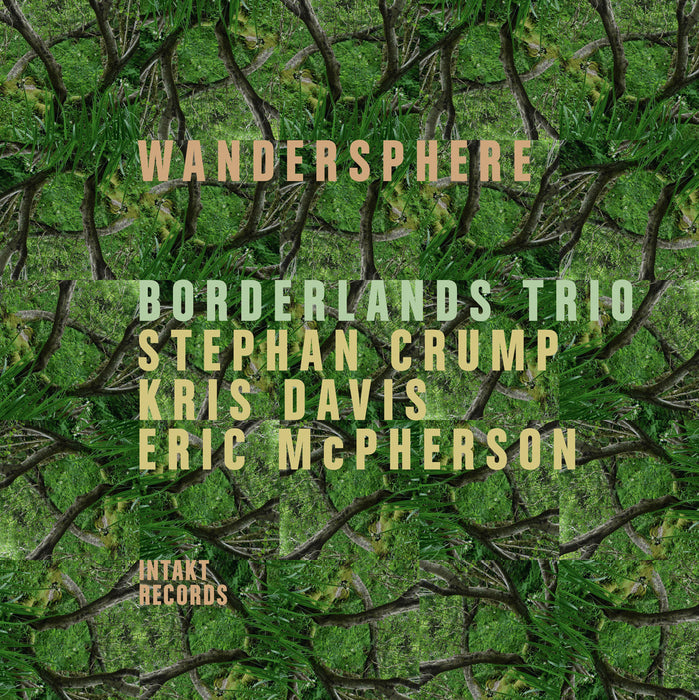
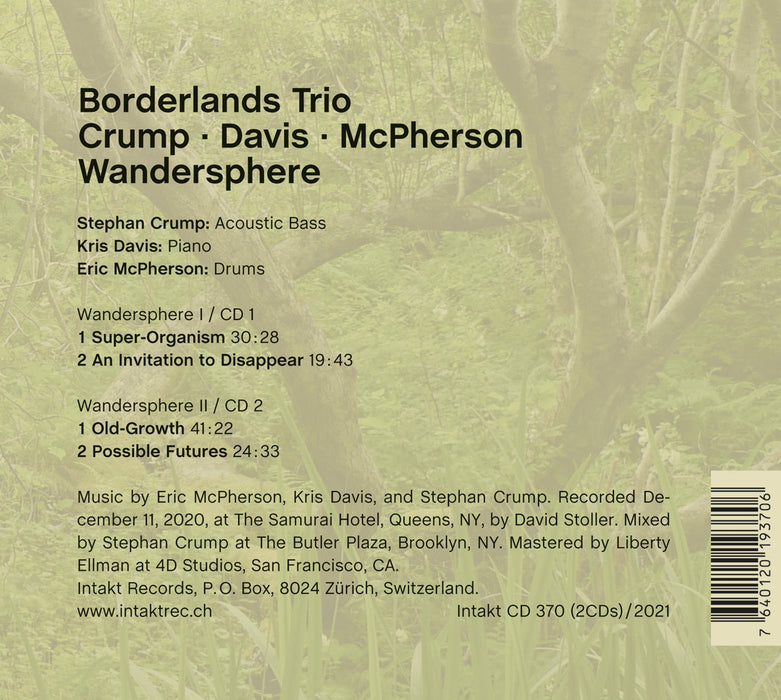
370: BORDERLANDS TRIO: STEPHAN CRUMP – KRIS DAVIS – ERIC MCPHERSON. Wandersphere (Double Album)
Intakt Recording #370/ 2021
Stephan Crump: Acoustic Bass
Kris Davis: Piano
Eric McPherson: Drums
Verkauf
Verkauf
Ursprünglicher Preis
CHF 17.00
-
Ursprünglicher Preis
CHF 39.00
Ursprünglicher Preis
CHF 39.00
CHF 17.00
-
CHF 39.00
Aktueller Preis
CHF 39.00
| /
More Info
Nach dem atemberaubenden Debüt-Album «Asteroida» legt das New Yorker Trio Borderlands mit Stephan Crump, Kris Davis und Eric McPherson eine Doppel-CD mit vier wunderschönen Improvisationen in der Länge zwischen zwanzig und vierzig Minuten. Aufgenommen während der Corona-Pandemie im Dezember 2020 in New York, kontrastiert die Musik die New Yorker Stimmung der Isolation und Depression mit einer einzigartigen Spielfreude, Intensität und musikalischer Intimität. Der Chicagoer/Berliner Jazzkritiker Peter Margasak schreibt in den Liner-Notes: «Die Stücke schweben, schaukeln, schwingen, atmen, rauschen und funkeln, ohne dass sie je ein Zögern oder einen Trott erkennen lassen. Ein grosses Spiel mit der Spontanität. Diese vier erstaunlichen Erkundungen spiegeln eine Art von totaler Musik wider.» Voller Enthusiasmus schreibt er: «Fast telepathisch baut Borderlands eine einheitliche Klangarchitektur auf, die den Akt der kollektiven Improvisation so tiefgründig, so schön und so vollständig zelebriert wie nichts, was ich je gehört habe.» – McPherson wurde am Tag der Aufnahme 50 Jahre alt und bezeichnet diese Erfahrung als «das ultimative Geburtstagsgeschenk».
Album Credits
Cover art and design: Jonas Schoder
Liner notes: Peter Margasak
Photos: Patrick Lambin, Jazzdor, Strasbourg, 2019
Music by Eric McPherson, Kris Davis and Stephan Crump. Recorded December 11, 2020, at The Samurai Hotel, Queens, NY, by David Stoller. Mixed by Stephan Crump at The Butler Plaza, Brooklyn, NY. Mastered by Liberty Ellman at 4D Studios, San Francisco, CA. Produced by Kris Davis, Stephan Crump, Eric McPherson and Intakt Records, Patrik Landolt, Anja Illmaier, Florian Keller. Published by Intakt Records.
- 5 stars: 30 (100%)
- 4 stars: 0 (0%)
- 3 stars: 0 (0%)
- 2 stars: 0 (0%)
- 1 star: 0 (0%)
A
Anonymous On croyait avoir atteint le Walhalla avec Nate Wooley, mais c'est le Borderlands Trio qui fournit à votre scribe son concert favori. Les visées sont différentes. Les relie une détermination jusqu'au-boutiste dans leurs démarches respectives. La présence de Wooley sur le label Pyroclastic est une autre trace de correspondances souterraines. Si l'instrumentation est classique, l'approche ne l'est point. Même si le piano est << préparé >>> en direct, on se trouve dans l'idiome jazz. Un jazz qui ne se réfugie derrière aucun gimmick, citation ou standard. Kris Davis (p) et ses acolytes révolutionnent paisiblement l'art du trio, innovant avec des moyens traditionnels plutôt qu'avec des gadgets branchés sur le secteur. Économe de notes, Davis joue en accords, emprunte des labyrinthes de traverse sur les rythmes que le phénoménal Eric McPherson (dm) n'a pas besoin de marquer, préférant les suggérer. Se dessine une temporalité élastique, pas si éloignée du quartette أحمد [ahmed]. Davis bloque les cordes, les caresse, arpente le clavier d'un air interrogatif. Chacun semble s'être donné pour mission d'en faire le moins possible. Écologie musicale, décroissance acoustique ? Les titres de Wandersphere tendent à le confirmer: << Super-Organism >>, << An Invitation to Disappear >>, << Possible Futures >>. Davis examine des motifs successifs et non prémédités sous différents angles. Alors qu'on tend déjà l'oreille, le trio baisse encore d'un ton. Tout ego absent de l'équation, Stephan Crump (b) prend l'archet, McPherson quitte la scène. Plus cela tient de la méditation, plus le public retient son souffle. Musique des potentialités, réalisées et imaginaires, qui aurait pu partir dans des directions différentes. D'ailleurs, un élan vigoureux survient sans crier gare, le jeu se fait rapide et éclaté, cascade de notes sur swing frondeur. Pour autant, la philosophie du trio se révèle opposée à celle des groupes de Chicago. Davis garde le silence, n'a pas de message à faire passer autre que celui contenu dans sa musique et qu'il appartient aux auditeurs de capter. Le rappel compacte les caractéristiques qui précèdent: début réductionniste, anticonformisme (le bassiste joue exclusivement sur le cordier, près du sol) et cap sur la plénitude collective.
B
Ben Taffijn Voor een pianist die jazz en aanverwante muziek speelt is het trio met bas en drums de ideale bezetting. Geen concurrentie van andere solisten, diezelfde bassist en drummer zo nu en dan uitgezonderd. Vandaar dat Stephan Crumb’s Borderlands Trio de beste samenstelling is die pianiste Kris Davis zich kan wensen. Samen met drummer Eric McPherson vormen ze zonder meer één van de beste pianotrio’s van dit moment. De onlangs bij Intakt Records verschenen dubbel Cd ‘Wandersphere’ laat dan ook niets te wensen over.
Twee Cd’s, vier stukken. Dit trio neemt de tijd. Dat blijkt al direct in het ruim een half uur durende ‘Super-Organism’ waarin de eerste minuten opgaan aan spaarzame pianoaanslagen en gerommel in de marge. En dan zeer geleidelijk ontwikkelt zich een ritme en pakt Davis de solo rol, in die voor haar zo typische stijl, balancerend tussen melodie en abstractie, met een perfect gevoel voor timing. Iets dat bijvoorbeeld mooi tot uiting komt in die heftig stromende passage iets voor de helft. En verderop laat het trio horen de grenzen van deze bezetting maximaal op te kunnen rekken. Ik **** een geluidswereld die past bij een wandeling door het bos, de grenzen zoekend die bij de naam van dit trio passen. Mooi ook hoe langzaam het ritme weer zijn intrede doet, op een repetitieve wijze. Naadloos loopt het over in ‘An Invitation to Disappear’, met zijn nog net geen twintig minuten het kortste stuk. Crumb begint solo, balancerend tussen geluid en stilte, McPherson voegt zich erbij, al even subtiel en aansluitend Davis. Er gebeurt weinig in die fase, iets dat prima past bij de titel en tegelijkertijd heel veel. De kracht van de nuance. Verderop logenstraft het trio dit gegeven, hier klinkt het juist uiterst ritmisch, met als hoogtepunt die klaterende stroom noten van Davis tegen het einde en raakt het verdwijnen aardig buiten beeld.
De tweede schijf begint met het ruim veertig minuten durende ‘Old-Growth’. In eerste aanleg een vrij abstracte ballade, tot na ruim tien minuten Crumb en McPherson het roer omgooien en het ritme naar binnen stroomt, culminerend in een prachtige frase rond de vijftiende minuut, waarin we een stevig hamerende Davis het trio horen aanvoeren. Maar het hoogtepunt van dit nummer en eigenlijk van het gehele album zit verderop, bij die bijzonder intieme solo van Crump, gebruikmakend van zijn strijkstok, gevolgd door een prachtig, al even verstild duet met Davis. Tot slot klinkt het bijna vijfentwintig minuten durende ‘Possible Futures’. Nieuwe gezichtspunten levert het niet op, het is meer van hetzelfde. Maar op dit hoge niveau betekent dat alleen maar nog meer uitstekende muziek, en dat is uiteindelijk het enige waar het om draait!
‘Super-Organism’ is te beluisteren via Bandcamp. Het album is daar ook te koop.
https://www.nieuwenoten.nl/borderlands-trio-wandersphere-cd-recensie/
C
Chris Searle There is irony in the title of the Borderlands Trio, for they embody the mainland of North America. Drummer Eric McPherson is a New Yorker, bassist Stephen Crump hails from Memphis and pianist Kris Davis is from Vancouver, growing up in Calgary.
Their new double album, Wandersphere, is a wondrous journey of sonic artistry with the musicians, in Davis's words, giving themselves "freedom to just really be in the moment." She should know: she plays with a beautiful abandon while keeping as close as a musical sister to her two confreres.
Listen to their timbral unity on the opener, Super-Organism, as they push the frontiers of their collective passage. McPherson's drumming anticipates and picks up every step of their way, while Crump's dancing bass guides and earths their every move.
115 minutes here of the concord of unified sound, by a trio of dedicated and stellar musical insurgents.
https://morningstaronline.co.uk/article/c/album-reviews-with-chris-searle-february-21-202
J
John Sharpe Whether due to pent up creative energy or release schedules making up for lost time, more terrific music has come my way than for several years, in spite of the last twelve months. From the 200 or so discs that I heard in 2021, here are ten new issues (in the order I came across them), plus two unearthed gems, which gave me the most pleasure. It's particularly invidious to pick and choose between honest artistic endeavours, this year more than many others. Perhaps it's better to view these selections as a chance to pick up on something that you might otherwise have missed. As a fan I always look forward to the annual year end lists for precisely that reason. If you share my taste (that's the key bit), then something here might just be for you!
The threesome luxuriates in the wide open vistas of four expansive improvisations of between 19 and 42 minutes on this double disc set. The decision to play and present entire pieces rather than excerpts, as they did on some of the shorter numbers on their debut Asteroidea (Intakt, 2017), pays rich dividends, as it allows opportunity to appreciate the daredevil creation on-the-fly as they invent structure, spawn tension, and uncover resolutions in unforced natural developments.
https://www.allaboutjazz.com/john-sharpes-best-releases-of-2021
P
Pat Youngspiel Die Möglichkeiten der Improvisation sind grenzenlos. Das müssen sich auch Pianistin Kris Davis, Bassist Stephan Crump und Schlagzeuger Eric McPherson gedacht haben, als das Trio, namens Borderlands, 2020 ins Studio ging, um den Nachfolger seines Debüts „Asteroida" aufzunehmen. Die vier Stücke auf „Wander sphere" sind zwischen 20 und 40 Minuten lang und erleben in ihrem Verlauf eine schier grenzenlose Variation an Stimmungen, melodischen Ideen, rhythmischen Impulsen und Arten sowie Weisen der Kommunikation. Es bedarf eines großen Repertoires und Vokabulars, um 40 Minuten am Stück die Energie und den Bogen spontaner, durch drei geteilter Interaktion aufrecht zu erhalten und wahrscheinlich auch eine kleine Portion Wahnsinn. Wahnsinnig gut gelungen ist das Ergebnis dieses überlangen Experiments. Die drei Jazz-Avantgardisten begeben sich gemeinsam auf tiefgründige Erkundungen von Klängen und Formen, verfallen dabei aber nie in klischeebehaftete chromatische Ekstasen, sondern suchen stets den noch nicht begangenen Weg. Dieser kennt das tonale Wesen, motivische Durchführungen und sich wiederholende perkussive Figuren. Er ist aber auch von abstrakten Gebilden gezeichnet, flächige Strukturen und ungeordnete Passagen intuitiven Musizierens, die der Atmosphäre dienen, nicht der Form und schon gar nicht dem Format. Freier, autonomer Jazz in all seiner Ausführlichkeit.
F
Franck Bergerot Nouveauté Kris Davis est l'une des grandes figures contemporaines du piano et de l'improvisation. Eric McPherson et Stephan Crump, vous les avez déjà aimés respectivement au côté de Fred Hersch et Vijay lyer. Tous trois avaient extrait des fragments de leurs improvisations libres sur l'album "Asteroidea" (Intakt, 2016). De celles enregistrées fin 2020, ils conservent l'intégralité, soit quatre suites allant de 19 à 41 minutes. Un art de la liberté sous contrôle, des vocabulaires et des syntaxes aussi imprévisibles qu'inépuisables, un sens du récit qui s'étire sans épuiser l'attention de l'auditeur. Sur le clavier, l'indépendance des deux mains s'accompagne d'un sens de l'espace et d'une qualité d'articulation sur tous les tempos au service d'une pensée musicale jamais à court au long de ces patients développements sans préalables, de la plus grande lisibilité narrative à l'abstraction parfois assortie de "préparations" des cordes. Sur la contrebasse, la profonde assise du pizzicato s'affranchit néanmoins de la fonction walking, cédant à un admirable archet ou à toute sorte de pratiques non idiomatiques. Une même diversité d'usages sur la batterie s'accompagne d'une maîtrise du temps que McPherson partage avec ses deux comparses, antenne vibrante de cette télépathie qui les unit.
T
Troy Collins Wandersphere is the follow-up to Asteroida, the 2017 Intakt debut from the New York-based Borderlands Trio. Recorded at Samurai Hotel during the pandemic in December 2020, bassist Stephan Crump, pianist Kris Davis, and drummer Eric McPherson decided to release the session as performed, unedited. On the group’s debut, shorter pieces were edited from longer improvisations, but this time the trio agreed to share the music uncut. Issued as a double CD comprised of four long improvisations that range in length from just under twenty minutes to over forty, this intimate music contrasts the then prevailing mood of pandemic isolation with untapped passion.
Despite the length of the tracks, the trio sounds focused; the members found their voice in the last three years playing together. Working without pre-arranged materials, they create a three-way dialog free of stylistic constraints. Each extended exploration progresses with an inevitable logic that reveals itself slowly, transitioning between extremes that range from impressionistic lyricism to expressionistic swing. Thinking compositionally, rather than simply following one another, they avoid familiar tropes to build a unified sonic architecture.
“Super-Organism” opens the date quietly, with the rustling of McPherson’s brushes, Crump’s creaking arco, and Davis’ atmospheric pianism. The tune’s free-flowing musical ideas slowly gather momentum over a half hour, recalling the life cycle of the mycorrhizae fungi that Crump was researching prior to the recording. The piece gradually segues into ostinato-driven passages where mutable grooves support cascading piano filigrees. Davis occasionally employs a prepared piano; assuming bass duties during the concluding vamp, the kaleidoscopic sounds of her augmented instrument add a cinematic flair to the proceedings.
“An Invitation To Disappear” follows, containing slow moving passages that provide subtle rewards for listeners with long attention spans. And like the prior excursion, it intensifies over the course of its twenty-minute duration, morphing into a series of hyperkinetic grooves. “Old Growth,” the forty-plus minute work that opens the second half of the set, vacillates between moods, from lyrical to swinging to introspective and back again. “Possible Futures” closes the date with a headlong rush of prismatic tonalities and oblique vamps, as Davis transforms the inside of her prepared piano into a gamelan orchestra.
Crump states, “Everyone’s thinking very compositionally, thinking sonically, and thinking about orchestrating the music.” McPherson, best known for his association with pianist Fred Hersch, proves the most revelatory, exploring his kit in a way that wouldn’t fit in more traditional contexts. “That’s what’s very exciting to me about it because it allows you to access your entire musicality,” he says. Davis also revels in the opportunity “to give yourself the freedom to just really be in the moment ... Who knows what tomorrow will bring; we are here for each other now and we will heal and find a way forward through the music we make together.” On Wandersphere that journey is long, but worthwhile.
https://pointofdeparture.org/PoD77/PoD77MoreMoments2.html
P
Pirmin Bossart Ideenreich
In Klassik und Jazz ausgebildet, zählt die kanadische Pianistin Kris Davis zu den hellen Sternen der Jazz-Avantgarde. Ihre Musikalität ist auf dem aktuellen Doppelalbum mit ihrem Borderlands Trio wunderbar abgebildet. Ideenreich, eindringlich und stets organisch halten Kris Davis, Bassist Stephan Crump und Drummer Eric McPherson über vier lange Stücke hinweg ihre Kollektivmusik relevant und anregend.
K
Kevin Whitehead Free improvising -- music-making with no pre-planned material -- was a legit jazz option by the late 1940s, when Lennie Tristano’s gang dipped into it. Then came 1960s' free jazz, though even then, most bands still played tunes, however briefly. Free play was going mainstream by the 1980s when the acclaimed Keith Jarrett/Gary Peacock/Jack DeJohnette trio only played improvisations and (unrehearsed) standards. For many jazz combinations nowadays it’s one tack among many, like playing over a funk or Brazilian rhythm. Jazzy bands that only improvise are rare, a pity since free play that swings is a beautiful thing. Which brings us to one of my favorite ensembles working now, the limber Borderlands Trio of pianist Kris Davis, bassist (and organizer) Stephan Crump and drummer Eric McPherson.
Skeptics used to dismiss free play as like tennis without a net -- too easy. After all, you only have to listen to and respond to what the other players are doing, instantly -- and have good instincts for when not to play, and when and how to reenter: sneak in, or announce yourself? You might pursue an independent line, parallel to whatever else is happening, or y’all might collectively coalesce around some spontaneous melody or motif. For variety, after a suitable amount of time, you’ll want to move on via graceful or violent transition, to some new episode, and begin again. At least that’s how the Borderlanders do it: a trapeze act without a net. They play long continuous spontaneous suites, and on their double-disc sophomore outing Wandersphere they put the concept to the test, by playing four of them. (David Stoller recorded the nearly two-hour program at the Samurai Hotel in Queens; Crump did the dry, clear mix. Extra points for not putting himself out front.)
Davis’s 2019 all-star album Diatom Ribbons and her work with the Berklee Institute of Jazz and Gender Justice have brought her wider attention, after years of being recognized as a terrific improvising pianist. She can do (and undo) quick preparations of the piano strings, for West African mbira or Indonesian gamelan timbral effects, without getting too literal/appropriative. With a firm, pliant touch at the keys, she can play lacy harmony with the right hand or snaky Lennie Tristano lines in the bass, can set strings a-humming using a guitarist’s e-bow, and scrabble fast and lightly over the keyboard’s high notes with no loss of propulsion. She has power but is never, ever drearily heavy. Bassist Crump’s plump plucked sound has gravitas; he makes himself felt in an ensemble where any member may take up the initiative at any time. And he gets a confident, frictive singing bass sound when he picks up his bow.
Eric McPherson came up playing with heavy swingers like Jackie McLean, was in inside/outside pianist Andrew Hill’s last band, and then joined a long-running Fred Hersch trio. The drummer can play over open terrain but obviously loves to swing, so flexible momentum is a given. As he reminds us over and over, there are infinite ways to swing on the drum kit, so many beats and inflections and colors. He never treats those swinging patterns like dogma: join me or else. More like: Hey! Here’s something else we can try.
Playing free, there’s always a temptation to dive in on what someone else is doing. When one trio member pivots, they all may, but each can be contrary too. There’s a moment on “An Invitation to Disappear” where McPherson slips into rapid pulsing on bass drum and cymbals -- an invitation in itself. But rhythmic or melodic counterpoint may be a more creative option. Rather than hopping on, Crump takes up an episodic base line, leaving space for responses the pianist obligingly provides. And McPherson obligingly fades out the pulsing out, comes back with more conversational maneuvers behind that piano-bass dialogue; they will all circle back to more overt time-playing soon enough. There are no end of deft transitions: one rhythm creeping up behind another, an adjustment in one’s player’s phrasing deflecting the trio toward a new inflection. They take the time to explore each new development but have excellent instincts for moving on, for not over-milking. They groove, but never on auto-pilot, keeping their footing on an ever-shifting terrain. And when someone gets quiet, the others will get out of the way.
Highlighting McPherson’s essential role, “Possible Futures” sticks with some kind of time-play for most of its 25 minutes. Swing is infectious. I often wish outward-bound musicians did more of it. One prominent avant-ish leader once told me, when the band starts swinging, they start listening to the rhythm section and not to each other. When the band’s all rhythm section, that is not a problem.
https://www.theaudiobeat.com/music/borderlands_trio_wandersphere_cd.htm
R
Rolf Thomas Das Borderlands Trio ist im Prinzip ein Klaviertrio, aber auf ihrer zweiten Veröffentlichung haben sich Pianistin Kris Davis, Bassist Stephan Crump und Schlagzeuger Eric McPherson alle Zeit der Welt genommen. Auf gleich zwei CDs finden sich vier Studioimprovisationen, die zwischen 20 und 40 Minuten lang sind. Die Stücke, wenn man sie denn so nennen will, haben einen unvergleichlich langen Atem und sind mit dem Begriff Free Jazz nur unzureichend charakterisiert. Das liegt daran, dass die drei alles zulassen, was ihnen in den Sinn kommt: Aus vorsichtiger Klangforschung entwickeln sich balladeske Momente, Groovepassagen wechseln sich ab mit furiosem High-Energy-Playing. „Wir versuchen nicht, irgendwelche Einflüsse zurückzuhalten“, kommentiert Crump diese Haltung. Für McPherson, der sonst bei Fred Hersch zu hören ist, war die gemeinsam improvisierte Musik „das ultimative Geburtstagsgeschenk“ – er wurde am Tag der Aufnahme 50 Jahre alt.
https://www.jazzthing.de/review/borderlands-trio-wandersphere/
A
Anonymous Best Jazz Albums of 2021
Discover our final and definitive “Best Jazz Albums of 2021” list.
This year, the selection is divided into albums featuring solos, duets, trios, quartets, quintets, and larger ensembles, with three selections per category, for a total of 18 albums. We also added one category for “Artist of the Year”, and one for “Archive of the Year”, thereby adding two albums to the final selection, for a grand total of 20 albums that sum up how great 2021 was for jazz.
Borderlands Trio
Wandersphere
(Intakt Records)
The four tracks wander on those organic paths, looking similar but never the same, taking different directions that lead nowhere but are consistently defined by one voice, the unique and endlessly captivating voice of the Trio themselves. Read our review: Wandersphere
Eric McPherson: drums; Kris Davis: piano; Stephan Crump: acoustic bass
Released September 17, 2021
https://bestofjazz.org/best-of-jazz-year-2021/
R
Russ Musto In celebration of their sophomore album Wandersphere, the double-disc followup to their acclaimed Asteroidea (both on Intakt), Borderlands Trio took to The Jazz Gallery stage for a two-night stand. The intrepid unit of pianist Kris Davis, bassist Stephan Crump and drummer Eric McPherson began its first set (Feb. 5th) tranquilly, Crump first bowing upper-register notes, McPherson gently brushing snare drum and rack tom in concentric circles and Davis carefully preparing the grand piano, utilizing gaffer's tape and silly putty to alter the tonality of the upper and lower registers of the instrument. An ominous plucked bass motif brought piano and cymbals into the fold and thus an hour-long, in-the-moment improvisation blurring the roles of soloist and accompanist took off. The music unfolded slowly, organically, equally defined by Davis' expansive lexicon (combining elements of the vocabularies of Cecil Taylor, Herbie Hancock and Thelonious Monk in a starkly original manner) and her judicious use of an Arturia MicroFreak Hybrid Synthesizer; Crump's arco and pizzicato virtuoso extended technique; and McPherson's omnidirectional, multi-tonal drumming. The trio rarely stayed in a single space for long, moving back and forth between atmospheric etherealism to cadenced earthiness, the audience listening in enraptured silence, foregoing any applause for the entire performance, even as the band paused before embarking on a shorter spontaneous creation.
G
George Grella Jazz is a unique combination of modernist and popular music, but the history of it has been lopsided, with a far more extensive incorporation - and subsequent elevation-of popular music than of the developments of Western art music. The latter has been almost predominantly confined to pulling in ideas from the early 20th century Western art music modernism of Stravinsky, Schoenberg, Bartók and Debussy.
But there is another modernist path that runs though Varése, Xenakis, Cage, Feldman and the like, full of ideas that seem worthwhile for jazz. Borderlands Trio-pianist Kris Davis, bassist Stephan Crump and drummer Eric McPherson - work with some of these ideas in a jazz context. That makes them important and the quality of their second album, Wandersphere, makes them musically fantastic.
The trio plays around with timbre and space within a recognizable jazz idiom. Significantly, Davis plays a great deal of prepared piano. The sound alone opens up the imagination to the world of Cage's Sonatas and Interludes to Pärt's Tabula Rasa and beyond. The music is improvised and these players are masters of finding their way to repeatable rhythmic and harmonic patterns balancing form against freedom. An essential part of that, the listener feels, is the musicians give space for the altered timbres of the piano to sound, listening and working precisely in clearly circumscribed niches and moments. As with Varése, timbre becomes a structural and formal element and it is profoundly exciting to hear jazz musicians wield this concept as an organizational means.
The listening is almost palpable, each empty space grips the ear as it waits for someone to outline a small part of it with a sound. The concentration means that there are moments that are breathtaking, like the transition from timbres to grooves in “Super-Organism" or locked-in rhythm the trio create together, on the spot, in "Possible Futures". This is some of the finest improvising across all genres one will hear and one of the more important jazz releases of the 21st Century.
C
Christoph Haunschmid Bassist Stephan Crump ist zweifellos eine der wichtigen Figuren der zeitgenössischen Jazz- und Improszene und das Borderlands Trio mit der Pianistin Kris Davis und dem Drummer Eric McPherson vielleicht sein avanciertestes Projekt. Ein absolutes Weltklasse-Trio, das die Musiziervarianten der klassischen Klavier/Bass/Schlagzeug-Formation deutlich erweitert, wobei auf Elektronik vollkommen verzichtet wird. Die neue Intakt-Einspielung ist eine Doppel-CD mit lediglich vier Stücken von beträchtlichem Umfang. Sie verstehen die Kunst des Spannungsaufbaus, zwischendurch fast zu verschwinden und den Zuhörer dennoch bei der Stange zu halten. Klangmalerisches, wie anscheinend zufällig Hingeworfenes, entwickelt sich zu pulsierendem Swing. Alle drei verfügen über gründliche Kenntnisse der jüngeren Jazzgeschichte und entwickeln eine unverkennbare Musiziersprache. Das Trio erzählt auch von Respekt, Vertrautheit und Zuwendung. Alle Stücke sind spontane Improvisationen und haben schöne, treffende Namen: Super-Organism, An Invitation to Disappear, Old-Growth und Possible Futures. Superplatte, etwas vom Besten, das man im Vorjahr zu hören bekam.
J
John Sharpe Like a billionaire with money to burn, the Borderlands Trio frequently launch into space, and hit the jackpot in doing so. On this double disc set, the threesome—comprising bassist Stephan Crump, pianist Kris Davis and drummer Eric McPherson—luxuriate in the wide open vistas of four expansive improvisations of between nineteen and forty-two minutes. The decision to play and present entire pieces rather than excerpts, as they did on some of the shorter numbers on their debut Asteroidea (Intakt, 2017), pays rich dividends, as it allows an opportunity to appreciate the daredevil creation on-the-fly as they invent structures, spawn tension, and unearth resolutions in unforced natural developments.
Although they operate in the free jazz arena, they use the syntax of the conventional piano trio to do so. The closest parallel might be Farmers By Nature, the similarly adventurous triumvirate of Craig Taborn, William Parker and Gerald Cleaver. McPherson proves the key as he anchors the trio by deploying a vocabulary, honed in stints with Andrew Hill and Fred Hersch, in impromptu but always appropriate ways. Crump and Davis affirm the feeling. They share not only a composerly sensibility, which means that form is always in mind, but also an affinity for shapeshifting minimalist cells, which become all the more thrilling when reinforced by McPherson's rhythmic acumen.
The rapport between Crump and McPherson impresses from the very start, as the merest wisps of bowed bass find their echo in a stick scraped across metal, then is repeatedly manifest in the spontaneous grooves the pair magic from thin air. Such shifts in and out of time, without jarring disconnects, while still playing free is one of the most difficult tricks to pull off, but here the transitions happen almost imperceptibly.
For his part Crump brings the refined sense of complex yet supple swing which illuminated his contributions to Vijay Iyer's Trio, and allies that to a propensity for extemporized melody and incisive counterpoint. Crisp and controlled, McPherson favors patterns and subtle propulsion rather than textures. He executes tight rhythmic kernels, like a bass drum throb, bustling cymbal traceries or ticking hihat, in graceful orbits across his kit.
Davis is a breathtaking improviser. She contrasts fast moving ripples with felicitous song like phrases, which she varies and mutates, with intermittent snags on miniature phrases. The interplay often takes on a percussive feel, accentuated when Davis morphs her sound through preparations to her piano interior, sometimes evoking a pocket gamelan orchestra, then at other times making judicious use of resonators on the wires to generate pure tones. When she pitches altered notes in one hand against untreated figures in the other, her ability to balance starkly different voices in each hand becomes devastatingly clear.
But even with such stellar components, it is an egalitarian outfit, creating strings of elegantly evolving ideas and moods which convince as so coherent they could be scripted. Among the many highlights, the lengthy "Old-Growth" stands out. One early peak comes as Davis interrupts her Morse-coded hammerings with increasingly wayward digressions, until she erupts in a keyboard-spanning explosion which is a reminder that Cecil Taylor remains one of her guiding lights. A decrescendo ensues as strums on the wire, dampened keys, whispering percussion and plaintive arco sighs conjure an atmospheric passage. It is here that McPherson reveals his amazing attention to detail as he complements the vibe with a cymbal wash rhythmically attenuated by his hand. Thereafter the piece again builds into another pulsing vamp, momentarily recalling the late lamented Esbjorn Svensson Trio, as it flows through multiple peaks and valleys.
It is a set which should feature highly in the upcoming year end reckonings.
https://www.allaboutjazz.com/wandersphere-stephan-crump-kris-davis-eric-mcpherson-intakt-records
A
Andrey Henkin RECOMMENDED NEW RELEASES
Borderlands Trio-Wandersphere (Intakt)
Rüdiger Carl/Joel Grip/Sven-Åke Johansson-In Early November (Corbett vs. Dempsey)
Sinne Eeg & Thomas Fonnesbæk-Staying in Touch (Stunt)
Wendy Eisenberg-Bloodletting (Out Of Your Head)
Eunhye Jeong-NOLDA (ESP-Disk')
Peter McEachern-Code 2 (SteepleChase)
Barre Phillips/John Butcher/Ståle Liavik Solberg-We Met-and Then (Relative Pitch)
David Sanford Big Band-A Prayer For Lester Bowie (featuring Hugh Ragin) (Greenleaf Music)
Michael Stephenson-Meets The Alexander Claffy Trio (Cellar Live)
Roseanna Vitro-Sing A Song of Bird (Skyline Productions)
D Laurence Donohue-Greene, Managing Editor
N Ray Anderson Pocket Brass Band-Come IN (Double Moon)
Art Blakey & The Jazz Messengers-First Flight to Tokyo: The Lost 1961 Recordings (Blue Note)
Rüdiger Carl/Joel Grip/Sven-Åke Johansson-In Early November (Corbett vs. Dempsey)
Carlos Henriquez-The South Bronx Story (Tiger Turn)
Marc Johnson-Overpass (ECM)
Peter Madsen's Six on Six Guitar Ensemble-Where There Was No Path (Playscape)
Mujician-10 10 10 (Cuneiform)
Bobby Naughton/Jerome Harris/Cleve Pozar-About Time (Otic)
Evan Parker ElectroAcoustic Quartet-Concert in Iwaki (Uchimizu)
We3-S/T (AUT)
Andrey Henkin, Editorial Director