
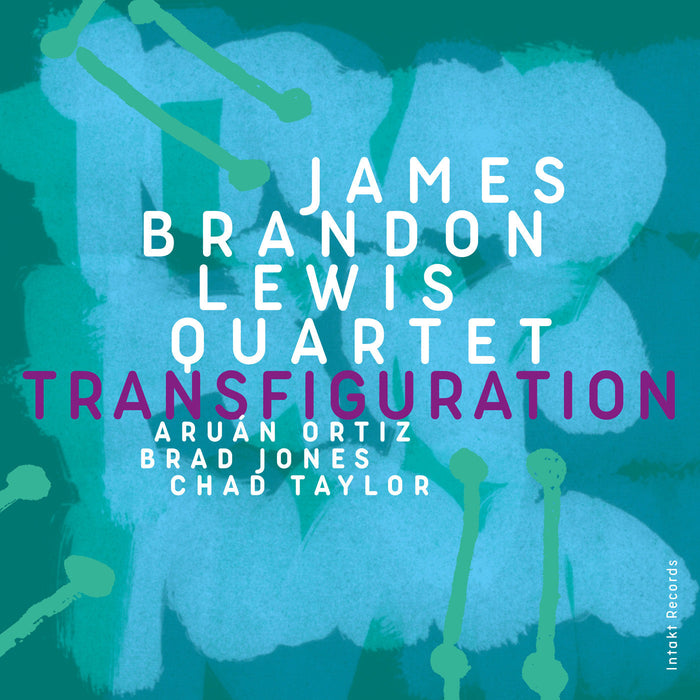
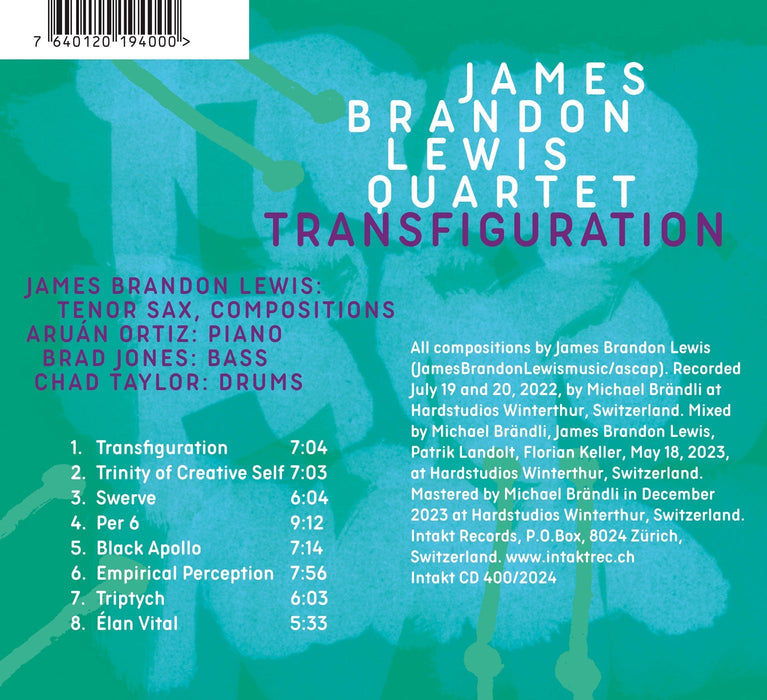
400: JAMES BRANDON LEWIS QUARTET. Transfiguration
Intakt Recording #400 / 2024
James Brandon Lewis: Tenor Saxophone, Composition
Aruán Ortiz: Piano
Brad Jones: Bass
Chad Taylor: Drums
Recorded July 19 and 20, 2022, by Michael Brändli at Hardstudios Winterthur, Switzerland.
Sale
Sale
Original price
CHF 12.00
-
Original price
CHF 30.00
Original price
CHF 30.00
CHF 12.00
-
CHF 30.00
Current price
CHF 30.00
| /
More Info
James Brandon Lewis is at the top of the international jazz world. He stands in the tradition of Saxophoneophonists such as Sonny Rollins, Albert Ayler and John Coltrane. With his powerful, direct and rich tenor Saxophone sound and a lyrical quality that unfolds in both his solos and his compositions, he is causing a sensation. Transfiguration is the fourth album by the acclaimed James Brandon Lewis Quartet with Aruán Ortiz, Brad Jones and Chad Taylor. The quartet was honored with the German Jazz Award as Band of the Year 2023. John Sharpe writes about the new album Transfiguration in the liner notes: “As the band has matured its chemistry has deepened. While it’s the melodies which first grab the ear, it’s the sublime interplay which sustains the interest in the long term.” A pleasure to listen to!
Album Credits
Cover art and graphic design: Paul Bieri
Minor visual elements: James Brandon Lewis
Liner notes: John Sharpe
Photos: Palma Fiacco
All compositions by James Brandon Lewis (JamesBrandonLewis- music/ascap). Recorded July 19 and 20, 2022, by Michael Brändli at Hardstudios Winterthur, Switzerland. Mixed by Michael Brändli, James Brandon Lewis, Patrik Landolt, Florian Keller, May 18, 2023, at Hardstu- dios Winterthur, Switzerland. Mastered by Michael Brändli in December 2023 at Hardstudios Winterthur, Switzerland.
Produced and published by Intakt Records. Intakt Records, P.O.Box, 8024 Zürich, Switzerland.
- 5 stars: 25 (100%)
- 4 stars: 0 (0%)
- 3 stars: 0 (0%)
- 2 stars: 0 (0%)
- 1 star: 0 (0%)
S
Scott Yannow 25 ESSENTIAL NEW JAZZ RELEASES FROM 2024
James Brandon Lewis - Transfiguration - Intakt
A
Anonymous Top Ten Albums of the Year
Cadence Critic's Poll 2024
Congratulations James Lewis Brandon - Transfiguration (Intakt)
has been selected in our Top Ten Critics poll for 2024 in Cadence Magazine.
B
Ben Taffijn Saxofonist James Brandon Lewis is eveneens een fan van het klassieke saxofoonkwartet. Hij bracht onder eigen naam ‘Transfiguration’ uit bij Intakt Records. Een album waarop we hem horen met pianist Aruán Ortiz, bassist Brad Jones en drummer Chad Taylor. We horen Lewis daarnaast, in diezelfde bezetting, in een aantal stukken op het door pianist Giovanni Guidi onlangs bij ECM Records uitgebrachte ‘A New Day’. Het kwartet wordt aangevuld met bassist Thomas Morgan en drummer João lobo. Twee totaal verschillende albums waaruit mooi dat grote talent van deze saxofonist blijkt. Zo fel en dynamisch als ‘Transfiguration’ klinkt, zo ingetogen zijn zijn bijdrages aan ‘A New Day’.
‘Transfiguration’ vangt aan met het titelstuk, naar eigen zeggen Lewis’ verkenning van het twaalftoonsstelsel: “the idea of renewal and transformation as a result of Molecular Systematic Music”. Dynamische, krachtige lijnen horen we hem hier blazen, opgezweept door Jones en Taylor. En ook Ortiz zorgt hier voor spannende magie. Voor Lewis is het belangrijk dat het ego, de innerlijke criticus en intuïtie met elkaar in evenwicht zijn, alleen dan ontstaan er integere kunstwerken met diepgang. Het is deze filosofie die ten grondslag ligt aan ‘Trinity of Creative Self’, waarin met name het samenspel van Lewis en Taylor opvalt. Het stuk begint en eindigt als een ballade, terwijl Lewis in het middenstuk de spanning krachtig laat oplopen. ‘Swerve’ begint met een ritmische bijdrage van Jones, waarna Taylor en Ortiz aanhaken, een mooie groove biedend voor ook hier weer fijn krachtig en melodieus spel van Lewis. Bijzonder ritmisch klinkt ook ‘Per 6’, duidelijk beïnvloed door de Latijns-Amerikaanse muziek. Het is, met name door het spel van Lewis, zonder meer één van de hoogtepunten van dit album. Drie stukken op dit album droeg Lewis op aan beroemde landgenoten. ‘Black Apollo’ aan de zwarte bioloog en docent Ernest Everett Just; ‘Empirical Perception’ aan de beeldend kunstenaar Jack Whitten en ‘Élan Vital’ aan de filosoof Henri Bergson. ‘Black Apollo’ is tevens het meest dynamische stuk op dit album, met een krachtig gruizige solo van Lewis en een mooi zangerige solo van Ortiz. Bijzonder tot slot is ook nog de krachtige ritmiek in ‘Tryptich’, een stuk met een hoofdrol voor Ortiz.
https://www.nieuwenoten.nl/?p=18323
C
Chris Searle TO hear the James Brandon Lewis Quartet is to begin to understand how jazz is founded on tradition and syncretism, yet moves towards a newfoundland of sound in its every co-operative note.
Transfiguration is their latest album, with Lewis’s tenor saxophone in complete concord with Brad Jones‘s resounding bass, Chad Taylor’s array of drums and Aruan Ortiz’s scintillating Cuban piano, every sound a sunrise.
Recorded in Switzerland, the foursome bring the Americas to the heart of Europe with huge sonic meaning. All the compositions are Lewis’s, with Trinity of Creative Self having some tender Ortiz piano, Taylor’s pounding drums and Jones’s echoing bass grounding Lewis’s melodic, imploring horn.
Or there’s the tantalising Swerve, where Ortiz chimes his notes alongside Lewis’s sliding sound patterns; or Black Apollo, full of an unassailable timbral pride. Every Lewis album builds on what came before, creating a growing mountain of new and powerful beauty.
https://morningstaronline.co.uk/article/jazz-album-reviews-chris-searle-september-2-2024
S
Stewart Smith One that got away: EFG London Jazz Festival 2023
Tyshawn Sorey, Pat Thomas, Irreversible Entanglements, Bill Orcutt Guitar Quartet, James Brandon Lewis...
My review of last November’s EFG London Jazz Festival slipped through the cracks, so I’m belatedly publishing it here. Several acts have already been announced for this year’s festival, including Marc Ribot, Dave Holland and Billy Cobham, so keep your eyes peeled for more.
Tyshawn Sorey’s visits to London are few and far between. In presenting three different sets from the visionary composer, improviser and multi-instrumentalist, EFG London Jazz Festival has pulled off a real coup. At King’s Place there’s a real buzz of anticipation as the audience gathers to hear his trio with pianist Aaron Diehl and double bassist Matt Brewer. Hands down the best straight-ahead jazz group going, they perform jazz standards and deeper cuts with remarkable sensitivity and curiosity. As Sorey explained to me in The Wire 465, there’s no attempt to radically alter the material through reharmonization or clever time signature changes: his aim is to honour the original forms while bringing “a new type of sensibility to it, that has to do with where we’re living now.”
Having completed a residency at the Village Vanguard a few days prior, the trio is operating at a higher level than ever. They go into the material rather than out. Instead of the predictable round of choruses, each soloist takes as long as they need to meditate on the different aspects of a tune. There’s a fluidity and freeness to the music that is just magical, yet it never feels aimless or drifting. Using a combination of brushes, mallets and sticks, Sorey draws a spectrum of tone colour from a pared-back drumkit: pellucid cymbal textures, muted rumbles, balletic side-steps. His style is steeped in jazz tradition, yet utterly fresh. He swings too, laying down a head-nodding groove behind Diehl’s soul jazz vamps on the encore of Harold Mabern’s “In What Direction Are You Heading?”
Sorey’s performances the following day are radically different. For the matinee at Café Oto he plays solo piano to a pitch black room. The setting creates a deep focus, with time melting away. Sorey begins by working at a series of angular, bluesy figures. Over time, he eliminates the spaces between notes, putting all his force onto the keys and pedals to create a sound of overwhelming density and power. He maintains that intense pitch for several minutes, the dark waves overlapping until they finally recede. It’s devastating.
For the evening set, Sorey is back behind the drum kit for a duo with Pat Thomas, who he rightly considers one of the greatest pianists in the world. Their set is relatively short but electrifying, with Sorey playing in a more assertive style than with his trio, his snare and cymbal rushes matching the energy of Thomas’s dancing clusters and right-hand leaps. Both artists share an expansive vision, refusing easy categorisation. Future collaboration is a must.
Irreversible Entanglements make a triumphant return to London, playing the cavernous EartH Hackney. The sound in the space can be a little muddy, with Camae Ayewa’s vocals lacking clarity at times, but nothing can suppress the energy, righteous and celebratory, that the band generate on stage. There’s a sense of ritual reminiscent of Art Ensemble of Chicago shows, with the band walking on stage wielding hand percussion, taking time to build a groove before moving to their primary instruments. Once they take off, they’re unstoppable. “Protect Your Light” and “Free Love” are joyful and uplifting, with Ayewa inviting the audience to dance and chant along. Yet they’ve lost none of their political charge. Against the backdrop of the unfolding genocide in Gaza, “Our Land Back” hits particularly hard.
The night before Bill Orcutt’s Guitar Quartet bring their ecstatic minimalism to King’s Place, its members perform individual sets at Café Oto. There’s a strong sense of camaraderie and banter, with Ava Mendoza introducing Orcutt as the benign patriarch of their backwoods guitar family. Shane Parrish is up first, weaving together threads of math-rock, Americana and English folk. Wendy Eisenberg performs a song-based set, their delicate jazz-inflected melodies underpinned by intricate voicings. Introduced as “the shredder in a band of shredders,” Mendoza has the biggest sound of them all, channelling Hendrix and Sharrock in an arresting set of avant-blues songs. Grappling with his four-string Telecaster, Orcutt closes with tender and ferocious readings of tunes from 2023’s Jump On It. A great night of guitar soli.
Café Oto’s festival closer is James Brandon Lewis with his Molecular Quartet of pianist Aruan Ortiz, bassist Brad Jones and drummer Chad Taylor. Together, they articulate the saxophonist’s Molecular Systematic Music, a cellular approach to composition. For all the sophistication of Lewis’s musical language, its blues and gospel roots come through s...
K
Ken Waxman Putting an individual stamp on a common jazz grouping, tenor saxophonist James Brandon Lewis and his quartet of pianist Aruán Ortiz, bassist Brad Jones and drummer Chad Taylor stretch the configuration’s parameters, but maintain steadying cadences that balance exploratory flights.Backed buy bass pops, supple percussion chops and keyboard dynamics, like John Coltrane before him, Lewis is free to open up improvisations that undulate and advance to reed cadenzas that roar, ripple and reverberate into split tones and harsh smears. Yet no matter how many textures he crams into his solos, as on the session defining “Per 6”, other players’ timbres are there not to harness invention, but to mix tradition with transfiguration. Ortiz outlines melodies as often as his modal time suspensions or rhythmic note sprinkles impressively challenge the saxophonist’s pivots to double-tonged altissimo on the balladic “Trinity Of Creative Self” or to preaching glossolalia on the intense “Empirical Perception”.
Never exceeding tasteful boundaries, Lewis’ saxophone control means that his onomatopoeic cries, bites and peeps are harmonized as well as transformative. He harmonizes with the others throughout, constantly returns to the theme by tunes’ conclusions and somewhat manages to quote “Rhapsody in Blue” during his solo on the title track. Transfiguration is the band’s third outing, each of which is sturdier and tighter and more coordinated than the previous one. If this trend continues this may become the most significant jazz quartet of the beginning of the 21st Century.
https://www.jazzword.com/reviews/james-brandon-lewis-quartet/
T
Tom Greenland At 40 years of age, tenor saxophonist James Brandon
Lewis, a jazz conservatory alumnus who garnered
considerable acclaim for The Jesup Wagon (2021), has
begun to question his own “trained intuition,” hoping
to move beyond skill, habit and gratuitous complexity
to explore deeper meanings of music-making.
Transfiguration, his fourth quartet album for Intakt,
with Aruán Ortiz (piano), Brad Jones (bass) and Chad
Taylor (drums), is a promising step in this direction.
The first thing to hit you is Lewis’ stentorian sound,
an echo of tenor titans Sonny Rollins, John Coltrane
or Albert Ayler, who could command attention with
a single, richly reverberant note. Emotional gravitas
from Lewis’ gospel background is here too, an ability
to generate skin-prickling electricity. His tunes are
hummable, harmony serving melody, not the other
way ‘round. But the quality most responsible for
taking this music “deeper” is cohesion, the kind of
empathy and trust that allows the quartet to change
its collective mindset at will or whim, to launch off on
any promising new detours, following in each other’s
footsteps even as they lead the way.
While many tracks adhere to the customary
sequencing of solos, “Trinity of the Creative Self”,
“Swerve” (based on a Muddy Waters-type blues
drone), “Black Apollo” and “Triptych”, show a less
ordered division of labor, where soloist, timekeeper
and accompaniment roles overlap and blur.
Another esthetic trope, heard on “Swerve”, “Per
6”, “Black Apollo” and throughout both in solos
and accompaniment, is the use of repeated riffs to
deepen and intensify the groove with each iteration,
each added layer, creating “nagging incantation[s]
freighted with emotional heft.” (as John Sharpe writes
in the liner notes). Muddy Waters and then some.
Not to suggest the music is repetitious or reductive—
rhythms are arranged in 5’s, 6’s, 7’s and 9’s, or 4’s
superimposed over 3’s, while a melody might
contain all 12 chromatic pitches—only that craft is
secondary to discovery, a mere vessel towards those
transcendental moments (or ‘trance-figurations,” if
you will) that occur, for example, in the middle of
“Black Apollo” or “Triptych”, when it feels like just
about anything is about to happen. The final track,
“Élan Vital”, ending with a slow churchy backbeat,
serves to ground the sublime adventurers back on
terra firma.
J
Jürg Solothurnmann Soulig und ideenreich ist der 40-jährige Tenorist
James Brandon Lewis auf bestem Weg, eine der
neuen Leitfiguren zu werden, zumal die Transfigurationen
dieses Albums auch die Jazzkomposition
auf eine neue Stufe heben. Ähnlich wie
z. B. Henry Threadgill, Steve Coleman oder Muhal
Richard Abrams kombiniert Lewis die afroamerikanischen
emotionelle Tradition mit Intellekt –
Einflüsse der Gospelmusik seiner Jugend und
der grossen Tenoristen des Postbop und Free
Jazz mit wissenschaftlichen Strukturen. Angeregt
von der Doppelhelix des DNA-Moleküls umfassen
sich die verschiedenen Seiten gegenseitig
und erzeugen ein evolutionäres Sowohl-alsauch:
”Innerhalb einer melodischen Linie erscheint
eine Gegenlinie mit anderen Rhythmen,
Tönen und Harmonik.” Nichts wird verworfen,
aber konventionelle Modelle und Rollen neu gedacht
und kombiniert. Oft mehrteilig in Episoden
gegliedert wechseln innerhalb der acht Stücke
Komponiertes und Improvisiertes miteinander
ab und tragen – aller Modernität zum Trotz –
mit dazu bei, dass diese Musik so kurzweilig ist.
Gewaltigen Anteil am Gelingen dieses Projekts
haben Lewis ebenbürtige Kollegen: stark und
bündig der mit Klassik, Kuba und Jazz gleichermassen
geläufige Virtuose Ortiz, dann der Bassist Jones, ein rhythmisches und melodisches
Rückgrat der Band, und der ebenso Sound- wie
Rhythmus-bewusste Drummer Taylor. Black Classical
Music.
J
Jean Buzelin Bien que pratiquant un langage plus contemporain qui s’appuie sur une méthode de composition sur les 12 tons qu’il appelle Molecular Systematic Music, avec des développements plus ouverts et modaux (le pianiste cubain Aruán Ortiz), le quartette de James Brandon Lewis fait aussi partie de la même famille. Le groupe en est à son quatrième opus sur Intakt et, d’une fois sur l’autre, il nous semble toujours progresser et atteindre l’excellence, grâce à une maîtrise, une profondeur, une conscience (de toujours faire mieux) amenant à une maturité épanouie. Assurément, il devient le grand quartette afro-américain d’une époque que l’on ne peut évidemment pas comparer avec celle de Coltrane. Et pourtant...
Le jeu de Lewis au ténor a atteint une dimension, une envergure que ses partenaires, parmi les meilleurs sur leur instrument respectif, enrichissent magnifiquement. Contrôle, rigueur, souplesse, liberté et... surtout beauté. Le final, Élan vital, dédié à Henri Bergson, est grandiose.
https://www.culturejazz.fr/spip.php?article4209#james_brandon_lewis_quartet_transfiguration
H
Howard Mandel James Brandon Lewis has proved in the past
dozen or so years to be the rising giant of the
tenor saxophone, whose supremely honed horn
skills and deep regard for jazz traditions serve
brilliant personal and community expression.
Lewis’ playing and contextual concept are
“free” in that they accept no restrictions and
acknowledge no contradiction in leading a subtly
attuned acoustic quartet or recording (and
touring) with the out-rockin’ Messethetics. Not
to pressure on the guy, but he’s clearly in the
lineage of Coltrane, Rollins and thus Coleman
Hawkins. He strikes one from first notes —
the keening figure, say, with which he enters
“Transfiguration” — as an original and serious
jazzman, not without humor but not just foolin’
around.
Lewis’ tone is commanding: full, solid,
gleaming, sometimes sorrowful, sometimes
gruff and most of all honest. His vocabulary is
his own, taking off from elders’, and exceptionally
wide-ranging — bottom to beyond top of
his tenor — still inventing and perhaps surprising
himself. Though he can rip through progressions,
he doesn’t do that here, yet his time
is uncanny and narrative strong. He may start
with a cell or pattern, but he worries them,
stress-testing modality with extensions of
irregular angles and lengths, aspirational tenderness
(as in “Trinity”) and timbral intensity
(the series of biting pitches on “Per 6”) à la
late Trane. He often improvises irregular vertical
phrases, jagged figures that hurtle both
vertically and horizontally with the urgency of
meaningful thought. Some of his lines — like
the knotty, serial “Tryptich” — demand their
players’ rapt attention; some of his gestures, like
the unaccompanied 30-second cadenza ending
“Fourth Wall” on the Messethetics record, are
tossed off as random musings despite their singular
beauty. Lewis seems equal to each challenge
and carries listeners along for the ride.
Of course Lewis choses his collaborators
with care. Transfiguration is this quartet’s
fourth date, and the band feels fully unified.
Ortiz’s pianism is richly atmospheric; he turns
rhapsodic, strumming the keys, and texturally
lush in contrast with the hornman’s stark
expression. Brad Jones and Chad Taylor contribute
substantially to the cohesion, the bassist
always pinning the fundamentals, pizz’ing
like mad (“Per 6” again, and “Black Apollo”),
the drummer generating a constant churn of
engaging, dynamic rhythms.
Transfiguation feels like a long program, its
tracks of one piece. So are those in Lewis’ shaggily
rockin’ cross-genre collaboration with the
Messethetics, a D.C.-based gogo-prog-punk trio
comprising Fugazi bassist Lally and drummer
Canty with game-to-explore guitarist Anthony
Pirog. This is a rare example of a project that compromises
neither rock’s loud roughness nor jazz’s
rugged individualism; the musicians simply meld.
Think Jack Johnson. Lewis’ big sound and
asymmetrical phrasing hold their own over
and through the Messethetic’s bold, amplified
backdrops. Pirog feeds him ringing, picked figures
and twining leads (“Three Sisters”) and
also shreds with abandon. No-holds-barred
tenor sax takes its place in wide-open, big-beat
macho music as something more than decor,
notably on “The Time Is The Place.” Fans across
borders, rejoice!
B
Bill Shoemaker James Brandon Lewis is perfecting the rhythm of releasing albums by two ensembles with contrasting instrumentation and artistic agendas. While his Red Lily Quintet focuses on seldom celebrated aspects of African American history like George Washington Carver’s Jessup Wagons and the midwifing of present-day gospel music by the majestic Mahalia Jackson, his Quartet extends the trajectory of the tenor saxophonist-led quartet still largely determined by John Coltrane, which makes it more vulnerable to the quicksand of influence. Lewis consistently and skillfully steers clear and delivers strong, well-shaped statements like Transfiguration.
Where Lewis’ quartet is comparable with both Coltrane’s and David S. Ware’s classic units is an immediately recognizable ensemble sound, attributable to his well-honed rapport with Aruán Ortiz, Brad Jones, and Chad Taylor. Arguably, this is a lift made heavier by the span of Lewis’ materials. Transfiguration is packed with impressive track-to-track leaps, typified by following the anguish-laced questing of “Trinity of Creative Self” with the pungently accented rhythms of “Swerve” and the bright Latin tinge of “Per 6.” Lewis also writes chimeric themes. The album’s finale, “Élan Vital,” blends nods to late Coltrane balladry, South African hymn, and the paeans of Keith Jarrett’s American quartet, then amps the intensity to a righteous scalding scream, and takes it out on a cooling groove.
Lewis calls his composition method Molecular Systematic Music, a name that suggests dry science and complexity for complexity’s sake. Time and again on Transfiguration, method is overwritten by expression, the keen responsive interplay within the quartet giving knotty ideas a visceral, even soul-shaking impact, particularly on Lewis’ 12-tone title piece. “Taking it to the next level” is a phrase signaling artistic ascent; it certainly has applied to Lewis’ previous quartet albums. Transfiguration emphatically suggests this to be an ongoing process. Most artists would believe they have arrived with such work, but it is obvious that Lewis will keep on pushing and that this recording and his next efforts should not be missed.
https://www.pointofdeparture.org/PoD86/PoD86MoreMoments4.html
K
Kevin Le Gendre In the third and final section of ‘Triptych’, the highlight of this outstanding album James Brandon Lewis’ quartet engages in a few tempo changes. The medium fast beat on which they started comes right down to ballad pace but it is much more than the shift of speed that catches the ear. The players suggest that the notes of the initially fast theme conspire to hang if not freeze in mid air and the effect is enchanting, making what was punchy and rhythmic languorous and melodic.
They then bring the pace right back up and the shock from the slumber hits hard. It is symptomatic of the vivid drama that permeates this new work which sees Lewis, an authoritative, stately saxophonist continue to make his quartet one of the most important bands in contemporary creative music. Its specific language, a compelling alloy of avant-garde and straightahead sensibilities that creates flexi-harmony and vari-rhythm, is steeped in history yet not trapped by any ready-made cliché. The ensemble sound can be tough, grainy and heavy, but also lyrical and plaintive, as exemplified by the beautiful gospel-tinged closer, ‘Elan Vital’, which betrays the known interest Lewis has for the music of Mahalia Jackson among others. This latest release further strengthens the argument that Lewis really is a modern-day tenor titan.
https://www.jazzwise.com/review/james-brandon-lewis-quartet-transfiguration
R
Reinhold Unger Dies ist bereits das vierte Al-bum, das James Brandon Lewis innerhalb von knapp dreieinhalb Jahren mit Aruán Ortiz (Piano), Brad Jones (Bass) und Chad Taylor (Schlagzeug) aufgenommen hat. Doch statt einer gewissen Sättigung stellt sich beim Hören Begeisterung ein über die immer noch weiter-wachsende Intuition dieses Vierers beim kollektiven Extemporieren der acht neuen Lewis-Kompositionen. Ob ein Stück würdevoll gemessen anhebt, in mysteriös-düsterem Rubato oder aufgekratzt latinesk: Immer entwickelt das Quartett mit unwiderstehlicher Bestimmtheit daraus die glutvolle Intensität eines so zeitgemäßen wie zeitlosen Jazz ohne Bindestrich, ohne Wenn und Aber. Die eigenwillige Phrasierung von Ortiz, eine Art postmoderne Monkiade via Hill und Moran, die sonore Souveränität von Jones, die schier unerschöpfliche Vielfalt an treibenden wie tänzelnden Rhythmen, die Taylor aus dem Drumkit zaubert: Man weiß gar nicht, was an dieser Band am meisten fasziniert. Vielleicht doch die kraftvoll-beseelte Autorität von Lewis' Tenorsaxo-phon, mit der er auf dem besten Weg in die Jazz-Geschichts-bücher zu sein scheint. Falls es Lewis gelingt, Ortiz, Jones und Taylor noch länger bei der Stange zu halten, wird man von dieser Formation vielleicht irgendwann als seinem »Classic Quartet« sprechen.
W
Wk James Brandon Lewis ist der Saxofonist der Stunde. Die Anzahl der Einspielungen, an denen er beteiligt ist, sprengt längst jede Dimen-sion. Kein Wunder, dass er auch schon wieder mit zwei eigenen Einspielungen am Start ist.
Bei seiner Begegnung mit der Band The Mess-thetics handelt es sich im mehrfachen Sinne um eine Supergroup, denn hier kommen Visionäre mit unterschiedlichsten Backgrounds zusam-men. The Messthetics sind an sich schon eine Supergroup. Der Prog erprobte Jazzgitarrist Anthony Pirog, vor allem im Umfeld von Henry Kaiser aktiv, macht gemeinsame Sache mit Bassist Joe Lally und Drummer Brandon Canty, die einst als Rhythmusfundament der DC-Hard-core-Rebellen Fugazi Geschichte schrieben.
Gemeinsam mit dem Saxofonisten betreten sie ein Feld des Free-Funk, das an Ornette Colemans elektrische Band Prime Time, Arthur Blythe auf „Lenox Avenue Breakdown" oder James „Blood" Ulmers Band Phalanx erinnert. Jeder Ton dieser Einspielung hat Gewicht, die Musik ist so dicht wie die Breitseiten von Fugazi und so frei assoziativ wie der Free Jazz der legendären New Yorker Loft-Scene. In seinem Quartett mit Pianist Aruán Ortiz, Bassist Brad Jones und Drummer Chad Taylor frönt er etwas weniger aufmüpfigem, dafür geradlinigerem Free Jazz mit starkem Sixtieseinschlag. Schon der Titel ruft ein Stück weit Alben von John Coltrane aus der Mitte der 1960er ins Gedächtnis. Lewis' Kompositionen sind viel komplexer als die von Coltrane, trotzdem ergibt sich aus ihnen nicht zuletzt aufgrund der Besetzung von Tenorsax, Piano, Bass und Schlagzeug ein coltranesker Flow. Der Saxofonist stellt indes sicher, dass dies kein verstecktes Tributealbum ist. Aus der Saat von Coltrane erntet er immer wieder souverän die eigenen Früchte. Wie Lewis über all seine Aktivitäten den Überblick behält, ist ein Rätsel. Sicher wurde „Transfiguration" in dieser Absicht weder eingespielt noch veröffentlicht, und doch wirkt die Platte wie das spirituelle Gegenstück zu dem aufpeitschenden Treffen mit den Messthetics.
J
James Brandon Lewis Got Flows? I asked myself aloud, listening to an audio recording of my ensemble playing a concert the night before. The question is one that is asked of a person claiming to know how to rap. The metaphoric use of the word “flow” in this context refers to the uninhibited, creative, and improvised use of language uttered by a lyricist over a beat or unaccompanied. This day at dawn silence was broken, not by vocals but by the cadence of a saxophone.
The year was 2019, the borough was Brooklyn, the venue was Public Records, and the instrumentation was piano, bass, drums, and my tenor saxophone. The band and I brought a memorable amount of funk and groove that night, somewhere between the music of James Brown and A Tribe Called Quest. The next morning I made myself a coffee and reflected on the music. In order to understand my musical behaviors, as a saxophonist and composer, my creative practice involves deep listening to recordings of my improvisations and compositions. Analyzing recordings always sparks questions: Was my pitch okay? Was my sound projecting? Did I use enough dynamics? Am I communicating with the band? But this listening session was more than thrills, frills, and groovy music — it was one of encounter, and forever changed my perception of music. This act of encounter ignited a realization and thus transformation of self, and as saxophonist Charlie Parker once said: “I came alive.”
Charlie Parker, bored with stereotyped changes (chord structures of music) being used at the time kept thinking there was bound to be something different. He could hear it sometimes, but could not play it.¹ In his book, Carl Woideck quotes Parker: “Well, that night I was working over ‘Cherokee,’ and as I did, I found that by using the higher intervals of a chord as a melody line and backing them with appropriately related changes, I could play the thing I’d been hearing. I came alive.”² His account depicts encounter as a process of transformation.
That morning in 2019 I heard two notes oscillating back and forth, and saw a spiral in my mind’s eye. Determined to figure out what kind of spiral I was visualizing, I rushed to my computer and searched for the word: S... P…I…R…A…L. Various spirals popped up, but few matched exactly what I saw in my head, and what I bodily felt was right. Suddenly there it was: the spiral of a double helix appeared. I was filled with instant gratification as light bulbs went off in my head and my brain began making connections between music and science. As my research continued, the topic of molecular biology kept appearing. I started to investigate the study of DNA, its spiral shape, the double helix.
My encounter with this visual metaphor, where notes became atoms, led to the creation of Molecular Systematic Music: the use of science as a metaphor for how to construct music. Metaphor became the catalyst of my work, gesturing at other ways of thinking about the human experience, knowledge, and the reinterpretation of music. The essence of metaphor is understanding and experiencing one kind of thing in terms of another.³ I searched for artists similarly utilizing metaphor, finding visual artist Jack Whitten and writer and poet André Breton.
In his book Notes from the Woodshed, Whitten suggests we “Use science as Metaphor.”⁴ He often used scientific terminology to describe his process for dreaming up artwork, commenting that the perceptions of artists are similar to those of scientists. Newly fond of anything related to molecular biology, I was naturally drawn to this idea, and embodied his statements. “Molecular Perception,” he states, “is a process of dealing with form down to its elemental levels, to the unit of what makes that form visible to the naked eye. Matter through Molecular Perception encodes information for the artist—we’re not scientists we are artists, we depend on our feelings, we depend on our intuition. We penetrate in the same sense that scientists penetrate deep down into molecular structures. In doing that, I found something extremely concrete. Through intuition and feelings we have access to other dimensions.”⁵
The reality of my music was being changed by the metaphor of science, and as I investigated the role of perception, I felt it necessary to strengthen the connection between molecular biology and music using poetry. While working on an album, An Unruly Manifesto, I became familiar with the 1920’s art movement of Surrealism and the manifesto written by its founder, Andre Breton. Breton was influenced by Arthur Rimbaud’s expression “alchemy of the word,” the idea of changing reality through the use of language, and felt it should be taken literally. One of the conditions of alchemical: the surrealist object in itself contains the transforming properties of metamorphosis, and is able to be one thing and another at the same time.⁶ I became familiar with the surrealist game of One inside Another, which helped me understand my visual encounter with the double h...