
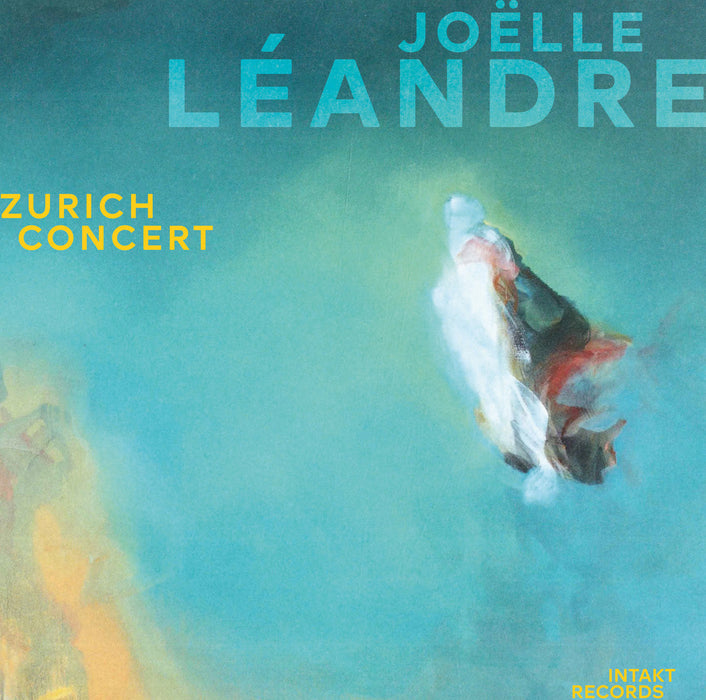
402: JOËLLE LÉANDRE. Zurich Concert
Intakt Recording #402 / 2023
Joëlle Léandre: Bass
Recorded March 17, 2022, at Taktlos-Festival at Kunstraum Walcheturm, Zürich, Switzerland.
Sale
Sale
Original price
CHF 12.00
-
Original price
CHF 30.00
Original price
CHF 30.00
CHF 12.00
-
CHF 30.00
Current price
CHF 30.00
| /
More Info
Joëlle Léandre is a living legend. It is almost impossible to list all the international greats of free music with whom Léandre has played in her decades-long career. With Zurich Concert, the magician and rebel on the double bass presents an impressive solo statement. “It is no coincidence that she once described the bass as her bedrock, her spinal column and the place where she stores her memories. Joëlle Léandre does not play music, she lives it ... (she) spins a continuous thread of sound which never snaps. On the contrary, she keeps spinning it onwards. We hear both high energy and quiet tenderness, but the transitions are always seamless and organic. In her bass playing and with her voice. No stopping, no pause within the individual improvisations. Onwards, ever onwards. A true magician of sound,” writes Nina Polaschegg in the liner notes.
Album Credits
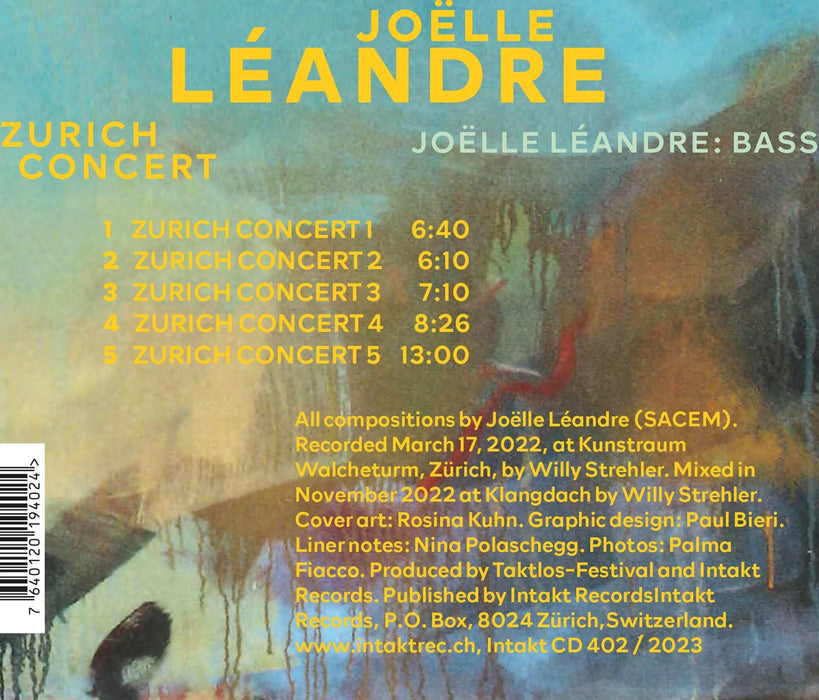
Cover art: Rosina Kuhn
Graphic design: Paul Bieri
Liner notes: Nina Polaschegg
Photos: Palma Fiacco
All compositions by Joëlle Léandre (SACEM). Recorded March 17, 2022, at Taktlos-Festival at Kunstraum Walcheturm, Zürich, by Willy Strehler. Mixed in November 2022 at Klangdach by Willy Strehler. Produced by Taktlos-Festival and Intakt Records. Published by Intakt Records.
- 5 stars: 24 (100%)
- 4 stars: 0 (0%)
- 3 stars: 0 (0%)
- 2 stars: 0 (0%)
- 1 star: 0 (0%)
K
Ken Waxman Along with live gigs and composing, the French doyen of creative double bass music was busy recording during 2022. At least that’s the impression given by these distinguished sessions. In March she recorded one of her heavyweight solo extravaganzas in Zürich; in October she was in Geneva playing with French snare drummer Rodolphe Loubatière, who has also worked with other innovators like Bertrand Gauguet; then in December she gave a duo concert in Vienna with much younger Brazilian double bassist Vinicius Cajado, who has also worked with artist as different as Franz Hautzinger and Golnar Shahyar.
Eminent as always in a solo bass recital, Léandre begins with measured low-pitch bowing but quickly creates an exposition built up from torqued col legno bounces, darkened and doubled string drones and squeals. By “Zurich Concert 3” she unveils novel surprises by transforming string twangs and rubs that seem to be stripping the finish from the strings to superfast spiccato bowing that then molds string pinches with vocalized bel canto yodeling. As droned glissandi and multi-string swirls reach a concentrated crescendo, her yelps, growls and speaking in tongues intensify at the same tempo and accelerating pitch as her strings. Climax arrives in the concluding “Zurich Concert 5” as animated string patterns work down the scale to become more restricted and relaxed. These single bow string-like pops slide into a defining narrative, with an affecting secondary theme slowly joining the first. More vocalizing and repeated thickening drones mark the finale.
With a monologue changing to dialogue, Estampe’s seven duets involve patterns that unite Léandre’s extended techniques with those of Loubatière. Using only a snare drum he slides, screeches and thick rubs patterns that create a contrapuntal role beside the bassist’s thick and harsh power sweeps. At points it appears as if string pressure jolts are as percussive – or even more so – than the impacts of sticks and other implements on the drum surface. Breaking up the percussion punches with a cymbal edges rubbed against drum tops, bell-like clangs and rim wood clattering, this shading emboldens Léandre to rattle her strings even more with the result even louder as sul ponticello sweeps meet bumping rhythms from Loubatière. Later ratcheting and sweeping string strategies are joined by the bassist’s whispers, eerie panting and nonsense syllable mumbles. Maintaining the musical dialogue Léandre’s pressurized string slaps and buzzing sul tasto challenge the drummer’s crackles, clips and pumps even as vocals descend to pants and barks. Stretching string buzzes alongside simple percussion ruffs the two finally reach a sweeping understanding.
Working alongside another improvising bassist as she has frequently done in the past, it appears that Léandre’s adaptation of extended techniques has subsequently become so universal, that there are points during Storm Dance that it seems as if a single eight-string double bass is being played. The most obvious corollary to that is on “Fifth Dance”, where an eruption of Léandre’s unique scatting and bel canto shouts is accompanied by downwards string slakes while Cajado creates higher pitches. A more general rule of thumb may be that she is more likely to be using arco motifs – along with pizzicato pumps from the other hand – while he projects designated plucks. Coordinated multiple string expression among higher and lower-pitched tones, with varied tempos and pressure, mean that such distinguishing role aren’t always obvious. Although the verbal barks, yelps, rhythming nonsense syllables and panting gurgles are from Léandre’s alone, dual riffing responses that encompass chunky slaps and sliding squeals could come from either. Following an audience affirming finale, the subsequent “Sixth Dance” encore leads to echoes of more conventional string playing with the measured and linear melody confirming both their partnership and dual interest in stretching the double bass’ improvised parameters.
Solo or in different duos, the ingenuity and invention of Léandre and partners is aptly showcased on these discs.
https://www.jazzword.com/reviews/joelle-leandre-rudolphe-loubatiere/
H
Hans-Jurgen Linke Hans-Jurgen Linke's Best of 2023 (DAS WAR 2023)
• Bestes Konzert
Michael Wollny und Pierre Laurent
Aimard, Alte Oper, Frankfurt
• Lieblingsmusik
Burkard Kunkel & Bob Degen:
Two Geese by the River
(Triangolo)
• Spätnachts
Velvet Revolution:
Message in a Bubble
(BMC / Galileo)
• Aus aller Welt
Joëlle Léandre:
Zurich Concert
(Intakt / Harmonia Mundi)
Entdeckung
Simon Lucaciu Trio:
STRG X (HatHut / NRW)
E
Europe Jazz Media Chart Top 5 2023 Europe Jazz Media Chart Top 5 2023
Jos Demol, jazzhalo.be:
JOËLLE LÉANDRE Zürich Concert (INTAKT)
ALBERT VILA Levity (Hypnote Records)
FRANK KIMBROUGH LullaBlueBye & Play (Palmetto Records)
CHRIS JORIS Until The Darkness Fades (WERF Records)
CÉCILE BROCHÉ 3D@Paris (discus music)
https://www.jazzhalo.be/articles/europe-jazz-media-chart-top-5-2023/
T
Thierry Giard [livre] Jean-François Foucault : jazz, musiques recto-verso et une valise rouge.
https://culturejazz.fr/spip.php?article4053#le_trio_h_j_t
P
Paul Medrano It certainly takes all the stoicism of the Swiss—whom we envy for all the anthological performances held in their country—to cordially applaud such a performance, but it’s an excellent choice for a recording, as any other place would certainly have seen the audience faint or go into endless standing ovations!
https://bestofjazz.org/best-of-jazz-year-2023/
F
Franpi Barriaux Joëlle Léandre seule à la basse. L’image est connue, et l’oreille croit savoir ce qu’elle va entendre, mais la récente lauréate du Life Achievement Award du Vision Festival a fait vœu depuis longtemps de nous surprendre, et ce Zürich Concert emprunte une voie que la contrebassiste ne nous avait pas montrée depuis longtemps. Sans doute est-ce l’envie qui nimbe ce concert capté en mars 2022 dans la ville suisse par Intakt Records. L’envie de jouer à nouveau après les confinements, l’envie de se livrer entière : sur ce disque, Joëlle Léandre ne donne pas de la voix, ou peu, hormis quelques babils intérieurs. Le mode de communication est l’archet, comme le ton est donné dès la première pièce, étonnamment courte : brûlant, urgent. On pense à Hasparren, le duo qu’elle avait proposé avec Daunik Lazro. Mais ici Joëlle est seule, intensément seule.
Il y a un côté fondamentalement terrestre dans le jeu de Léandre lorsqu’elle aborde un solo dans cet état d’esprit. Les deux pieds bien campés dans le sol, elle fait chanter sa contrebasse sur des fréquences perceptibles par Richter ; dans « Zurich Concert 3 », l’archet se fait plus lent, il danse pour aller quérir des infrabasses qui viennent par sympathie, comme s’il venait se mêler au chœur de la contrebasse. C’est un instant puissant, de plus en plus véloce, qui ne perd rien en intensité : on s’attend à entendre Joëlle déclamer, il n’en est rien, il faut continuer à suivre les craquements du bois et la course des frappes sur les cordes. Le chant qui vient est intérieur, comme chamanique. Difficile de ne pas se laisser totalement submerger, d’autant que « Zurich Concert 4 » vient pour nous replonger au plus profond de la basse, comme un soc qui labourerait de nouveaux sillons.
C’est à ce moment que la parole revient, la contrebasse se laissant elle aussi dépasser par un énergie qui s’exprime autrement, dans une colère rentrée qui n’explose pas mais tend l’atmosphère davantage encore. La fusion est à son comble entre la musicienne et son instrument : c’est le moment parfait pour conclure sur un feu d’artifice. Avec « Zurich Concert 5 », le pizzicato est de retour. C’est comme une éclosion, une montée de sève. L’énergie ne se décuple pas, elle se décentre et laisse la place à un roulement, à un ronflement né d’une colère sourde, d’un solo joué à bras-le-corps sans temps morts. Avec ce Zürich Concert, Joëlle Léandre nous offre l’une des plus belles expériences solistes de sa longue discographie. La gageure n’est pas commune.
https://www.citizenjazz.com/Joelle-Leandre-3482438.html
N
Nick Ostrum Coming off her fabulous 2021 release At Souillac en Jazz, bassist Joëlle Léandre has delivered another entrancing solo release. Recorded live at Kunstraum Walcheturm at Zurich's Taktlos-Festival, Zurich Concert continues to push free improvisation into mystical realms that Léandre seems to conjure at will. It is hard to identify exactly what it is that distinguishes her work from that of other bassists. She gets a big sound, layering tones into something that sounds less like a chord and more like a single shuttering line of convergence. She runs up and down the bass with an intentionality and sheer force that many bassists only ever approach. She plays with a gravity and confidence that makes her solo work almost sacred.
Zurich Concert continues this trend. Much of the album is comprised of heavy arco work. Léandre has proven her chops and vision here many times before. She has a unique sense of melody that must emanate from her classical training, at least in part. "Zurich Concert 1" is a perfect example of this. She showcases her dexterity in a range of moods — jaunty, nervous, accepting — while repeating techniques and phrases in a manner that evokes new music's dramatic patience. She also does not shy from thick, droning passages, which, when extended, seem to open more space than they fill. And, of course, when moved, Léandre adds her singular vocals, which are equal parts operatic, incantatory and primal. "Zurich Concert 5" is the notable exception. For the first half, Léandre abandons the bow for her fingers, plucking out powerful strutting lines. By the end of the piece, however, she has returned to her bow for an extended passage that is both plangent and hopeful. One hears the classical influence most strongly here, as she staggers the line between contemporary minimalism and Copeland, or some other early 20th century creator of orchestral music for the people. Léandre, of course, is no orchestra, but a single person. She is, however, much larger than life, as is her sound.
https://www.squidco.com/cgi-bin/news/newsView.cgi?newsID=2658
J
John Sharpe Now 71, French bassist Joëlle Léandre is a consummate improviser allying unrivalled facility to boundless imagination. Her early performances were in new music, but before long the allure of free improvisation unleashed her passion and creativity, with bassist Peter Kowald and guitarist Derek Bailey her lodestars. But Léandre has transcended genre in a lengthy career garlanded with accolades, the most recent being the receipt of the Lifetime Achievement Award at the 2023 Vision Festival in New York City. By this juncture she is unmistakable, readily identifiable by her authoritative tone, ecstatic and incantatory phrasing, rich color palette and unconstrained attitude to theatricality and humor.
While Léandre’s discography stretches to over 240 titles, only a handful find her in the sole company of her bass, including of course her memorable debut Contrabassiste -Taxi (Adda, 1982). Zurich Concert provides the latest installment of a long journey, captured at the Taktlos Festival in the titular Swiss city some forty years after her first excursion in the format. Even though she’s on record as expressing a preference for communal music making, Léandre assuredly pulls the listener into her world, one where the absence of partners proves no hindrance to enthralling expression. Having spent many years working with contemporary composers as varied as Boulez, Cage, and Scelsi, she’s picked up one or two things along the way. So even though these five pieces are improvised, her sense of form manifests clearly, maybe even more than usual without the stimulus of others.
The opening number sets out her stall in style. Beginning with dramatic vibrant arco, she extemporizes a brooding theme, which she subjects to variations, modulating volume and the number of strings sounded. Eventually she conjures a beseeching, aching feel, which she supplements by understated vocal sighs and breaths. Then she ascends into a thin upper register before ending on a booming slurred pizzicato. The logic and inspiration is palpable. It is like being led through a natural sequence of interlinked rooms.
She generates a flow to the whole album as if presenting a suite, with contrasts both within and between tracks. The classical vibe of the opener, her legitimate technique prominent, leads to more abstract textures on the next cut, anchored by a tolling note which constitutes a recurring motif. Léandre has stated that she employs her voice like a fifth string, and it’s one she calls on more as the concert progresses. She adds a jubilant line to the folky dance on “3,” and exuberant exhortations on “4” before reverting to a vocal muttering atop her careening bow work later in the same selection. Her voice supplies a direct human dimension, which she uses both to reinforce her instrumental voice, but also on occasion to subvert it, levity undercutting the gravity, resulting in an intriguing ambiguity. Voluble and virtuosic, Léandre melds everything into an outstanding musical experience.
hEARoes documents a first-time meeting many years in the making. Although Léandre’s association with violist Mat Maneri goes back a long way, and her familiarity with pianist Craig Taborn extends almost as far, it was the invitation to put together a group for the 2022 Sons d’hiver festival in Paris which was the catalyst for the realization of a long-held wish, the outcome of which can be heard on this recording. Of course, like Léandre, Maneri and Taborn are spectacular instrumentalists. Even though this isn’t the forum for Taborn to flex his rhythmic muscles, his tightly wound figures and under the bonnet manipulations impart a glinting almost crystalline quality to counter the strings. Taborn also reminds of his mastery of the pedals and consequent overtones in stunning fashion at the contemplative outset of “o,” which resolves into an urgent duet with the bassist.
While Léandre doesn’t impose, she nonetheless establishes the foundation for the absorbing interplay, to which Maneri contributes an immense dolorous emotional heft. Belying their freely improvised origins there’s an almost formal elegance to each of the seven pieces. Perhaps that’s what Stuart Broomer detects in the music which accounts for his reference to Schoenberg in his liner notes. Or perhaps it’s the spontaneous orchestration, in evidence throughout but most obvious in “A,” where a delicately tumbling unaccompanied piano introduction gives way to Léandre’s keening bowing, before all three come together in meditative combination for the finish. It furnishes a satisfying structure which gifts shape to the inspired playing. There’s an arc to the just shy of 40-minute set, from the respectful but not tentative “h,” with its oblique dialogue in taut balance, to the quickfire interchanges of the concluding “s” with hands hurtling across keys and fingerboards. On the way they explore every nook and cranny of the chamber before that final dash for freedom.
https://pointofdeparture.org/PoD83/...
G
Guy Peters Kort door de bocht:
artiesten als loëlle
Léandre herinneren
je eraan dat ie een
onderscheid kan
maken tussen
artiesten die goed
zijn en zij die gedreven worden door het
heilige vuur. Deze grande dame van de
contrabas verzuchtte ooit ens dat de
moderne improvisatie meer nood heeft
an grote karakters, kanonnen die
publiek én navolgers begeesteren en
canzetten tot grotere daden. William
Parker is er zo eentje, wijlen Peter
Kowald was dat ook. En natuurlijk
maakt Léandre ook deel uit van dat
selecte clubje. Zurich Concert mag
gelden als zoveelste bewiis: doorheen
vijf stukken gat ze de confrontatie aan
met het instrument, gebruikt ze het als
spreekbuis voor haar ontembare
artistieke impulsen.
Als vanouds laat ze die strijkstok over
de snaren dansen, schuren en razen, met
een onwaarschiinlijk bereik aan
klanken, texturen en boventonen, nu
eens potig percussief en dan weer
subtiel zingend. Soms begeleidt ze
zichzelf met woordenloze zang, krijgt de
muziek de vibe en intensiteit van een
oeroud ritueel. En laat dat net zin wat ie
overhoudt van Léandre's beste albums
en performances: niet enkel bewiis van
die technische virtuositeit en imposante
instrumentbeheersing, maar ook die
onstuitbare urgentie en geëngageerde
dadendrang, die zich eigenlijk op een
primitief, fysiek niveau afspeelt. Je zou
kunnen concluderen dat Léandre's
theatrale muziek niet voor iedereen is,
maar tegelijkertijd vergt het enkel de
openheid en sensitiviteit waarmee ie
ok een gedicht of schilderij benadert.
Wat er vervolgens binnenkomt kan je
dag helemaal op z'n kop zetten.
Dát gevoel.
J
Jos Demol "The "grande dame" grants listeners a glimpse into her world through five instant compositions ('Zurich Concert 1-5). She actively wields the bow in her well-known physical style. A few times she adds shamanic vocals. An incantatory listen." (Georges Tonla Briquet)
J
John Sharpe LUCIANO ROSSETTIOPHOCUSAGENCY
ON THE COVER
JOELLE LEANDRE Lifetime Rebel
BY JOHN SHARPE
Now 71, French bassist Joëlle Léandre (born September 12, 1951) is a consummate improviser who allies unrivalled facility with boundless imagination. Her early performances were in the field of New Music, especially focused on the works of John Cage and Giacinto Scelsi, who both composed pieces specifically for her. It wasn't until she met the iconoclastic English guitarist Derek Bailey in New York in 1980 that her dedication to free improvisation really took flight. She has long since outgrown explicit influences, but they still inform her authoritative tone, incantatory phrasing, rich color palette and openness to theatricality and humor. Having performed on over 240 albums, and over the years, she has recorded with about everyone, from Anthony Braxton, George Lewis, William Parker, Marilyn Crispell, John Zorn and Steve Lacy, to a slew of up-and- coming talent. As such, she is a worthy recipient of the annual Vision Festival Lifetime Achievement Award, to be presented to her at Roulette this month.
As a woman from a working class background, operating in what is largely a male-dominated art form, Léandre's journey has not been straightforward. She studied at the local conservatory in Aix-en-Provence before pursuing her education in Paris. Although she was still on the classical music career track, it was here that African- American music first made its mark, firing up a lifelong passion and independence of spirit. "I was 19 years old. It was the American Center. I'm a child of free jazz. I was there to listen. Bill Dixon, Frank Wright, Rashied Ali, Anthony Braxton, Art Ensemble of Chicago, Frank Lowe. When these men played, they gave me the sense of jubilation. The sense of freedom to effectively play your ****. I talk about Afro-American music. They create and invent for different reasons, political and other things. And this always was attractive."
Although Léandre largely performed contemporary new music over the next decade, working with composers Pierre Boulez, Morton Feldman, Cage and Scelsi, she also rebelled against the straitjacket of playing other people's scores and increasingly turned to improvisation. Her fearless approach manifested itself early on when a solo concert for London's Actual Music festival in the late '70s unexpectedly became a duo with German bassist Peter Kowald. She grasped what proved a pivotal moment. "Kowald invited me to Wuppertal. If you play in Wuppertal, you play in Berlin. There's a mafia. I was invited to play, (and) record with different musicians." Such adventurousness has defined her career. She sets out her credo: "If tomorrow on the street a person goes to me, 'Oh Madame Léandre, I know who you are, I have a project, we could have three or four gigs', then I say 'Yes!' I was ready for this adventure, because life is just so risky. Many people have only one job, the same employer. I don't have a day that's like another day. Never. So I'm a nomad. I'm a gypsy."
It was on a year's scholarship to New York that the significant turning point occurred: encountering Derek Bailey, who she credits as the spiritual father of European free improvisation, at one of his Company presentations. She recalls: "I went there, and I went to talk with Derek because that's my character. He says 'Oh, Joëlle, we have to play together. We have to try.' You do your best and we go and we improvise. It was in 1980. We played all day and
drank tea, talking about Boulez, about free music, about lots of things." She forged yet more connections when Bailey subsequently asked her to join another Company week a few months later with Bill Laswell, Zorn and others; the next year he called on her to play a trio with Evan Parker for the BBC.
Even though renowned as an improviser, Léandre is dismissive of the idea that what she plays is totally free. "Improvisation means something. We are not free. Free music means nothing for me. When you have an instrument in your hand, [you] are not free. When you improvise, it's a selection. It's a kind of continuous composition." Certainly, listening to her play, the sense of form she conveys is striking. How could it be any other way? "I played New Music for ten years. You learn about a lot of things if you have an open mind. I learned about form, structure, music [from] a lot of different composers. When I improvise, I compose. Yes, to give a sense of repetition, organization, validation, themes. Everything has a sense, an organization, in terms of memory, how you start, who you play with, instrumentation. The first sound and you're on the train and you become responsible to the other ones around. That's why for me improvisation equals first collective- it's collective music. It's instrumental music, and definitely for me it's a chamber music."
It was through Kowald that Léandre first met William Parker in Berlin. Duets, quartets and other collaborations ensued and she su...
s
shanleyonmusic All alone onstage, or in the studio, the sounds that a bass can produce might feel familiar. The low rumbling open E (or the even lower C, if the instrument is equipped for that). The blend of the D and G strings together, created a heavy double-stop if an A is played on the latter string. It might evoke thoughts of Jimmy Garrison hitting those pitches in a solo or two; or Charlie Haden running up the neck in "Ramblin'." In other words, it might recall someone else's performances.
Yet there are times when a performer strikes those same notes, but the results bear more than just those pitches. You're hearing a performer and their personality coming through the instrument. That was the feeling that happened when I put out Zurich Concert, the March 2022 performance by prolific French bassist Joëlle Léandre. She begins by bowing the instrument, creating deep textures which even briefly feel like hard rock riffs, as well as overtones that howl. But Léandre's technique sounds completely original and vital. In the second track (all are titled "Zurich Concert" with a number delineating each band), it sounds like she might be utilizing two bows, since she sustains low notes while producing quick scrapes in the upper register simultaneously.
Next, she vocalizes along with her instrument, as if she and the bass have become one connected being. The fourth track feels almost like a tone poem, as Léandre creates some high, bowed overtone drones, which continue as she taps on both the frame of the instrument and the strings, eventually adding more visceral chants. Track 5, the one track to clock in at double digits (13), begins with the one chance to hear some plucking, before she explores more harmonies and rising dynamics that eventually bring everyone back to earth.
Léandre has a prolific output - at least 200 releases, according to the liner notes, and that doesn't count an even newer release on RogueArt with Nicole Mitchell and Myra Melford. Zurich Concert feels like the best gateway into her world, offering an understanding of why a bassist has recorded so much. Now I'd like to find footage of it.
Zurich Concert consisted of five separate pieces (whether they were improvised or not), with breaks between for applause and moments for Léandre to catch her breath. Conversely, vilevilevilevilevilevilevilevilevile, the solo album by Brandon López feels like one continuous performance, banded into eight tracks which flow into one another. The bassist - already building a big C.V. thanks for work with the New York Philharmonic, John Zorn, Gerald Cleaver and poet Fred Moten - changes the way he approaches the instrument with each track.
"LikeTheEdgeOfAMachete" starts the album with some searing bow work, with guttural vocalizing underneath. "Piri" follows, more than half of its six minutes devoted to López playing his frame percussively. When he does pluck the strings, he first produces the petulant sound that Charles Mingus utilized in "What Love," as he chewed out Eric Dolphy. As López heads into the lower register, the force he exerts might snap the strings. The final strike offers a great segue into "Billie" which is all pizzicato. Full of dynamic shifts and accents that leap forward, it feels like a realization of what the bassist was alluding to up to this point.
It doesn't feel right to say that López merely repeats himself in several of the following tracks, but many of them tread the same ground as earlier cuts. "RealBadVibes" follows "Billie," returning to the bow for more frenetic overtones. A singular version of that title, with spaces between the words, concludes the album, with a very similar arco attack.. The Spanish translation of the opening track's title, "como el filo del machete," also offers a bit of a continuation from its precedent. The title track branches out further and "PonceNewYork" like "Billie" delivers some the albums highlights, with both hands on strings, hammering and moving rapidly.
Taken as a whole, vilevilevilevilevilevilevilevilevile (that's "vile" repeated nine times, if my eyes are correct, although the press kit states that the proper title appears to be 125 repetitions of the word) offers myriad examples of the chops López displays on his instrument. If the individual tracks come off more as technique showcases than separate pieces, that's probably because it wasn't made that way. Anyway, it moves quickly enough that only the listeners who wandered into this recital accidently might be alienated.
https://shanleyonmusic.blogspot.com/2023/06/cd-reviews-joelle-leandre-zurich.html
P
Pirmin Bossart Joëlle Léandre ist eine Musikerin, die in jeder Situation
auf ihrem Instrument etwas Vitales zu
sagen hat. Wie sie den Bogen führt und die
Klangspektren öffnet, wie sie kratzbürstig sich
selber und andere herausfordert, wie sie aufmüpfen
und explodieren, aber auch humorvoll
und theatralisch performen kann, das ist untrüglich
Joëlle Léandre. Wahrscheinlich hat sie kaum
je ein schlechtes Konzert gegeben, weil sie nicht
Erwartungen erfüllen will, sondern in jeder Gemütslage
mit Haut und Haar in sich hinein und
aus sich heraus geht und tut, was der Moment
hergibt. Die vorliegende Live-Aufnahme im Walcheturm
am Taktlos 2022 ist ein weiterer Baustein
ihres musikalischen Seins, zu dem neben
ihrem wuchtigen Kontrabass-Spiel auch der gelegentliche
”stream of consciousness” ihrer
Stimme gehört. Die 71-jährige Französin ist, wie
Irène Schweizer am Piano, eine ”grande dame”
der freien Improvisation. Die beiden wirkten und
politisierten in der Feminist Improvising Group
und im Trio Les Diaboliques mit Maggie Nichols.
Léandre bringt eine klassische Ausbildung auf
dem Kontrabass mit, eine Auseinandersetzung
mit Neuer Musik und eine jahrezehntelange Erfahrung
in der freien Improvisation. Wo andere
im Gang durch das Musikbusiness schon längst
weichgespült oder sonstwie abgeschliffen wurden,
ist sie Rebellin geblieben.
G
Gabriel Aniol Sie ist eine der ganz Großen am Kontrabass. Das weiß noch besser, wer sie live gehört hat
- und da am besten solo. Welch Expressionsbandbreite! Was Joëlle Léandre aus dem französischen Aix-en-Provence seit Jahrzehnten improvisatorisch leistet, ist eine Wegmarke, die zu überschreiten den wenigsten gelingen dürfte. Gleich anfangs dieses Solo-Live-Recitals aus dem Zürcher Kunstraum Walcheturm vom März 2022, sie da schon über siebzig, zeigt Léandre mit dem Bogen eine Unmenge an filigranen wie groben Schattierungen und ebenso ziemlichen Punch.
Alles, was sie tut, entsteht aus dem Moment. Darauf muss man sich natürlich einlassen wollen, spontane Abstraktions-aufschichtungen mögen. Doch lässt man sich ein, hat man gewonnen. Es gibt hier Passagen von immenser emotionaler Dichte und, wie beim dritten Stück, von blitzartigen, locker eingestreuten Reminiszenzen an Klassik-Literatur, hier - wie auch in den Stücken Nummer vier und fünf - summt und spricht Léandre sich und uns in Native Americans nahe Trance-zustände. An dieser Stelle, doch nicht nur da, zeigt sich ihre Wesensverwandtschaft zu einem anderen der Großen: zu Peter Kowald. Auch er suchte unermüdlich nach neuen Intensitätsebenen. Davon gibt es bei diesem Konzert so viele, dass jede Skepsis freier Improvisation gegenüber, ob schierer Potenz dieser Musik, in den Orkus weichen muss.
N
Nazim Comunale Ho un debole per il contrabbasso in solo: da "Fluvine" di Ferdinando
Grillo ai lavori di Barre Phillips, da Daniele Roccato al nuovo album di
Mirco Ballabene. Una vera esperienza lasciarsi condurre nei celestiali
inferi acustici delle corde in questo disco che ha la potenza di un ritua-
le. Curiosamente accreditata al piano nel retro copertina laddove l'uni-
co strumento è il contrabbasso (con una splendida, sciamanica appari-
zione della voce nel terzo e quarto movimento), Joëlle Léandre offre un
altro saggio del suo magistero allo strumento: viscere terrestri, sfrega-
menti, bagliori, veglie, preghiere, inni ancestrali, nene cosmiche, agguati, rivelazioni: tutto un repertorio
acquisito ma ogni volta stupefacente perché in continua evoluzione, a rinnovare il mistero intatto di quante
oltre possa andare lo strumento, se lasciato nelle mani giuste. Qualcuno potrebbe dirvi che è una selva
oscura, che è musica che richiede troppa concentrazione. Balle: basta essere disposti a sparire nella musica
e fare come suggeriva Octavio Paz: chiudere gli occhi e aprirli verso dentro. In quali abissi ci porterai la
rossima volta, Joëlle?
P
Pat Youngspiel Andrew Cyrille, langjähriger Begleiter des Experimentalisten der Avant-garde, Cecil Taylor, ist durch seine über sechs Dekaden lange Karriere hinweg ein Enigma geblieben. Enig-ma, weil er sich stets neuen Herausforderungen stellt, die sich entsprechend der Wechselwirkung an sein Publikum übertragen. Herausforde-rungen, die über die Jahre in immer gleicher Quantität und Qualität gemeistert werden. So ist dies auch nicht sein erstes Schlagzeug-Soloal-bum - in den 70ern veröffentlichte er „What About", in den 80ern „The Loop". Was sein gesamtes Oeuvre also verbindet: unablässige Neugier. Wer schon einmal wissen wollte, wie es klingt, wenn über dreieinhalb Minuten lang auf einem Assortment von Cowbells getrommelt wird, braucht nicht weiter zu suchen. Wie es sich anhört, wenn diverse Tambourine zugleich und nacheinander ins Verhältnis zueinander gestellt werden, erfährt man auch hier. Es wird mit Händen getrommelt, Toms werden mit Schlägeln massiert, Becken mit Nadeln gekratzt und Sticks... nun mit Drumsticks wird Schlagzeug gespielt.
Aber alles hat Rhythmus, alles hat Energie, das Geräusch wird Klang, der Klang hat einen Puls und der Puls haucht Leben in diese wundersame Perkussionsmusik.